Pellet Die Compression Ratio Chart, Material by Materialwhat each ratio means in millimetres of hole
A compression ratio of 1:6 on a 6 mm hole means the material is pushed through 36 mm of hole. Wood pellets run at 1:5–1:7, straw at 1:8–1:10, rice husk at 1:9–1:12. Too short and the pellet crumbles in the pellet cooler; too long and the die plate blocks and the motor trips.
- Thirteen material groups, from 1:5 wood to 1:12 rice husk, with the hole length each one gives
- A ratio-to-millimetre chart: 1:4 to 1:14 across 4, 5, 6, 8 and 10 mm holes
- What a die plate cut too short and too long actually does to the pellet
- Four steps to measure the ratio on a die plate you already own, with a calliper and a wire
Die plates cut to order in 7 working days · 4 to 12 mm holes · Re-cutting an existing die plate also quoted

What a compression ratio actually is
One number, and it is not the plate thickness.
A pellet die’s compression ratio is the working length of the hole divided by its diameter. Nothing else goes into it — not motor size, not die temperature, not the model of pellet mill. A 1:6 die plate with a 6 mm hole is 36 mm of hole; the same 1:6 on an 8 mm hole is 48 mm. The ratio decides how much pressure the material meets on its way through, and pressure is what decides whether the pellet holds. The table below is the ratio we cut for each material group, and the hole length that ratio gives at the diameter the group normally runs.
Ratios and hole lengths are the figures we cut to, not a laboratory certificate — a 20 kg test on your material settles which one holds.
Thirteen material groups, and the ratio we cut for each
Read the second and third columns together: the ratio means nothing until you know the hole diameter it is cut on. The last column is how long the die plate lasts before the holes bell-mouth and the effective ratio falls away.
| Material | Die ratio | Hole Ø | Hole length | Why this ratio | Die plate life |
|---|---|---|---|---|---|
| Pine and hardwood sawdust | 1:5–1:7 | 6 mm | 30–42 mm | 25–30 % lignin binds unaided; extra length only adds heat | 500–800 h |
| Wood shavings, ground | 1:5–1:7 | 6–8 mm | 30–56 mm | Same lignin as sawdust once it is through a 5 mm screen | 500–800 h |
| Bark | 1:6–1:8 | 8 mm | 48–64 mm | 3–6 % ash and short fibre — the length is what compacts it | 300–500 h |
| Bamboo | 1:5–1:7 | 6–8 mm | 30–56 mm | Dense fibre, low ash, binds like hardwood | 400–600 h |
| Palm fibre (EFB) | 1:6–1:8 | 8 mm | 48–64 mm | Long fibre bridges a short hole; 8 mm keeps it moving | 400–600 h |
| Bagasse | 1:6–1:8 | 8 mm | 48–64 mm | Pithy and light — needs length rather than pressure | 300–500 h |
| Grass and alfalfa | 1:6–1:8 | 6–8 mm | 36–64 mm | 14–18 % lignin; alfalfa’s 7–10 % ash wears the hole | 300–450 h |
| Wheat and rice straw | 1:8–1:10 | 6–8 mm | 48–80 mm | Low lignin and a waxy cuticle — the length forces the bind | 250–400 h |
| Corn stover, cotton stalk | 1:7–1:10 | 8 mm | 56–80 mm | Hard nodes and low lignin; 8 mm stops the hole blocking | 250–400 h |
| Rice husk | 1:9–1:12 | 6–8 mm | 54–96 mm | 15–20 % silica ash; the longest ratio in common use | 200–300 h |
| Coconut and palm kernel shell | 1:6–1:8 | 8 mm | 48–64 mm | Hard and dense with little spring — length gives density | 250–400 h |
| Poultry manure | 1:5–1:6 | 8 mm | 40–48 mm | Fibre already broken down by fermenting; short hole plus binder | 200–300 h |
| Animal feed, cattle and sheep | 1:8–1:10 | 4–6 mm | 32–60 mm | Starch is the binder, not lignin — feed dies run longer | 800–1,200 h |
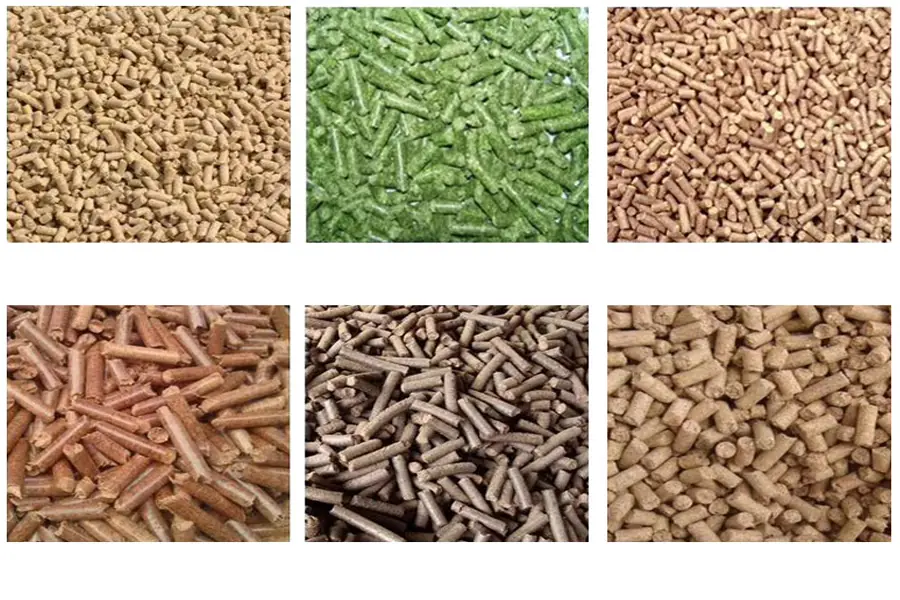
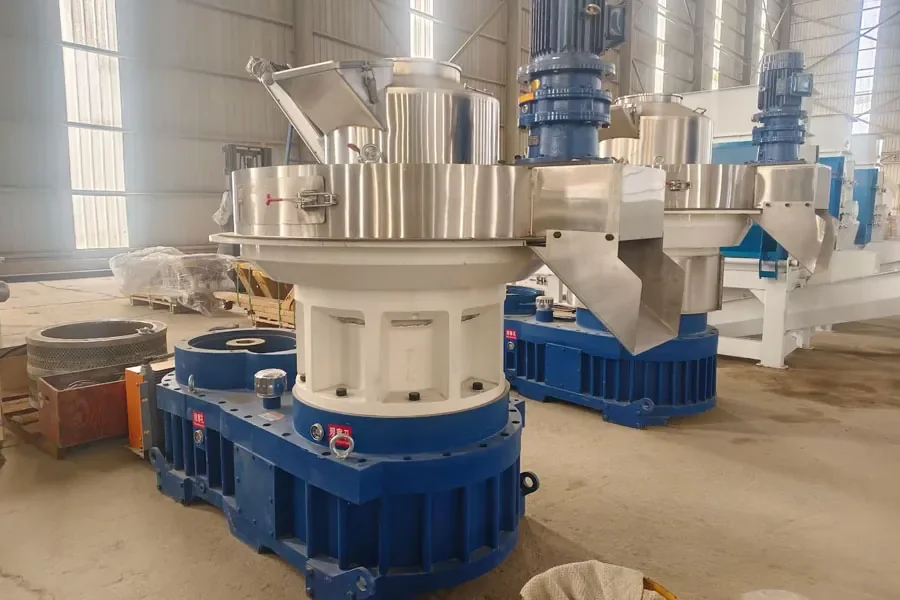
Hole length is the working length — the straight part of the hole, from the face to the point where it opens out. Die plate life is the range we quote for a hardened die plate run at its rated output on clean material; it is not a guarantee, because ash content and grind size move it more than the ratio does. A PM-D580B flat die pellet mill and an HML-600 vertical ring die wood pellet mill take the same ratio on the same material, and the die plate is cut to that ratio before either one ships.
Six columns do not fit a phone. Swipe the table sideways for the hole length, the reason and the die plate life.
Two ratios are quoted for some groups because the right answer depends on the grind, not on the material. A 5 mm screen in the wood hammer mill gives a denser, more uniform meal that binds at 1:5; the same sawdust through a 6 mm screen needs 1:6–1:7 to reach the same hardness. If you are choosing between the two ends of a range, take the shorter one when your grind is fine and your material is dry, and the longer one when it is coarse or the load has been out in the rain.
Die plate life falls as the ratio rises, and it falls faster than the column suggests. A 1:12 die plate on rice husk lasts 200–300 hours not because 96 mm of hole wears out, but because the pressure needed to push through 96 mm polishes the inlet of every hole into a bell mouth. Once that bell mouth is 10 mm deep the working length is 86 mm, the ratio is 1:10.75, and the pellets start coming out soft with nothing else changed.
Every ratio, in millimetres of hole
Find your ratio down the side and your hole diameter across the top. The number where they meet is the working length of hole the material has to pass through.
| Compression ratio | 4 mm hole | 5 mm hole | 6 mm hole | 8 mm hole | 10 mm hole |
|---|---|---|---|---|---|
| 1:4 | 16 | 20 | 24 | 32 | 40 |
| 1:5 | 20 | 25 | 30 | 40 | 50 |
| 1:6 | 24 | 30 | 36 | 48 | 60 |
| 1:7 | 28 | 35 | 42 | 56 | 70 |
| 1:8 | 32 | 40 | 48 | 64 | 80 |
| 1:9 | 36 | 45 | 54 | 72 | 90 |
| 1:10 | 40 | 50 | 60 | 80 | 100 |
| 1:12 | 48 | 60 | 72 | 96 | 120 |
| 1:14 | 56 | 70 | 84 | 112 | 140 |
Read across, not down. The 6 mm column is where most wood pellets are made; the 8 mm column is where boiler fuel and palm fibre sit. A 1:8 die plate at 6 mm and a 1:6 die plate at 8 mm are both 48 mm of hole and behave the same way — which is why the ratio, not the plate thickness, is the number to quote.
This is the arithmetic behind every figure in the table above, and it is worth doing once by hand. A customer who asks for “a 40 mm die” is asking for a plate thickness: two die plates 40 mm thick can be 1:6.6 on a 6 mm hole and 1:5 on an 8 mm hole, and they will not run the same. Ask for the ratio and the hole diameter and there is nothing left to misread.
The ratios above 1:12 exist and we cut them, but not for biomass. They are for high-density compounds and for feed where a hard, water-stable pellet is worth the throughput — a 1:14 die plate at 4 mm gives 56 mm of hole and roughly half the output of a 1:6 die plate at the same diameter.
How to measure the ratio on a die plate you already own
Four steps, a calliper and ten minutes. The figure you get is the one that explains what your pellets are doing.
Measure the hole
At the inlet, with a calliper, on five holes across the plate and not just one. A 6 mm die plate measures 5.95–6.05 mm when it is new; after 500 hours the inlet is wider than the hole and the calliper reads the bell mouth, not the bore.
Find the working length
Push a soft wire through a hole from the outlet side, mark it where it meets the plate face, and pull it out. On a straight die plate that is the plate thickness. On a relieved die plate it is shorter, because the last few millimetres are bored out to a larger diameter.
Divide
Working length in millimetres divided by hole diameter in millimetres. 36 mm through a 6 mm hole is 1:6. 48 mm through an 8 mm hole is also 1:6, and both are wood ratios.
Compare with the chart
If your figure sits below the range for the material you are running, the die plate is worn or was cut for something else. That, not the moisture, is usually the answer to “why are my pellets soft”.
A die plate wears from the inlet down. The bell mouth that forms is a funnel, and a funnel is not a working length — it is a chamfer. That is why the same die plate makes a hard pellet in March and a crumbly one in September with nothing else changed on the pellet mill, and why we ask for a photo of the die plate face before quoting a replacement.
Two more things move the effective ratio and neither is in the number. Hole count and open area decide how much material sits inside the die plate at any moment: a 6 mm die plate with 20 % open area carries twice the load of the same ratio at 10 %. And hole finish decides friction — a polished hole runs 5–8 % more output at the same ratio as a rough one, which is what a die plate run in with an oil and sand mix is for.
What a wrong ratio does to the pellet
Three outcomes, and you can tell which one you are in by looking at the end of a pellet and listening to the motor.
-
Too short — 1:3 to 1:4
The pellet comes out with a matte, slightly ragged end and crumbles in the pellet cooler. Durability sits at 80–88 %, under the 97.5 % an ENplus A1 stove pellet needs, and the fines come back to the die plate as a re-grind. Output runs 10–15 % above the chart figure and motor load is low, which is why a die plate is sometimes cut short to chase capacity — and why those pellets are often rejected at the bag.
-
Matched — the row in the chart
A 6 mm pellet at 96–98 % durability, a glossy but not glassy surface, and the motor drawing 85–90 % of its rated current. If you are inside the range and the pellet still crumbles, the problem is moisture or grind and not the ratio — both are covered in the 24-material pelleting guide, and moisture above 16 % defeats any die plate ever cut.
-
Too long — 1:12 and up on wood
The pellet comes out glossy and scorched, with a dark ring at the end where the lignin burned. Die temperature climbs past 100 °C, the material smears rather than shears, the motor trips on overload, and output falls 30–40 % before it does. A die plate that long is right for rice husk and wrong for sawdust, and no amount of drying will make it work on wood.
A die plate can be re-cut, and it is the cheapest fix on this page. Taking 6 mm off the face of a 1:6 die plate turns it into 1:5 on a 6 mm hole — a workshop job on a surface grinder, not something to attempt on site. We re-cut die plates for customers who bought the wrong ratio elsewhere; it takes a week including freight and costs a fraction of a new die plate. The other direction is not possible: you cannot add working length to a die plate that was cut too short, which is why the ratio is worth settling before the pellet mill ships rather than after.
What buyers ask about die compression ratio
Eight questions, answered the way we answer them on the phone.
What is die compression ratio in a pellet mill?
The working length of the hole in the die plate divided by its diameter. A 1:6 die plate with a 6 mm hole is 36 mm of hole; the same 1:6 on an 8 mm hole is 48 mm. It is a property of the die plate, not of the pellet mill, which is why the same model can be quoted two different ratios for two different materials.
What compression ratio do I need for wood pellets?
1:5–1:7 on a 6 mm hole, which is 30–42 mm of working length. Dry pine or hardwood sawdust sits at the short end because it carries 25–30 % lignin and binds easily; bark and shavings sit at the long end because the fibre is shorter and the ash is higher.
How do I calculate the compression ratio of a die plate?
Measure the hole diameter at the inlet with a calliper, then find the working length with a soft wire pushed through from the outlet side. Divide the length by the diameter. 36 mm through 6 mm is 1:6; 60 mm through 6 mm is 1:10.
Can I change the compression ratio of a die plate I already own?
Only downwards. Grinding 6 mm off the face of a 1:6 die plate turns it into 1:5 on a 6 mm hole, because the working length drops from 36 mm to 30 mm. You cannot add working length, so a die plate cut too short has to be replaced.
Why are my pellets soft when the die plate ratio is right?
Four causes, in the order we check them: moisture above 16 %, a worn die plate whose holes have bell-mouthed, a grind coarser than 6 mm, or a material under 15 % lignin with no binder. The first two account for most of the cases we are called about.
Does a higher compression ratio make a harder pellet?
Up to a point, and then it makes a scorched one. Hardness comes from density, and density comes from pressure — so 1:8 gives a harder wood pellet than 1:5. Past about 1:10 on sawdust the lignin scorches, the pellet gets a burnt ring at the end, and the extra length adds heat rather than density.
6 mm or 8 mm hole — which should I choose?
6 mm for stove pellets and anything that has to meet ENplus A1; 8 mm for boiler fuel, palm fibre and bark, where the larger hole keeps a long-fibre material moving and halves the pressure on it. Output rises going to 8 mm because the hole passes nearly twice the cross-section at the same pressure, and the pellet is softer for it.
Is the compression ratio the same on a flat die pellet mill and a vertical ring die wood pellet mill?
The arithmetic is identical and the numbers are the same — 1:6 on a 6 mm hole is 36 mm of hole on either. What differs is how the die plate or the ring die is changed: a flat die plate is swapped in about twenty minutes, a ring die is re-cut or replaced as a complete ring, which is a decision you make once per material rather than once a week.
Tell us the material, and we will cut the die plate to it
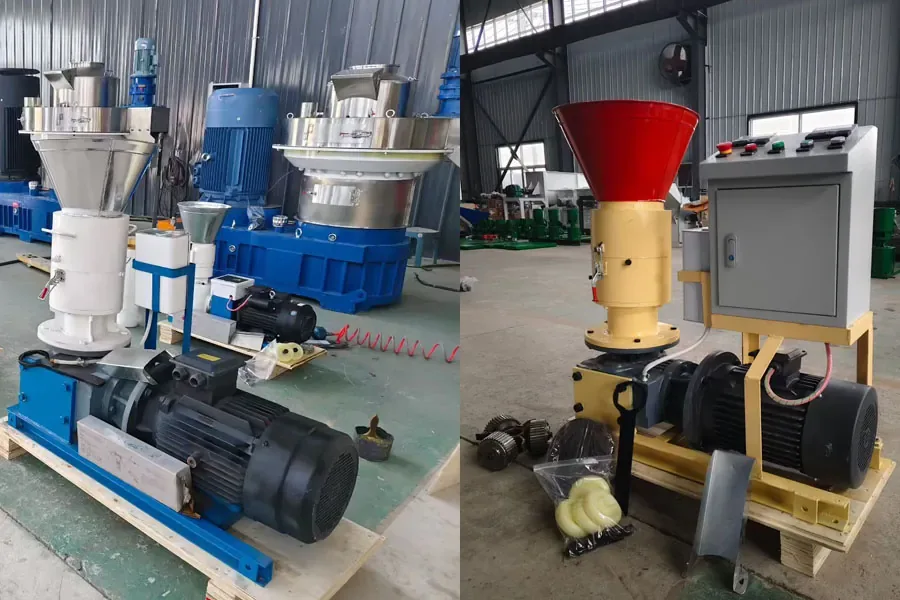
Send 20 kg and we run it on a 7.5 kW flat die pellet mill with three die plates — a short, a matched and a long one — and report which holds, at what output, and what the pellet weighs per litre.
What happens next
We reply with the ratio, the hole diameter and the model that makes your output capacity, then run the test and send you the video before you pay anything.
Your details are not shared. One follow-up, no mailing list.