Pellet Cooling and Screening: 90 °C Down to Roomsix to ten minutes, and 22 to 34 m³ of air a tonne
Pellets leave the die at 70–90 °C and 15–18 % moisture, and neither is acceptable in a bag. Cooling and screening are the two jobs between the die and the weigher, and below a tonne an hour they are done in one frame while above it they are two machines. This page is the selection: how much air a pellet needs, how long it has to sit in it, which of the two families fits a production line of your size, and what the screen is actually for.
- 70–90 °C at the die, within 3–5 °C of room temperature in the bag
- 22–34 m³ of air a tonne a minute, by pellet diameter
- 6–10 minutes of retention on a counterflow pellet cooler
- Fines under 2 mm are the reason the screen exists at all
Combined pellet cooler and screener to 1 t/h · counterflow pellet cooler to 5 t/h · Air volume and retention reported with the model
The short answer
Three jobs — cool, dry the last few points, take out the fines — and one family below a tonne an hour that does all three, one above it that does the first two.
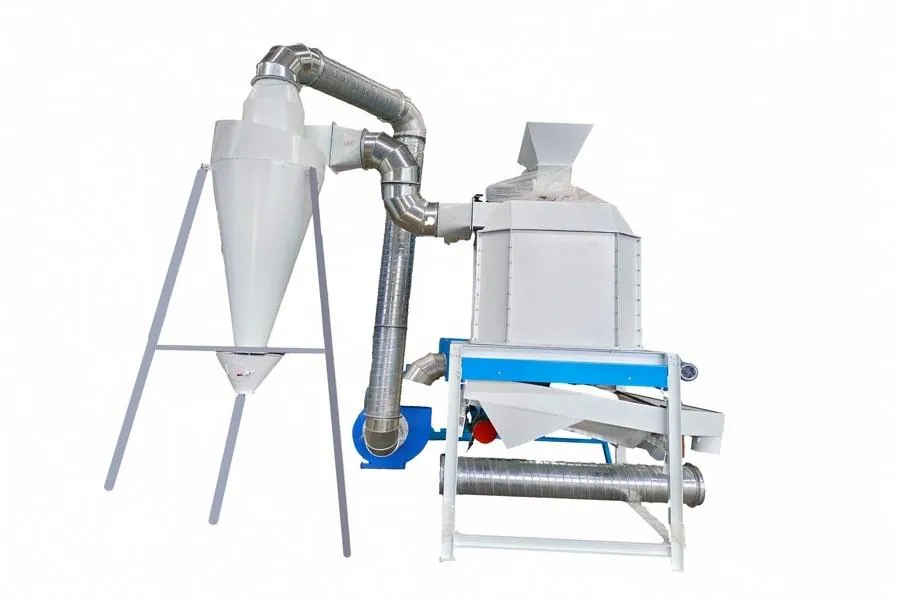
Three jobs, one machine or two. The pellet has to come down from 70–90 °C to within 3–5 °C of room temperature, lose the last three to five points of moisture, and give up the fines the die left behind. Below about a tonne an hour all three happen in one frame: a combined pellet cooler and screener, LQ-50 at 0–500 kg/h or LQ-70 at 0–1,000 kg/h, with the screen in the discharge path. Above that the cooling is a counterflow pellet cooler, NL-11 at 1–2 t/h or NL-14 at 2–5 t/h, and the screening is a separate machine downstream. The figure that sizes either one is air: 22 to 34 cubic metres per tonne of pellets per minute, set by the largest pellet you will run rather than by the output capacity.
Air volumes are from the pellet cooler manual and are per tonne of pellets per minute; the model capacities are on feed pellets at the rated diameter, and a wood pellet runs close to the same figure because the load on the blower is set by the diameter rather than by the material. The temperature target is the one we quote against: within 3–5 °C of ambient at the bagging chute, measured with a probe and not with a hand.
How much air a tonne of pellets needs, at each diameter
The air volume is the number that sizes the blower, the ducting and the model. It follows the largest pellet in your range, not the average and not the output.
| Pellet diameter | Air volume m³ per t per minute |
What it means | Pellet cooler that suits |
|---|---|---|---|
| 4–5 mm | 22 | Feed pellets, dense and short of path — the easiest load on a blower | LQ-50, LQ-70, NL-11 |
| 6 mm | 25 | Feed pellets and small wood pellets | LQ-50, LQ-70, NL-11, NL-14 |
| 8–10 mm | 28 | Wood pellets, grass pellets, larger feed pellets | LQ-70, NL-11, NL-14 |
| 12–20 mm | 31 | Large feed pellets and coarse biomass | NL-11, NL-14 |
| 22 mm and up | 34 | The heaviest load — size the blower on this figure, not on the average | NL-14 |
Work the air volume out on the largest diameter in your product range and damper the blower down for the rest. A blower sized on the average starves the big pellet, and the symptom is a bag that is warm in the middle and cold at the ends. The cooling side of this table is from the pellet cooler range; the moisture side — how much water those last three points are — is on the moisture page.
Four columns will not fit a phone. Swipe the table sideways for the air volume and the model column.
Air volume is the number that sizes everything else, and it is the one buyers never ask about. A counterflow pellet cooler needs 22 to 34 cubic metres of air per tonne of pellets per minute, and the figure moves with the diameter of the pellet rather than with the output: a 4 mm feed pellet is dense and short of path, a 22 mm pellet is a much bigger load on the same blower. Buy the blower for the biggest pellet you will ever run and damper it down for the rest. The other way round does not work, because a blower that is short of air cannot be made to deliver more.
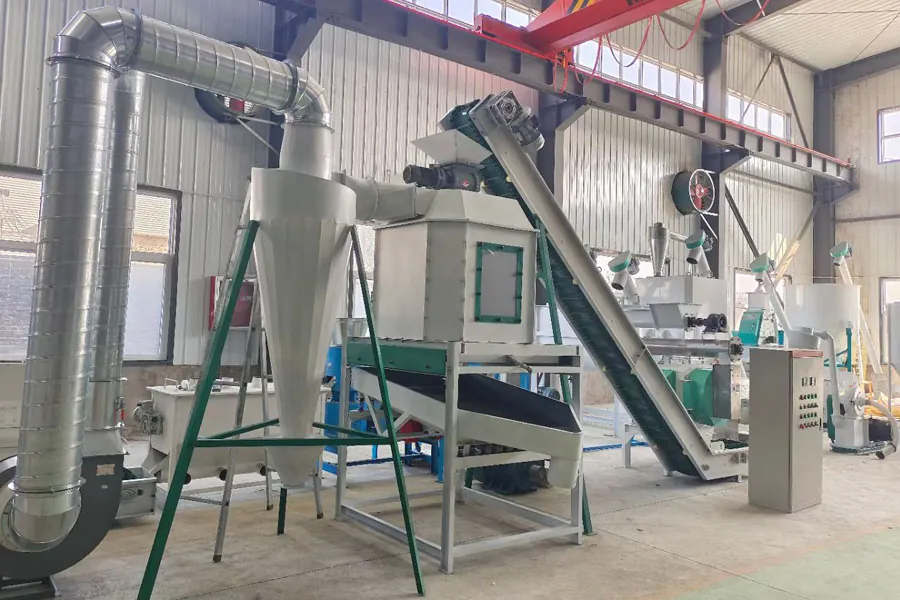
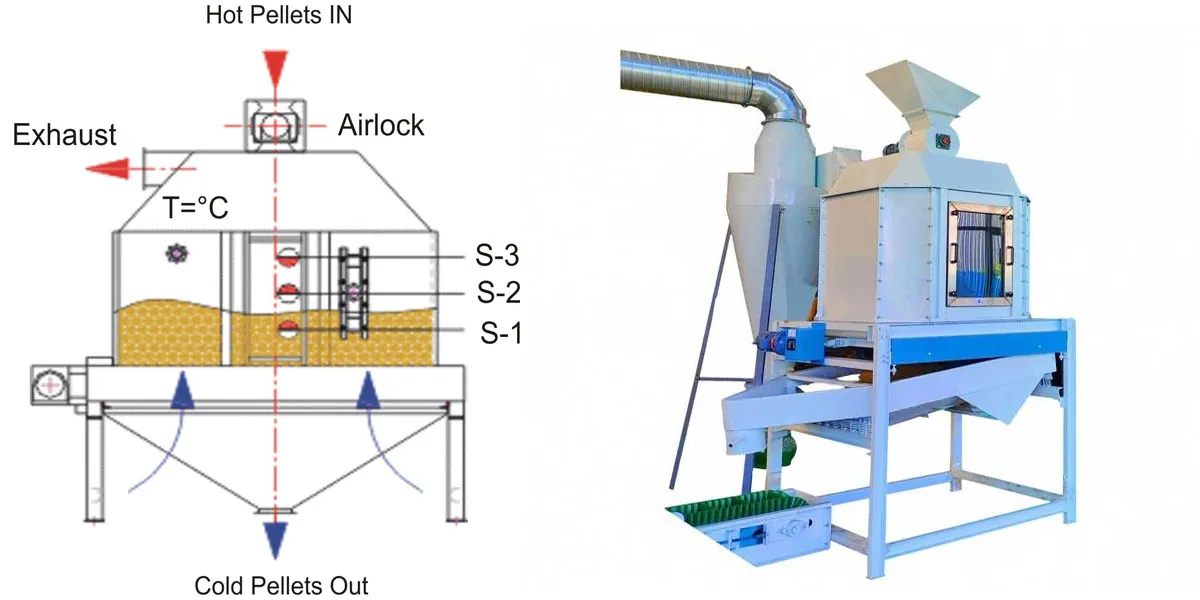
The second figure is retention time, and it is what separates a cold pellet from a pellet with a cold skin. A counterflow pellet cooler holds the pellets for 6–10 minutes at rated capacity, long enough for the heat to come out of the core; a combined pellet cooler and screener cools in a single pass of a few minutes because the bed is shallow and the air is pulled straight through it. Both work. What does not work is running either one at double its rated capacity and calling the result cooled.
The two families, dimension by dimension
One is a box with a screen in it and the other is a tower with a slide valve. The row that decides most purchases is the headroom.
| Dimension | Combined pellet cooler and screener | Counterflow pellet cooler |
|---|---|---|
| How it cools | Air is pulled across a shallow bed in a box; one pass of a few minutes | Air and pellets travel in opposite directions through a tall chamber, so the temperature step across each pellet is small |
| Capacity | 0–500 kg/h on the LQ-50, 0–1,000 kg/h on the LQ-70 | 1–2 t/h on the NL-11, 2–5 t/h on the NL-14 |
| Screening | Built in — the pellets cross a screen on the way to the discharge chute | Not built in; a separate screener sits downstream |
| Retention | A single pass of a few minutes | 6–10 minutes at rated capacity |
| Footprint | 1,800 × 750 × 1,100 mm at floor level | 2,050 × 1,320 × 3,200 mm on the NL-11, 2,480 × 1,700 × 3,400 mm on the NL-14 |
| Headroom | None above the box | The roof clearance for the airlock and the cyclone, plus the conveyor above |
| Discharge | Chute at the bottom, straight into a bag or a short conveyor | Slide valve, intermittent, driven by the level sensors |
| What goes wrong | A blocked filter bag cuts the air and the pellets leave warm | The airlock wears; a choked cyclone dumps dust back into the bed |
| Bought with | A 500 kg/h or 1 t/h build on a flat die pellet mill, or a farm site bagging its own feed | A build on a ring die pellet mill, a larger build on a flat die pellet mill, or any site where the pellet cooler sits under a mezzanine |
The headroom row is the one to read twice, because it is a building decision rather than a choice of pellet cooler. A counterflow pellet cooler has to be loaded from above: on a production line built on a ring die pellet mill, the pellet mill discharges at die height and the pellet cooler sits on a mezzanine, fed by a belt or a bucket elevator. If the shed has no height for that, the combined pellet cooler and screener at floor level is the honest answer, at a lower capacity. The full dimension sheet is on the pellet cooler page.
Three columns will not fit a phone. Swipe the table sideways for the counterflow column.
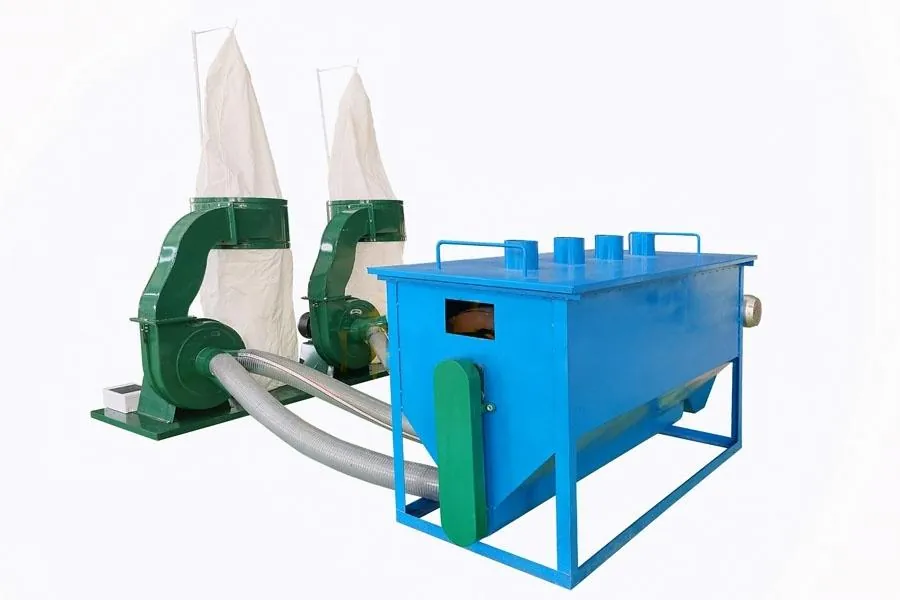
The combined pellet cooler and screener is the answer when the whole build has to fit in one shed. Cooling box, screen deck, two or three blowers and the filter bags all sit on one frame of 1,800 × 750 mm, the discharge is a chute at the bottom, and a bag goes under it. There is no mezzanine, no airlock on the roof and no bucket elevator — which at 300 kg/h is most of the installation cost.
The counterflow pellet cooler is the answer when the build was planned as a production line. Air and pellets travel in opposite directions, so the coldest air meets the coldest pellet and the temperature step across any single pellet stays small; that is what makes 6–10 minutes of retention enough to bring the core down. It needs 3.2–3.4 m of height for the airlock and the cyclone, and it discharges intermittently through a slide valve, which means a conveyor or a bin below it rather than a bag.
What the screen takes out, and what happens to it
Half the pellet diameter is the rule of thumb for the mesh, rounded down. The column that matters is the last one — where the fines go decides whether screening pays for itself.
| Pellet diameter | Screen opening rule of thumb |
What passes through | What to do with it |
|---|---|---|---|
| 4–5 mm | 2 mm | Fines, dust and broken pellet ends | Back to the pellet mill, or into the binder mix |
| 6 mm | 3 mm | Fines and the occasional cracked pellet | Back to the die, up to about 10 % of the output |
| 8–10 mm | 4–5 mm | Fines and the dust a conveyor makes | Back to the die, or sold as a separate grade |
| 12–20 mm | 6–10 mm | Fines only — the pellets are too big to pass | Back to the die |
| 22 mm and up | 11 mm | Fines and small fragments | Back to the die |
The mesh is a rule of thumb and the real figure is chosen with the screening machine against what you want to keep: too fine and good pellets go back to the die, too coarse and the fines stay in the bag, where they smoke on the customer’s stove and settle as dust in the hopper. The pellet mill that takes the fines back is on the buying guide, and the die that made them in the first place is on the compression ratio chart.
Four columns will not fit a phone. Swipe sideways for the mesh and the fines column.
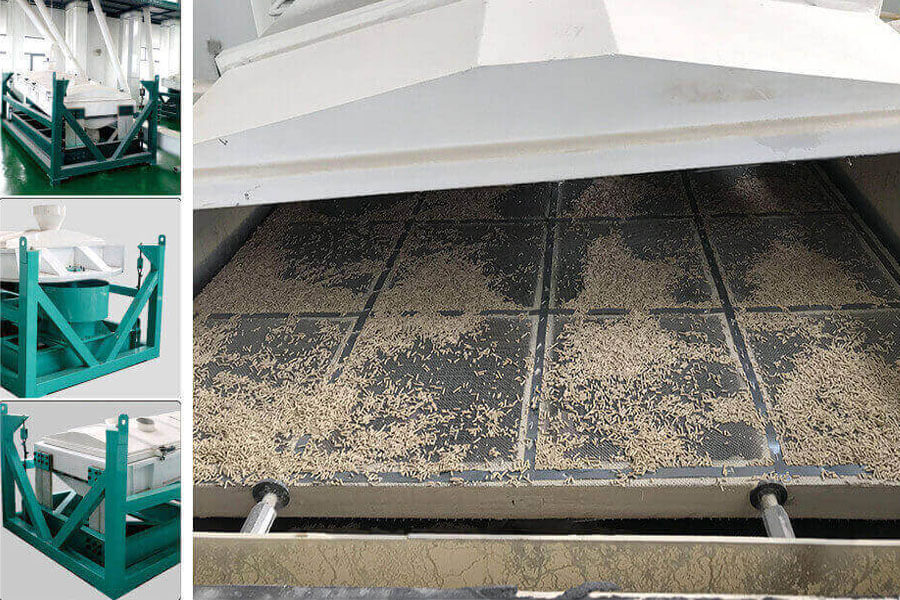
Fines are the half of screening that gets ignored and the half the customer notices. A die throws fines, a conveyor breaks corners and a pellet cooler adds a few more; under 2 mm they behave like dust, they burn badly and in a bag they settle to the bottom and make the last 5 kg useless. Screen them out and two things happen: the bag holds pellets, and the fines come back to the die as material you have already paid to dry.
On a combined pellet cooler and screener the screen is in the discharge path and the fines drop through to a tray, which is why the family exists at all. At 500 kg/h a separate screener is a frame, a motor, a metre of floor and a second conveyor. On a 2 t/h line it is the right answer, because the deck area a 2 t/h line needs does not fit inside a cooling box, and the fines want their own collection point.
Six things that take cooling away from you
Air is the only thing doing work in a pellet cooler, so everything that reduces it reduces cooling. These are the six that turn into a complaint rather than an alarm.
| What changes it | What it does | What you do about it |
|---|---|---|
| Pellet diameter | 22 m³ a tonne a minute at 4 mm, 34 at 22 mm | Size the blower on the biggest pellet, damper down for the rest |
| Throughput | Air scales with capacity; retention does not | A pellet cooler run above its rating loses retention before it loses air |
| Ambient temperature | 70–90 °C at the die, plus whatever the shed is | Air at 35 °C cools to 38 °C, not to 25 — plan for the hottest week of the year |
| Humidity | Damp air takes less water and more time | In a wet season the moisture comes out slower than the temperature does |
| Ducting | Every bend costs pressure, and a horizontal run collects condensate | Short, few bends, lagged where the air is still warm |
| Filter bags | A blinded bag cuts the air volume silently | Change on a schedule, not on a complaint |
The last two rows are the ones that become a service call. A blocked filter bag does not stop the pellet cooler — it just makes it cool less, and the symptom is a warm bag three weeks later rather than an alarm. Ducting is the same: a horizontal run of duct on warm, damp exhaust condenses, and the water runs back into the bed.
Three columns will not fit a phone. Swipe sideways for the figure and the remedy.
Air is the only thing doing work in a pellet cooler, so everything that reduces it reduces cooling. That is why the blower is sized on the largest pellet rather than on the average, why the filter bags are a maintenance item and not an accessory, and why the duct run matters more than the fan curve on the datasheet.
The ambient figure is the one that surprises plants in hot climates. A pellet cooler rated to bring pellets to room +3–5 °C will do exactly that at 40 °C ambient — which is 43–45 °C, still too warm to bag without condensation. In that climate the answer is more air and more retention, not a bigger motor.
Your output, your pellet size, and the air it needs
Three fields. The diameter sets the air volume, the output sets the model, and the third field is the one that decides whether a counterflow pellet cooler is even possible in your building.
At 1,500 kg/h of pellets at 6 mm the pellet cooler has to move 38 cubic metres of air a minute and hold the pellets for 6–10 minutes. The answer is NL-11, rated 1–2 t/h, and it needs 3.2 m of height for the airlock and the cyclone.
The air figure is the output in t/h times the volume for the largest pellet: 22 m³ at 4–5 mm, 25 at 6 mm, 28 at 8–10 mm, 31 at 12–20 mm and 34 at 22 mm and up. It is air at the blower, before the pressure drop through the bed and the ducting, which is why a blower is bought on the largest pellet rather than on the average. Retention is the rated figure for the family: 6–10 minutes on a counterflow pellet cooler, a single pass of a few minutes on a combined pellet cooler and screener.
The air figure the tool returns is cubic metres a minute at the blower, which is the number to hold a supplier to. A pellet cooler quoted at 1 t/h could be moving 22 or 34 cubic metres a minute depending on the pellet it was sized for, and the one sized on 4 mm feed pellets will not cool 8 mm wood pellets at the same output.
The third field is the awkward one and it is deliberately there. Ask for a counterflow pellet cooler at floor level and the tool will tell you it has to be loaded from above rather than quote you one — a mezzanine is a building cost, and it belongs in the comparison from the first day rather than in the installation week.
Choosing one, in the order it has to happen
Two of these are measurements, one is a decision about the building and the last one is about what you do with the fines.
Measure the temperature at both ends
A probe in the pellet stream at the die and another at the bagging chute. If the second reads more than 5 °C above ambient the pellet cooler is short of air or short of retention, and the two are fixed differently — air is a blower and ducting, retention is a bigger machine or a lower throughput.
Fix the largest pellet, not the average
The air volume follows the biggest diameter in your range. A site that runs 6 mm all year and 22 mm winter needs a blower sized on 22 mm, because the one sized on 6 mm cannot be made to deliver more air in January.
Decide where the pellet cooler sits
Floor level means a combined pellet cooler and screener to about 1 t/h. Above that a counterflow pellet cooler needs a mezzanine and 3.2–3.4 m of height for the airlock and the cyclone, and that is a building decision taken before the quotation rather than after it.
Then the screen and the fines
Half the pellet diameter, and a decision about what happens to what falls through: back to the die, into a binder mix, or sold as a separate grade. The answer changes the mesh, and on a small line it changes whether you need a separate screener at all.
The first step is the one that is never taken, and it is free. A site that measures the temperature the bagging chute once a shift knows within a day whether the pellet cooler is doing its job; a site that judges by hand knows nothing, because a pellet at 45 °C feels cool next to one at 80 °C and is still far too warm to bag.
The third step is where the money is decided, and it is not about the pellet cooler. A counterflow pellet cooler on a mezzanine costs a mezzanine, a bucket elevator and the steel to hold both; a combined pellet cooler and screener at floor level costs a frame. Below about a tonne an hour the second is almost always the cheaper route into the same pellet temperature.
Three ways people actually cool, and what each one commits to
Almost every pellet cooler on this page is one of these three. They differ in what you have to build around them.
-
300–500 kg/h, one shed, no mezzanine
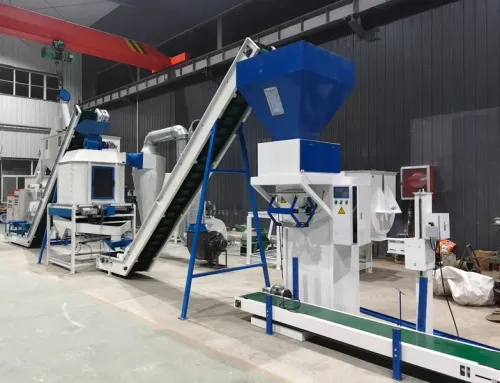
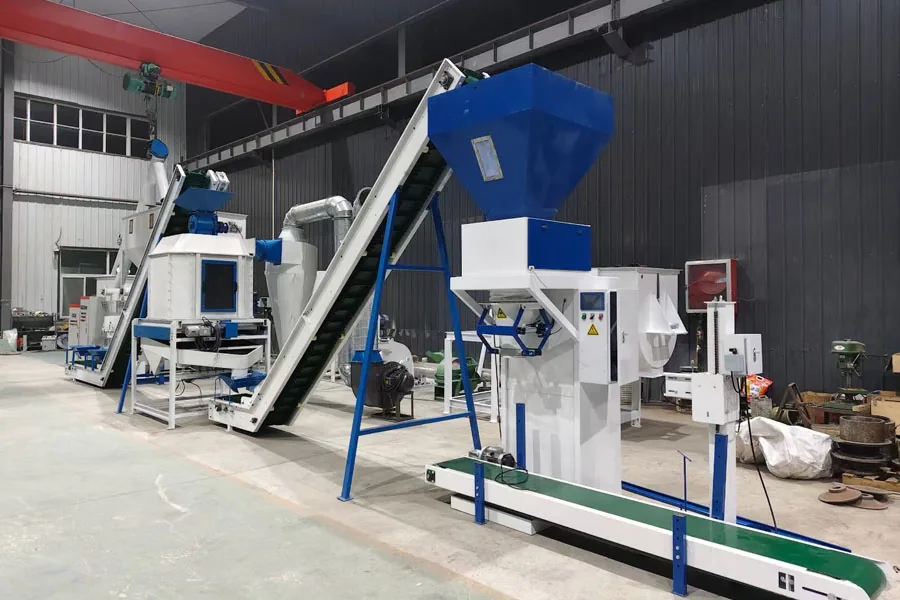
An LQ-50 at floor level with the screen built in. This is the build in the 500 kg/h feed pellet production line — press, conveyor, pellet cooler and screener, bagging, all on one slab. It is the cheapest route into cooled pellets and the one that fits a shed that already exists.
-
1–2 t/h
An NL-11 counterflow pellet cooler on a mezzanine, with a separate screener downstream. The 1,000 kg/h feed pellet production line is this build, and the 3.2 m of height is the thing to plan for before the steel goes up.
-
2–5 t/h
An NL-14, and from here the screening is its own machine with its own motor and its own fines collection. Two of them above 5 t/h, or one per press on a production line with more than one vertical ring die pellet mill.
The three routes are separated by height rather than by output, which is unusual for a pellet cooler choice. A site that can put a mezzanine in gets a counterflow pellet cooler and 6–10 minutes of retention; a site that cannot gets a combined pellet cooler and screener and a single pass, and at 500 kg/h the second produces the same bag of cold pellets. The most expensive mistake on this page is buying the tower and then discovering the roof is 3 m.
What buyers ask about cooling and screening
Eight questions, answered the way we answer them on the phone.
How long do pellets need to cool before bagging?
Six to ten minutes on a counterflow pellet cooler at rated capacity, or a single pass of a few minutes on a combined pellet cooler and screener. The test is temperature rather than time: within 3–5 °C of room temperature at the bagging chute, and no warmer.
Why are my pellets cracking after cooling?
Usually cooling too fast. Cold air on a hot pellet shrinks the skin before the core, and the stress cracks the pellet along its length. It shows up as a fines problem at the bagger rather than as a temperature problem, which is why it gets blamed on the die.
How much air does a pellet cooler need?
22 cubic metres per tonne of pellets per minute at 4–5 mm, 34 at 22 mm and up. Size the blower on the largest pellet in your range and damper it down for the rest — a blower sized on the average starves the big pellet.
Do I need a separate screener?
Below about a tonne an hour, no: the combined pellet cooler and screener has the screen in the discharge path. Above that, yes — the deck area a 2 t/h line needs does not fit inside a cooling box, and the fines want their own collection point.
What mesh should the screen be?
About half the pellet diameter as a rule of thumb — 2 mm for a 4 mm pellet, 3 mm for 6 mm, 4–5 mm for 8–10 mm. Too fine and good pellets go back to the die; too coarse and the fines stay in the bag, where they smoke on the customer’s stove.
Can I cool pellets without a pellet cooler?
On a very small plant, by spreading them on a floor for an hour. It works at 50 kg/h and it stops working at 200, because the pellets at the bottom of the pile never cool and the floor space grows faster than the output.
Where do the fines go?
Back to the die, usually, up to about 10 % of the output. They are dry material that has already been through the pellet mill once, so they pellet easily; the limit is that too many fines make the rollers slip on the die plate.
Does the pellet cooler have to be indoors?
It can be outside, but the airlock, the drive and the control box cannot, and the exhaust has to go somewhere. In practice a counterflow pellet cooler sits under a roof because the conveyor feeding it does, and the 3.2 m of height has to be under that roof.
Send the pellet diameter and the kg/h — we will size the air and the model
The pellet diameter, the kg/h off the pellet mill, the moisture at the die and the height you have available. That is enough to name the family, the model and the air volume.
What happens after you send it
We reply with the family the height allows, the model that makes your output in it, the cubic metres of air a minute the blower has to move, and the retention you will get at your capacity. If the honest answer is a combined pellet cooler and screener when you asked about a counterflow pellet cooler, we say so and show you the height arithmetic.
Your details are not shared. One follow-up, no mailing list.