


Pellet CrumblerTwo-roller and three-roller roller crumblers, 1 to 20 t/h
A chick cannot eat a 5 mm pellet and neither can a fingerling. The obvious answer is to press a small pellet — and it is the wrong one, because a small die makes less and burns more. The cheaper answer is to press the pellet the die likes and break it down afterwards. That is what a pellet crumbler does: cooled pellets go between two rollers turning at different speeds and come out as crumble, at three to four times the output for a fraction of the power.
- SSLG two-roller pellet crumbler — 15×60 to 20×170, 1–12 t/h, 3 to 11 kW
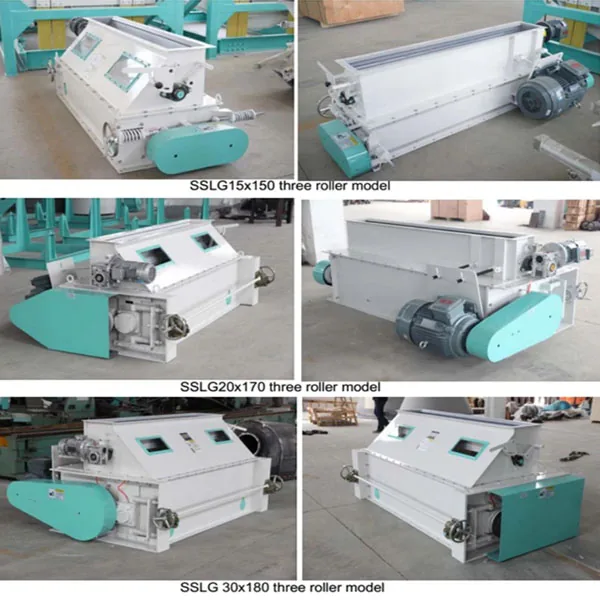
- SSLG three-roller pellet crumbler — 20×80×3 to 20×170×3, 3–20 t/h
- Crumble from 0.7–1.5 mm on fine teeth to 1–2.5 mm on ordinary teeth
- Air-operated inlet gate, variable-speed feed, bypass and roller protection as standard
Reply in 12 working hours · Sized on your pellet diameter and capacity · Delivered to 40+ countries
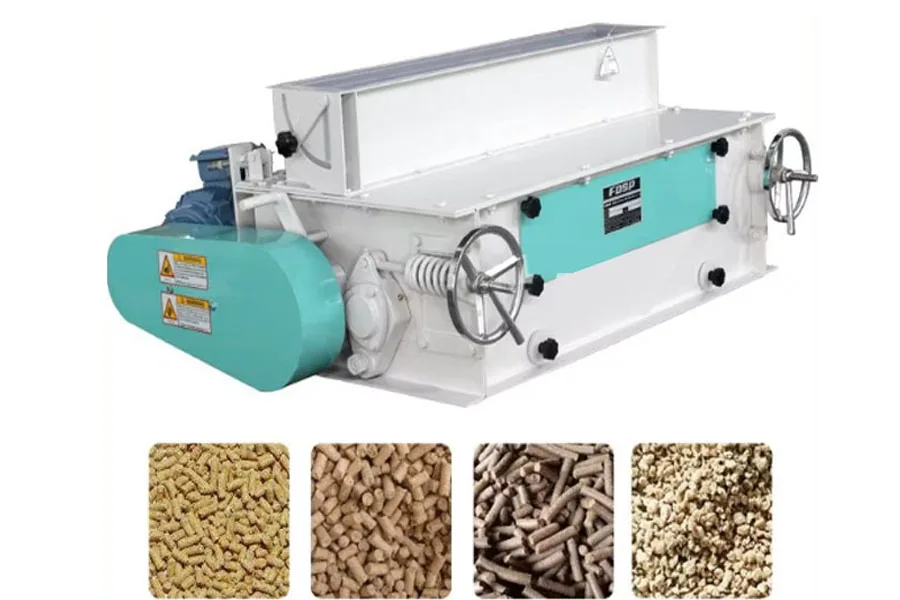
Press the pellet the die likes, then break it down
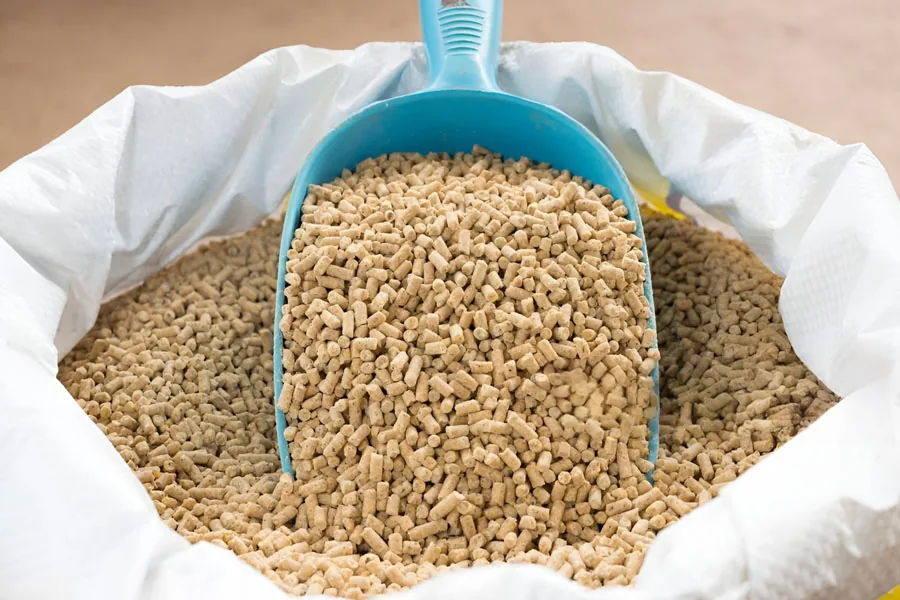
A pellet crumbler exists because a small die is a bad deal. Ask a ring die press for a 2 mm pellet and the output falls, the power per tonne climbs, and the die wears out faster than it should. Ask the same press for a 5 mm pellet and break it afterwards, and the arithmetic reverses.
That is the whole case for the pellet crumbler, and the pellet crumbler manual puts numbers on it: press large and crumble, and output goes up three to four times while the energy per tonne falls by two to three. The pellet crumbler is the only machine on a feed pellet line that pays for itself by adding a step.
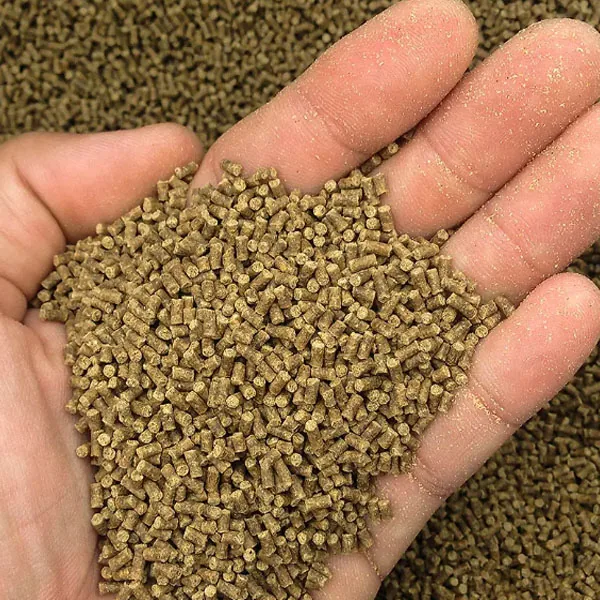
It works because a pellet is not a solid block. A cooled feed pellet has a skin and a slightly softer core, and it fractures along the skin rather than shattering. Two rollers turning at different speeds — 725 r/min on the fast one, 475 on the slow one — squeeze the pellet, then shear it, then tear it, and what comes out is a cube with rounded corners, not dust. Grind the same pellet in a hammer mill and you get meal, which is a different product and a worse one for a young animal.
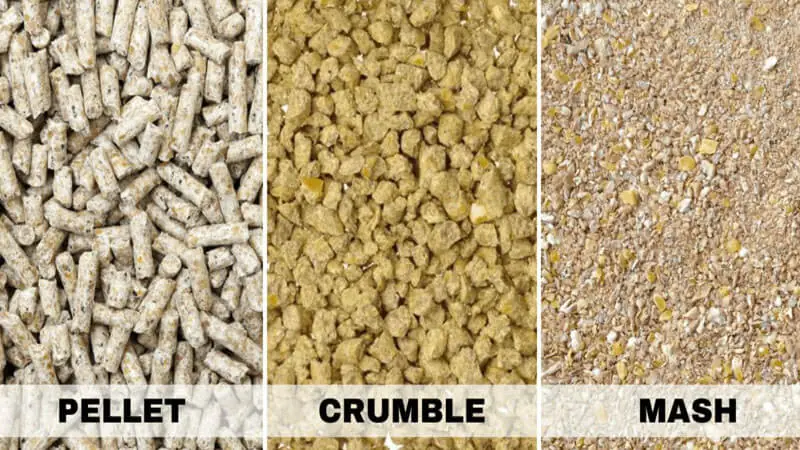
The crumble size is set two ways and both are mechanical. The teeth decide the range — fine teeth leave 0.7–1.5 mm, ordinary teeth leave 1–2.5 mm — and the gap between the rollers sets where in that range you land. The rule in the manual is a gap of one half to two thirds of the pellet diameter: a 5 mm pellet runs a 2.5 to 3.3 mm gap. Too wide and whole pellets walk through; too tight and the roller teeth do the work of a grinder, which is where the powder in your bag comes from.
None of this needs a cooled pellet to be cold, only hard. Crumble a pellet that is still warm and soft and it smears between the rollers instead of breaking, the gap loads up, and the result is a paste that blocks the pellet crumbler. That is why the pellet crumbler sits after the pellet cooler and never before it, and why the inlet has a gate that can be shut while the pellet cooler fills.
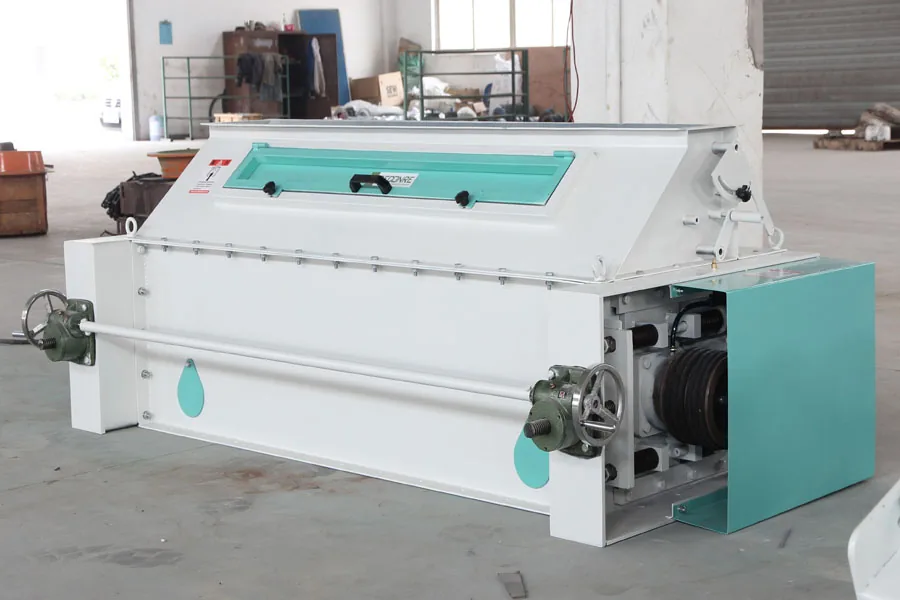
Two rollers, or three with a feed roller on top
Both machines break a pellet the same way. The difference is how the pellets arrive at the nip, and that difference is worth money on aquatic feed and worth nothing on a poultry line.
| Two-roller pellet crumbler (SSLG) | Three-roller pellet crumbler (SSLG ×3) | |
|---|---|---|
| Rollers | Two: a fast roller on a fixed bearing block, and a slow roller that swings on a dowel to set the gap | Three: the same two crushing rollers with a feed roller added above the nip |
| What the third roller does | Nothing extra. The gate under the inlet drops pellets straight into the nip, so the feed is as even as the gate setting allows | Turns at its own speed and lays a thin curtain of pellets into the nip, so the crush is the same at both ends of a 1.7 m roller and there is no material left sitting against the seals |
| Capacity | 1–2 t/h on the 15×60, up to 8–12 t/h on the 20×170 — five sizes | 3–6 t/h on the 20×80×3, up to 15–20 t/h on the 20×170×3 — four sizes |
| Crumble | 0.7–1.5 mm on fine teeth, 1–2.5 mm on ordinary teeth | The same range, held more evenly along the roller — which is what a graded aquatic feed needs |
| Power | 3 to 11 kW, one motor | 5.5 + 1.1 to 18.5 + 1.5 kW — the second figure is the feed roller |
| Best for | Poultry, pig and ruminant feed, where the crumble only has to be small | Fish and shrimp feed, and any line where the crumble is screened to a tight band afterwards |
| Footprint | Shorter frame, and the same width for a given roller length | About 60 mm longer and 50–100 mm taller than the two-roller of the same roller size, because of the feed roller above the nip |
The rule we work to: if the crumble is going into a bag without being graded, the two-roller machine is enough and it is the cheaper machine to run. If the crumble is going over a screener and has to sit inside a narrow band — fish feed, shrimp feed, anything sold on a particle-size spec — pay for the feed roller.
Tell us the pellet and the capacity
Four answers size a pellet crumbler: the diameter of the pellet going in, the crumble size you want out, the capacity in t/h, and what the pellet crumbler has to stand under. Everything else — two rollers or three, tooth form, gap range, inlet height — follows from those.
What happens after you send this
We answer with the model, the tooth form, the motor and a price, and with the gap setting we would start you on. If a two-roller machine will do the job we will say so rather than sell you the three-roller.
Reply within one working day. No obligation.
The pellet crumbler, part by part
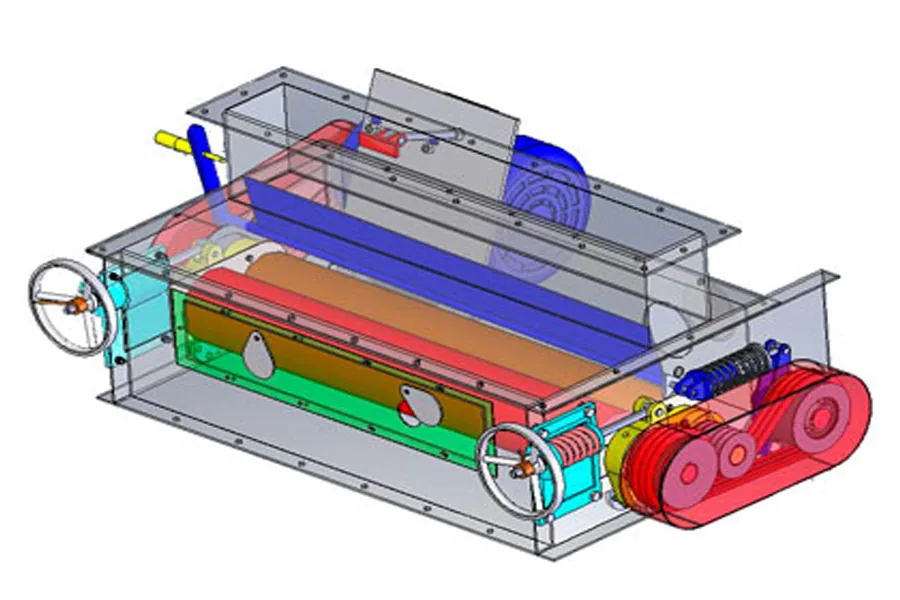
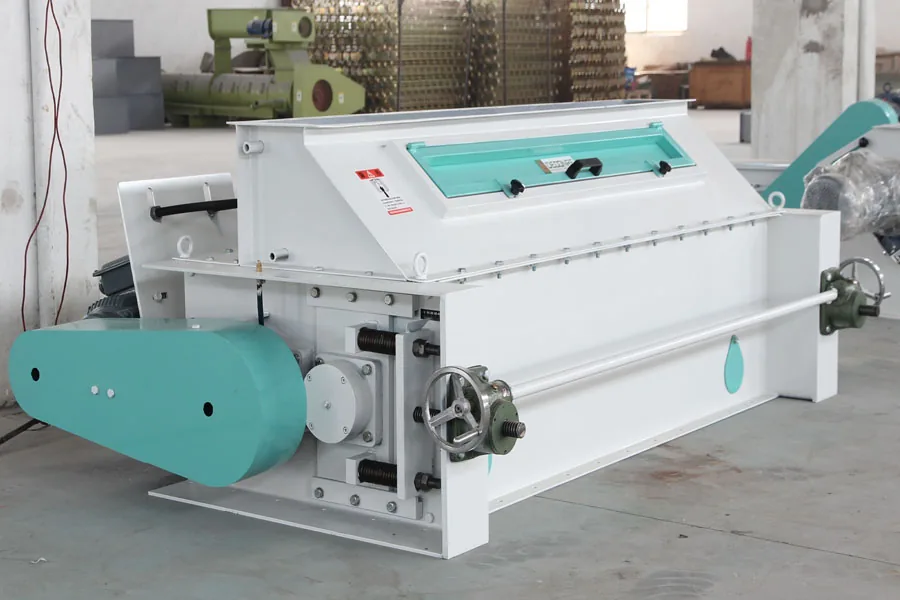
Everything on a roller pellet crumbler is there to do one of four things: feed the nip evenly, hold the two rollers at a set distance, let the pellets past when you do not want them crushed, and protect the rollers when something hard gets in.
-
Inlet and air-operated gate
A rectangular inlet on the centre line, with a flap gate under it. The gate is air-operated on the standard pellet crumbler: shut it and the pellet crumbler is out of the circuit while the pellet cooler fills or the feed pellet line changes product.
-
Variable-speed feed
An impeller feeder on a variable-frequency drive. Feed rate is the operator’s main control — run the pellet crumbler full and the crumble gets coarser, run it half full and the same gap gives a finer, more even crumble.
-
Fast roller
On a bearing block bolted to the side frame, so its position never changes. 725 r/min, driven off the motor by V-belt. Its surface is the datum the gap is measured from.
-
Slow roller
On a bearing block that pivots on a dowel at the bottom, loaded by a spring through a pull rod. 475 r/min, driven from the fast roller by a second belt. It is the roller that moves when the gap is adjusted and the one that backs off when something hard gets in.
-
Roller gap adjustment
A hand wheel at each end of the pull rod, with a gauge on the frame that reads the gap directly. Two hand wheels, not one, because the gap has to be the same at both ends — a roller that is closer at one end than the other crushes one side of the pellet crumbler and lets the other side through.
-
Bypass
Pull the gate and the pellets run down one side of the nip and out without being touched, and the pellet crumbler motor can be stopped. This is what makes the pellet crumbler liveable on a feed pellet line that changes product twice a day.
-
Rollers
Alloy cast iron, double-layer chilled centrifugal casting, with the teeth cut into the hard shell. They are the wear part and they are the reason the pellet crumbler has a long life between rebuilds.
-
Drive and frame
V-belts throughout, which is why the pellet crumbler is quiet. The frame is welded steel with the motor on a swinging seat, so belt tension is set with one bolt.
Squeeze, shear, tear — in that order, in about a tenth of a second
A pellet is in the nip for a very short time and three things happen to it while it is there. The speed difference between the rollers is what turns a squeeze into a cut.
Gate and feed
Cooled pellets drop through the inlet gate into the nip, or onto the feed roller on a three-roller machine. The gate sets the depth of the curtain; the variable-speed feeder sets how fast it moves.
Squeeze
The gap is one half to two thirds of the pellet diameter, so the pellet is compressed as it enters. This is where a soft or warm pellet fails — it deforms instead of cracking, and the gap starts to load up.
Shear
The fast roller runs at 725 r/min and the slow one at 475 — a ratio of about 1.5 to 1. That difference drags one face of the pellet past the other and cuts it rather than crushing it flat.
Tear
The teeth finish the job, and the pellet leaves as a cube with cut faces. Cut faces are why the crumble holds together in the bag and why the fines stay low.
Bypass or protect
No crumbling wanted: pull the gate and the pellets run past the nip. Something hard in the feed: the spring on the slow roller lets it swing back, the object passes, and the roller returns to its gap without damage.
The gap adjustment is worth understanding because it is the only thing an operator touches. The slow roller bearing block hangs on a dowel at its bottom end, so it can rotate through a small arc. Its top is forked over a pull rod with a spring on it, and the hand wheel on that rod sets how far the block can swing. Turn the wheel in and the slow roller moves towards the fast one; the gauge on the frame reads the result. There is a wheel at each end of the rod because the two ends have to match.
The spring is doing two jobs at once, and that is the neat part of the design. It sets the crushing force — a harder pellet pushes the roller back a little and takes more passes to break — and it is the roller protection. A bolt or a piece of tramp metal that will not crush simply pushes the slow roller out of the way and drops through, and the spring pulls it back to the same gap afterwards.
| Fault | What you see | What it usually is |
|---|---|---|
| Coarse or uneven crumble | Whole pellets in the bag, some crushed some not | Gap too wide, or the two ends of the roller are not parallel. Set both hand wheels to the same gauge reading |
| Too much powder | Fines climbing in the bag, crumble that will not hold | Gap too tight, or the roller teeth are worn. Open the gap first, then look at the teeth |
| One side of the roller worn | Wear pattern on one end only, the pellet crumbler feels like it is choking | Feed is arriving in one place. Spread the inlet flow, or fit the feed roller of a three-roller pellet crumbler |
From the pellet crumbler manual. All three come back to the same two settings — gap and feed — which is why the pellet crumbler has a gauge on the front and a variable-speed feeder rather than a fixed drive.
Nine sizes, 1 t/h to 20 t/h
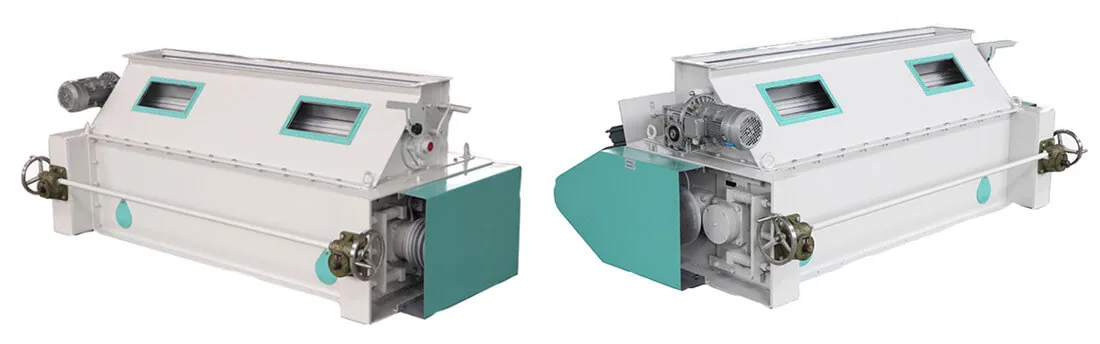
Capacity is quoted on a cooled 4–6 mm feed pellet at the rated gap. Run a smaller pellet, or run the pellet crumbler below its rating, and the figure goes down — the pellet crumbler does not lose capacity, it simply passes less material.
Two-roller pellet crumbler, SSLG series five models
| Model | Roller size | Capacity | Power | Motor |
|---|---|---|---|---|
| SSLG15×60 | 150 × 600 mm | 1–2 t/h | 3.0 kW | Y100L2-4 |
| SSLG15×80 | 150 × 800 mm | 2–4 t/h | 4.0 kW | Y112M-4 |
| SSLG15×100 | 150 × 1,000 mm | 3–6 t/h | 5.5 kW | Y132S-4 |
| SSLG15×150 | 150 × 1,500 mm | 5–10 t/h | 7.5 kW | Y132M-4 |
| SSLG20×170 | 200 × 1,700 mm | 8–12 t/h | 11 kW | Y160M-4 |
Every model runs the fast roller at 725 r/min and the slow roller at 475 r/min. The model code is read straight off the pellet crumbler: SL is broken pellet, G is roller type, and 15×100 means a 150 mm diameter roller 1,000 mm long. Capacity is on feed pellets; a harder or larger pellet runs below the figure.
Three-roller pellet crumbler, SSLG ×3 series four models
| Model | Roller size | Capacity | Power |
|---|---|---|---|
| SSLG20×80×3 | 200 × 800 mm | 3–6 t/h | 5.5 + 1.1 kW |
| SSLG20×100×3 | 200 × 1,000 mm | 5–10 t/h | 7.5 + 1.5 kW |
| SSLG20×140×3 | 200 × 1,400 mm | 8–16 t/h | 11 + 1.5 kW |
| SSLG20×170×3 | 200 × 1,700 mm | 15–20 t/h | 18.5 + 1.5 kW |
The second figure in the power column is the feed roller. It is a small motor and it buys you a crumble that holds the same size across the full roller length, which is what a screened aquatic feed needs.
Envelope dimensions mm, A × B × C
| Model | A | B | C |
|---|---|---|---|
| SSLG15×80 | 1,146 | 950 | 540 |
| SSLG15×100 | 1,346 | 990 | 590 |
| SSLG15×150 | 1,846 | 1,050 | 590 |
| SSLG20×170 | 2,500 | 1,200 | 700 |
| SSLG15×80×3 | 1,200 | 950 | 600 |
| SSLG15×100×3 | 1,400 | 995 | 600 |
| SSLG15×150×3 | 2,100 | 1,000 | 700 |
| SSLG20×170×3 | 2,500 | 1,200 | 800 |
A, B and C are the letters on the general arrangement drawing, which we send with the quotation. The number that matters on site is rarely the overall length — it is the height of the inlet, because the pellet crumbler has to sit under the pellet cooler outlet with its inlet on the same centre line. Send us the height you have and we will confirm the model against it.
Two settings decide everything an operator can see
Crumble size is not a quality of the pellet crumbler, it is a setting on it. Teeth set the range, the gap sets the point inside that range, and feed rate decides how even it comes out.
| What sets it | Result | How to use it |
|---|---|---|
| Fine tooth roller | 0.7–1.5 mm | Chick starter, duckling, fingerling — the smallest crumble the pellet crumbler makes, and the one that needs the tightest gap |
| Ordinary tooth roller | 1–2.5 mm | Piglet and grower feed, where the crumble still has to hold its shape in a bag and in a feeder |
| Roller gap | ½ to ⅔ of the pellet diameter | Set on the hand wheel and read on the gauge. A 5 mm pellet runs a 2.5–3.3 mm gap; a 4 mm pellet runs 2–2.7 mm |
| Feed rate | Rated capacity or below | The second control. Running under the rating with the same gap gives a finer, more even crumble, not a coarser one |
The starting point we quote with every pellet crumbler is the pellet crumbler manual’s rule: gap at one half to two thirds of the pellet diameter, both hand wheels on the same gauge reading, then trim with feed rate. Change the gap and re-check both ends — a roller that is closer at one end crushes one side of the pellet crumbler and lets the other side through.
Teeth are a factory choice rather than an operator one, so it is worth getting right at the order. Fine teeth cut a smaller crumble and wear faster; ordinary teeth are the general-purpose set and cover most feed. Tell us the smallest crumble you will ever sell and we will fit the teeth to that, because going finer later means a pair of rollers, not a setting.
The one thing that cannot be adjusted out is a pellet that is too soft. Crumble a warm pellet and the rollers smear it; the gap loads, the ammeter climbs and the crumble comes out as paste. If you are seeing that, the problem is upstream at the pellet cooler — either the retention time is short or the pellet cooler is being run above its rating — and no amount of gap adjustment will fix it.
After the pellet cooler, before the screener — never the other way round
A pellet crumbler is one machine in a feed pellet line and its position is fixed by physics: the pellet has to be cool and hard before it will break cleanly, and the crumble has to be screened after it is made, not before.
A feed pellet production line runs: feed hammer mill → batching scale → feed mixer → conditioner → flat die feed pellet mill or a ring die press → pellet cooler → pellet crumbler → screener → bagging scale. The pellet crumbler takes the pellet cooler discharge, breaks it to size, and hands it to the screener, which takes out the fines the pellet crumbler made and returns them to the pellet mill.
An aquatic feed pellet line runs the same order with a different pellet mill: dry type fish feed extruder → dryer → pellet cooler → pellet crumbler → screener → bagging. This is where the three-roller pellet crumbler earns its price. Fish feed is sold on a particle-size band, the band is checked on a sieve, and a crumble that varies along the roller will not pass it.
The two mistakes we see in layouts are both about height. The first is a pellet crumbler bought before the pellet cooler is chosen, so the inlet ends up 200 mm below the pellet cooler outlet and the fix is a chute with a bend in it — which is where pellets break and where the pellet crumbler starts to choke. The second is no room to open the top cover, which turns a ten-minute roller inspection into a two-hour job. Give the pellet crumbler 600 mm of clear space above the inlet and both problems disappear.
If you are buying a whole feed pellet line rather than a pellet crumbler on its own, the pellet crumbler is worth deciding early for a different reason: it changes the pellet mill. A feed pellet line that crumbles can run one large die and serve three product sizes; a feed pellet line that does not has to change dies, and every die change is an hour of lost output. That is the argument for the pellet crumbler, and it is the one that shows up in the payback rather than on the quotation.
What we change on a standard pellet crumbler
The rollers, the frame and the gap mechanism are standard. Everything around them is set by the feed pellet line you are putting the pellet crumbler in, and it is all settled on the drawing before the steel is cut.
-
Tooth form
Fine or ordinary teeth, chosen on the smallest crumble you will sell. It is a factory decision — changing it later means a new pair of rollers.
-
Inlet position and height
Set to the pellet cooler outlet, on the same centre line. This is the dimension we ask for first, and the one that is hardest to change afterwards.
-
Gate operation
Air-operated flap gate as standard, with a manual hand lever if you have no air on site. The gate is also the bypass, so it is operated several times a day.
-
Feed control
Variable-frequency impeller feeder. On a feed pellet line that runs two products at different rates, the VFD is what lets one pellet crumbler serve both without changing the gap.
-
Motor and electrics
380 V / 50 Hz three-phase as standard; 415 V, 440 V and 60 Hz to order. Local control box with the feeder drive, or wired into your panel.
-
Finish
Paint colour to your specification, stainless contact parts where the feed is corrosive or the feed mill washes down.
Delivery is 15–25 working days after the deposit for a two-roller pellet crumbler, 25–35 for a three-roller machine with the feed roller. Payment is TT with 40 % in advance and the balance before delivery. Rollers, bearings and belts ship as a spare kit in the same crate if you ask for one — the wear parts list is four 3209 bearings, two sealed 60209, seven oil seals and nine V-belts across the range.
What comes before and after the pellet crumbler
A pellet crumbler is one machine in a feed pellet line and it is useless on its something has to press the pellet, something has to cool it, and something has to grade what comes out. Below are all three ends.
Rollers, bearings, oil seals and V-belts are on the spare parts page. Tell us the model and we will send the right set — the teeth wear, and a worn roller is the usual cause of a bag full of fines.
Tell us what the pellet crumbler has to do
Pellet diameter in, crumble size out, capacity in t/h, and the height you have under the pellet cooler. We answer with the model, the tooth form and a price.
Your details are not shared. One follow-up, no mailing list.
The pellet crumbler running, and the feed pellet line it belongs in
The first clip walks the pellet crumbler from inlet to discharge with the parts named. The second is our showroom, where the same pellet crumbler sits between a pellet cooler and a bagging scale in a working feed pellet line.


More test runs, shipping records and installation footage on our YouTube channel, and the whole Feed Processing Machines playlist.
What buyers ask before ordering a pellet crumbler
What does a pellet crumbler do?
It breaks a cooled feed pellet into smaller pieces without grinding it to meal. Two rollers turn at different speeds, squeeze the pellet, shear one face past the other and tear it, and what comes out is a cube with cut faces. Fine teeth leave 0.7–1.5 mm, ordinary teeth 1–2.5 mm, and the roller gap sets where in that range you land.
Why crumble instead of pressing a small pellet directly?
Because a small die is expensive to run. The pellet crumbler manual puts the difference at three to four times the output and two to three times less energy per tonne, compared with pressing the small pellet directly. The pellet mill runs the die it is efficient with, and the pellet crumbler makes the small size afterwards.
Two rollers or three?
Two-roller if the crumble goes straight to a bag. Three-roller if it is going over a screener and has to sit inside a narrow band — fish feed and shrimp feed, mainly. The third roller is a feed roller above the nip: it lays an even curtain of pellets along the full roller length, so the crumble is the same at both ends of a 1.7 m roller.
How do I set the crumble size?
Gap first, then feed rate. The manual’s rule is a gap of one half to two thirds of the pellet diameter — 2.5 to 3.3 mm for a 5 mm pellet. Set both hand wheels to the same gauge reading, because a roller that is closer at one end crushes one side of the pellet crumbler and lets the other side through. Then trim with the variable-speed feeder.
Can I run the feed pellet line without crumbling?
Yes. Pull the gate and the pellets run past the nip through the bypass, and the pellet crumbler motor can be stopped. This is a standard feature, not an option — most feed pellet lines change product during the week and re-setting a roller gap every time would make the pellet crumbler unusable.
What happens if a piece of metal gets in?
The slow roller swings back. Its bearing block pivots on a dowel and is held by a spring through the pull rod, so anything that will not crush pushes the roller out of the way and drops through, and the spring returns it to the same gap. The spring also sets the crushing force, so it is doing both jobs at once.
Does the pellet have to be cooled first?
Yes, and this is the one rule that is not negotiable. A warm, soft pellet smears between the rollers instead of breaking, the gap loads up and the crumble comes out as paste. The pellet crumbler sits after the pellet cooler and before the screener, always in that order.
What capacity do I need?
Match it to the pellet mill, not to the bagging scale. The two-roller range runs 1–2 t/h on the 15×60 up to 8–12 t/h on the 20×170; the three-roller range runs 3–6 t/h on the 20×80×3 up to 15–20 t/h on the 20×170×3. Ratings are on cooled 4–6 mm feed pellets; a harder or larger pellet runs below the figure.
How often do the rollers need replacing?
The rollers are alloy cast iron, double-layer chilled centrifugal casting, and the teeth are cut into the hard shell. Life depends on what you crumble and at what gap — running the gap too tight wears teeth faster and puts powder in the bag. Watch for a rising fines level; that is the signal, not a calendar.
What maintenance does it need?
Little. Grease the bearings once every three months, check the V-belt tension and the stud bolts, and keep the nip clear. The pellet crumbler manual’s whole maintenance section is six lines, which is about right for a pellet crumbler with two moving parts.
How long is delivery?
15–25 working days after the deposit for a two-roller pellet crumbler, 25–35 for a three-roller pellet crumbler. Payment is TT with 40 % in advance and the balance before delivery.
Send the pellet size and the capacity
The pellet diameter going in, the crumble size you want out, the capacity in t/h and the height you have under the pellet cooler. Those four answers choose between a two-roller and a three-roller pellet crumbler and fix the tooth form.
- Emailinfo@pelletmachines.net
- WhatsApp+86 186 0385 1787
- HoursMon–Sat, 08:00–20:00 (GMT+8)
A photo of the pellet cooler outlet and the height from the floor to it saves a round of questions. If you are replacing a pellet crumbler, send the model plate of the old one.
What happens after you send this
We answer with the model, the tooth form, the motor and a price, and with the gap setting we would start you on. If a two-roller pellet crumbler will do the job we will say so rather than sell you the three-roller pellet crumbler.
Your details are not shared. One follow-up, no mailing list.