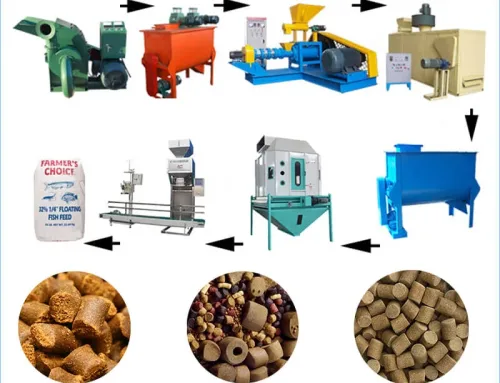
Fish Feed Production Line100 kg/h to 5 t/h, from the hammer mill to the sealed bag
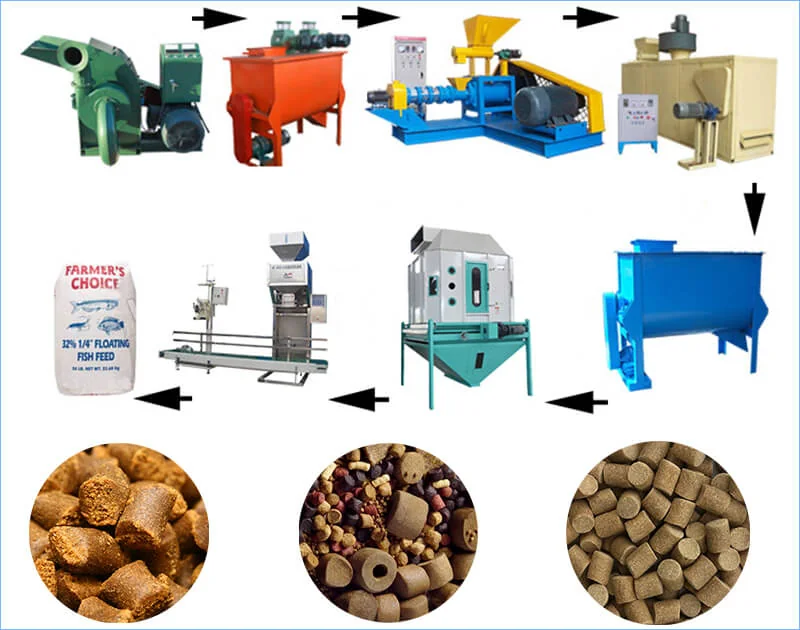
A fish feed production line is eight machines in a row: grinder, feed mixer, extruder, dryer, coater, cooler and packing scale, with a boiler if the line is wet type. We size the whole sequence around one number — the capacity in kg per hour of finished, bagged feed you want to sell.
- 100 kg/h to 5 t/h of finished floating or sinking fish feed
- Dry type fish feed line — no boiler; wet type fish feed line — steam conditioning and 30–60 % more output
- Laid out to your building, your power supply and your raw material
- One supplier for the grinder, the extruder, the dryer and the packing scale
Reply in 12 working hours · Layout drawing with the quotation · Delivered to 40+ countries
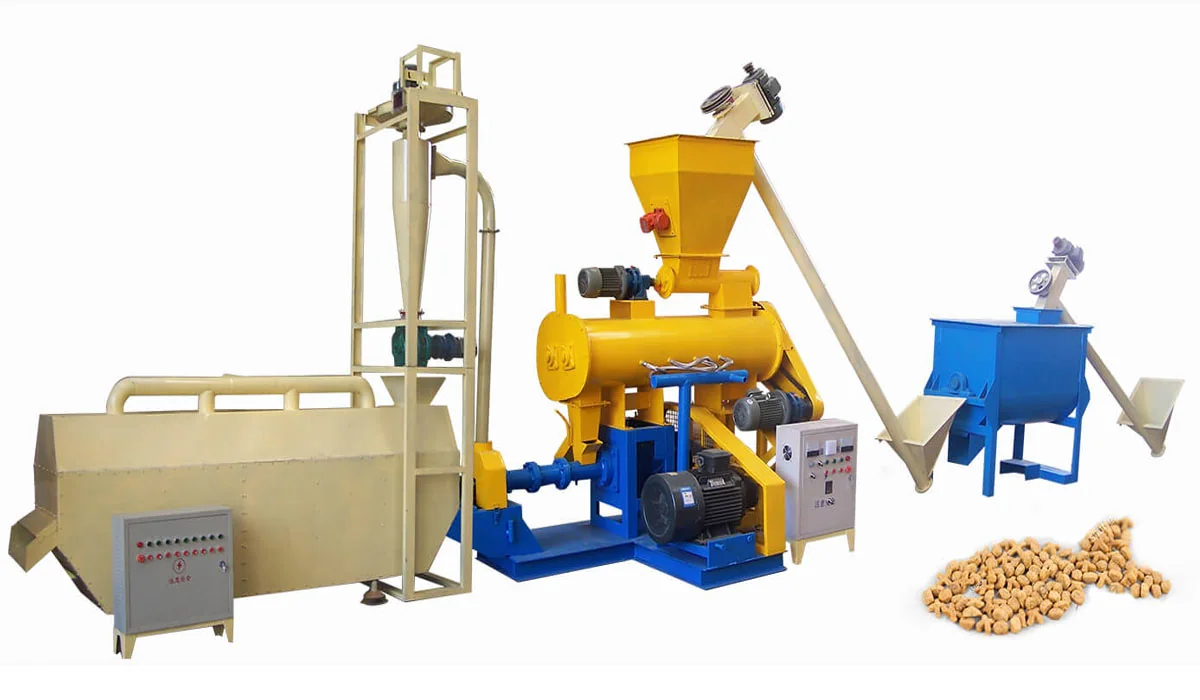
What stands between the raw material and the sealed bag
A fish feed production line is not one machine with accessories. It is eight stages, and a line is only as good as the weakest of them — which is usually the dryer, because it is the stage buyers try to skip.
The eight stages of a fish feed production line dry type or wet type
| # | Stage and machine | What it does | Why it matters |
|---|---|---|---|
| 01 | Grinding — hammer mill | Meal to 60–80 mesh through a fine screen | Coarse meal will not gelatinise evenly and the pellet breaks up in water |
| 02 | Mixing — mixer | Premix, oil and water blended to 25–30 % moisture | An uneven mix shows up as pellets that float and pellets that sink in one bag |
| 03 | Conditioning — conditioner and boiler, wet type only | Steam to 80–95 °C, held 30–90 s | Cooks the starch before the screw sees it; this is the 30–60 % capacity gain |
| 04 | Extrusion — fish feed extruder | 120–150 °C and 3–5 MPa at the die | The pressure drop at the die is what expands the pellet and makes it float |
| 05 | Drying — dryer | From 25–30 % moisture down to 10–12 % | Bagged wet pellets mould in days; the dryer is not optional above 500 kg/h |
| 06 | Coating — oil coating drum | Fish oil and premix sprayed on after drying | Oil through the screw makes a soft pellet; added after drying it stays in |
| 07 | Cooling — cooler | Pellets down to within 5 °C of ambient | Warm pellets sweat in the bag and the surface goes mouldy |
| 08 | Packing — weighing and sealing scale | 5 to 50 kg bags, sewn or heat sealed | The scale is where a farm becomes a feed business |
Stage 3 exists only on a wet type fish feed line. Everything else is the same whether the extruder is a dry type fish feed extruder or a wet type fish feed extruder — the dryer is sized by the moisture the extruder leaves in the pellet, not by the model number.
Six bands, and the machine that sets each one
Capacity is quoted on finished, bagged feed at 10–12 % moisture — not on what the extruder can push through an empty die. The dryer is what usually pulls a line below the extruder’s rating, so we size the two together.
Fish feed production line by capacity indicative, laid out to your building
| Line capacity | Extruder | Drying and cooling | Floor area | Typical buyer |
|---|---|---|---|---|
| 100–200 kg/h | DGP50, DGP60 | Sun drying or a small hot-air tray dryer | 80–150 m² | A farm feeding its own ponds |
| 300–500 kg/h | DGP70, DGP80 | Single-pass belt dryer, cooler | 150–250 m² | A co-operative, or a farm selling to neighbours |
| 500–1,000 kg/h | DGP90, DGP120 | Two-pass belt dryer, cooler, packing scale | 300–450 m² | A regional feed mill |
| 1,000–2,000 kg/h | DGP135, DGP160 or DSP60, DSP90 | Three-pass belt dryer, coater, cooler | 500–800 m² | A commercial feed plant, dry or wet type |
| 2,000–3,000 kg/h | DSP135, DSP160 | Three-pass dryer with a boiler house | 800–1,200 m² | A wet type plant selling branded feed |
| 3,000–5,000 kg/h | DSP200 | Multi-pass dryer, two coolers, automatic bagging | 1,200 m² and up | An industrial line with a boiler house and a laboratory |
Floor area is the covered space for the line itself, not the warehouse or the raw material store. Two rules that hold across every band: leave 1.2 m of walking width on both sides of the dryer, and put the packing scale where a loaded pallet can be taken away without crossing the extruder. Where the building is tight, a vertical layout — grinding and mixing on a mezzanine above the extruder — saves 30–40 % of the floor.
Tell us the band and the building, and the line lays itself out
A fish feed production line is quoted stage by stage, and the layout is quoted with it. Four answers — the band, the raw material, the floor area and whether there is a boiler — are enough to send a first layout and a price per stage.
Send the capacity and the floor area
Send the band you want to run, the raw material and the covered floor area you have. We come back with a layout drawing, the machine list per stage and a price for the line as laid out.
Reply within one working day. No obligation.
The only real choice in the line is whether there is a boiler
Everything downstream of the extruder is identical. The decision sits at stage three: steam conditioning, or heater bands and screw friction.
The dry type fish feed line. A dry type fish feed extruder and nothing else at stage three. It needs a three-phase supply, a flat floor and about 3 m of headroom, and it makes floating feed from 60 kg/h to 2 t/h. Below about 1 t/h this is the only line that makes financial sense — a boiler, a softener and an operator cost more than the extra capacity is worth.
The wet type fish feed line. A wet type fish feed extruder with a conditioner, a 0.05–0.5 t/h boiler, softened water and insulated steam piping. Same screw diameter, 30–60 % more output per hour, and a denser pellet — which is what shrimp, crab and deep-water species need. Above 2 t/h it usually pays for its boiler inside the first year.
What changes downstream. Almost nothing. A wet type pellet leaves the die at 18–25 % moisture against 25–30 % for a dry type one, so the dryer is slightly smaller for the same capacity — but the cooler, the coater and the packing scale are the same machines. That is why a line can be built dry type now and converted later: the extruder and the boiler change, the rest stays.
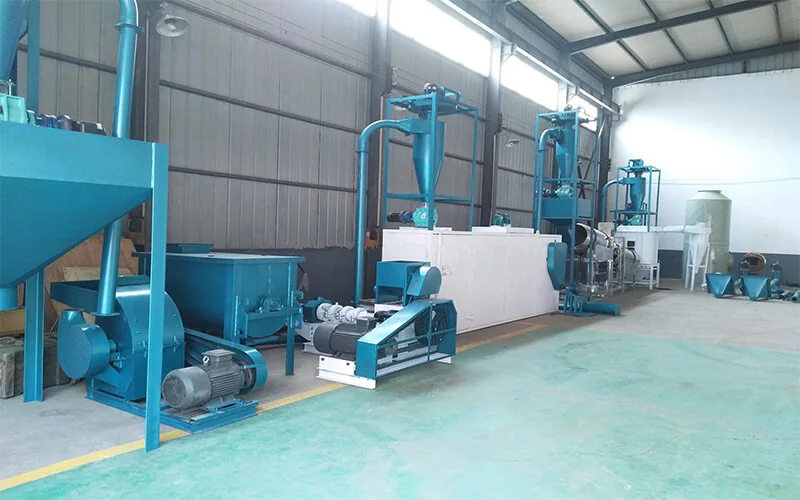
What fits where — and the five things we need to know about your building
A layout is drawn around the building, not the other way round. Before we can draw one we need five answers about the building — they decide whether the line runs in a straight row, in an L, or on two levels.
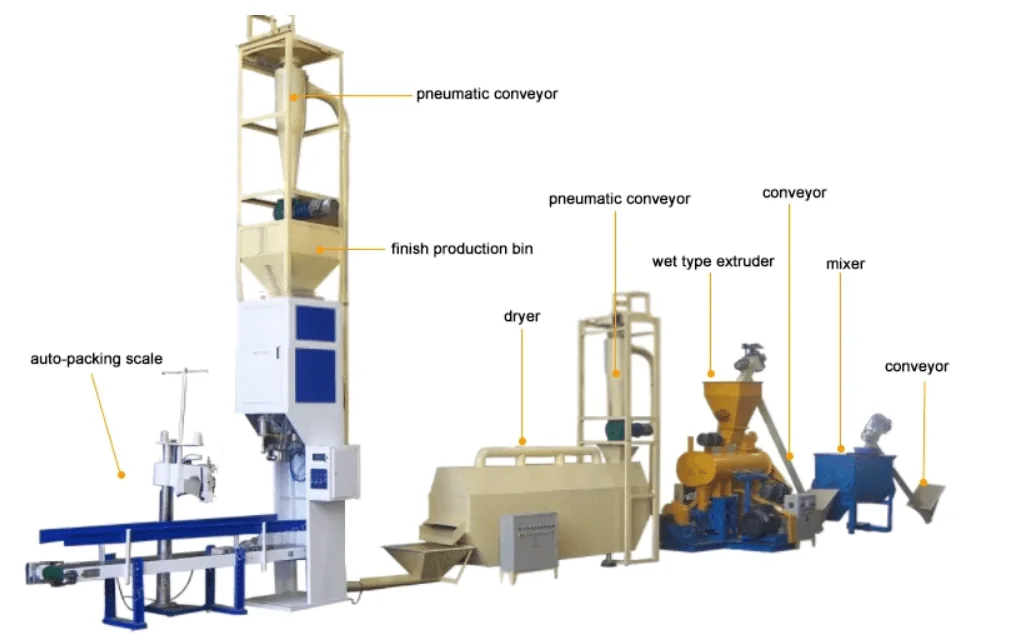
- Floor length and widthThe straight-row layout needs roughly 18 m for a 500 kg/h line and 30 m for a 2 t/h line. A shorter building means an L or a vertical layout.
- Door height and widthThe dryer and the finish bin are the tall items — 3.5 to 6 m. If they will not pass the door, they are built in place, which costs more.
- Power supplyTotal connected load is roughly 1.4 to 1.8 times the extruder motor for a dry type fish feed line, and 2 to 2.5 times for a wet type fish feed line with the boiler auxiliaries.
- Water and drainageThe mixer needs 25–30 % water into the mash, and a wet type line needs softened water for the boiler.
- Raw material and finished goodsWhere the meal comes in and where the pallets go out decides which end the grinder sits at — and that decides the whole drawing.
Crusher, mixer, extruder, dryer, coater, cooler, packing — in that order, for a reason
The order is not a preference. Each stage sets a condition the next one needs: the grinder sets the mesh, the mixer sets the moisture, the extruder sets the density, and the dryer sets whether any of it survives the bag.
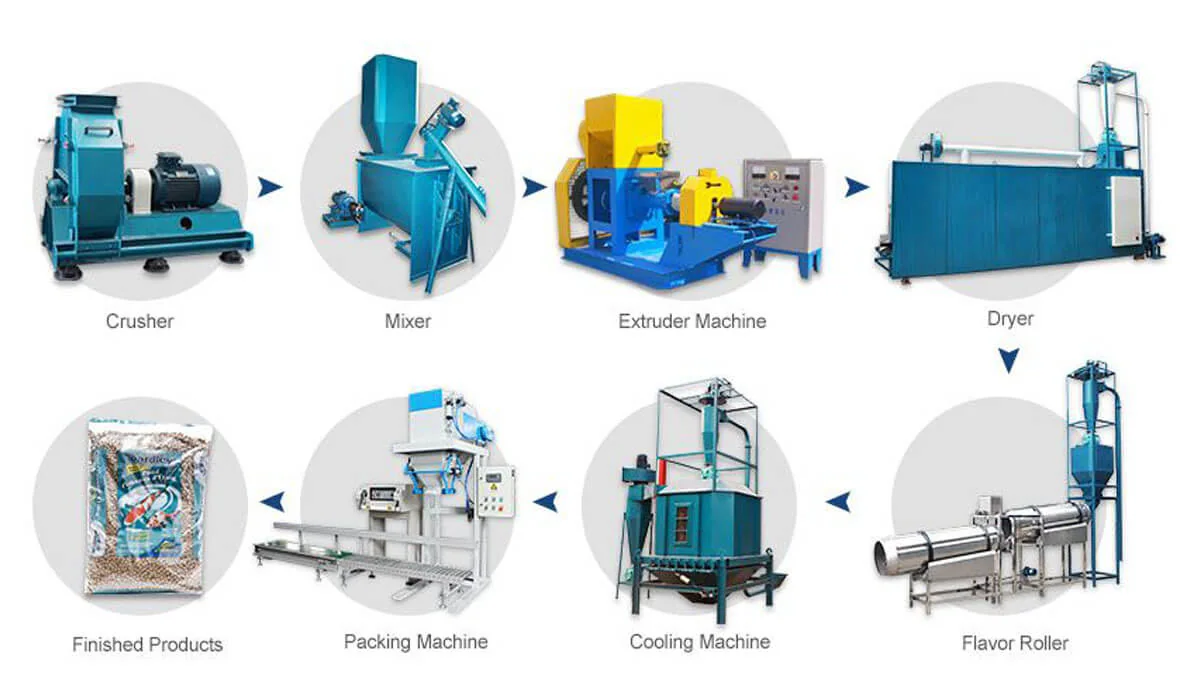
Two shortcuts worth knowing about. If your raw material already arrives as fine meal — fish meal, soybean meal, premix — the grinder can be smaller or skipped and the line starts at the mixer. And if you only ever sell floating feed at under 500 kg/h, sun drying on a concrete apron is a real option; above that it is not, because the weather sets your delivery dates. For a worked example of a complete line at a fixed capacity, see the 500 kg/h wood pellet plant — the layout logic is the same, only the extruder and the dryer change.
Four steps from the first message to a running line
A line is a project, not an order. Most of the risk sits in the two weeks before the machines ship, which is why we spend them on drawings rather than on paperwork.
- 1 · The four numbersFinished capacity in kg per hour, pellet diameter, dry or wet type, and the building. We come back with a model list and a price band inside 12 working hours.
- 2 · The layout drawingA plan and an elevation at 1:50 with the power draw, the water points and the duct runs marked, so your builder can price the civils before you commit.
- 3 · Test run on your formulationWe run your recipe on the extruder we are going to ship and send the video with the pellet in it — float time, diameter and moisture measured, not claimed.
- 4 · Shipment and commissioningThe line ships in crates numbered to the layout drawing. Commissioning is remote or on site, and the first batch is run with your operator on the controls.
A complete line running, and the showroom it is built in
Three clips from our channel: a complete wet type fish feed production line running end to end, a walk through the showroom, and an overview of the fish feed range.
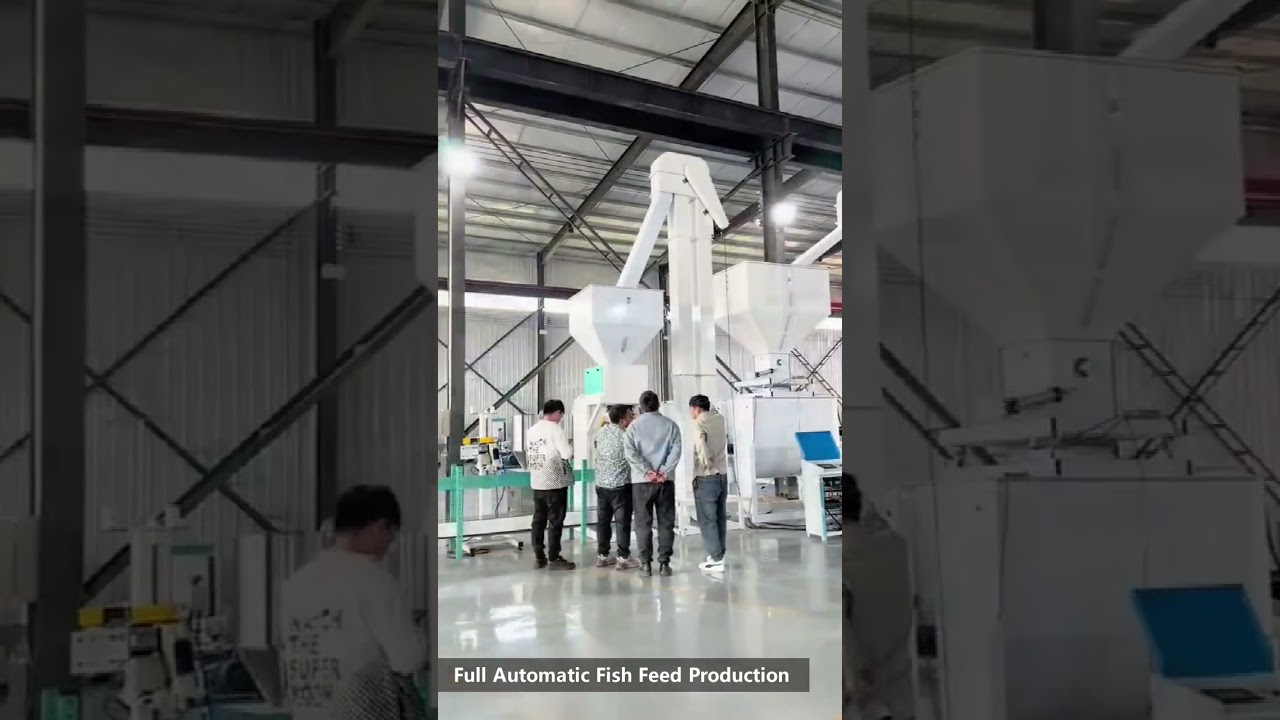


More line footage, single-machine test runs and shipping records on our Fish Feed Machines playlist and the rest of the channel.
Every stage has its own page
Start with the extruder, because that is the machine the rest of the line is sized around — then the grinder in front of it and the machines behind it.
Tell us the capacity and the building
Finished kg/h, pellet diameter, dry or wet type, and the floor length, width and power you have. We reply with a model list, a layout and a price band.
Reply within one working day. No obligation.
What buyers ask before ordering a fish feed production line
What is a fish feed production line?
Eight machines in sequence: hammer mill, mixer, extruder, dryer, coater, cooler and packing scale, plus a conditioner and boiler on a wet type fish feed line. It turns raw meal into bagged floating or sinking fish feed at 100 kg/h to 5 t/h.
How much does a fish feed production line cost?
It depends almost entirely on the capacity band and on whether there is a boiler. A 100–200 kg/h dry type fish feed line is a handful of machines on one floor; a 3–5 t/h wet type fish feed line is a building with a boiler house and a laboratory. Send the capacity and the pellet diameter and we quote the model list stage by stage.
Do I need a dryer?
Above about 500 kg/h, yes. Pellets leave the extruder at 25–30 % moisture on a dry type fish feed line and 18–25 % on a wet type one, and they have to come down under 10–12 % before bagging or they mould in days. Below 500 kg/h sun drying on a concrete apron works in a dry climate, but the weather then sets your delivery dates.
Dry type fish feed line or wet type fish feed line?
Below about 1 t/h a dry type fish feed line wins, because the boiler, the water treatment and the operator cost more than the extra capacity is worth. Above about 2 t/h a wet type fish feed line usually pays for its boiler inside the first year. Between the two it depends on your running hours and your steam cost.
How much floor space does a line need?
Roughly 80–150 m² at 100–200 kg/h, 300–450 m² at 500–1,000 kg/h and 1,200 m² and up at 3–5 t/h. A vertical layout — grinding and mixing on a mezzanine above the extruder — saves 30–40 % of the floor where the building is tight.
Can I start small and add capacity later?
Yes, and it is the usual way. Buy the extruder at the capacity you expect in two years, run the dryer and the packing scale at today’s capacity, and add a second dryer pass or a second cooler later. The extruder is the machine that is expensive to change; the rest scales in modules.
Can the same line make pet food?
Yes. Dog and cat kibble, bird food and small poultry feed run on the same extruder with a different die profile and a higher starch share, and through the same dryer, coater and cooler. Most buyers run fish feed first and add pet food as a second product on the same line.
What do you need from me to draw a layout?
Four things: the finished kg/h, the pellet diameter, dry or wet type, and the building — floor length and width, door height, and the power supply you have. With those we send a plan and an elevation at 1:50 with the power draw and the water points marked.
Four numbers and we can draw your line
Finished capacity in kg per hour, pellet diameter, dry or wet type, and the building. With those four we send a model list stage by stage, a layout at 1:50 and a price band — before you commit to anything.
- Emailinfo@pelletmachines.net
- WhatsApp+86 186 0385 1787
- HoursMon–Sat, 08:00–20:00 (GMT+8)
Send a photo of the building if you have one — the door height and the columns usually decide more about the layout than the drawing does.
What happens after you send this
We answer with the model list, the layout and a price band — then send a test-run video on your formulation before you pay a deposit.
Your details are not shared. One follow-up, no mailing list.