Pellet Mill Buying Guide: Material, Die Type, Drivethree steps, and only one order works
A pellet mill is chosen in three steps and the order is not optional. The material decides the die type, the die type decides which drives you can have, and the drive decides how big you can go. Run it the other way round — pick the drive first, or the price first — and you end up with a pellet mill that either will not take your material or cannot be powered where the material is. This page runs the three steps once, for twelve material families, three die types and three drives, and ends with the model that fits.
- Twelve material families against three die types, in one table
- A flat die pellet mill is the only one of the three built with a diesel engine or a PTO
- 62–94 kW per tonne on a flat die pellet mill, 60–66 on a vertical ring die pellet mill
- 80 kg/h to 2.5 t/h per unit, and the honest answer above 2.5 t/h
A flat die pellet mill, a vertical ring die pellet mill and the third type we do not build · 12 materials · 3 die types · 3 drives
The short answer
Material, then die type, then drive, then size. Three of those four are decided by the one before it.
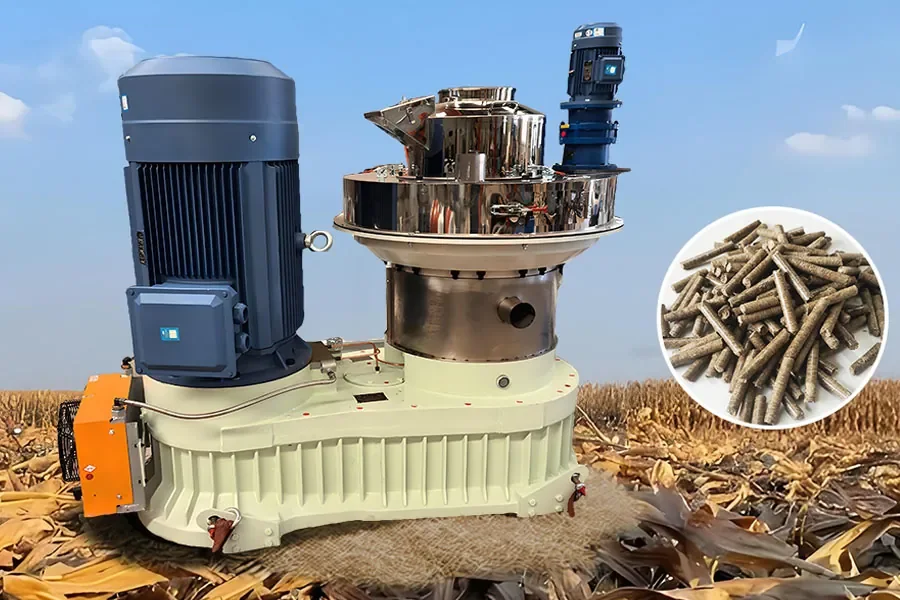
Start with the material, because it rules machines out before a price is mentioned. Rice husk makes about 60 % of the sawdust output on the same motor and needs 2–3 % starch to hold together; palm fibre at 55–65 % moisture has to be dried and its long fibre bridges a die plate; feed grain wants steam and a conditioner, which is a different pellet mill altogether. Then the die type, which in our range is a choice between a flat die pellet mill from 80 to 800 kg/h and a vertical ring die pellet mill from 1.0 to 2.5 t/h. Then the drive, and this is the step most buyers get wrong: a flat die pellet mill is built with an electric motor, a diesel engine or a 540 rpm PTO, and a ring die pellet mill is electric at every size. If you have no grid and need 1.5 t/h, the answer is not a bigger engine — it is a genset, or a smaller output.
Output figures on this page are rated capacity on sawdust at 12–15 % moisture, on a die cut for the material. Everything else is the arithmetic behind them: kW per tonne is motor divided by capacity, and the percentages against sawdust come from the twenty-four material table. A 20 kg test on your own material moves the figures by more than any table can, which is why the last section asks for one.
Twelve material families, three die types, and what each one costs you
Down the side is the material. Across is the die type. The cell says whether that type takes the material and what you lose in output if it does — not whether we would like to sell it to you.
| Material family | Flat die pellet mill | Vertical ring die pellet mill | Horizontal ring die pellet mill |
|---|---|---|---|
| Softwood sawdust pine, spruce, fir |
First choice to 800 kg/h 100 % of the figure |
First choice above 1 t/h 100 % |
Not a biomass machine at this size |
| Hardwood sawdust oak, eucalyptus, teak |
Works, on a tighter die ratio 95 % |
Works, same die ratio 95 % |
Not a biomass machine at this size |
| Wood shavings and chips after a wood hammer mill |
Works once ground below 5 mm 85–90 % |
Preferred — long fibre bridges a die plate 85–90 % |
Not used for wood |
| Bark and long fibre | Only finely ground, and the fibre still bridges 70 % |
The type that takes it without grinding twice 70 % |
Not used for wood |
| Rice husk | Works, with starch 2–3 % 60 % |
Works, and the die ring wears faster 60 % |
Too abrasive for a feed die |
| Wheat straw, rice straw, corn stover |
First choice below 800 kg/h 70–75 % |
First choice above 1 t/h 70–75 % |
Only with a conditioner, and rarely quoted |
| Palm fibre (EFB), bagasse | Needs drying first, then a bigger motor 85–90 % |
Preferred — high moisture and long fibre 85–90 % |
Not used for biomass |
| Alfalfa and grass | Common at farm scale 75–80 % |
Above 1 t/h 75–80 % |
A feed machine; possible with steam |
| Poultry manure | Works after fermenting; corrosion is the issue 60 % |
Works; stainless where it touches 60 % |
Rarely — the highest die cost a tonne of the three |
| Palm kernel shell, coconut shell |
Works, abrasive on the plate 70–75 % |
Works, abrasive on the ring 70–75 % |
Not used for shell |
| Feed grain and meal corn, wheat, soybean |
Farm scale, dry, to about 800 kg/h 100 % |
Not a feed machine — it runs dry, without steam | The feed-mill standard from about 1 t/h |
| Fish feed, shrimp feed | No — an extruder, not a pellet mill | No — an extruder, not a pellet mill | No — an extruder, not a pellet mill |
The percentages are the share of the sawdust output you can expect on the same motor, and they come from the twenty-four material pelleting guide. Rice husk and poultry manure are the two that hurt, and they hurt every type equally — which is why neither is a reason to change type. The die ratio each material wants is on the compression ratio chart, and the drying it needs before it will pellet at all is on the moisture page.
Four columns of sentences will not fit a phone. Swipe the table sideways for the two ring die pellet mill columns, which are the ones that change the answer.
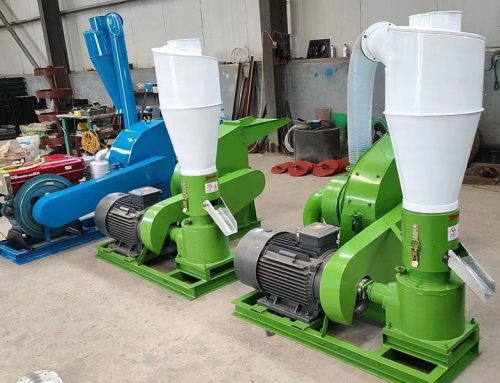
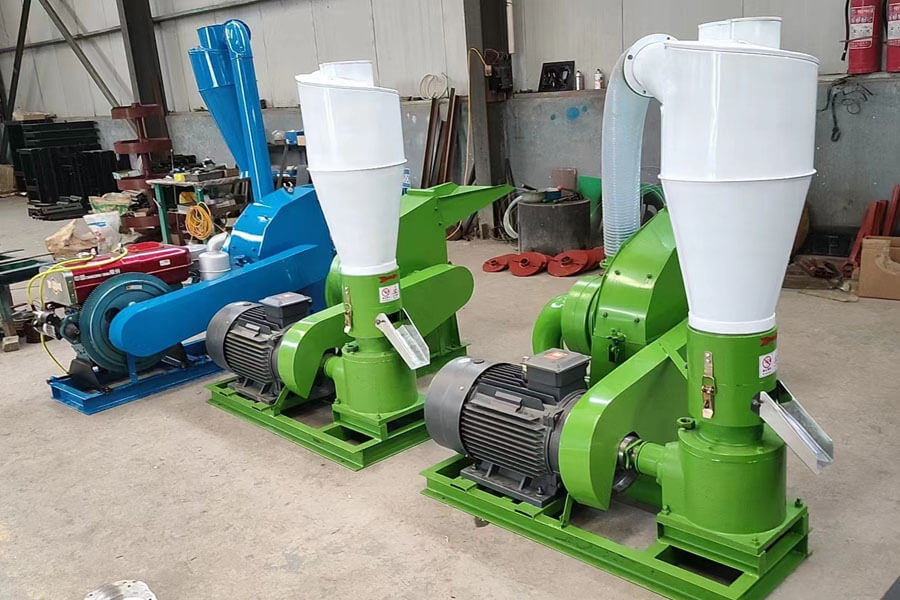
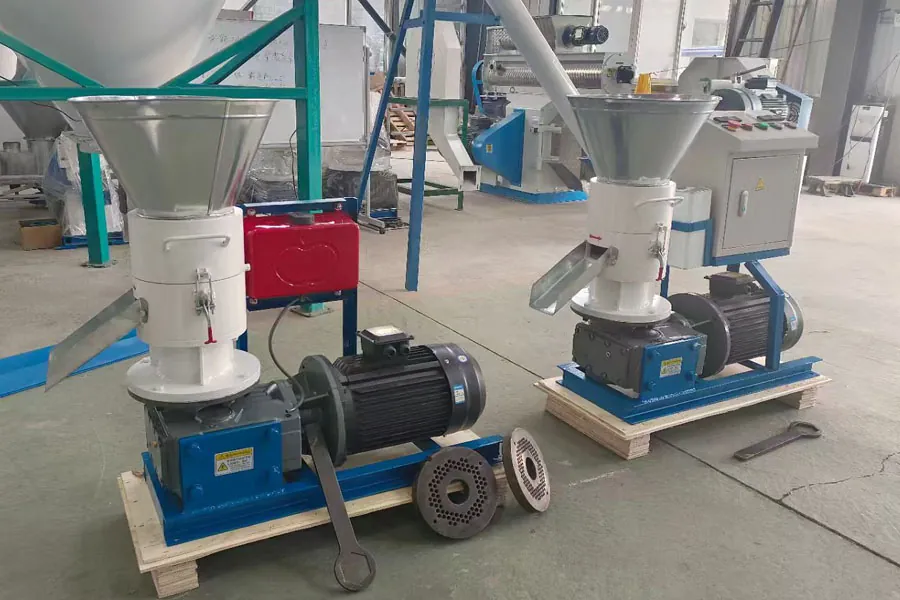
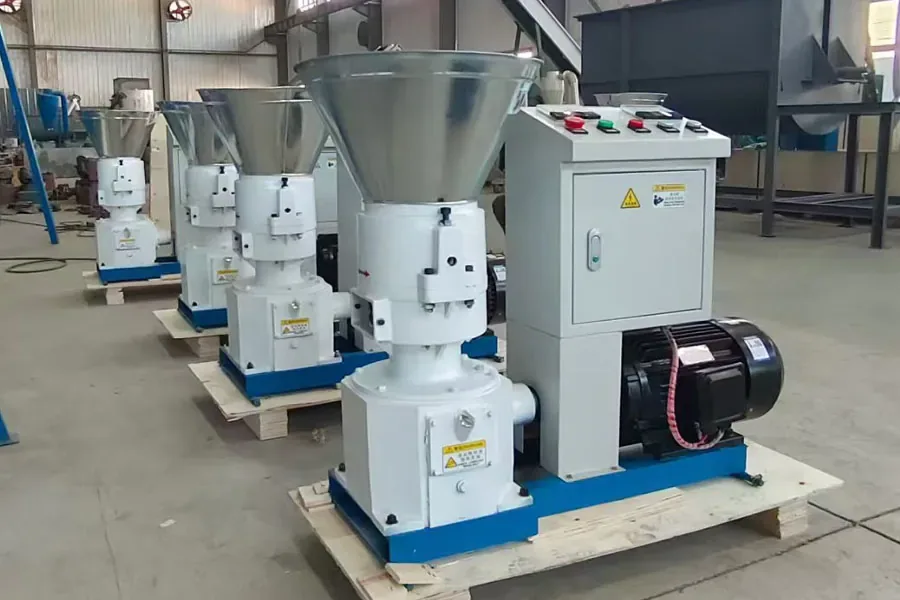
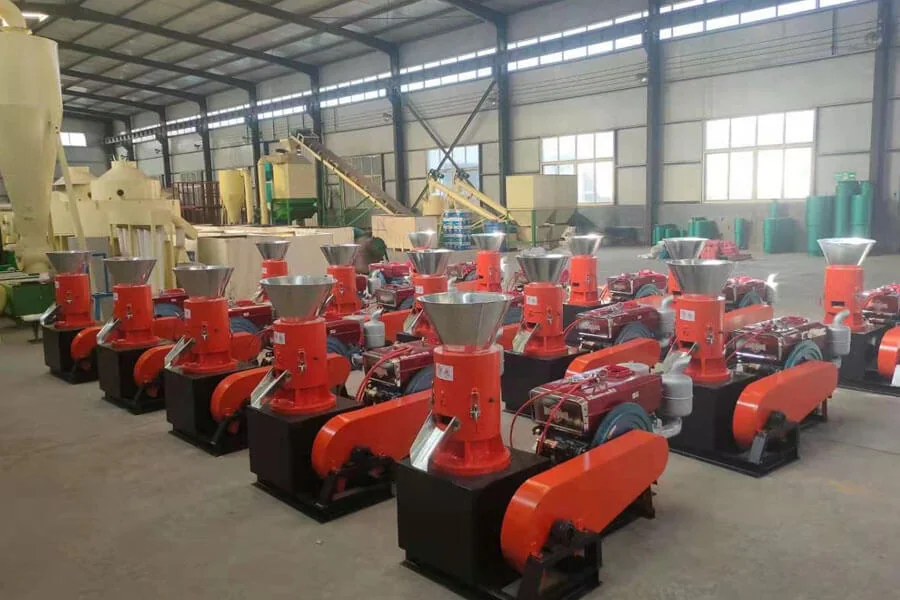
Read the flat die pellet mill column for the materials a small plant actually meets: sawdust, shavings, straw, husk, feed grain. Every one of them pellets on a flat die pellet mill, and the die plate is the cheapest wear part on the page — 400 to 1,200 for a plate, changed in twenty minutes with a spanner. What a flat die pellet mill will not do is take long fibre without grinding it first, and it will not go above 800 kg/h. Those are the two limits, and neither is about pellet quality.
The two ring die pellet mill columns are not the same pellet mill turned ninety degrees, and the difference shows up in what you have to add. A vertical ring die pellet mill is a dry machine: material in, pellets out, no steam, no conditioner, which is why it is the biomass type. A horizontal ring die pellet mill is a feed-mill machine: it expects a conditioner and a steam line, and its whole economic case is built on them. That is also why the last column has so many cells that say no — it is a good machine being asked the wrong question.
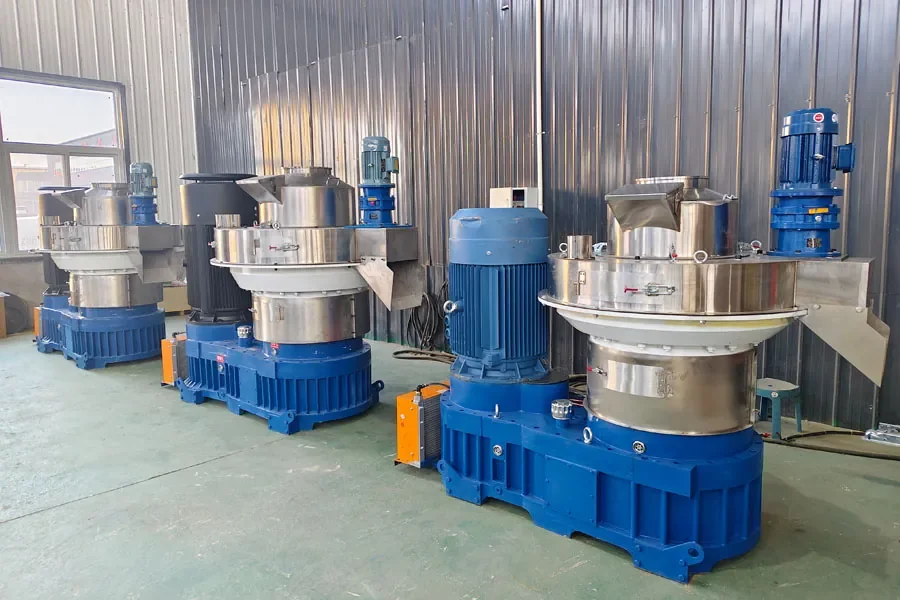
The three die types, dimension by dimension
Two of these we build and one we do not, and the table says which is which rather than leaving it to the last row. The row that decides most purchases is the fourth.
| Dimension | Flat die pellet mill | Vertical ring die pellet mill | Horizontal ring die pellet mill |
|---|---|---|---|
| How the die sits | A die plate lying flat, with two or three rollers running on top of it | A die ring standing upright, rollers running inside it, pressure outwards | A die ring lying on its side, rollers inside, material fed in at one end |
| Output per unit | 80–800 kg/h | 1.0–2.5 t/h | About 1–20 t/h |
| Motor per tonne | 62–94 kW per t/h, rising as the plate grows | 60–66 kW per t/h, holding as the ring grows | 35–55 kW per t/h, with steam conditioning |
| Drives it is built in | Electric, diesel, 540 rpm PTO | Electric only | Electric only |
| Die change | 20 minutes, one man, a spanner | 2–3 hours, a hoist, two men | 1–2 hours from the side, with a hoist |
| Headroom over the pellet mill | About 1.5 m; a 3 m roof is enough | 4.5 m, because the die ring comes out upwards | 3.5–4 m, and the die ring comes out sideways |
| What the wear part costs | 400–1,200 a plate — the cheapest wear part we sell | Several times a die plate | The most expensive of the three, and the longest lead time |
| What it suits | Short fibre, feed, straw, husk — and anything you change weekly | Long fibre, high-capacity wood, one material all year | Feed, with steam, and large biomass plants |
| What goes wrong | Roller slip on wet material, and pellets re-pressed on the plate | A dry die ring glazes and blocks; the main bearing is a bigger job | The conditioner, the feeder and the steam trap — rarely the pellet mill |
| What we build | PM-D225B to PM-D580B, 7.5–75 kW | HML-560 to HML-700, 90–160 kW | Not built here — a feed-mill machine, bought with a feed project |
The fourth row is the one to read twice. It is not a preference or a sales policy: a diesel engine on a ring die pellet mill is a gearbox, a coupling and a fuel tank wrapped round a pellet mill that wants 90 kW or more, and nobody builds one, including us. So the drive question and the die type question are not independent, and the order in which you ask them decides whether the answer exists. The drive page takes the drive question on its own once the type is settled.
Four columns will not fit a phone. Swipe sideways for the ring die pellet mill columns — the fourth row is the one that takes an option away from you.
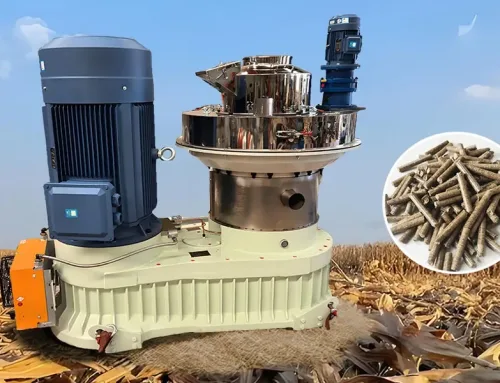
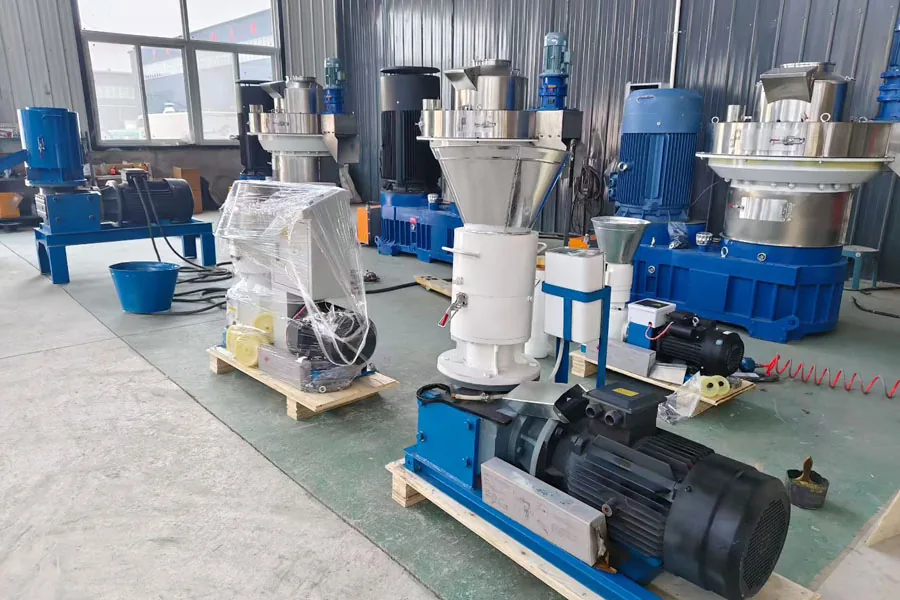
The vertical and the horizontal ring die pellet mill are the same idea turned ninety degrees, and the orientation is not the difference that matters. A vertical ring die pellet mill is fed from above by gravity and centrifugal force, runs dry, and is built for wood, straw, husk and fibre — that is what our HML range is. A horizontal ring die pellet mill is fed from one end through a forced feeder, expects steam-conditioned mash, and is built for feed. The die ring, the rollers and the knife are recognisably the same family; everything around them is not.
We do not build the horizontal type, and this page is more useful for saying so. What a buyer needs from a buying guide is the ability to tell which of the three a quotation is describing, and then whether that is the right one for the material. If your process turns out to need a horizontal ring die pellet mill — feed at a tonne an hour and up, with a conditioner — you will be buying it as part of a feed mill project, and the rows above are the specification to hold it to.
Which drive survives at each output capacity
The same ladder read from the drive end. The empty cells are the answer: there is no diesel pellet mill above 350 kg/h, and no power take-off above 600.
| Target output | Electric motor | Diesel engine | Tractor PTO | What it decides |
|---|---|---|---|---|
| 80–120 kg/h | PM-D225B, 7.5 kW | 16 kW engine | PM-225P, 15 hp | All three, at the smallest size |
| 120–200 kg/h | PM-D250B, 15 kW | 16–22 kW engine | PM-250P, 30 hp | All three still |
| 250–350 kg/h | PM-D300B, 22 kW | 22–30 kW engine | PM-300P, 41 hp | The top of the diesel range |
| 350–450 kg/h | PM-D400B, 30 kW | — | PM-400P, 55 hp | Diesel stops; PTO continues |
| 450–600 kg/h | PM-D450B, 45 kW | — | PM-450P, 75 hp | The top of the PTO range |
| 600–800 kg/h | PM-D580B, 75 kW | — | — | Electric only, and the top of the flat die pellet mill range |
| 1.0–2.5 t/h | HML-560 to HML-700, 90–160 kW | — | — | Electric, or a genset sized on starting current |
| Above 2.5 t/h | Two or more HML units | — | — | A horizontal ring die pellet mill, or a second production line |
The blanks are not gaps in the range, they are the range. A diesel flat die pellet mill stops at about 350 kg/h because the engine that would carry more is a lorry engine, and bolting one to a pellet mill frame costs more than the grid connection it is avoiding. A 540 rpm power take-off stops at 600 kg/h because the tractor behind it does — a 75 hp tractor will hold 45 kW at the shaft for a shift, and nothing much bigger will. Above either limit the answer is electricity, from the grid or from a genset.
Five columns will not fit a phone. Swipe sideways for the diesel and PTO columns, which are the two that run out.
This is the table that kills the most bad purchases, and it kills them at the top rather than the bottom. A buyer with no grid, 2 t/h of sawdust and a preference for diesel is not choosing between drives — the drive he wants does not exist at that output, and the real choice is between a genset and a smaller plant. A genset is sized on the starting current of the largest motor rather than on its running load, which is on the power supply page, and the 35 % fuel penalty a genset carries is on the drive page.
At the small end all three drives exist, and the choice there is about what you already own rather than about output. A farm with a 55 hp tractor and no three-phase supply has the cheapest route into pelleting there is: a PTO flat die pellet mill, no engine to buy, no cable to run. A site with three-phase at the wall should not read this table at all — the motor is cheaper to buy than the engine and about half the cost a tonne to run.
Six things that move the price, in the order they move it
Two buyers can ask for the same output capacity and get quotations a long way apart, and it is almost always one of these six.
| What moves it | How much it moves | Why |
|---|---|---|
| The die type | The largest single step | A vertical ring die pellet mill carries a cast base and a gearbox sized for three times the work of a flat die pellet mill at the same output. Below 800 kg/h that extra is not buying you anything |
| The drive | 20–35 % for diesel, less for PTO | An engine, a fuel tank, a battery and a heavier frame. A PTO build is the cheapest of the three because there is no engine at all — the tractor is already bought |
| Output capacity | Steeper than linear | Doubling the output roughly triples the motor and the steel. The kW per tonne falls as the pellet mill grows, but the price per kg/h of capacity does not |
| Steam and conditioning | 10–25 % on a steam-conditioned build | A conditioner, a forced feeder and a steam line are part of a feed build and are not in a dry biomass price. Ask which of the three a quotation is for before comparing it |
| What is in the quotation | 15–25 % on the equipment price | Spare parts, installation, trial material, freight, dies and electrical work sit outside the equipment price — the quotation page lists all six |
| What is not in it | The wear part, monthly | A die plate at 400–1,200 or a die ring at several times that is a running cost. Budget it monthly, and see the die ring and roller hour schedule for how often |
The first two rows are the ones buyers weigh heaviest and the last two are the ones that decide whether two quotations are comparable at all. A price that excludes the wear part, the installation and the freight is not a lower price, it is a smaller number — and the difference between the cheapest and the dearest quotation on the same specification is usually smaller than the difference between two scopes.
Three columns will not fit a phone. Swipe sideways for the figure and the reason.
Output capacity is the row where the arithmetic surprises people in both directions. A PM-D225B makes 120 kg/h on 7.5 kW, which is 62 kW per tonne; a PM-D580B makes 800 kg/h on 75 kW, which is 94. The small pellet mill is the more efficient one per kW and the more expensive one per kg/h of capacity, because you are paying for a motor, a frame and a control cabinet either way. That is why a farm buying 200 kg/h should not be sold a ring die pellet mill, and why a plant buying 2 t/h should not be sold four flat die pellet mills to save money on the first invoice.
The quotation row is where a buying guide earns its keep. Ask for the same six lines from every supplier — the pellet mill, dies, spare parts, installation, freight, electrical — and the comparison becomes arithmetic. Ask for a single number and you will be comparing the scope each supplier chose to leave out. The landed cost calculator on the quotation page does that sum, including the duty and the port charges that never appear on the equipment price.
Your material, your output, your power
Three fields, and the answer is the die type, the model and the drive that survives all three. It follows the tables above rather than a preference.
At 1,000 kg/h of sawdust you need about 1,000 kg/h of pellet mill, which is one HML-560 vertical ring die pellet mill at 90 kW, rated 1,500 kg/h. Two PM-D450B flat die pellet mills come to the same 90 kW, which is the one genuine tie on this page.
The material field carries the output penalty from the table at the top of the page, so the model it returns is bigger than the number you typed for everything except sawdust and feed grain. The kW per tonne is quoted at the rated capacity of the model, which is how the two ranges in this guide are stated: 62–94 kW per t/h on a flat die pellet mill, 60–66 on a vertical ring die pellet mill. Running either below its rating raises that figure, which is why a pellet mill bought for half its output costs more a tonne than the same model run at capacity.
The material field carries the output penalty, so the model it returns is bigger than the number you typed for everything except sawdust and feed grain. Rice husk at 600 kg/h asks for about 1,000 kg/h of machine, which is a PM-D580B — that is the 60 % in the material table doing its work, not a rounding error.
The power field is the one that produces the awkward answers, and they are the honest ones. Ask for diesel at 1.5 t/h and the tool will tell you that no diesel pellet mill exists at that output rather than quote you one. Ask for a PTO above 600 kg/h and it will say the same. Those two limits are the reason this page puts the drive after the die type.
Buying one, in the order it has to happen
Two of these are measurements you can take this week, one is a decision, and the last one is a conversation with a supplier.
Send the material, not its name
Twenty kilograms, in a sealed bag, with the moisture if you have measured it. Two materials with the same name behave differently — rice husk from one mill and rice husk from the next can differ by ten points of ash — and the die ratio and the binder question are settled on the sample, not on the name.
Fix the output capacity and the hours
The kg/h you need and the hours a day you will run. That pair, not the annual figure, decides the model: 500 kg/h for two shifts is a different purchase from 1,000 kg/h for one, and the second is usually the cheaper way to make the same annual output because the kW per tonne falls as the pellet mill grows.
Pick the die type the material wants
A flat die pellet mill below 800 kg/h, a vertical ring die pellet mill above 1.5 t/h, and between the two both work on about 90 kW. Long fibre and high moisture push towards the vertical ring die pellet mill; anything you change weekly pushes towards the flat die pellet mill, because a die plate comes off in twenty minutes and a die ring does not.
Then the drive your site can carry
Measure at the wall: volts, phases, breaker size and how many hours a week the supply is on. No supply means diesel to 350 kg/h or a PTO to 600, and above either of those a genset — which is a supply decision, not a pellet mill decision.
The first step is the one buyers skip, and it is the only one that cannot be corrected later without buying a different die. A pellet mill ordered on the strength of a material name, without a test, is a pellet mill whose die ratio is a guess: too loose and the pellets crumble, too tight and the motor stalls on a cold morning. Twenty kilograms and a week of patience removes that risk entirely, and the test is free apart from the freight.
The third and fourth steps are the ones this page exists to keep in order. A buyer who picks the drive first — because diesel is what the neighbours run, or because a tractor is available — then finds that the output he needs does not exist in that drive, and either buys a pellet mill that is too small or a genset he did not budget for. Deciding the die type first costs nothing and removes half the wrong answers before the quotation stage.
Three ways people actually buy, and what each one commits to
Almost every purchase on this page is one of these three. They differ in what you own afterwards, not just in what you pay.
-
One pellet mill on a farm
80 to 600 kg/h, a flat die pellet mill, and any of the three drives. This is the smallest commitment and the most flexible: a die plate per material, a die change in twenty minutes, and a pellet mill that a PTO version can move between sites. It is also the route where the drive question is worth the most, because at this size all three exist and the difference between them is what you already own rather than what the pellet mill can do.
-
A production line from 500 kg/h
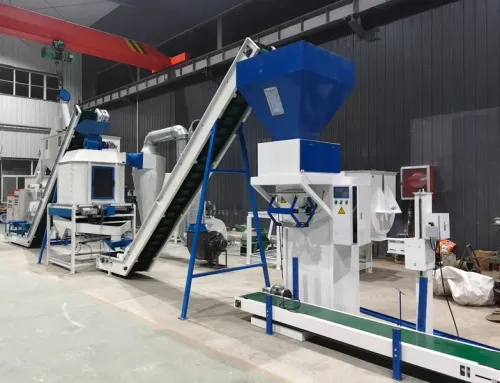
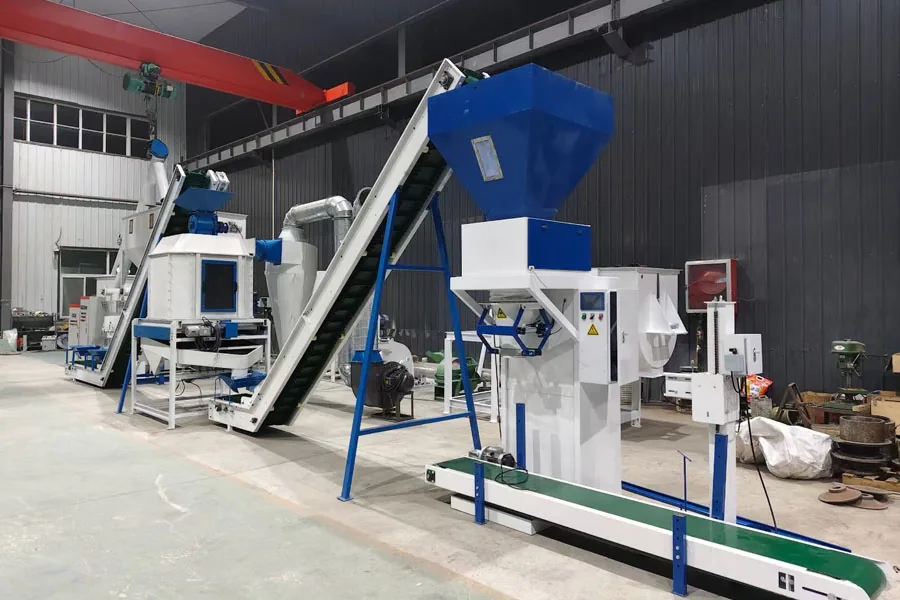
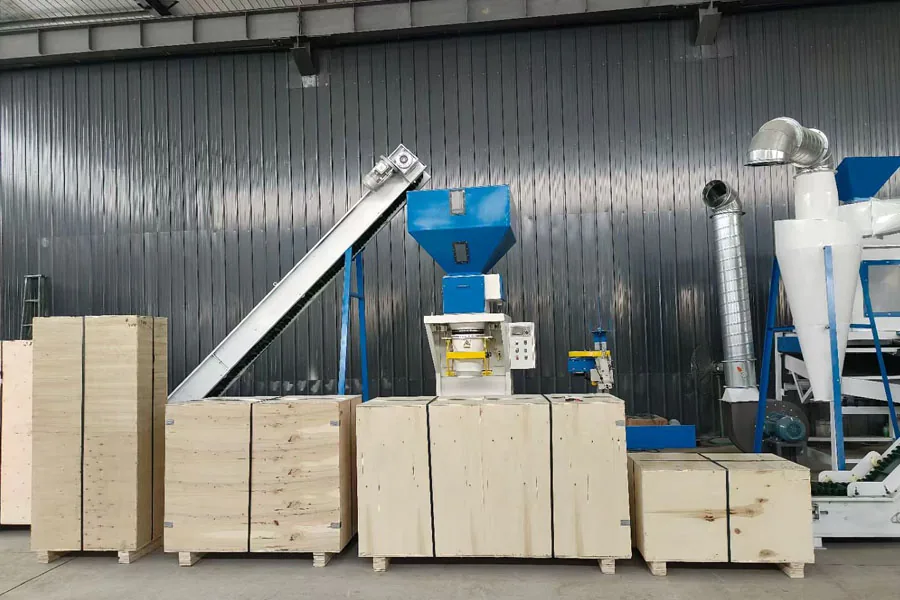
A 500 kg/h wood pellet production line is a flat die pellet mill with a wood hammer mill, a dryer, a pellet cooler and a packer around it. At 1 t/h the same line can be built on two flat die pellet mills or one vertical ring die pellet mill, which is the closest call in the range — and above 1.5 t/h it is a vertical ring die pellet mill. From here the pellet mill is one line item among six, and the layout decides more than the model does.
-
A plant that sells pellets
1.5 t/h and up, a vertical ring die pellet mill, a dryer sized on the water you have to remove, and a building with 4.5 m of headroom over the die ring. This is the route where the material supply matters more than the pellet mill: a plant at 2 t/h needs 4,600 t of dry material a year at two shifts, and the pellet mill is the easy part of that. The layout guide sizes the shed and the store before anything is ordered.
The three routes are not a ladder from cheap to expensive, they are three different businesses. A farm making 300 kg/h for its own boilers has no use for a 4.5 m shed or a dryer, and a plant selling into the ENplus market cannot run on a flat die pellet mill and a tarpaulin. The most expensive mistake on this page is buying the next route up before the material supply justifies it.
What buyers ask before they choose
Eight questions, answered the way we answer them on the phone.
How do I choose a pellet mill for my material?
Three questions in this order: how much output do you need, how much moisture does the material arrive with, and how long is the fibre. Below 800 kg/h the answer is a flat die pellet mill whatever the material; above 1.5 t/h it is a vertical ring die pellet mill. Long fibre such as palm fibre or bark, and anything above 15 % moisture, pushes towards the vertical ring die pellet mill. Rice husk and poultry manure cut the output by about 40 % on either type.
Can I buy a ring die pellet mill with a diesel engine?
No, and it is not a matter of finding the right supplier. A ring die pellet mill wants 90 kW and up, and an engine that size is a lorry engine on a fabricated frame — nobody builds one, including us. Diesel in our range stops at about 350 kg/h on a flat die pellet mill. If you have no grid and need more than that, the answer is a genset and an electric motor, sized on starting current.
What is the difference between a vertical and a horizontal ring die pellet mill?
Orientation, and what comes with it. A vertical ring die pellet mill is fed from above by gravity and centrifugal force, runs dry, and is built for wood, straw, husk and fibre. A horizontal ring die pellet mill is fed from one end through a forced feeder, expects steam-conditioned mash, and is built for feed at 1 to 20 t/h. The die and the rollers are the same idea; the conditioner, the feeder and the steam line are not.
Do I need to dry the material before pelleting?
If it is above 15 % moisture, yes — a pellet mill will press damp material into soft pellets that break in the bag. Sawdust arrives at 10–15 % dry and 45–60 % green; palm fibre at 55–65 %; bagasse at 45–55 %. The dryer is sized on the kilograms of water an hour it has to remove, not on the output capacity, and the moisture page has the ratio for each material.
How much power does a pellet mill need per tonne?
62–94 kW per t/h on a flat die pellet mill, rising as the plate grows, and 60–66 on a vertical ring die pellet mill, holding as the ring grows. In electricity that is about 89 kWh a tonne at 300 kg/h on a 30 kW motor. A horizontal ring die pellet mill with steam conditioning is lower again, 35–55 kW per t/h, because the steam does some of the work.
How many pellet mills do I need for 2 t/h?
Three ways to get there: four PM-D450B flat die pellet mills at 180 kW between them, two HML-560 vertical ring die pellet mills at 180 kW, or one HML-600 at 132 kW if the material suits it. The first is the cheapest to buy and the most work to run; the last is the calmest plant. The multi-unit page works through the downtime arithmetic.
Can one pellet mill make both animal feed and wood pellets?
Not well, and usually not at all. Feed wants steam conditioning, a mash feeder and a die built for a soft, high-protein mix; wood wants a dry die with a much tighter compression ratio and a die thickness set for abrasive fibre. A flat die pellet mill can be re-died between the two, which is why farm-scale plants sometimes do it, but a ring die pellet mill cannot be switched without changing the feeder and the conditioner as well.
What do I need to send to get a quotation?
The material and where it comes from, its moisture as received, the kg/h you need and the hours a day you will run, the power at the site in volts and phases, and whether the pellet mill has to move. Add a photograph of the building if there is one — 4.5 m of headroom decides between two types before any price is discussed.
Send 20 kg and we will tell you which of the three types takes it
The material, the moisture, the output capacity and the power you have. We run the sample on a 7.5 kW flat die pellet mill with three die ratios and report the one that holds, the output capacity it makes, and whether the answer is a flat die pellet mill at all.
What happens after you send it
We reply with the die type the material wants, the model that makes your output in it, the drive that survives your supply, and the cost a tonne on your own tariff. If the honest answer is a type we do not build, we say so and tell you what to specify instead.
Your details are not shared. One follow-up, no mailing list.