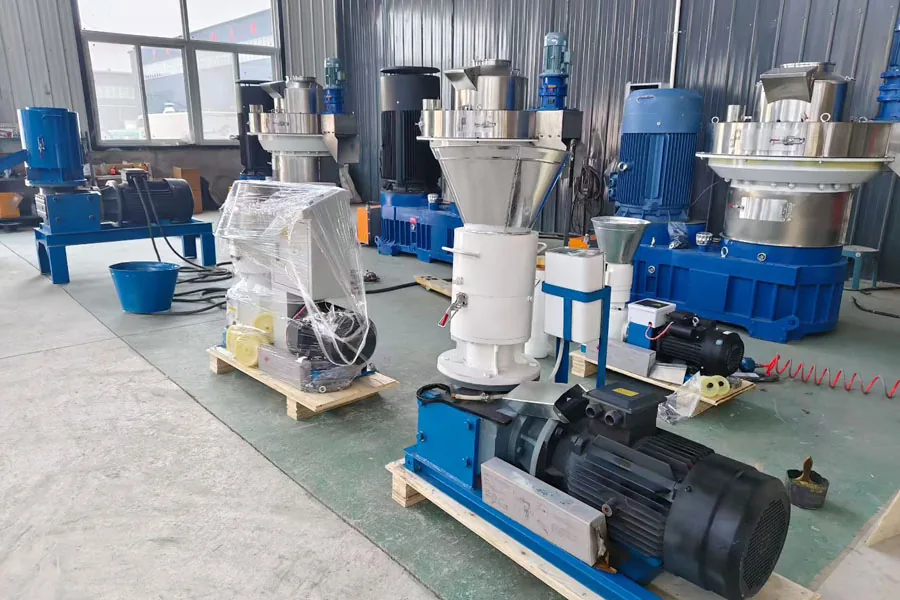
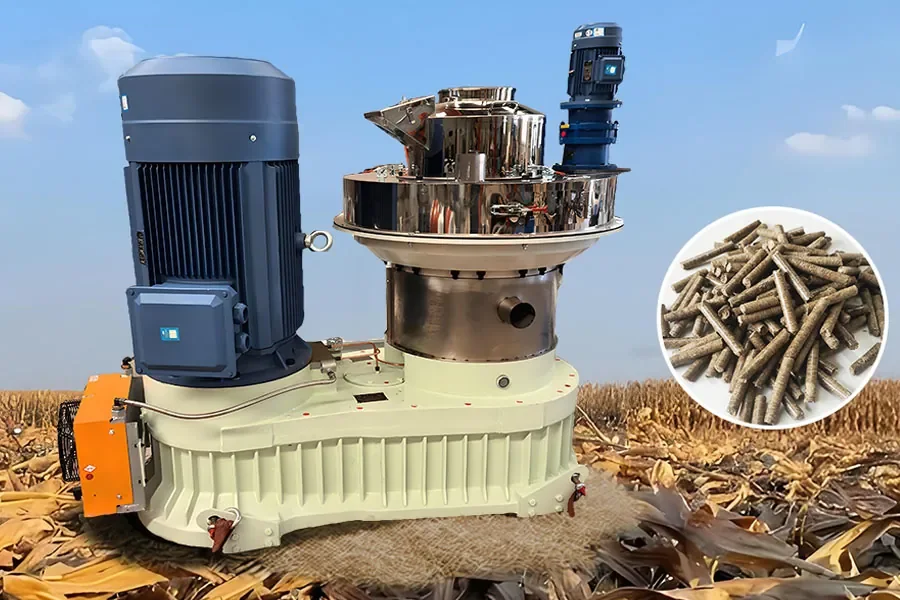
Pellet Mill Sizing: kg/h per kW, by Materialand why the same motor makes less on rice husk
A 45 kW flat die pellet mill is rated 450–600 kg/h on sawdust and about 270–360 kg/h on rice husk. That is the whole method: rated capacity divided by motor power, then multiplied by the material. The two tables below carry the figure for nine models and six material bands, and the calculator turns your own output capacity into motor power.
- Nine models, 7.5 kW to 160 kW, with kg/h per kW on each
- Six material bands, from 100 % on sawdust to 60 % on rice husk
- A calculator: type your output capacity, read the motor power
- Why a vertical ring die wood pellet mill gives 25 % more per kW
Sized on rated capacity, not on a best day · We will say so when a smaller pellet mill will do the job
The short answer
Two divisions, and you have the motor size.
A flat die pellet mill makes 10.7–16.0 kg/h for every kW of motor. A vertical ring die wood pellet mill makes 15.2–16.7. Divide your output capacity by that figure and you have the motor power; then multiply by the material band, because rice husk and poultry manure run at 60 % of what sawdust does. 1,000 kg/h of rice husk therefore needs the motor of 1,667 kg/h of sawdust — 100 kW on a vertical ring die wood pellet mill, or 125 kW on a flat die pellet mill, against 60 and 75 kW for the same capacity on pine sawdust.
These are the rated figures for our own models on sawdust at 12–15 %, not a laboratory certificate. On your material the same motor can make 40 % less, which is why the second table exists and why we run a 20 kg test before quoting a number you will hold us to.
Nine models, and the kg/h each one gives per kW
Rated capacity is on sawdust at 12–15 % moisture. Divide it by the motor and you have the figure every other page on this site uses — including the crossover table and the production line pages.
| Model | Motor | Rated capacity | kg/h per kW |
|---|---|---|---|
| PM-D225B flat die pellet mill |
7.5 kW | 80–120 kg/h | 10.7–16.0 |
| PM-D250B flat die pellet mill |
15 kW | 120–200 kg/h | 8.0–13.3 |
| PM-D300B flat die pellet mill |
22 kW | 250–350 kg/h | 11.4–15.9 |
| PM-D400B flat die pellet mill |
30 kW | 350–450 kg/h | 11.7–15.0 |
| PM-D450B flat die pellet mill |
45 kW | 450–600 kg/h | 10.0–13.3 |
| PM-D580B flat die pellet mill |
75 kW | 600–800 kg/h | 8.0–10.7 |
| HML-560 vertical ring die wood pellet mill |
90 kW | 1,000–1,500 kg/h | 11.1–16.7 |
| HML-600 vertical ring die wood pellet mill |
132 kW | 1,500–2,000 kg/h | 11.4–15.2 |
| HML-700 vertical ring die wood pellet mill |
160 kW | 2,000–2,500 kg/h | 12.5–15.6 |
Rated capacity is on sawdust at 12–15 % moisture — the same reference the 24-material guide uses, so the last column here and the last column there multiply straight through. kg/h per kW is rated capacity divided by motor power, and the range is the two ends of the rated capacity: a PM-D450B at 450 kg/h is 10.0, at 600 kg/h it is 13.3. Every other page on this site quotes the top figure, because that is the capacity we build to.
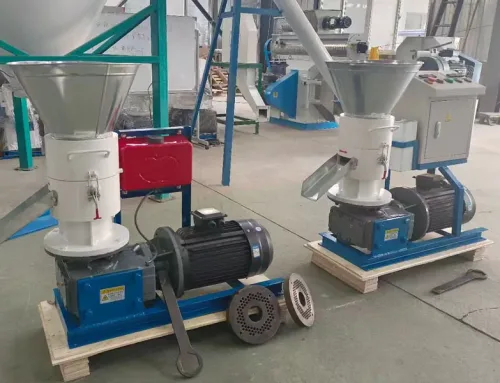
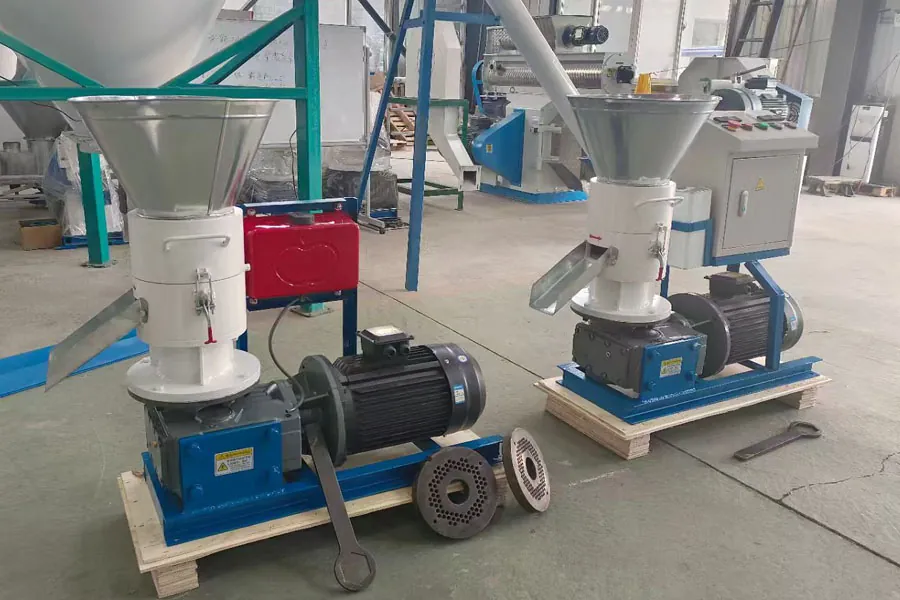
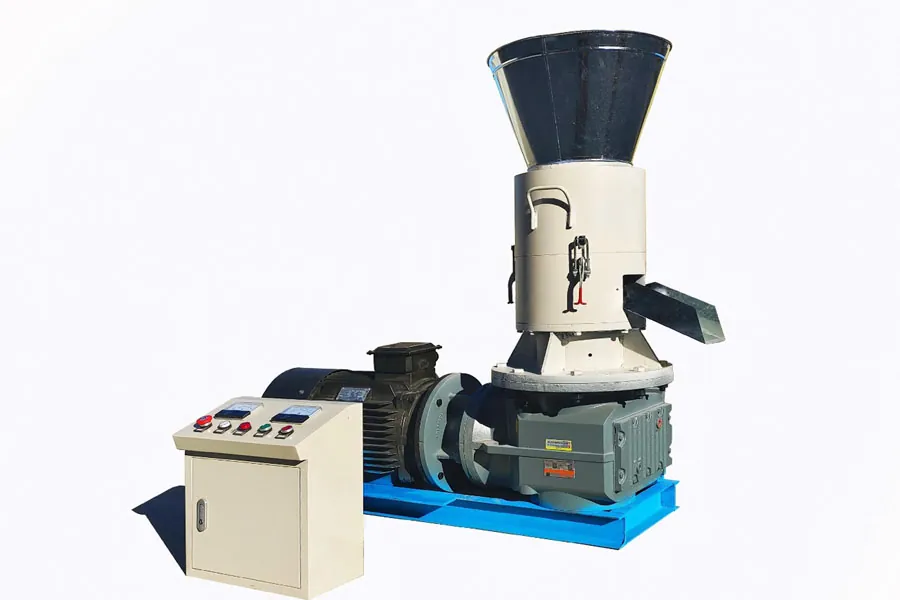
The flat die pellet mill column gets worse as the model gets bigger, and that is not a defect. Output rises with the area of the die plate, which rises with the square of its diameter; the pressure you can put on it rises with the motor, which is linear. So a PM-D225B at 16.0 kg/h per kW is the best flat die pellet mill figure we quote and a PM-D580B at 10.7 is the worst. If you need 800 kg/h you can have it on one 75 kW flat die pellet mill or on two 45 kW ones — the one is 75 kW and a single die plate to change, the two are 90 kW and twice the maintenance.
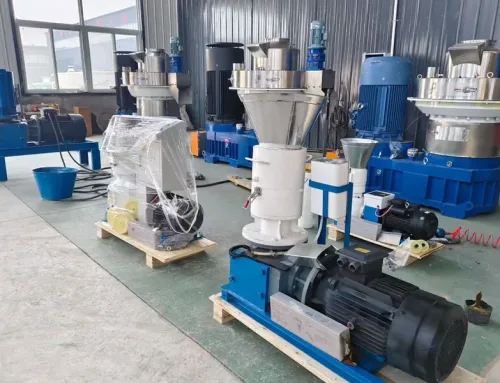
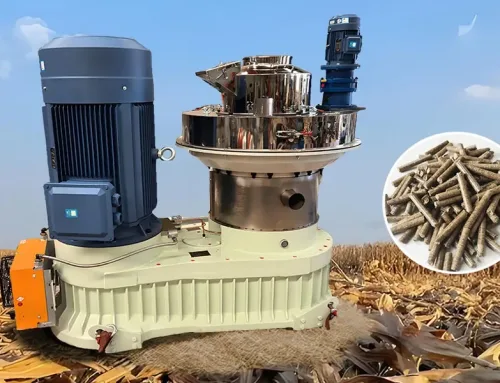
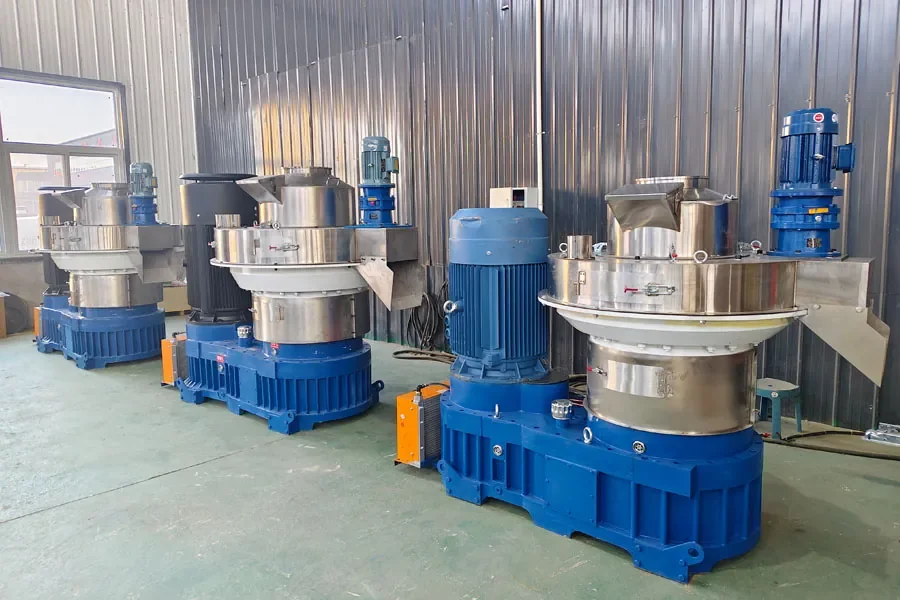
The vertical ring die wood pellet mill does not go the other way — it holds. A ring die is a ring and not a plate, so a bigger ring gives more hole length and more pressure at the same time, but the kg/h per kW barely moves: HML-560 at 16.7, HML-600 at 15.2, HML-700 at 15.6. What a bigger ring buys is output, not efficiency — and that is the whole argument for the ring, which only starts to bite above about 1.5 t/h. Below that a flat die pellet mill is the better buy, which is what the flat die vs vertical ring die comparison sets out band by band.
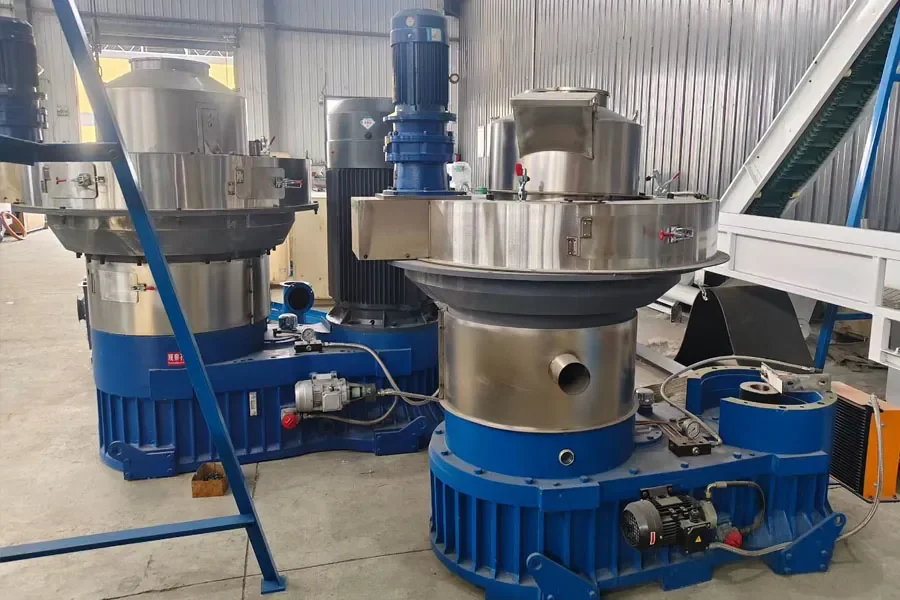
Six material bands, and what each one costs you per kW
Take the figure from the table above and multiply by the band. This is the table that turns a motor size into a capacity on your material, and the one to read before you accept any quotation that quotes a single figure for every material.
| Output vs sawdust | Materials in this band | Flat die pellet mill | Vertical ring die wood pellet mill |
|---|---|---|---|
| 100 % | Pine sawdust, hardwood sawdust | 13.3 | 16.7 |
| 90–95 % | Wood shavings, palm fibre (EFB), spent coffee grounds | 12.0–12.7 | 15.0–15.9 |
| 85 % | Wood chips, corn cob, bagasse, bamboo, paper and card | 11.3 | 14.2 |
| 75–80 % | Wheat straw, cotton stalk, alfalfa, napier grass, palm kernel shell, peanut shell, sunflower husk, tea waste | 10.0–10.7 | 12.5–13.4 |
| 70 % | Bark, rice straw, corn stover, coconut shell | 9.3 | 11.7 |
| 60 % | Rice husk, poultry manure | 8.0 | 10.0 |
kg/h per kW, on the material in the second column. A PM-D450B makes 13.3 kg/h per kW on pine sawdust and 8.0 on rice husk, which is why 1,000 kg/h of husk needs the motor of 1,667 kg/h of sawdust. The bands are the same factors as the 24-material guide, where each material has its own row, its moisture and its die; this table is that list sorted by what it costs you in output.
Three things move a material down the bands, and only one of them is hardness. Ash is the first — rice husk at 15–20 % and manure at 20–30 % are abrasive rather than hard, and the die has to be longer to hold them, which is pressure you pay for twice. Lignin is the second: below about 15 % there is nothing to bind the pellet and the die has to work harder for a worse pellet. Bulk density is the third, and it is the one buyers forget — a light, fluffy material spends more of the motor’s effort pulling itself into the die and less on compressing it.
The band is a starting point and not a quotation. Two loads of the same material rarely measure the same, and the difference between a good month and a bad one on rice husk is about ten points of output. If the number matters to you — and on a production line it does — send 20 kg and we will run it on a 7.5 kW flat die pellet mill with three die ratios, then tell you the band, the die and the capacity, rather than quoting you the table.
Put your own output capacity in
Two inputs: the capacity you need and the material band. The two figures are the motor power the ratio calls for: the number you then round up to a model, and the number you wire and pay for. Not what the meter reads.
At 1,000 kg/h on pine sawdust that is 75 kW on a flat die pellet mill or 60 kW on a vertical ring die wood pellet mill.
Installed motor power, not what the meter reads. Rounded to the nearest kW. It comes from the rated capacity in the table above, and the motor you buy is the next standard size up, so the model named under the outputs is usually one step larger than the figure — 60 kW here is an HML-560 at 90 kW. On a worn die plate the same motor makes less.
The calculation is the same two divisions the rest of this page is built on: capacity divided by kg/h per kW, once for a flat die pellet mill and once for a vertical ring die wood pellet mill. It is a sizing aid and not a quotation. It does not know that your material is wetter than the band, that your site is at 2,000 m, or that you want to run 6,000 hours a year — all three change the answer, and all three are questions we ask before we send a price.
What it does tell you is the order of magnitude, which is usually the thing that decides whether a project goes ahead. If your target is 600 kg/h and the calculator says 45 kW, you are looking at one flat die pellet mill and a shed, not a production line. If it says 400 kW, you are looking at a 5000 kg/h wood pellet production line and a transformer, and the conversation is a different one.
From your output capacity to a motor size
This is the order we do it in when a buyer sends an enquiry with a target and a material. Steps 01 and 02 take ten minutes.
Measure the material
Moisture at the die inlet, 12–15 %, and enough of a sample to see the fibre length. Both decide which band you are in before any arithmetic starts.
Divide
Output capacity in kg/h divided by the band figure. 1,000 kg/h on sawdust at 13.3 is 75 kW; the same 1,000 kg/h on rice husk at 8.0 is 125 kW.
Round up to a model, not a number
A motor size that does not exist is not a design. 75 kW is two PM-D450B or one HML-560, and which of those you buy is a question about headroom, die changes and spares.
Add the rest of the production line
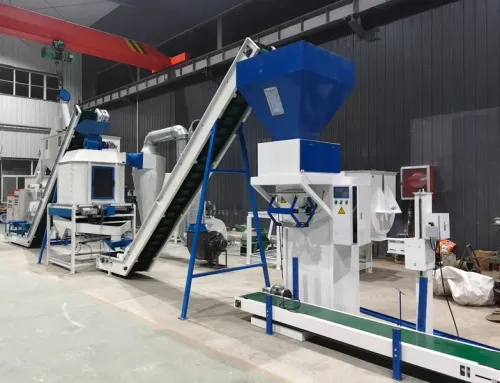
The pellet mill is about half the installed power on a wood line. A 1000 kg/h line is 190 kW installed and 90 kW of it is the pellet mills.
The step people skip is 03. A capacity figure is not a model: 90 kW could be one vertical ring die wood pellet mill or two flat die pellet mills, and the two answers have different floor space, different die costs and different maintenance. The crossover table takes each output band from 80 kg/h to 6 t/h and gives the build for both types, which is the page to read after this one.
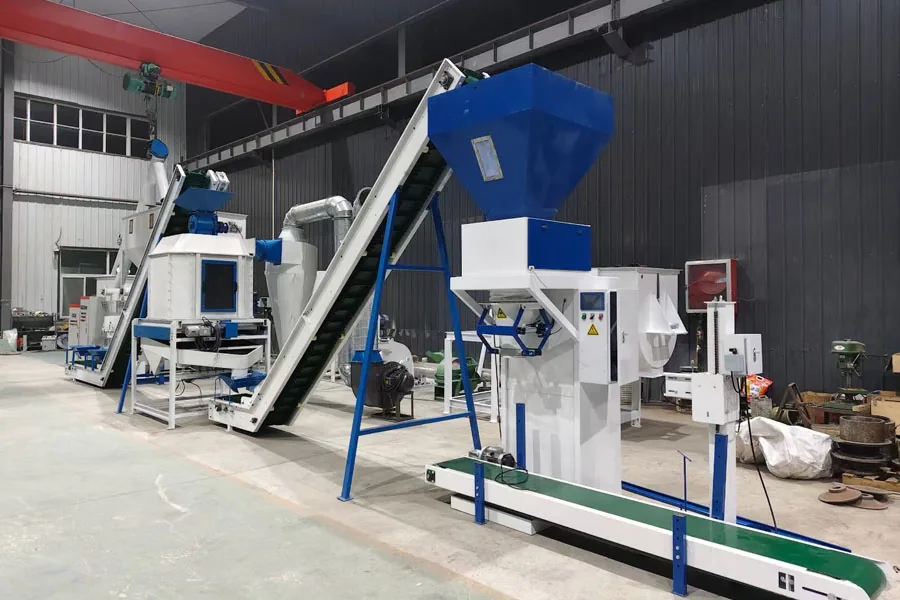
Step 04 is where a quotation surprises people. The pellet mill is the biggest single motor on a production line but it is not half the bill: the biomass sawdust dryer and its burner, the wood hammer mill, the pellet cooler, the fans and the conveyors all draw. Budget the transformer on the production line figure, not on the pellet mill figure.
What kg/h per kW does not include
Three things the number leaves out. All three are the difference between a paper answer and a working plant.
-
It is the pellet mill, not the production line
On our own builds the pellet mills are 45–51 % of the installed power: a 500 kg/h wood pellet production line is 99 kW with 45 kW on the pellet mill, and the 5000 kg/h line is 775 kW with 396 kW on three HML-600. The rest is drying, grinding, cooling, conveying and dust collection, and it has to be there whether or not you count it.
-
It is installed power, not consumption
Nameplate kW is shaft power at rated load. At the wall it is 8–12 % higher, and at 60 % load it is lower in absolute terms but worse per kg/h. A pellet mill run at a third of its capacity — which is what happens when a buyer oversizes to be safe — uses more kWh per kg/h than the same pellet mill at rated load, not less.
-
It is rated capacity, not your capacity
Rated capacity is a continuous figure on material in the band at the right moisture with a die that is not worn. Add start-up, a die change, a wet load and an operator learning the pellet mill, and a production line that is quoted at 1,000 kg/h runs 700–800 kg/h across a month. Size on the shift you actually run, and leave the rated figure as headroom.
One thing worth saying plainly, because it is the mistake we see most. Buyers oversize to be safe and get the opposite. A pellet mill at 30 % load makes a worse pellet than the same pellet mill at 80 % — the die runs cold, the material does not plasticise, and the fines come back. If the arithmetic says 75 kW, buy 90 kW for headroom, not 200 kW for comfort. The pellet quality troubleshooting guide has a whole table of what an oversized or badly loaded pellet mill does to the pellet.
What buyers ask about sizing
Eight questions, answered the way we answer them on the phone.
What size pellet mill do I need for 1 ton per hour?
On sawdust, 60 kW on the ring and 75 kW on the flat. Round those up to models and it is one HML-560 vertical ring die wood pellet mill at 90 kW, or two PM-D450B flat die pellet mills at 90 kW between them. On rice husk the same 1,000 kg/h needs 100 kW on the ring and 125 kW on the flat, because husk makes 60 % of what sawdust does on the same motor.
How many kg/h per kW does a pellet mill make?
10.7–16.0 on a flat die pellet mill and 15.2–16.7 on a vertical ring die wood pellet mill, on sawdust at 12–15 % moisture. Multiply by the material band: 0.85 for wood chips and bagasse, 0.7 for bark and rice straw, 0.6 for rice husk and poultry manure.
Is a bigger pellet mill more efficient?
No — not in kg/h per kW. On a flat die pellet mill the figure falls as the model grows, from 16.0 on a PM-D225B to 10.7 on a PM-D580B, because the die plate area grows with the square of its diameter and the pressure does not. On a vertical ring die wood pellet mill it holds, from 16.7 on an HML-560 to 15.2 on an HML-600 and 15.6 on an HML-700. What a bigger ring buys is output per unit — 2.5 t/h from one HML-700 against 1.5 t/h from an HML-560 — not a better number.
Does the motor size decide the output?
No — the die and the material do, and the motor has to be big enough to hold the pressure they need. A 45 kW motor on a die cut for straw makes less than the same motor on a die cut for pine. That is why the die plate is matched to the material and the motor is matched to the die.
Why does rice husk need almost twice the motor?
Two reasons that compound. The material makes about 60 % of the sawdust figure, and the die has to be longer — 1:9 to 1:12 against 1:5 to 1:7 — because husk is 15–20 % ash and will not bind without the extra working length. The compression ratio chart has the ratio for each material.
How much of a production line’s power is the pellet mill?
45–51 % on our own builds. A 1000 kg/h wood pellet production line is 190 kW installed with 90 kW on two flat die pellet mills; a 5000 kg/h line is 775 kW with 396 kW on three vertical ring die wood pellet mills. The rest is the biomass sawdust dryer, the wood hammer mill, the pellet cooler, the fans and the conveyors.
Is installed power the same as what the meter reads?
No. Nameplate kW is shaft power, so a 45 kW motor draws about 49 kW at the wall at full load. A pellet mill also rarely runs at full load for a whole shift: the average draw across a day is usually 70–85 % of nameplate, and the kWh per kg/h is worse at the low end of that range.
Can I run a pellet mill below its rated capacity?
You can, and up to a point you should not. Below about 50 % load the die runs cold, the material does not plasticise properly and the pellet comes out soft — which is the first row of the twelve defects. Buy one size up for headroom, not three.
Tell us your output capacity and your material
Four figures — the capacity you need, the material, its moisture, and the power supply you have. That is enough for us to name the models, the motor and the installed power of the production line, and to say so when a smaller pellet mill will do the job.
What happens next
We reply with one or two models, the motor on each, and the installed power of the production line around them. If the honest answer is a smaller pellet mill than you asked about, we say that too.
Your details are not shared. One follow-up, no mailing list.