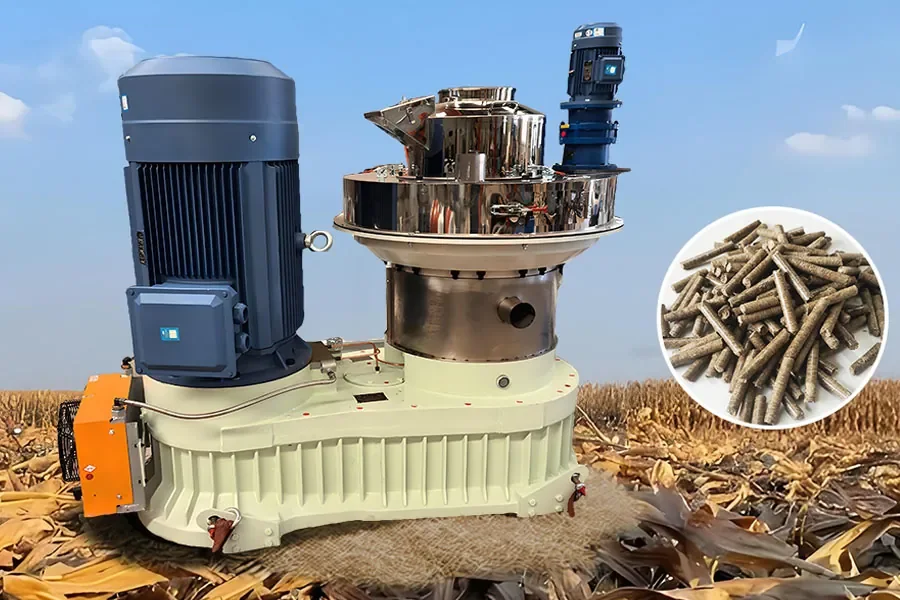
How Long a Pellet Mill Takes to Pay Backthe margin, the hours, and the year nobody counts
Payback is capital divided by the margin you make in a year, and the margin is the figure most sellers would rather you did not work out. This page does it in the open: what a 1,000 kg/h build has to sell, how many t of margin each 100,000 of capital needs, why the hours move the answer more than the price of the equipment, and a calculator that takes your own quotation, your own cost per tonne and your own selling price.
- Payback = capital ÷ (margin per tonne × t a year)
- How many t of margin each 100,000 of capital needs
- Why 4,000 hours beats a cheaper pellet mill
- A calculator: your quotation, your price, your hours
Worked on your quotation and your invoices · No price list · The arithmetic, not a sales projection
The short answer
Capital divided by the margin a year. Two numbers, and one of them is a guess until you have costed a tonne.
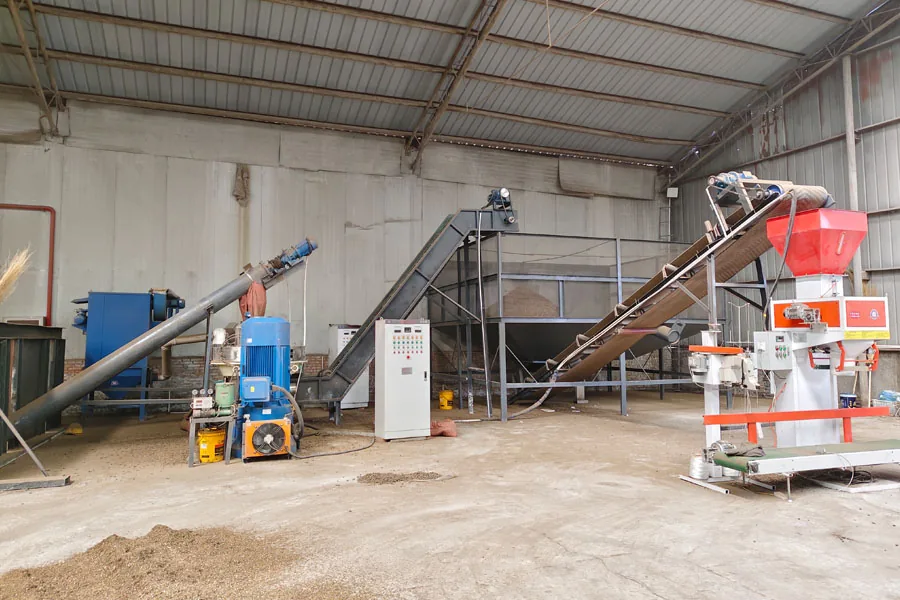
A wood pellet production line usually pays back in two to five years. The arithmetic is capital ÷ (margin per tonne × t sold a year): a 1,000 kg/h build making 3,000 t a year at a margin of 20 a tonne returns 60,000, so 100,000 of capital comes back in 1.7 years and 250,000 in 4.2. The margin is the number that decides the answer, and the margin comes from the cost per tonne — six lines, not the price of the pellet mill. If the material costs more than the pellet sells for, no volume fixes it.
No capital figure is written on this page, because a quotation for a 1,000 kg/h production line in Nigeria and one in Chile are not the same number. The arithmetic is the same in both, and it is below.
Five inputs, and only one of them is a figure you can look up
Four of the five are estimates, and all four are estimates of the same thing from different angles: how much money moves per tonne, and how many t move in a year.
| The input | Where it comes from | What moves it | A sober range |
|---|---|---|---|
| Capital | Your quotation, plus the electrical panel, the foundations, the erection and the first set of spares | How much of the work you do yourself, and how far the equipment travels | Machine price × 1.2–1.4 installed |
| Margin per tonne | Selling price per tonne − cost per tonne from the six lines | The price you actually get, and the material price at your gate | 5–40 a tonne, and it decides everything |
| t sold a year | Rated capacity × hours × load | Hours first, load second, capacity third | 3,000 t on a 1,000 kg/h build at 4,000 h and 75 % |
| Working capital | Material and bags bought before the first invoice is paid | How long your buyers take to pay, and how much stock you hold | 1–3 months of production cost |
| The ramp-up year | The share of rated capacity you reach in months 1–12 | Whether anyone on site has run a pellet mill before | 50–70 % in year one |
The second row is the one to argue about. A margin of 5 a tonne and a margin of 40 are the same production line and two different businesses, and the difference is not in the equipment — it is in what you pay for material and what your buyer pays for the bag. The six lines that make up the cost are on the cost per tonne page.
Four columns of sentences do not fit a phone. Swipe the table sideways for the range, or read the first column and the last, which is the number to sanity-check your own against.
Capital is the only one of the five that is a single number you can look up, which is why it gets quoted so often and the other four get skipped. The other four are estimates, and they all point the same way: a payback calculated from the equipment price alone is always too optimistic, because the price is the one input that stops changing once you have paid it.
Watch the ramp-up year, because it is the one that turns a two-year answer into a three-year answer. A new production line does not run at rated capacity on the first day: the operators are learning which die to use, how wet the material can be, and how fast the pellet cooler can take pellets without cracking them. Six months at 60 % of rated capacity costs more than any discount you can negotiate on the pellet mill.
How many t of margin each 100,000 of capital needs
Read it either way: with 100,000 of capital and a margin of 20 a tonne you need 5,000 t before the capital is back. Both sides are in the same currency, so the table works in any.
| Capital | At 5 a tonne | At 10 a tonne | At 20 a tonne |
|---|---|---|---|
| 25,000 | 5,000 t | 2,500 t | 1,250 t |
| 50,000 | 10,000 t | 5,000 t | 2,500 t |
| 100,000 | 20,000 t | 10,000 t | 5,000 t |
| 250,000 | 50,000 t | 25,000 t | 12,500 t |
Capital ÷ margin per tonne, with no currency attached. A 1,000 kg/h build makes 5,000 t in 5,000 hours, so at a margin of 20 a tonne a 100,000 production line is paid back after about 15 months of two-shift running. Which is why the next table, the one about hours, matters as much as this one — and why the sizing guide comes before the quotation rather than after it.
The table is deliberately small. Change the capital and the answer moves in a straight line; change the margin and it moves in a hyperbola, which is the shape of every argument about whether a pellet plant is worth building. Halving the margin doubles the t you need, and no amount of shopping around on the pellet mill recovers that.
So use it backwards. Decide what margin you can defend — the price your buyer has already agreed, minus the cost you can actually measure — then read across and ask whether the t required is a number your site can physically make. If it is not, this is not a problem a smaller build solves; it is a problem the material price solves.
The same build at 2,000, 4,000 and 6,000 hours
Rated capacity multiplied by hours. The capital does not change when you add a shift, which is why hours are the cheapest lever in the whole calculation — and the one most often left at nameplate.
| Build | 2,000 hours | 4,000 hours | 6,000 hours |
|---|---|---|---|
| 500 kg/h | 1,000 t | 2,000 t | 3,000 t |
| 1,000 kg/h | 2,000 t | 4,000 t | 6,000 t |
| 2,000 kg/h | 4,000 t | 8,000 t | 12,000 t |
| 5,000 kg/h | 10,000 t | 20,000 t | 30,000 t |
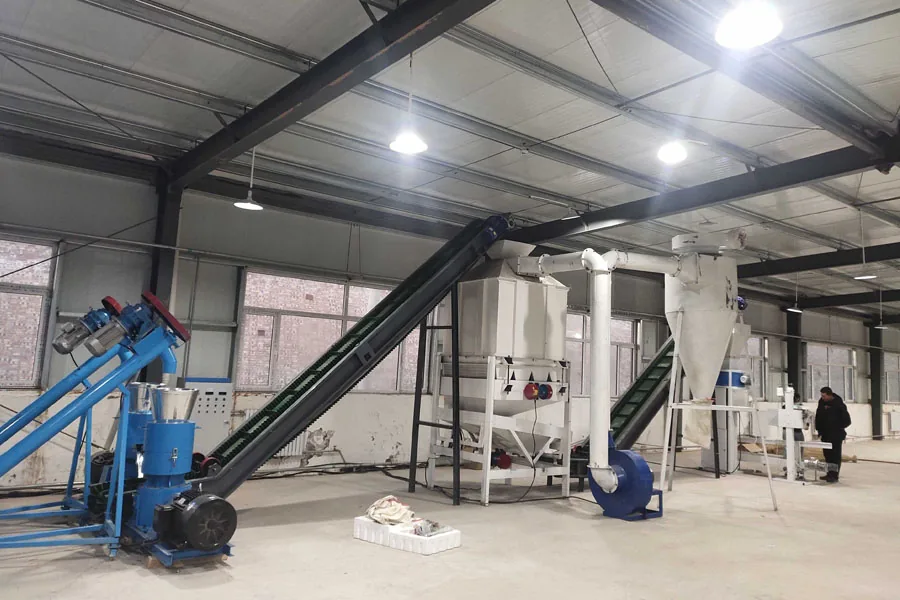
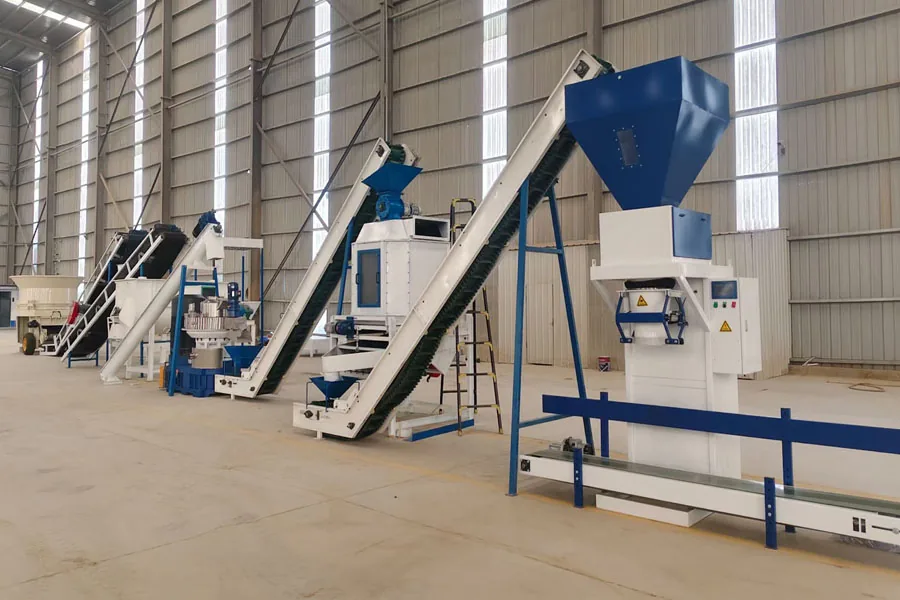
Rated capacity at 100 % load. Multiply by 0.75 for a realistic year: 1,000 kg/h at 4,000 hours is 4,000 t on paper and about 3,000 t in the yard. 2,000 hours is one shift of 250 eight-hour days, 4,000 is two shifts, 6,000 is three. The flat die vs vertical ring die comparison says which build each of these rows actually is.
The second column is the one to plan on and the third is the one to aim at. A production line running two shifts pays back in half the time of the same production line running one, and nothing about the equipment changes — the same flat die pellet mill, the same pellet cooler, the same capital.
What stops people adding the third shift is not the equipment, it is the market. Doubling the hours only doubles the margin if the extra t can be sold, and a pellet plant that makes 6,000 t into a market that takes 3,000 has not doubled anything — it has halved its price. Work the hours backwards from the demand you can prove, not forwards from the capacity you can buy.
Put your own numbers in
Six fields and no currency: enter the price and the cost in whatever you trade in, and the answer comes back in the same one. The margin is the selling price minus the six cost lines — not minus the price of the pellet mill.
At 130 a tonne sold and 110 to make, the margin is 20 a tonne. A 1000 kg/h wood pellet production line at 4,000 hours and 75 % load makes 3,000 t a year, so 60,000 of margin against 100,000 of capital is 1.7 years.
The capital field starts at 100,000 because it has to start somewhere — it is a placeholder, not a quotation, and if you change the build above you have to change this field with it, because a 5,000 kg/h production line does not cost what a 1,000 kg/h one does. Installation, the electrical panel, the foundations and the first spare die and roller set usually add another 20–40 % to the equipment price, and all of it belongs in that field. The margin is the selling price minus the six cost lines, not minus the price of the pellet mill.
The field that changes the answer most is the one people are least sure about: the margin per tonne. Everything else — the build, the hours, the load — is a volume question, and volume moves the answer in a straight line. The margin does not. A production line at a margin of 5 a tonne needs four times the volume of the same production line at 20 to pay back in the same time, and four times the volume usually means four times the market.
The second thing to watch is the capital field. It starts at 100,000 because the box has to start somewhere, and it is a placeholder rather than a quotation. Whatever your real figure is, put the installed cost in it: the machines, the electrical panel and cabling, the foundations, the erection, the freight, the first spare die and roller set, and the material and bags you buy before the first invoice is paid. The sizing guide covers which of those scale with the build and which do not.
Building your own payback
In this order. The first step takes the longest and decides the other three.
Cost the tonne first
Six lines, on the cost per tonne page. A payback built on an equipment price and a guess about electricity is not a payback, it is a wish.
Use the price you get, not the price you see
The export price at the port, the price on a competitor’s website and the price on your last three invoices are three different numbers. Only the third one pays anything back.
Count hours at 75 %, then take out the die changes
A ring die change costs two to four hours. On a production line running 500 hours a die that is 1 % of the year gone before anything breaks.
Add the ramp-up year and the working capital
Months 1–12 at 60 % of rated capacity, plus one to three months of material and bags bought before the first invoice is paid.
Payback is a blunt instrument and it is still the one buyers ask about, because it answers the question a bank asks: how long is my money at risk? What it does not answer is what happens after the payback date. A production line paid back in three years and still running in year ten has done far more for its owner than one paid back in two and scrapped in year four, and the calculation above cannot tell the two apart. If you need the number a lender wants, that is a discounted cash flow, and it takes the same inputs plus a discount rate.
The other thing payback ignores is the second production line. Almost nobody who buys a pellet mill stops at one: the material is already there, the market is already open, and the second build costs less per tonne than the first because the front end and the biomass sawdust dryer are already paid for. That is the argument for buying one size bigger than today’s demand rather than one size smaller — but only if the first build pays back, which is what this page is about.
Where a payback calculation goes wrong
All three make the answer shorter, which is why they survive review.
-
The price
The export price at the port is not the price a buyer two hours away pays, and the price in a good month is not the price in a wet one. Take the average of your last three invoices, at the bag size you actually sell.
-
The hours
Nameplate capacity times 6,000 hours is a beautiful number and nobody runs it. Take out the die changes, the wet days, the waiting for a truck and the hour after a bearing goes. 4,000 hours at 75 % load is an honest year.
-
The capital
The quotation is the machines. The electrical panel and cabling, the foundations and civil work, the erection, the freight, the first spare die and roller set and the working capital for the first three months are not in it, and they are usually 20–40 % on top.
If your arithmetic comes out under a year, check all three before you believe it. The calculation is not hard; the inputs are where the optimism gets in, and every one of the three above fails in the same direction.
What buyers ask about payback
Eight questions, answered the way we answer them on the phone.
How long does a pellet mill take to pay back?
Two to five years on a wood pellet production line that runs two shifts and sells what it makes. The number is capital ÷ (margin per tonne × t a year), so a 1,000 kg/h build making 3,000 t at a margin of 20 returns 60,000 a year and pays back 100,000 in about 20 months. At a margin of 5 the same build takes about seven years.
Is a pellet mill profitable?
It is if the margin per tonne is positive and the volume is real. The equipment does not decide that; the gap between what material costs at your gate and what a bag sells for does. A pellet mill with free sawdust and a buyer is profitable at almost any size, and one buying chips at port prices into a crowded market is not, at any size.
What margin per tonne should I use?
The one your own numbers give: the selling price per tonne minus the six cost lines on the cost per tonne page. On wood pellets that is often 10–40 a tonne, and the range is that wide because material price and local selling price are local facts rather than industry facts.
How many hours a year should I count?
4,000 for two shifts over 250 days, at 75 % load. 2,000 is one shift and 6,000 is three. Counting hours at nameplate is the most common reason a payback comes out too short — the capital is fixed, so every hour you assume is an hour of margin you have not made.
Does a bigger production line pay back faster?
Only if you can sell the extra t. Capital rises faster than capacity — a 5,000 kg/h build is not five times the price of a 1,000 kg/h one, but it is three to four times — so the bigger build wins on cost per tonne and loses on payback if half its output sits in the yard.
What is a good payback period for a pellet plant?
Three years is good, five is acceptable, and seven needs a reason you can write down. Under two usually means the margin input is optimistic rather than the project being exceptional.
What does a payback calculation leave out?
Everything after the payback date, the cost of the money, and the resale value. It also leaves out the second production line, which is where most of the real return sits. Use it to screen a project, not to choose between two of them.
Can I pay back faster by running three shifts?
Yes, if the t sell. The capital is fixed and the third shift adds hours rather than equipment, so the margin per year goes up by roughly half. What it also does is wear the die and the roller set faster, which is a cost per tonne line, not a capital line.
Send us your numbers and we will run them with you
The quotation, the material price at your gate, the price your buyer pays and the hours you can run. We will tell you what payback that gives, and if the answer is that the project does not work at your material price, we will say so.
What happens next
We reply with the payback at your numbers, the build that fits them, and the two inputs we would change first if the answer is short. No price list — the figures that decide it are yours.
Your details are not shared. One follow-up, no mailing list.