How Long Does a Pellet Die Last? 500–800 Hoursa die is replaced on hours, not on failure
A die ring runs 500–800 hours on clean wood at 12–15 % moisture and 200–300 hours on rice husk, and the ash is what takes the hours, not the material. Turned into output that is 250 t on a 500 kg/h pellet mill and 2,500 t on a 5,000 kg/h one. Four checks decide where in that range you land: at 50, 250, 500 and 800 hours.
- 500–800 hours on clean wood, 200–300 on rice husk
- 250 t per die at 500 kg/h, 2,500 t at 5,000 kg/h
- Two roller sets per die — they wear 2–3× faster
- Four checks, and only one of them needs a hoist
Die, roller set and the hours we quote on your material · By model, HML-560 to HML-700 and PM-D225B to D580B
The short answer
A die does not wear out on its own. It wears out at the rate the ash and the rollers let it.
A die ring lasts 500–800 hours on clean wood at 12–15 % moisture, and 200–300 hours on rice husk. Turned into output, one die makes 250 t on a 500 kg/h pellet mill, 500 t at 1 t/h, 1,000 t at 2 t/h and 2,500 t at 5,000 kg/h; a die that reaches 800 hours makes 400, 800, 1,600 and 4,000 t. The range is wide because two things decide where in it you land and neither of them is the die. The first is ash, which polishes the entry of every hole rather than wearing the bore — that is why a rice husk die stops at 300 hours with its plate thickness intact. The second is the roller set: a roller shell lasts about two-thirds as long as the die it runs on, so a 600-hour die takes two sets, and a worn set on a new die takes 30–40 % off the hours you paid for.
The hours here are the ones we quote with a die, and they assume 12–15 % moisture, a grind that suits the hole and a clearance that is set rather than guessed. Run the same die on green sawdust at 25 % and it will not see 300 hours. Nothing on a pellet mill counts die hours, so every figure on this page is only as good as the log you keep — an hour meter is the cheapest item in the maintenance budget and the one that makes the rest of it measurable.
Four checks, and the two that need a hoist
The first three are toolbag work. The fourth is half a day and a hoist on a die ring, so it is the one that has to be planned into the week rather than discovered on a Friday afternoon.
| Hours | What you do | What it takes | What it prevents |
|---|---|---|---|
| Every shift | Look at the pellet and the ammeter, not at the pellet mill | Nothing | A blocked hole running for a week, and the 40 hours it takes off the die |
| 50 hours | Roller clearance, and grease at every nipple | A 0.1–0.3 mm feeler gauge, a grease gun | A flat spot on a roller, and the 30–40 % of die life a flat spot costs |
| 250 hours | Ten holes against a drill bit, and the roller surface under a torch | A drill bit the size of the hole, a torch | Holes that closed quietly, and a ridge pattern that has gone smooth |
| 500 hours | The roller set, and the clearance again after it beds in | Two or three shells, a torque wrench | A worn roller hammering a die that still had 300 hours in it |
| 800 hours | The die | A die, a hoist on a die ring, 2–3 hours | A die that cracks at the clamp and takes the rollers and the shaft with it |
| 1,500–2,500 hours | The bearings behind the die — main shaft and roller | A bearing puller, a seal kit | The failure that ends a gearbox instead of a die |
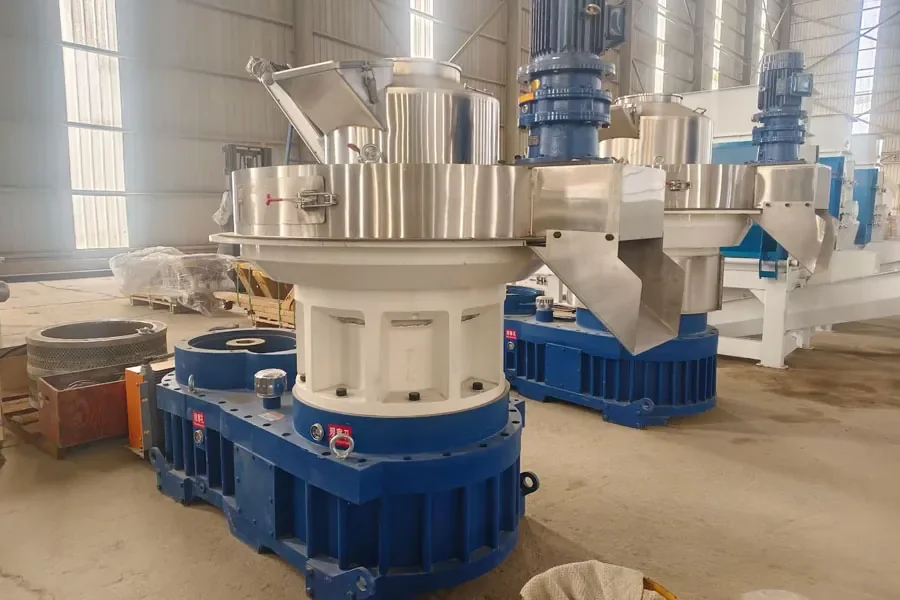
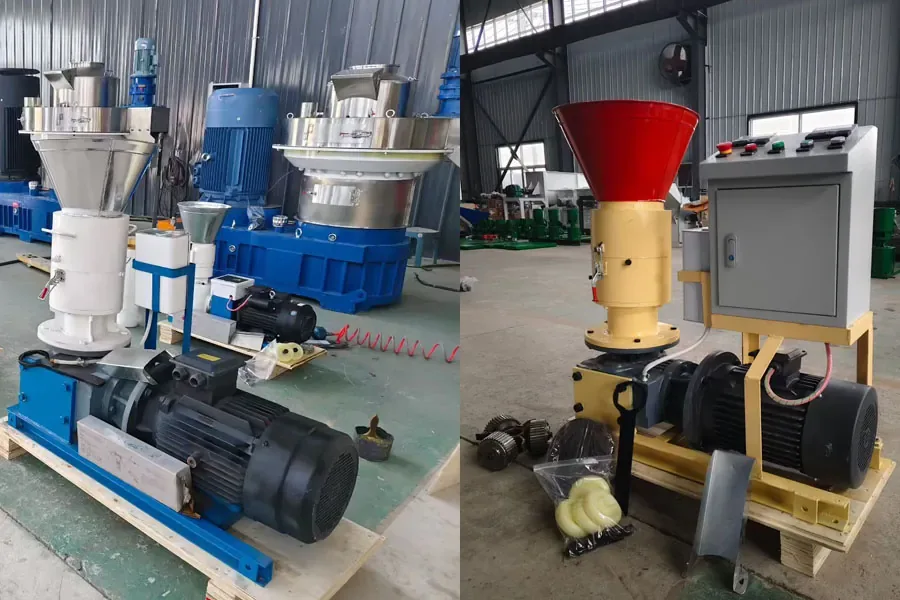
The 500-hour row is the one that gets skipped, because the pellet still looks right and the ammeter has not moved. It is also the row that pays: a roller shell is a fraction of the price of a die ring, and the two hours it takes to change one is the cheapest two hours in the schedule. On a flat die pellet mill the roller set is two bolts and a spanner; on a vertical ring die pellet mill it is the die chamber open, a hoist and two people.
Four columns will not fit a phone. Swipe the table sideways for the check and what it prevents, which are the two columns to copy into a maintenance sheet.
The hour figures are running hours on the die, and they start again at zero when a die goes in. Two shifts a day at 8 hours is 500 hours in a month, so a pellet plant running continuously changes a die every five or six weeks on clean wood and every two or three weeks on husk. That is the figure to put in a maintenance budget, not an annual one: the annual figure hides the fact that it arrives four times a year and always in the same week.
Nothing on the list needs an instrument except the feeler gauge. The clearance check is a 0.1 mm and a 0.3 mm blade between the roller and the die surface at three points round the track. If the 0.3 mm blade goes in, the roller is loose and the die is being hammered rather than rolled; if neither blade goes in, the roller is too tight and the symptom is amps climbing at a feed that used to be fine. The comparison page has the change time for each of the two types.
Seven things you see before the hours are up
The die tells you it is going well before the hour count does. Each of these has a different cause, and two of them are not the die at all.
| What you see | What it usually is | Check this first | What to do |
|---|---|---|---|
| Output falls 10–15 % at the same amps | The holes have closed — the bore is smaller than the drill | Ten holes with the drill bit the die was cut for | Re-cut, or replace if the hours are past 700 |
| Amps climb at a feed that was fine | Clearance too tight, or one hole blocked | The feeler gauge, then ten holes against a light | Re-set the clearance, clear the hole |
| Pellets come out soft and warm | Feed too wet, or pushed faster than the die can take | Moisture at the die, and the die temperature by hand | Dry two points, or slow the feed and let the die recover |
| A ring of fines round every pellet | A hole worn oversize, so the pellet is extruded fat | Hole diameter at three points with a caliper | Replace the die — this one does not re-cut |
| Black or scorched pellets at one spot | A blocked hole, packed and cooking | The hole pattern against a torch | Clear it, then find what blocked it |
| The die runs hot in one place | A flat spot on a roller, dragging rather than rolling | Roller roundness, and the clearance at that point | Replace the roller set |
| A crack at the clamp | Bolts over-torqued, or a die run cold after a wet stop | Bolt torque against the manual, and the seat | New die, and a torque wrench in the toolbag |
The first two rows are the same fault seen from opposite ends: a die losing output at a constant ammeter has closed holes, and a die drawing more amps at a constant feed has a clearance problem or a blockage. Both are cheap to fix at 250 hours and neither is fixable at 700, which is the argument for the inspection rather than the repair.
Four columns will not fit a phone. Swipe sideways for the check and the fix, which are the two columns to work from at the pellet mill.
The fourth row is the one that ends a die early and cannot be undone. A hole worn oversize extrudes a pellet with a burr on it, the burr breaks off in the pellet cooler, and the fines come back as a durability failure in a laboratory six weeks later. Nothing about it looks like a die problem at the time: the pellet is the right length, the colour is right, and the only sign is the ring of dust round each pellet on the way out.
The last row is worth a torque wrench. A die ring is clamped to a seat and the bolts are specified in the manual for a reason — under-torque lets the ring move and crack at the bolt hole, over-torque cracks it in the same place from the other direction. Neither is a wear failure, both arrive as a broken die, and both are recorded against the hours as though they were.
What lasts how long, and which part is actually worn
Six parts wear on a pellet mill and they wear at four different rates. Reading the wrong one as worn is how a die gets changed when the rollers were the problem.
| Part | Clean wood, 12–15 % | Rice husk | What ends its life |
|---|---|---|---|
| Die ring or die plate | 500–800 h | 200–300 h | The holes close, then the entry chamfer polishes away |
| Roller shell | 300–500 h | 150–250 h | A flat spot first, then the ridge pattern goes smooth |
| Roller bearing | 1,500–2,500 h | 800–1,500 h | Grease — too little, the wrong one, or water in it |
| Main shaft bearing | 8,000–12,000 h | 4,000–6,000 h | Water in the grease, and a die run out of balance |
| Cutter blade | 300–600 h | 200–400 h | The edge, and a pellet length that has drifted long |
| Die clamp bolts | With the die | With the die | Fatigue, not wear — torque and heat cycles, not hours |
Read the first two rows together, because they are the decision the page is about. A roller shell lasts about two-thirds as long as the die it runs on, so a die that reaches 800 hours has had two roller sets through it. Put a new die in with worn rollers and the die wears at the rate of the roller rather than its own: the flat spot hammers one band of the die, that band closes first, and the die stops making output at 500 hours with three-quarters of its surface still good.
Four columns will not fit a phone. Swipe sideways for the hours on rice husk, which is where the range collapses.
The bearing rows are the ones that are never on a schedule and always in a breakdown. A roller bearing that has lost its grease does not announce itself: it heats, the roller stops turning freely, and the first symptom is a die that suddenly runs hot in one place. By then the shell is scrap as well, so the 50-hour grease check in the schedule is the whole of the prevention.
The cutter row is there because a worn blade gets read as a die fault more often than any other part. A blunt blade makes long pellets, long pellets break in the pellet cooler, and the breakage comes back as fines — which is the same symptom as a die with oversized holes. Check the blade before you price a die.
What a die and its rollers cost per tonne
Four fields. The answer is almost never the die price — it is the hours you get out of it, and the roller sets it eats on the way.
At 600 hours and 1,000 kg/h one die makes 600 t. The die is 2.00 a tonne and the two roller sets it wears out add 1.00, so the wear cost is 3.00 a tonne. Double the die price and get double the hours out of it and it is still 3.00 — the hours are the lever, not the price.
The roller count is fixed at two sets per die, which is the ratio the life table gives on clean wood: a shell lasts about two-thirds as long as the die it runs on. On rice husk both lose about 60 % of their hours, so the ratio holds and the cost per tonne roughly doubles — the arithmetic is the same, the inputs are not. The figure is wear only: it does not include the two hours of downtime a die change costs, which on a 1,000 kg/h pellet mill is worth more than the die.
The arithmetic is the dies and rollers row of the cost table: die price divided by the t the die makes, and the t are hours times output capacity. Which is why the same die is 4.80 a tonne on a 500 kg/h build and 0.48 on a 5,000 kg/h one. Nothing about the die changed; the output did.
The second number is the one that gets left out. A die wears out two roller sets on its way through, and at a fraction of the die price each they still add half again to the wear cost of a tonne. That is why the roller set belongs in the same budget line as the die, and why the 500-hour row of the schedule is not optional.
Getting the hours, in the order it has to happen
One of these is a purchase, one is a habit, and two are five minutes with a torch.
Fit an hour meter, or start a log
Die life is a number of hours and nothing on a pellet mill counts them. A 20 hour meter, or a notebook with the date and the reading at every shift change, is the whole of the measurement — without it every figure on this page is somebody else’s number.
Set the clearance before you set the feed
0.1–0.3 mm between roller and die, checked at three points. Too tight and the mill draws more amps and hammers the die; too loose and it slips, the die runs cold and the pellets come out soft. Set it cold, then check again after two hours, because a new roller beds in.
Inspect at 250 hours, not at 500
Ten holes against a drill bit and the roller surface under a torch, at the half-way point. The whole value of the check is that it arrives while there is still something to decide: at 250 hours a closed hole can be drilled out, and at 500 it is a die.
Plan the die change into the week
2–3 hours, two people and a hoist on a vertical ring die pellet mill; 20 minutes and one spanner on a flat die pellet mill. Put it in the plan at 700 hours rather than waiting for 800, because the last 100 hours are where a die cracks and takes the rollers with it.
The step that pays for itself first is the clearance, and it is the one nobody writes down. A roller set at 0.5 mm instead of 0.2 mm does not fail — it just makes less, and the operator compensates by feeding faster, which is what closes the holes early. Two months later the die is changed at 400 hours and the die gets the blame.
The log matters more than it sounds, because it is the only way to find out that your 500-hour die is really a 350-hour die. Record the material, the moisture, the hours and the t for each die and after three dies you have your own number rather than ours. Every pellet plant that has done this has found one feedstock or one operator that was costing a die a year.
A worn die: re-cut it, replace it, or change the specification
Three routes, and the first one is only open for part of the die’s life.
-
Re-cut it
Drill the closed holes back to size and re-chamfer the entry, which is 10–20 % of the price of a new die and buys 100–200 hours. It only works while the bore is still round and the plate still has its thickness: a die worn oversize cannot be cut down, and one whose entry has polished away on husk has lost the funnel rather than the bore, so drilling does nothing.
-
Replace it, and the rollers with it
The usual route at 800 hours, and the one that costs least per tonne when the hours are genuinely used up. A new die with two new shells is a known quantity for the next 600 hours; a new die with the old rollers is a die wearing at somebody else’s rate, and it will not reach the hours you paid for.
-
Change the specification
A deeper compression ratio, a different hole diameter or a different open area, when the material has changed under you. This is not maintenance, it is a purchase — and it is the right answer when the die that keeps dying at 300 hours is being asked to press a material it was not cut for. The ratio chart is where that decision starts.
The order matters. Re-cutting is worth doing once, on a die that has closed its holes but still has a bore; doing it twice on the same die is money spent on a plate that is already thin. Replacing is the default and should be planned rather than reactive. Changing the specification answers a question the other two cannot: if the die keeps dying early, the die is not the problem.
What buyers ask about die and roller life
Eight questions, answered the way we answer them on the phone.
How long does a pellet die last?
500–800 hours on clean wood at 12–15 % moisture, and 200–300 hours on rice husk. In output that is 250 t at 500 kg/h, 500 t at 1 t/h, 1,000 t at 2 t/h and 2,500 t at 5,000 kg/h, or 400, 800, 1,600 and 4,000 t for a die that reaches 800 hours. The hours are running hours on that die, not calendar time.
How do I know when to change the die?
Output falling 10–15 % at the same ammeter reading, amps climbing at a feed that used to be fine, a ring of fines round every pellet, or pellets that come out oversized. Change on the hours as well: at 700 hours a die is close enough to the end that the next wet stop can crack it.
Can a worn die be re-cut?
Yes, if the bore is still round and the entry chamfer is intact. Drilling the closed holes back to size and re-chamfering costs 10–20 % of a new die and buys 100–200 hours. A die worn oversize cannot be cut down, and a rice husk die that has polished its entry has lost the funnel rather than the bore, so re-cutting it does nothing.
Do I have to change the rollers with the die?
You should. A roller shell lasts about two-thirds as long as the die, so two or three sets go through one die. A new die on worn rollers wears at the rate of the flat spot rather than its own and loses 30–40 % of its hours, which costs more than the roller set does.
What clearance should there be between roller and die?
0.1–0.3 mm, checked with a feeler gauge at three points round the track. Too tight and the mill draws more current and hammers the die; too loose and the roller slips, the die runs cold and the pellets come out soft. Set it cold and check again after two hours of running.
How often do the roller bearings need grease?
Every 8 hours of running where the roller has a grease nipple — that is a shift task, not a monthly one. A sealed roller bearing has no interval: it is replaced with the shell, and over-greasing a sealed unit is as bad as leaving it dry.
Why did my die last 200 hours when you quote 500?
Four causes, in the order we check them. The material: husk, straw and anything with sand in it takes the hours down to 200–300. The moisture: above 15 % the die runs cold. The clearance: set too loose it hammers, set too tight it draws current and heats. And blocked holes left running, which close a band of the die in a week.
Can I run a die until it breaks?
No. A die fails by cracking at the clamp, and a cracked die ring takes the rollers with it and sometimes the main shaft. The difference between changing it at 700 hours and changing it after the crack is 2–3 hours of planned downtime against a week of unplanned, plus a roller set and a shaft.
Send the model and we will quote the die, the rollers and the hours
The pellet mill model, the material, and the hours you run a week. We come back with the die ring or plate for it, the roller set, the hours we quote on that material, and what the two work out at per tonne.
What happens after you send it
We reply with the die and the roller set for your model, the hours we quote on your material and moisture, the price of both, and the cost per tonne that comes out of them. If the die you are running is dying early we will say which of the four checks is missing, because a new die on the same schedule lasts the same 300 hours.
Your details are not shared. One follow-up, no mailing list.