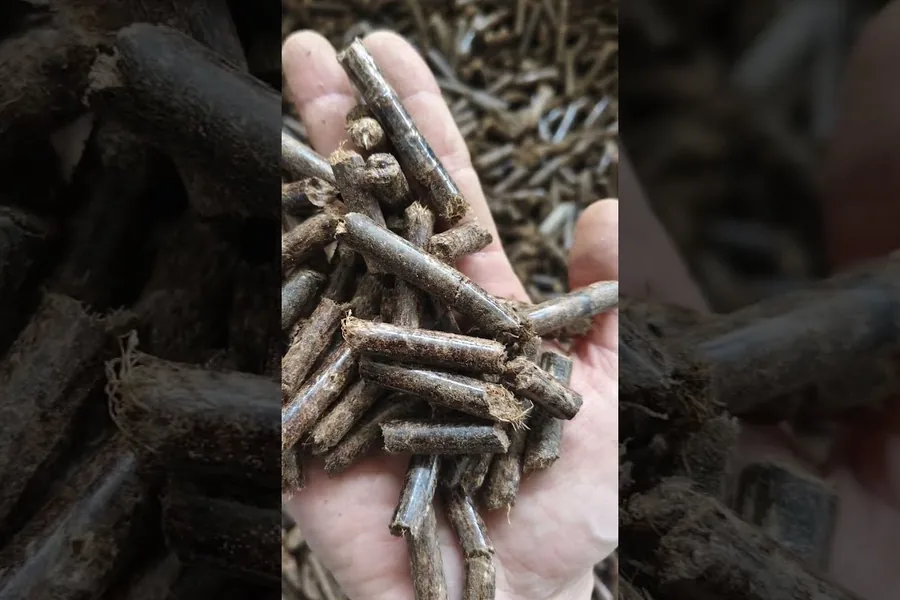
Rice Husk Pellet Production LineThe lightest material we pellet, and the hardest on a die
A 1.5 t/h rice husk pellet production line built around a 90 kW vertical ring die pellet mill: a 22 kW wood hammer mill, a counterflow pellet cooler, a vibrating screener and a pellet packing machine. Five stages, no chipper, no dryer, 146 kW on 20 × 10 m of floor.
- No chipper and no biomass sawdust dryer — husk arrives at 8–12 % moisture and 10 mm long
- 22 kW hammer mill, because husk grinds easily; the power goes into the die, not the grinding
- 90 kW vertical ring die pellet mill on a 1:9–1:12 die — the longest compression ratio we cut
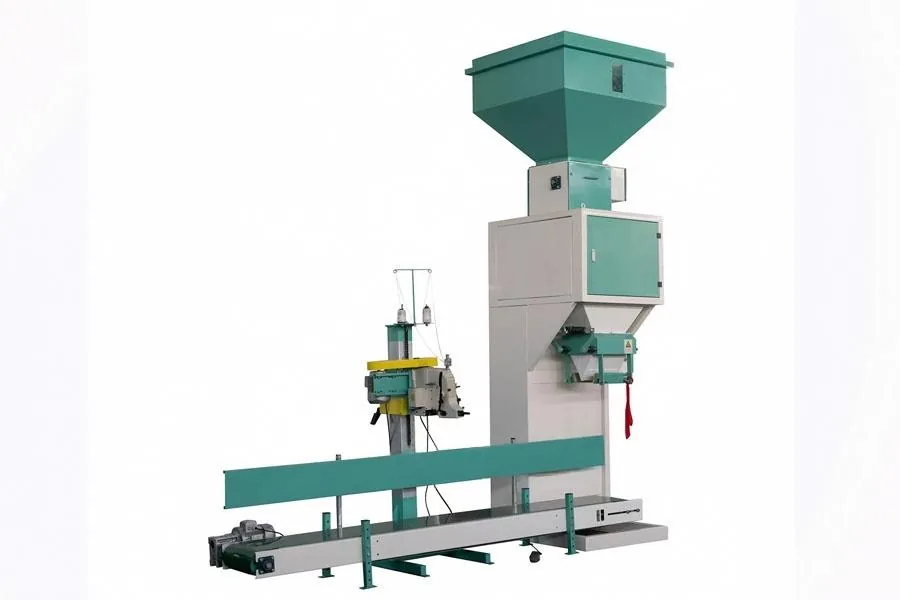
- Counterflow pellet cooler, vibrating screener and a 25–50 kg pellet packing machine
Reply in 12 working hours · Sized on your material and its moisture · Layout drawing and die specification included
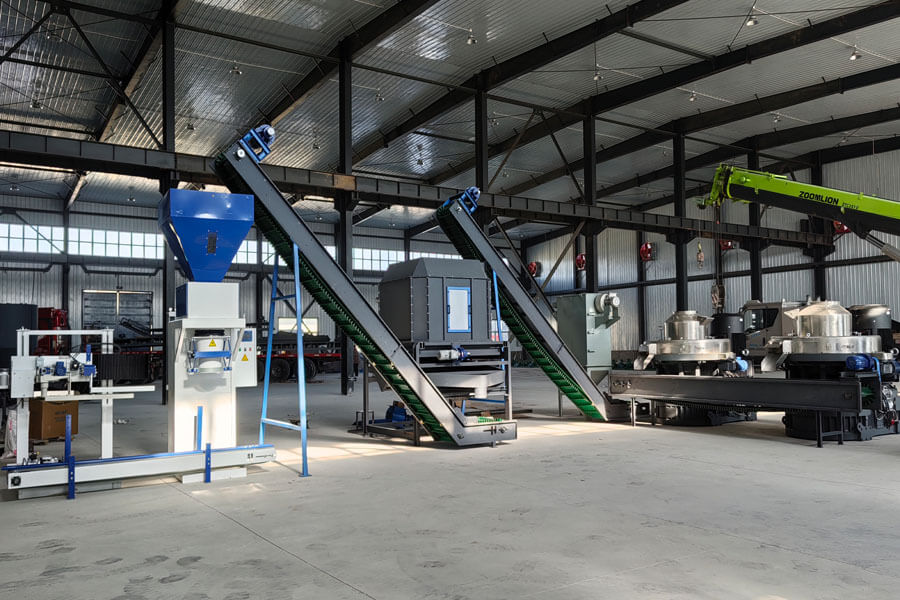
Short pellet production line, hard material
Rice husk needs fewer machines than any other material on our list and punishes the one machine that matters most. Both of those facts come from the same number: 15–20 % ash.
Rice husk comes off the mill at 8–12 % moisture and about 10 mm long, which is why a rice husk pellet production line has no chipper and no dryer. A 22 kW wood hammer mill takes it to 3 mm in one pass and that is the whole of the preparation stage. Five machines, one container, 146 kW.
What husk does have is silica. Roughly 90 % of the ash in rice husk is silica, and at 15–20 % ash that makes husk the most abrasive material we pellet. The vertical ring die pellet mill on this pellet production line is specified around that fact — a long compression ratio, a hardened die ring, and a spare die on the shelf rather than on order.
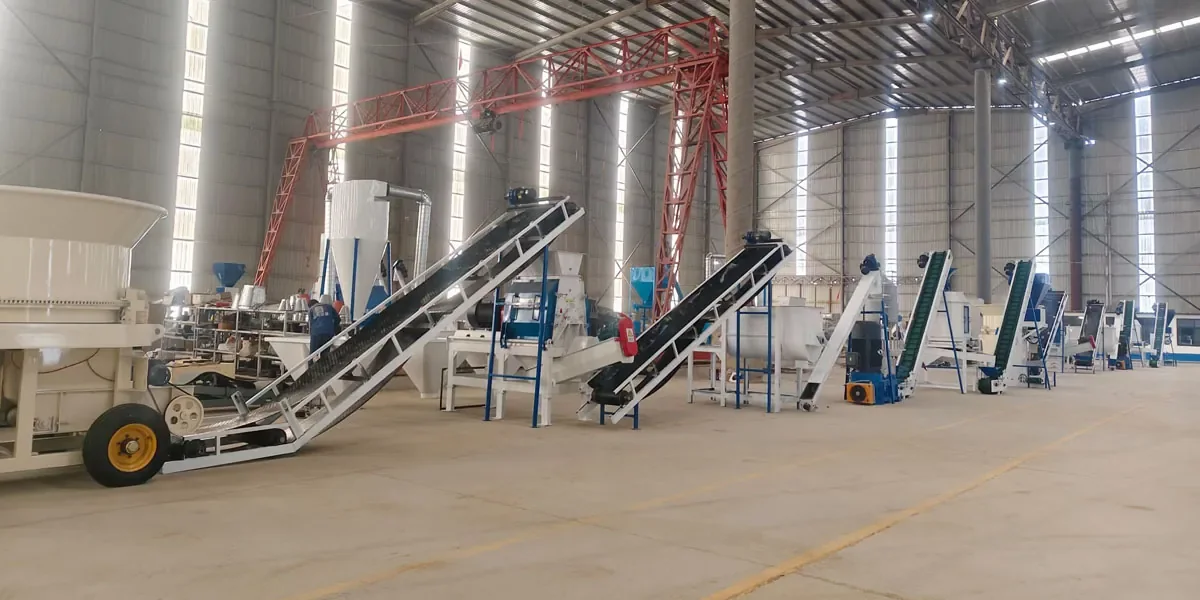
A 1.5 t/h rice husk pellet production line 146 kW installed
| Stage | Machine | Model | What it does |
|---|---|---|---|
| 01 | Wood hammer mill | FS-500, 22 kW | 10 mm husk down to 3 mm in one pass through a 3 mm screen |
| 02 | Vertical ring die pellet mill | HML-560, 90 kW | A 1:9–1:12 die and a hardened ring, for a material that is 15–20 % ash |
| 03 | Pellet cooler | NL-11 counterflow | 80 °C husk pellets down to room temperature |
| 04 | Vibrating screener | 1.5 kW | Fines and oversize out, whole pellets on to the bag |
| 05 | Pellet packing machine | BZ-50 | 25–50 kg bags with a sewing head, or 1,000 kg bulk bags |
Installed power is 146 kW across all 5 stages, on 20 × 10 m of floor at 6 m clear. Every machine in the table is also sold on its own, and the dies, rollers and screens for them are shipped as spares.
Twenty by ten metres and 146 kW is the whole pellet production line. That is a quarter of the floor a palm fibre pellet production line of the same output needs, and half the power of a straw pellet production line, because husk is dry, short and easy to grind. The money in a rice husk pellet production line is not in the machines — it is in the dies.
The usual question is whether to blend. Running 30–50 % sawdust or wood chips through a rice husk pellet production line raises the bulk density, cuts the ash figure and roughly doubles die life, at the cost of a material you have to buy. If you have sawdust available at a sensible price, blend — it is the cheapest die-life upgrade there is.


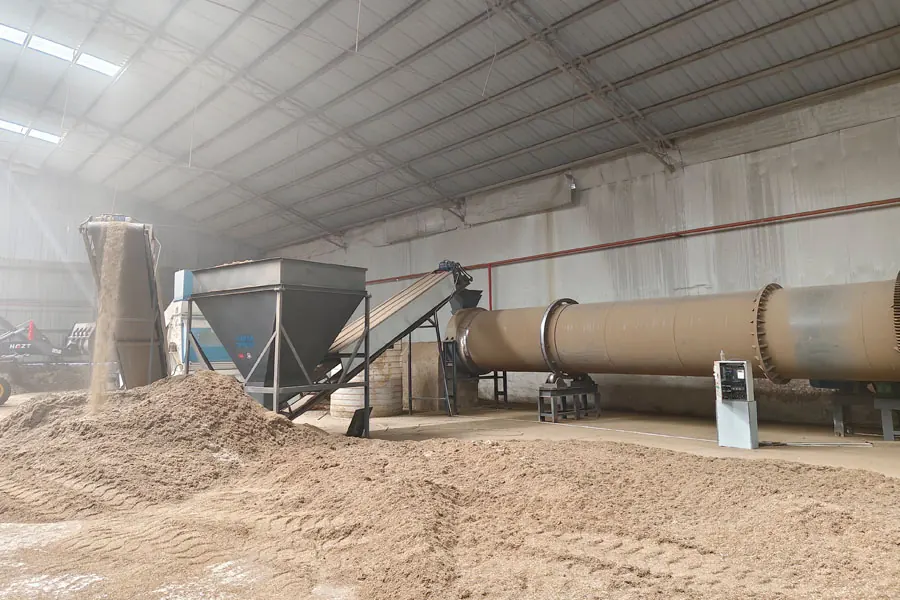
What each stage does on a 1.5 t/h rice husk pellet production line
Read them in order — the material only moves one way. Every stage links to its own product page, where the model range and the power figures are.
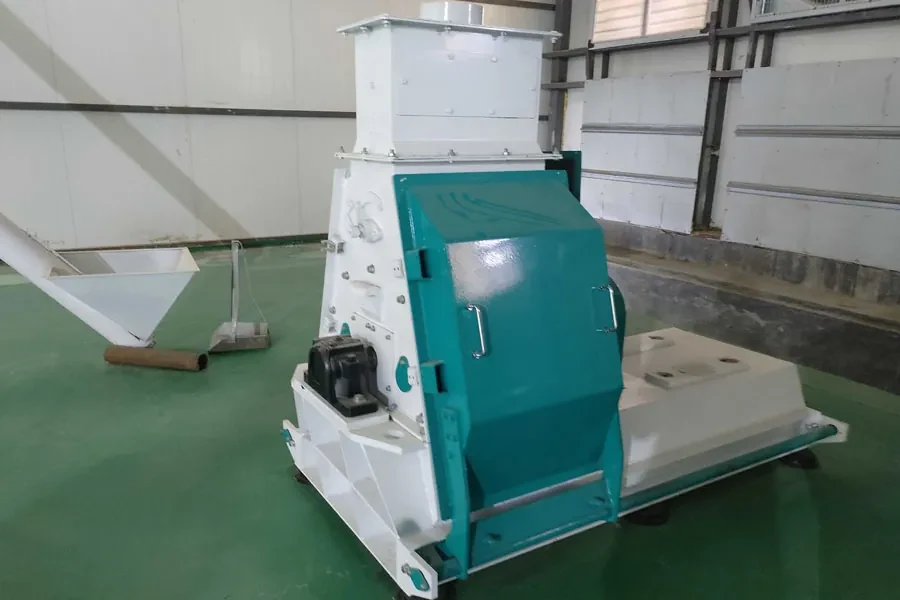
Wood hammer mill
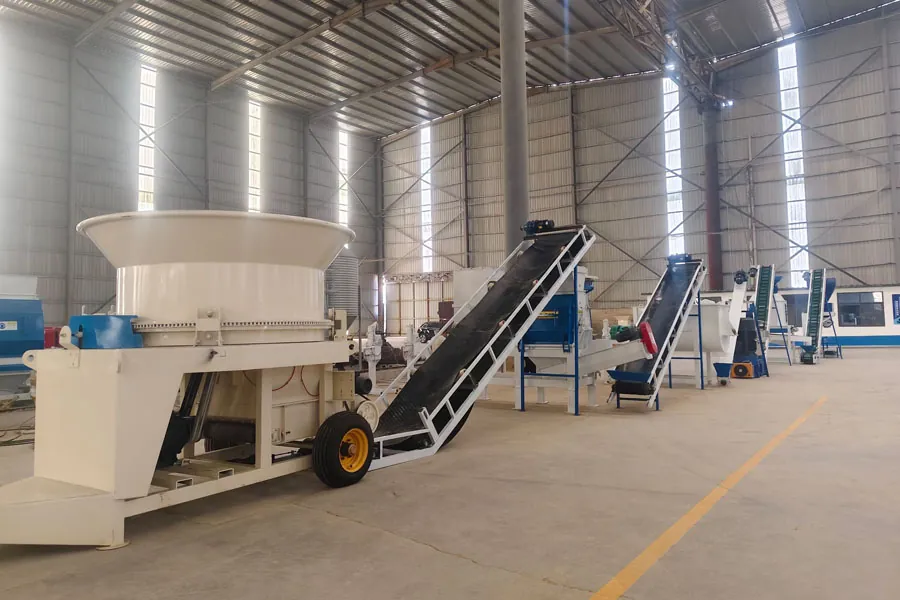
Husk is the easiest material on our list to grind — 22 kW for 1.5 t/h against 75 kW for the same output on straw. It is brittle, it is already short, and it shatters rather than bends. A 3 mm screen is what we fit, and the mill runs at about 70 % of its rating, which is where the particle size is most even.
The cyclone and bag filter above it are not optional. Husk dust is finer than sawdust dust and it is a recognised respiratory hazard — the bag house is a safety item as much as an environmental one, and it is on every rice husk pellet production line we quote.
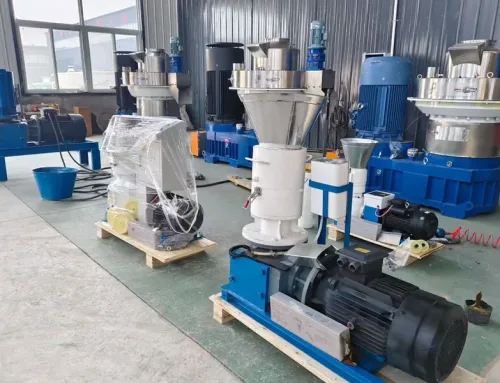
Wood hammer mill — FS series, 120 to 1,600 kg/h, 3 to 37 kW.
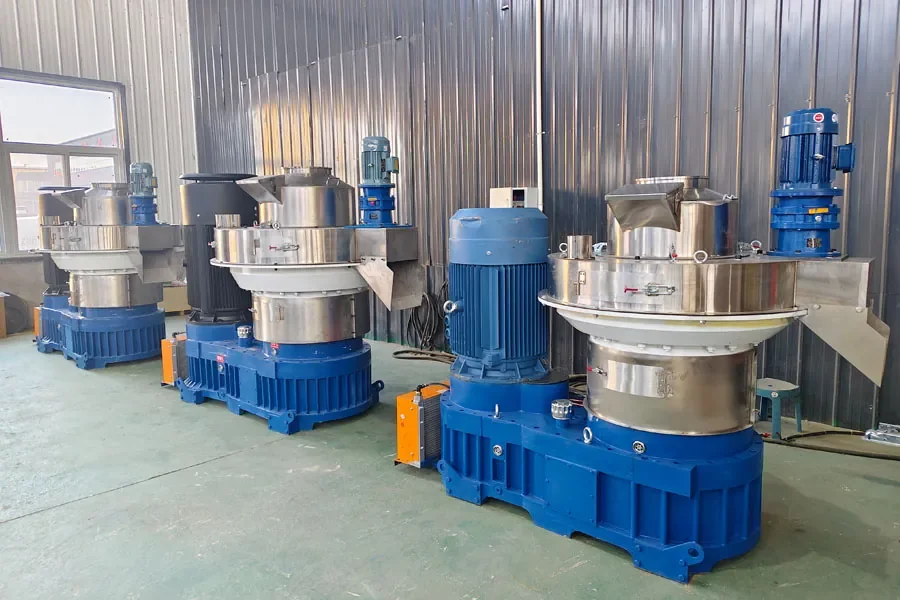
Vertical ring die pellet mill
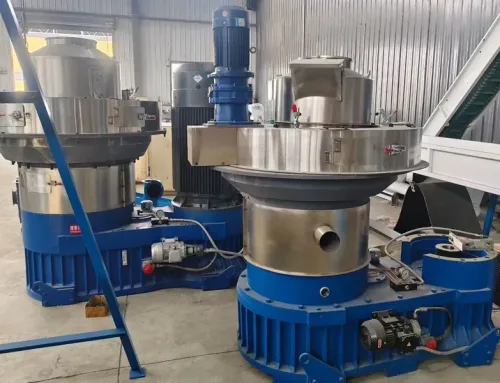
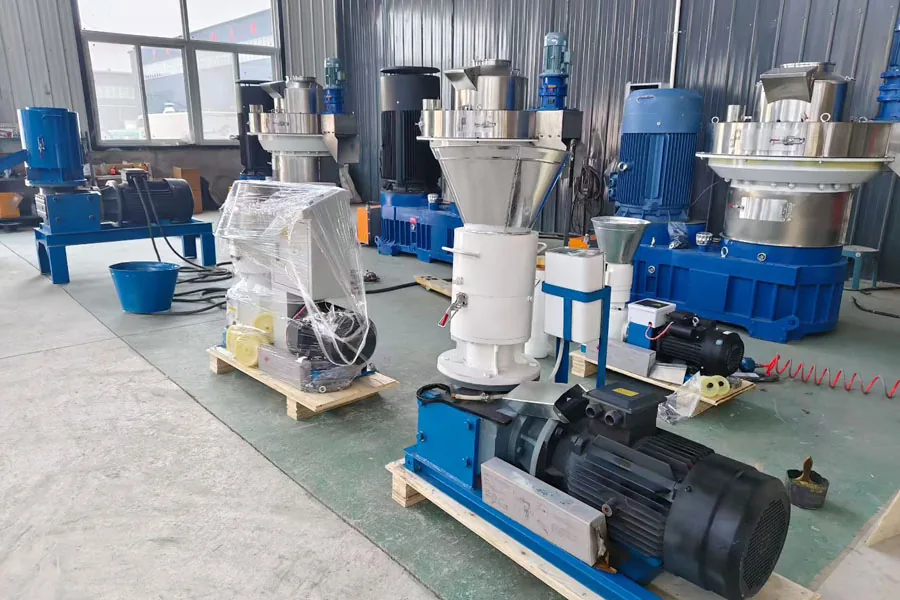
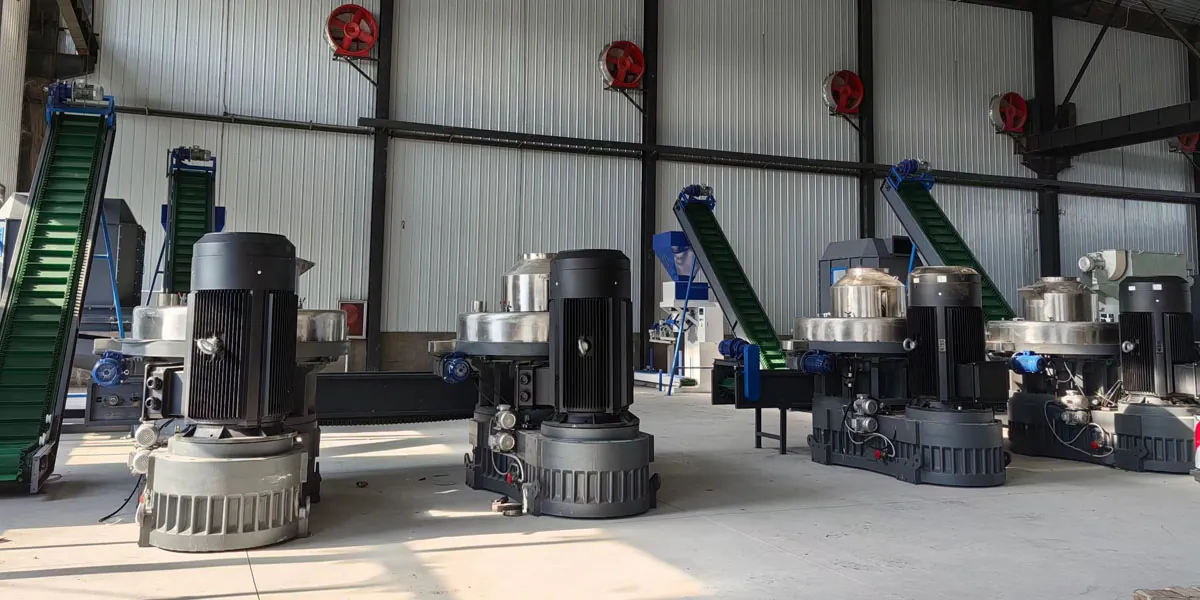
A 90 kW vertical ring die pellet mill on a 1:9 to 1:12 compression ratio — the longest die we cut for any material. Husk has low bulk density (110–150 kg/m³) and only about 20 % lignin, so the die has to hold pressure on it for a long time to get a pellet that survives the cooler.
The ring is hardened, and it is the wear part you plan for. On clean husk a die runs 150–250 hours, against 500–800 on sawdust. We quote a spare die with the pellet production line rather than leaving you to order one in month three, and the change takes an hour with two men.
Vertical ring die pellet mill — HML-560 / 600 / 700, 90 to 160 kW, 1.0 to 2.5 t/h.
Pellet cooler
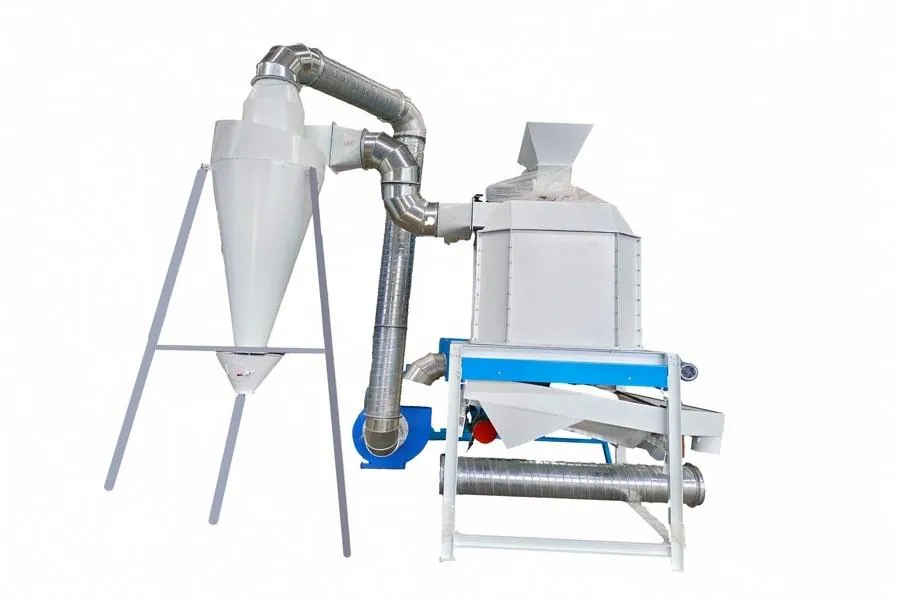
Husk pellets come out of the die hot and, because of the long die, denser than most. The counterflow pellet cooler brings them to within a few degrees of ambient over seven to nine minutes. A crossflow cooler cracks them — husk pellets are brittle — so the counterflow design is the one we specify.
Husk pellets are also dusty. Expect 4–6 % fines at the cooler outlet against 1–2 % on wood, and size the screen deck and the return conveyor for that rather than for the wood figure.
Pellet cooler — LQ-50 0–500 kg/h, LQ-70 0–1,000 kg/h, NL-11 1–2 t/h counterflow.
Vibrating screener
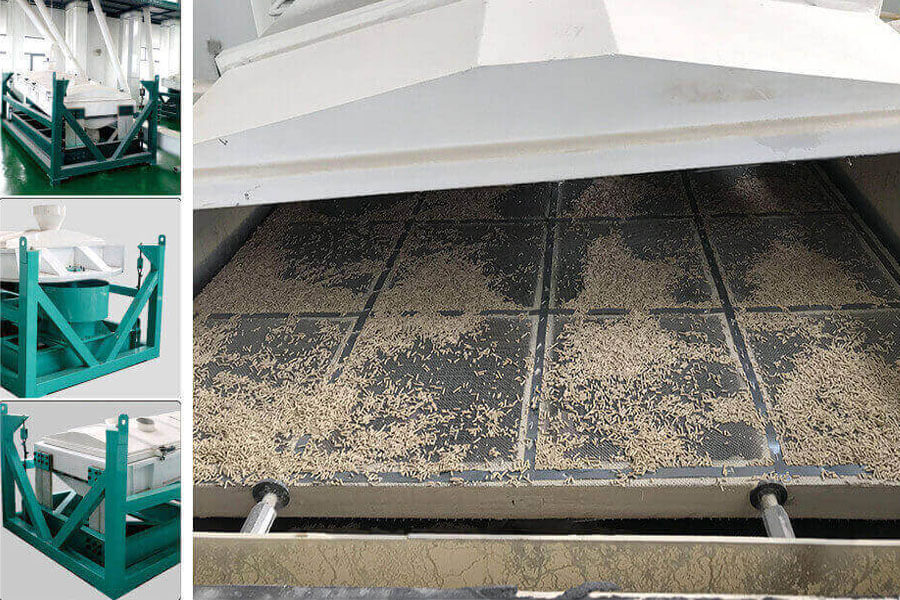
On husk the screener is a separate machine rather than a deck under the cooler, because the fines fraction is high enough that a single deck cannot keep up. A 1.5 kW vibrating screener with a 1.6 × 1.6 m deck takes out the fines and the oversize, returns the fines to the pellet mill and sends the whole pellets on to the bag.
It is also where you find out whether the die is right. A screener that is throwing back 10 % fines is telling you the compression ratio is too short for the material, and no amount of screening will fix that.
Pellet cooler and screener — the same page covers the cooler decks and the stand-alone vibrating screen, which is the one we quote on husk.
Pellet packing machine
Husk pellets are light — about 550–650 kg/m³ in the bag against 650–700 for wood — so a 50 kg bag of husk pellets is physically bigger than a 50 kg bag of wood pellets. If you are selling by volume rather than by weight, that is a marketing problem rather than an engineering one, but it is worth knowing before you print the bag.
A 1.5 kW quantitative pellet packing machine with a sewing head covers 25–50 kg at three to five bags a minute. For a plant selling into a biomass power station, a 1,000 kg bulk bag station is the better last stage and about the same money.
Pellet packing machine — 10–50 kg bags or 1,000 kg bulk bags, with weighing and sewing.
Price a 1.5 t/h rice husk pellet production line
Send the material, its moisture as received and the shed you have. We answer with a model list, a layout drawing at 1:50 and a price.
Tell us the material and the output
The material, its moisture, the pellet diameter and the kg/h you need. We come back with a model list, a die specification and a price.
Reply within one working day. No obligation.
Five steps, and one of them is a wear part
A rice husk pellet production line is the shortest we build. The material is already dry, already short and already at the mill — so the pellet production line starts at the hammer mill.
Receiving
Husk tipped into a hopper, lifted by screw conveyor into a buffer bin.
Grinding
A 22 kW hammer mill takes 10 mm husk to 3 mm through a 3 mm screen.
Pressing
A 90 kW vertical ring die pellet mill on a 1:9–1:12 hardened die at 1.5 t/h.
Cooling
Counterflow air to ambient over seven to nine minutes; 4–6 % fines screened out.
Bagging
25–50 kg sacks with a sewing head, or 1,000 kg bulk bags for a power station.
The moisture question barely arises on husk. At 8–12 % the material is already inside the window the die wants, and the only thing that moves it is storage. Husk stored in the open through a wet season comes in above 15 % and then a dryer earns its place — which is why we quote the dryer as an option rather than crossing it off.
The power split is the mirror image of straw. On a rice husk pellet production line the hammer mill is 22 kW and the pellet mill is 90 kW — 60 % of the electricity goes into the die. On straw it is the other way round. That is the single clearest sign of how differently two builds on the same stages can be specified.
Die life is the whole running cost. At 150–250 hours a die on clean husk, a 1.5 t/h pellet production line running two shifts changes a die every three to five weeks. That is why we quote a spare die with the pellet production line, why the ring is hardened, and why blending 30 % sawdust is worth considering if the sawdust is available.
The longest compression ratio we cut
Husk is where the die specification matters more than the pellet mill model. The same 90 kW frame runs 1.5 t/h on wood and 1.2 t/h on husk, and the difference is entirely in the ring.
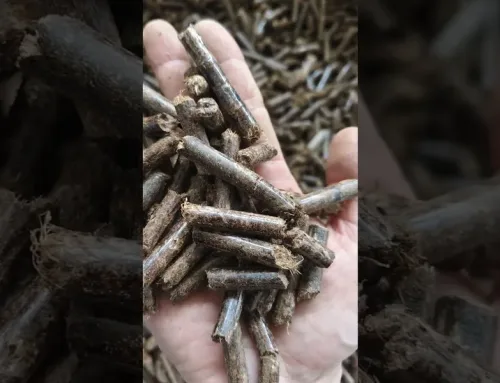
A compression ratio is the length of the hole through the die divided by its diameter. Wood binds at 1:5–1:7 because it carries 25–30 % lignin. Husk carries about 20 % and is far lighter, so the material has to be held under pressure for much longer before the lignin sets — 1:9 to 1:12. Push husk through a wood die and it comes out as a fragile shell that breaks in the cooler.
The cost of that long ratio is power and wear. A longer hole means more friction, so the same motor makes fewer kilos per hour, and more friction on a material that is 15–20 % silica means the ring wears out faster. Both of those are accepted on a rice husk pellet production line because the alternative is no pellet at all.
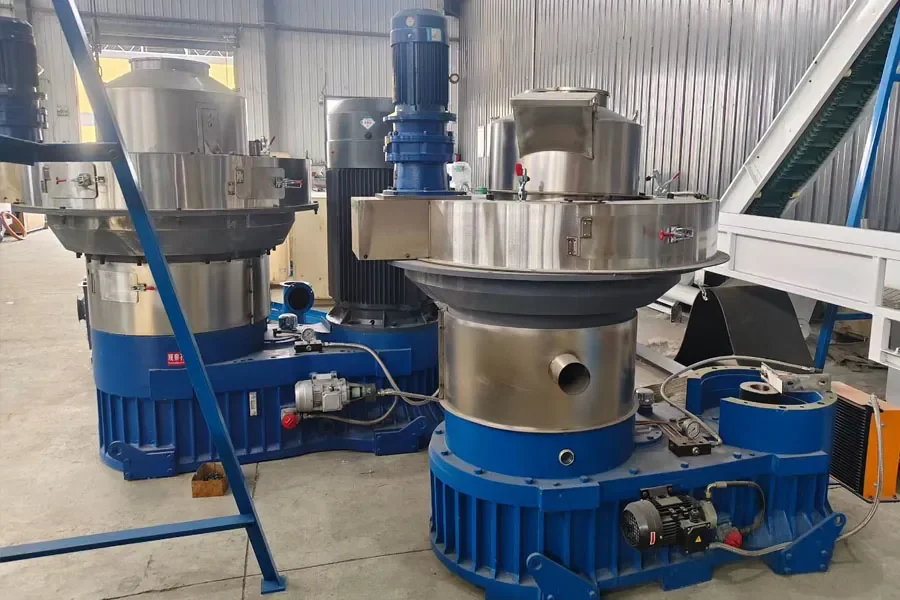
Pellet mills for a rice husk pellet production line
| Model | Power | Capacity | Where it fits |
|---|---|---|---|
| HML-560 | 90 kW | 1.2–1.5 t/h on husk | The standard build for a 1.5 t/h rice husk pellet production line |
| HML-560 | 90 kW | 1.0–1.5 t/h on wood | Same frame, 1:5–1:7 die — the ratio is the whole difference |
| HML-600 | 132 kW | 1.8–2.2 t/h on husk | Two of them for a 3–4 t/h husk plant |
| HML-700 | 160 kW | 2.2–3.0 t/h on husk | The largest single husk pellet mill we build |
Capacity is quoted on clean rice husk at 8–12 % moisture with a 1:9–1:12 hardened die. A blend of 30 % sawdust raises the figure by about 15 % and roughly doubles die life.
A flat die pellet mill will make husk pellets, and below about 600 kg/h it is the cheaper machine. What it will not do is survive the wear: a flat die is a plate, and on a material this abrasive the cost per tonne of pellets is two to three times what a re-cuttable ring die costs. Above 600 kg/h we quote the ring die.
The other option is to blend. Thirty to fifty per cent sawdust or wood chips through the same pellet production line lifts the bulk density from 110–150 kg/m³ to 250–300, cuts the ash figure from 15–20 % to 8–12 % and roughly doubles die life. The pellet is also better for a domestic stove. If you can buy sawdust at a sensible price, blend.

What rice husk decides, before any machine is chosen
Two numbers drive everything on a rice husk pellet production line: 110–150 kg/m³ bulk density, which makes it light, and 15–20 % ash, which makes it abrasive.
| Item | Figure | Why it matters |
|---|---|---|
| Moisture as received | 8–12 % | Already inside the die window. This is why there is no dryer |
| Moisture into the die | 12–15 % | Some plants add 1–2 % water; dry husk pellets poorly |
| Bulk density, loose | 110–150 kg/m³ | The lightest material on our list — 40 % lighter than sawdust |
| Particle size after the hammer mill | 3 mm | One pass through a 3 mm screen; husk shatters easily |
| Die compression ratio | 1 : 9 to 1 : 12 | The longest we cut. Low lignin, low density, high silica |
| Die life | 150–250 hours | Against 500–800 on sawdust. The running cost that decides the business |
| Ash in the finished pellet | 15–20 % | About 90 % of that ash is silica, which is what wears the die |
| Pellet diameter | 6 or 8 mm | 8 mm is usual — husk pellets are light and a bigger pellet handles better |
The ash figure is the one that decides where husk pellets can be sold. At 15–20 % ash they fail every domestic stove standard in Europe and they are sold instead to biomass power stations, cement kilns and industrial boilers that are built for high-ash fuel. That is a different market with a different price, and it is worth understanding before the pellet production line is ordered.
The bulk density figure explains the layout. At 110–150 kg/m³ loose, a tonne of husk takes seven to nine cubic metres, so the buffer bin above the pellet mill is large and the screw conveyors run full. It also means the bag is light: a 50 kg bag of husk pellets is physically bigger than a 50 kg bag of wood pellets, which matters if you sell by volume.
What the site has to provide
A 1.5 t/h rice husk pellet production line is 146 kW of motors on 20 × 10 m of floor, under a roof 6 m high.
| Item | Figure | Note |
|---|---|---|
| Installed power | 146 kW | All five stages, motors only |
| Largest single motor | 90 kW on the pellet mill | The figure that sizes the transformer |
| Electrical supply | 200 kVA, 380 V / 50 Hz, four-wire | Size on the largest motor, not the total |
| Footprint | 20 × 10 m, 200 m² | Arranged in a straight line, husk store excluded |
| Building height | 6 m clear | Under the hook, at the buffer bin over the pellet mill |
| Operators | 2 per shift | One on the pellet mill, one on the bagging end |
| Water | Not required | The pellet cooler is air cooled |
| Compressed air | 0.6 m³/min at 7 bar | Bag clamp and weigh gate |
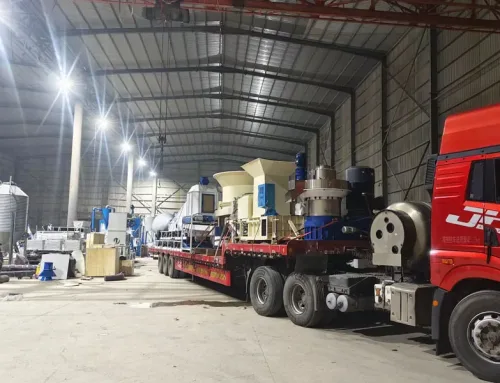
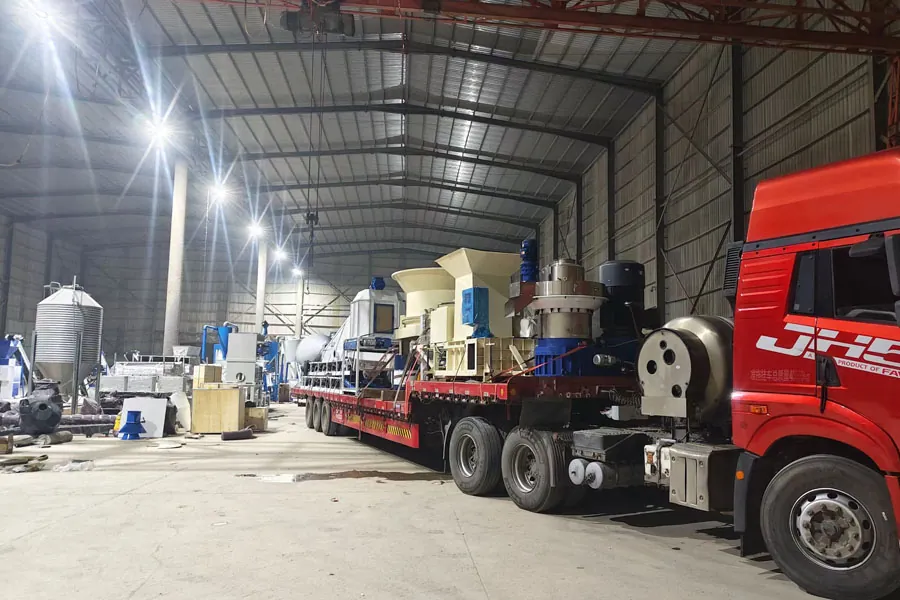
| Containers | 1 × 40HQ | The whole pellet production line ships in one container |
The supply is sized on the 90 kW pellet mill motor. The hammer mill is 22 kW and starts unloaded, so the total connected load of 146 kW does not translate into a 146 kW supply requirement — a 200 kVA transformer covers the pellet production line with margin.
Husk storage needs more thought than the pellet production line does. At 110–150 kg/m³ a 1.5 t/h pellet production line running two shifts consumes 24 t a day, which is 160–220 m³ of loose husk. Under cover, because wet husk is the one thing that puts a dryer back on the quotation, and away from the hammer mill because husk dust is explosive in the right concentration.
Dust is the site safety item on a rice husk pellet production line, more than on any other material we handle. The bag filter on the hammer mill cyclone, the ducting on the pellet mill and the extraction at the bagging head are all specified with the layout drawing, and none of them should be value-engineered out.
What ships, and what the site has to build
A rice husk pellet production line is quoted as a set. This is what is inside the price.
-
All five stages
Wood hammer mill, vertical ring die pellet mill, counterflow pellet cooler, vibrating screener and pellet packing machine — with motors, starters and guards.
-
Conveyors and ducting
Screw conveyors with magnetic separators, the buffer bin, belts between the stages and the ducting from the hammer mill cyclone.
-
Control cabinet
One panel for the pellet production line, with the interlock that stops the feed when the pellet mill stops and the extraction that runs on after shutdown.
-
Dies and rollers
One hardened 1:9–1:12 die at your pellet diameter, a spare die, and a spare roller set.
-
Layout drawing
1:50 plan and elevation, with the foundation blocks and the cable runs marked.
-
Commissioning
One engineer on site for the first run, at our cost, for a pellet production line of this size.
Not included, and quoted separately if you want them: a dryer, if your husk has been stored wet; the husk store; the civil works; and the transformer. Delivery is 20–25 working days from deposit, FOB Qingdao, in a single 40HQ container. Spare parts are on the shelf at spare parts.
Watch a rice husk pellet production line run
Four clips: a rice husk pellet production line end to end, the same build at 3–4 t/h, and the pellet mill on its own.
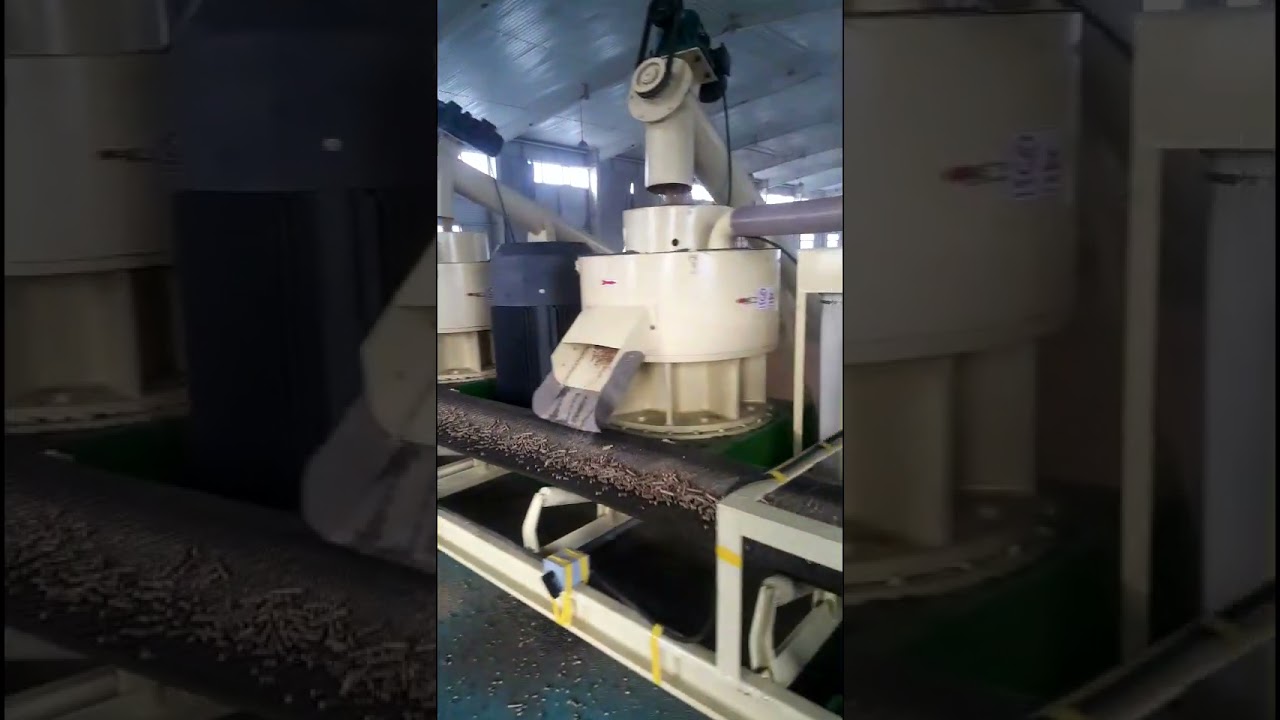
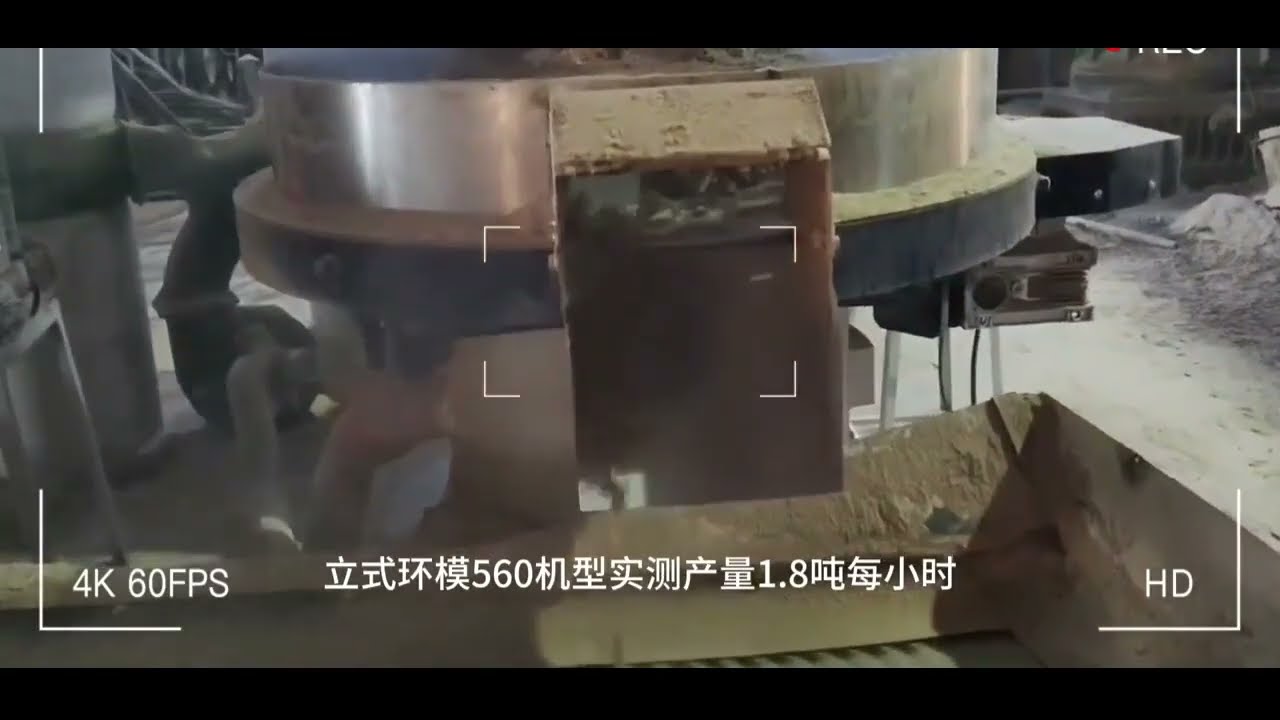
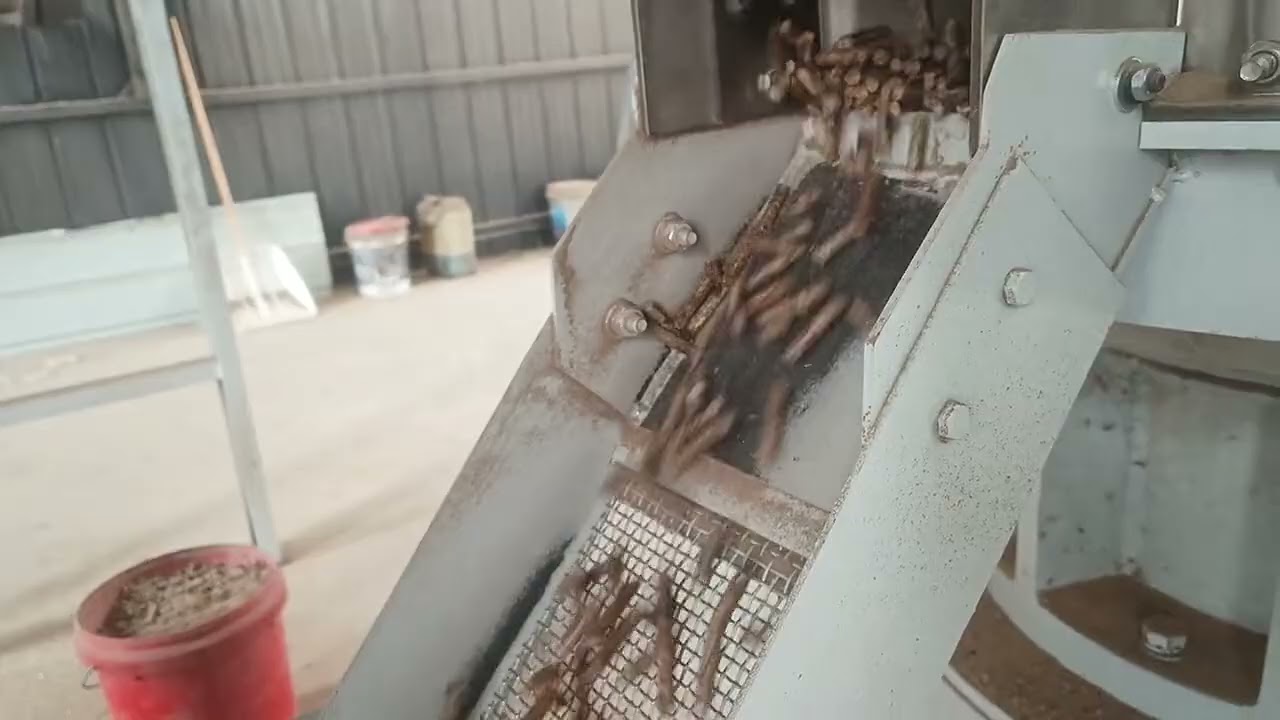

More on the PelletHills channel — the biomass playlist is where the pellet production line and pellet machine clips go up first.
What buyers ask before ordering a 1.5 t/h rice husk pellet production line
11 questions we answer on the phone most weeks.
What does a 1.5 t/h rice husk pellet production line include?
Five stages: a wood hammer mill (22 kW), a vertical ring die pellet mill with a hardened 1:9–1:12 die (HML-560, 90 kW), a counterflow pellet cooler (NL-11), a vibrating screener and a 25–50 kg pellet packing machine. Installed power is 146 kW and the footprint is 20 × 10 m. There is no chipper and no dryer.
Why is there no dryer on a rice husk pellet production line?
Because rice husk comes off the mill at 8–12 % moisture, which is already inside the window the die wants. A dryer would only drive out moisture the material needs. The exception is husk stored in the open through a wet season — that comes in above 15 % and a dryer earns its place.
Why does husk need a longer compression ratio than wood?
Because it has less lignin (about 20 % against 25–30 % for wood) and much lower bulk density (110–150 kg/m³). The die has to hold pressure on the material for longer before the lignin sets, so we cut 1:9 to 1:12 against 1:5–1:7 for sawdust. A wood die on husk gives a fragile shell that breaks in the cooler.
How long does a die last on rice husk?
150–250 hours on clean husk, against 500–800 on sawdust. About 90 % of the 15–20 % ash in husk is silica, and silica is what polishes a die out. That is why the ring is hardened, why we quote a spare die with the pellet production line, and why the change is designed to take an hour.
Can I blend husk with sawdust?
Yes, and it is worth doing if sawdust is available at a sensible price. Thirty to fifty per cent sawdust lifts bulk density from 110–150 kg/m³ to 250–300, cuts ash from 15–20 % to 8–12 % and roughly doubles die life. The pellet is also better for a domestic stove. Tell us the blend and we cut the die for it.
Where do husk pellets get sold?
Biomass power stations, cement kilns and industrial boilers built for high-ash fuel. At 15–20 % ash they fail every domestic stove standard in Europe, so the market is industrial rather than retail. That is a different price and a different contract from wood pellets, and it is worth knowing before the pellet production line is ordered.
What is the smallest rice husk pellet production line you build?
The same five stages with a 55 kW ring die pellet mill at 800–1,000 kg/h, shipped in a 20 ft container. Below that, a combined pellet mill and hammer mill will make 100–350 kg/h from husk with no cooler and no bagging scale.
Do I need a binder?
No. Husk binds on its own lignin given a long enough die, which is what the 1:9–1:12 ratio is for. Some plants add 1–2 % water at the die inlet, and a few add 1 % starch when running very dry husk. Neither is standard on our builds.
How much husk does it consume?
About 1.05 t of husk for every 1 t of pellets, so 24 t a day on two shifts at 1.5 t/h — 160–220 m³ of loose husk. That has to be under cover and away from the hammer mill, because husk dust is explosive in the right concentration.
How long does installation take, and what is the delivery time?
Six to eight days on site with our engineer present, plus the civils — the shortest install of any pellet production line we build, because there are only five machines. Delivery is 20–25 working days from deposit, FOB Qingdao.
Can the pellet production line run on something other than rice husk?
Yes — sawdust, straw, palm fibre, bagasse and coffee husk all run on the same five stages with a different die and screen. Husk is the hardest of them on the die and the easiest to grind. Tell us the material and we cut the die for it.
Request a quotation for a 1.5 t/h rice husk pellet production line
Tell us the material, its moisture, the pellet diameter and the shed you have. We reply with a model list, a layout drawing and a price.
What happens after you send this
We answer with the model list, the die compression ratio and a price, then send a test-run video on your material before you pay a deposit.
Your details are not shared. One follow-up, no mailing list.