Sawdust Dryer Selection: Flash Pipe or Rotary Drumtwo filters, and the one tonne an hour between them
A sawdust dryer is chosen by two filters and neither of them is the price. The first is what the material looks like when it arrives — powder goes up a flash pipe sawdust dryer and chips do not — and the second is how much water an hour has to leave. Between them they pick the family, and the family picks the model. This page runs both filters over twelve material forms and eight models, from a HG-Q260 at 200 kg/h to an HG-G 1800 at 2.5 t/h.
- Flash pipe sawdust dryer at 200–600 kg/h, rotary drum sawdust dryer at 500–2,500 kg/h
- 1–3 seconds in the air stream against 8–25 minutes in the drum
- Powder below 5 mm, chips to 20–30 mm — that is the first filter
- Sized in kilograms of water an hour, not in t of pellets an hour
Two families, eight sizes · 200 kg/h to 2,500 kg/h · Furnace, fan, cyclone and airlock sized together
The short answer
Form of the material first, kilograms of water second. Everything else — furnace, fuel, floor space — follows from those two.
Two filters, in this order. First the form of the material: a flash pipe sawdust dryer carries powder and particles up to about 5 mm in a hot air stream for one to three seconds, and anything coarser drops out of the riser and blocks it. A rotary drum sawdust dryer tumbles chips and shavings of 20–30 mm through a drum for 8–25 minutes and takes the wetter material as well. Second the water: a sawdust dryer is sized in kilograms of water an hour, and the same drum rated at 1,000 kg of water an hour makes 1.2 t of pellets from 50 % material and 3.2 t from 30 %. Everything else follows from those two figures. In our range that is the HG-Q260 to HG-Q350 at 200–600 kg/h and the HG-G 650 to HG-G 1800 at 500–2,500 kg/h, and the honest dividing line between the two families is about one tonne an hour of dry material.
Capacity on this page is dried material leaving the sawdust dryer, at the moisture stated for each family — 25–30 % in and 10–15 % out on a flash pipe sawdust dryer, 30–40 % in and 10–12 % out on a drum. The water column is the arithmetic in between: at 30 % in and 12 % out, 257 kg of water leaves for every tonne that stays. Fuel figures for the flash pipe models are firewood at about 4,000 kcal/kg; gas and diesel change the running cost and not the air volume.
Twelve material forms, and which of the two families takes each one
Down the side is what arrives at the sawdust dryer — the material and the size it is in, not its name. Across is the two families, and whether each one takes it.
| Material and form | What arrives | Flash pipe sawdust dryer | Rotary drum sawdust dryer |
|---|---|---|---|
| Sawdust from a saw 0–5 mm |
25–45 % moisture | First choice 200–600 kg/h |
Works, and is oversized for the job |
| Sawdust from a chipper and a wood hammer mill |
30–50 % moisture | Works to 600 kg/h | First choice above 1 t/h |
| Wood shavings 5–20 mm |
15–30 % moisture | Only after regrinding below 5 mm | Takes it as it is |
| Wood chips 10–30 mm |
35–50 % moisture | No — a chip will not stay airborne | First choice |
| Bark 20–50 mm, stringy |
40–60 % moisture | No — the fibre wraps the riser | Works after a wood crusher |
| Rice husk 0–3 mm |
8–12 % moisture | Usually no drying needed | Usually no drying needed |
| Wood powder 100–200 mesh |
5–10 % moisture | The material it was designed for | Too fine — it blows straight through |
| Palm fibre (EFB) long fibre |
55–65 % moisture | No — the fibre bridges the riser | Works after a wood crusher |
| Bagasse fibrous, 5–20 mm |
45–55 % moisture | No | Works |
| Corn cob 5–15 mm |
15–20 % moisture | Marginal — regrind first | Works |
| Straw, chopped 10–50 mm |
12–18 % moisture | No | Works, at a lower capacity |
| Grass and alfalfa 5–20 mm |
60–70 % as cut | No | Works, with a bigger furnace |
The right-hand column is not a sales answer. A rotary drum sawdust dryer takes every material a flash pipe sawdust dryer takes, and takes the coarse ones as well — it is simply the more expensive answer at 300 kg/h, which is the whole reason the flash pipe family exists. The moisture each material arrives at, and the water per tonne it implies, is on the moisture page; the pellet mill that follows the sawdust dryer is on the buying guide.
Four columns of sentences will not fit a phone. Swipe the table sideways for the two sawdust dryer columns, which are the ones that change the answer.
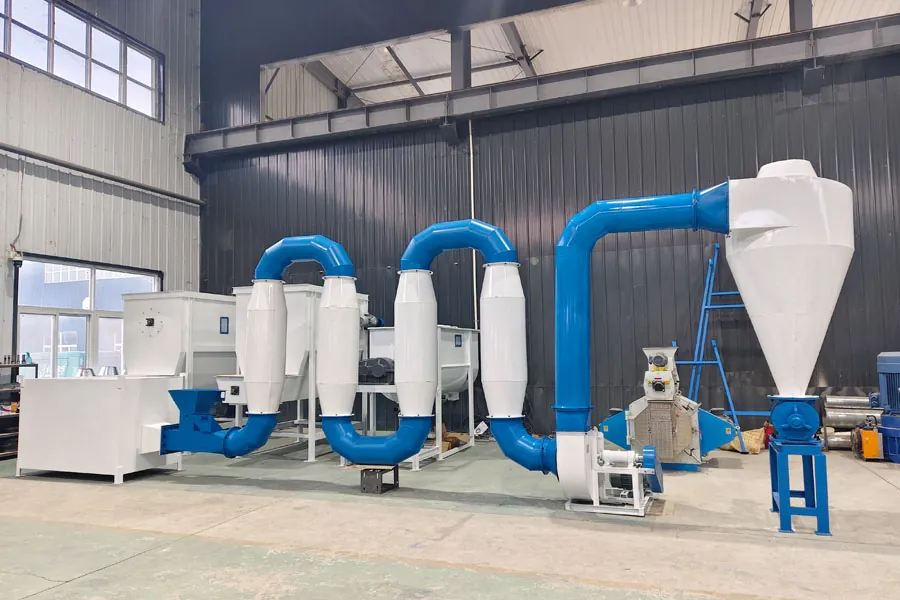
The flash pipe sawdust dryer is the type to look at when the material is already powder. Sawdust off a saw, dust from a sander, rice husk, wood powder — all of it goes up a 260 to 350 mm riser in an air stream, gives up its water in one to three seconds and lands in a cyclone. There is no drum to wear, no lifters to rebuild and no foundation: the HG-Q260 stands on 9 × 2.5 m of flat floor. What it will not do is take a chip, and the failure is not gradual — a 20 mm chip falls out of the air stream at the first bend and the riser plugs within a minute.
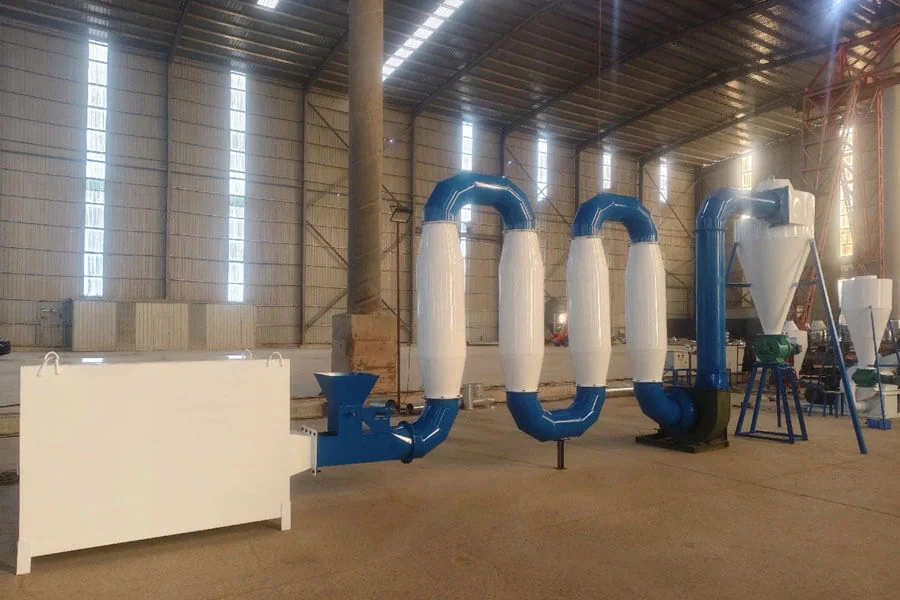
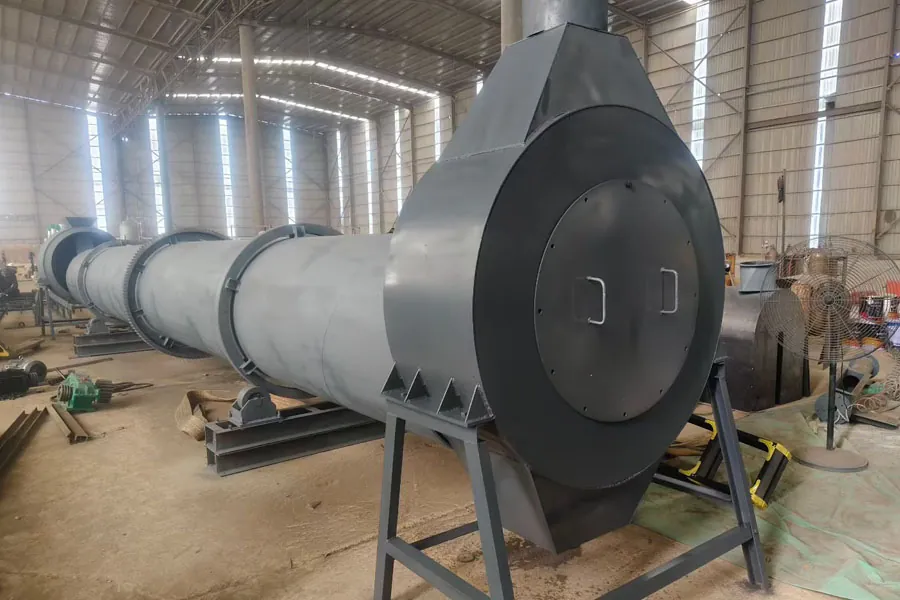
The rotary drum sawdust dryer is the type to look at for anything that has to be broken down first, and for everything above a tonne an hour. Chips, shavings, bark, palm fibre and bagasse all go through it, because the drum does not need the material to stay airborne — lifters pick it up and drop it through the hot gas, and a 30 mm chip simply takes longer. That is also why the drum is the wetter machine: 30–50 % in against 25–30 %, and it rides over a wet patch that would stall a flash pipe sawdust dryer. The price of that is 12–20 m of floor, a concrete foundation and roughly twice the capital.
The two families, dimension by dimension
The residence time row is the one that decides the rest. Everything below it is a consequence of how long the material spends in the hot gas.
| Dimension | Flash pipe sawdust dryer | Rotary drum sawdust dryer |
|---|---|---|
| How it dries | Material is carried up a riser in a hot air stream and gives up its water to the air | Material is lifted and dropped through hot gas inside a turning drum |
| Residence time | 1–3 seconds | 8–25 minutes |
| Capacity | 200–600 kg/h | 500–2,500 kg/h |
| Moisture in | 25–30 %, and up to 40 % with the furnace sized for it | 30–50 %, and it rides over a wet patch |
| Moisture out | 10–15 %, set by feed rate and air temperature | 8–12 %, set by gas temperature and retention time |
| Particle size | Powder and particles to about 5 mm | Chips and shavings to 20–30 mm |
| Floor space | 9 × 2.5 m on the HG-Q260, 18 × 3 m on the HG-Q350 | 12–20 m long, on a concrete foundation |
| Headroom | 3 m on the HG-Q260, 3.2 m on the HG-Q300 and HG-Q350 | 3.5–4 m, plus the feed conveyor above the inlet |
| Motors | 4–11 kW main, 1.1–1.5 kW airlock | 15–48 kW over three motors — drum, fan, airlock |
| What goes wrong | A wet patch plugs the riser; the airlock wears on abrasive material | The shell warps if the furnace runs hot; the lifters need rebuilding |
| Models | HG-Q260, HG-Q300, HG-Q350 | HG-G 650, HG-G 1000, HG-G 1200, HG-G 1500, HG-G 1800 |
One to three seconds in an air stream is enough to take a film of water off a 1 mm particle and nowhere near enough to take 25 points out of a 20 mm chip, because the water has to travel from the middle of the chip to its surface before the air can take it. That is the physics behind the 5 mm limit, and it is why the two families are not interchangeable at any price. The furnace and the airlock are on the biomass sawdust dryer page with the full dimension sheet.
Three columns will not fit a phone. Swipe the table sideways for the rotary drum column.
The flash pipe sawdust dryer is a cheap machine doing a narrow job, and it is worth saying that plainly. One furnace, one fan, one airlock, four risers — the HG-Q260 is 1.7 t of equipment on 9 m of floor and it dries 200–250 kg/h. There are no moving parts in the drying path at all, which is why it lasts: the wear parts are the airlock vanes and the fan impeller, and neither sits in the hot gas.
The rotary drum sawdust dryer is a kiln with a fan on the end. Three motors — the drum drive through a gearbox on the tyre ring, the induced-draught fan and the airlock — and a shell built to take 300 °C without warping. Above HG-G 1000 the shell ships in two sections and is assembled on your foundation, which is a site job rather than a delivery. It costs about twice what the flash pipe sawdust dryer costs at the same output and it burns less fuel a tonne, so the crossover is decided by your fuel price and your hours, not by the invoice.
What each size takes out of the material
Kilograms of water an hour at 30 % in and 12 % out, which is the figure a sawdust dryer is actually sized on. The last two columns are what the sizing costs you to run.
| Model | Dry output | Water removed 30 % in, 12 % out |
Firewood | Motor |
|---|---|---|---|---|
| HG-Q260 | 200–250 kg/h | 51–64 kg/h | 40–50 kg/h | 4 + 1.1 kW |
| HG-Q300 | 400–500 kg/h | 103–129 kg/h | 60–80 kg/h | 7.5 + 1.1 kW |
| HG-Q350 | 500–600 kg/h | 129–154 kg/h | 80–100 kg/h | 11 + 1.5 kW |
| HG-G 650 | 500–800 kg/h | 129–206 kg/h | Quoted with the furnace | 7.5 + 7.5 + 1.5 kW |
| HG-G 1000 | 800–1,200 kg/h | 206–309 kg/h | Quoted with the furnace | 7.5 + 7.5 + 1.5 kW |
| HG-G 1200 | 1,300–1,500 kg/h | 334–386 kg/h | Quoted with the furnace | 7.5 + 15 + 1.5 kW |
| HG-G 1500 | 1,500–2,000 kg/h | 386–514 kg/h | Sized by an engineer | 11 + 22 + 1.5 kW |
| HG-G 1800 | 2,000–2,500 kg/h | 514–643 kg/h | Sized by an engineer | 11 + 37 + 2.2 kW |
The water column is the one to take to a supplier, because it is the only figure that compares two quotations honestly. Ask what the sawdust dryer evaporates an hour and at what moisture in — a sawdust dryer rated at 1,000 kg of water an hour makes 1.2 t of pellets from 50 % material and 3.2 t from 30 %, and both are called 1 t/h on the quotation. The arithmetic is t in = (100 − 12) ÷ (100 − moisture as received), and the moisture page has it from 15 % to 60 %.
Five columns will not fit a phone. Swipe sideways for the water and fuel figures.
Two of these rows are the same machine with a different furnace, and it is worth knowing which. The HG-Q260, HG-Q300 and HG-Q350 differ in riser diameter — 260, 300 and 350 mm — and the riser sets the air volume, so the capacity ladder is fixed by the pipe and not by the burner. Putting a bigger furnace on an HG-Q260 gives you hotter gas and a drier product; it does not give you more capacity, and it is the most common misunderstanding about a flash pipe sawdust dryer.
The drum range works the other way round: the shell diameter sets the residence time and the furnace is sized to the water you have to take out. That is why the fuel column says quoted with the furnace from HG-G 650 upwards — two buyers ordering the same drum with 30 % and 45 % material are ordering two different furnaces, and the second one is what decides whether the outlet reaches 12 %.
Your material form, your moisture, and the water an hour
Four fields. The form decides the family, the two moisture figures decide the water, and the water decides the model — which is the same order as the rest of this page.
At 500 kg/h of dry material from 35 % down to 12 % there is 177 kg of water an hour to take out. The HG-Q300 is rated 400–500 kg/h and burns about 80 kg of firewood an hour, which is 160 kg a tonne of dry output.
The water figure is c × (in − out) ÷ (100 − in), which is the same arithmetic as the moisture page read the other way round: 500 kg/h out at 35 % in and 12 % out means 677 kg/h of material in. The firewood figure is 0.16 kg per kg of dry output at 4,000 kcal/kg, which is the middle of the 40–100 kg/h range the three flash pipe models are quoted at. A rotary drum sawdust dryer has no comparable figure because its furnace is sized on the water, not on the model.
The form field is the one that overrules the others. Ask for 400 kg/h of shavings and the tool will not give you an HG-Q300, even though 400 kg/h is inside the flash pipe range, because a 20 mm shaving will not go up a 300 mm riser. That is the first filter doing its work, and it is the filter buyers skip when they compare on capacity alone.
The water figure is what you send to a supplier. A sawdust dryer quoted at 500 kg/h could be evaporating 129 kg of water an hour or 206, depending on which family and which moisture it was sized for — a factor of 1.6 between two quotations that look identical on the first line.
Choosing one, in the order it has to happen
Two of these are measurements you can take this week, one is arithmetic and the last one is a decision about fuel.
Measure the moisture in an oven
Sawdust off a saw reads 8 % on a pin meter and 40 % in an oven, because a pin meter measures the surface of the particle and sawdust has almost no thickness. 200 g in an oven at 105 °C for three hours, weighed before and after, is the only figure worth sizing a sawdust dryer on.
Write down the form, not the name
"Sawdust" covers 0.5 mm dust and 30 mm chips. A photograph of the pile next to a ruler settles the family in one look: below 5 mm is flash pipe territory, above 5 mm is drum territory, and no amount of furnace changes that.
Turn the output into water
The pellet mill needs 500 kg/h at 12 % and the material arrives at 35 %. That is 177 kg of water an hour, and it is the number the sawdust dryer is sized on. Two suppliers quoting 500 kg/h may be quoting machines that differ by a factor of two, and the water figure is how you find out.
Then the furnace and the fuel
What you can burn decides the running cost: your own dust and offcuts, bought firewood, gas or diesel. A flash pipe sawdust dryer on firewood at 4,000 kcal/kg burns 150–250 kg a tonne of dry output; the same tonne on diesel is three to four times the money and a different furnace.
The first two steps are free and they are the ones buyers skip. A sawdust dryer ordered on a material name and a capacity figure is a sawdust dryer whose furnace, riser and airlock were sized on a guess, and the failure shows up as a plugged riser on a wet Monday or an outlet at 18 % that will not pellet.
The fourth step is where the running cost lives and where the two families separate again. A flash pipe sawdust dryer is direct-fired and burns 150–250 kg of firewood per tonne of dry output; a rotary drum sawdust dryer at the same output burns less per tonne because the gas stays in contact with the material for minutes rather than seconds. If you own the dust and the offcuts the first is cheap to run; if you buy fuel by the tonne the second usually wins over a year.
Three ways people actually dry, and what each one commits to
Almost every sawdust dryer on this page is one of these three. They differ in what you have to build around them, not just in what you pay.
-
Under 1 t/h, and the material is already powder
A flash pipe sawdust dryer, HG-Q260 to HG-Q350, 4–11 kW on 9–18 m of floor. This is the cheapest route into drying and the only one that needs no foundation: the frame stands on a flat slab, the furnace comes with the delivery and the whole circuit is one fan. It is also the route that fails if the material is not ground, so the wood hammer mill in front of it is not optional.
-
1–2.5 t/h, and the material is chips or shavings
A rotary drum sawdust dryer, HG-G 650 to HG-G 1200, on a concrete foundation with 12–20 m of floor and a feed conveyor above the inlet. The wood crusher upstream makes the size and the drum does the rest. This is the build most 1 t/h and 2 t/h wood pellet production lines use, and the one inside the 1,000 kg/h wood pellet production line.
-
Above 2.5 t/h
Two HG-G 1800 dryers, or a covered yard and a longer drying time. Above 2,500 kg/h the sawdust dryer stops being one machine and becomes a drying section: two drums, one furnace or two, and a buffer silo between the drying and the pelleting so that a wet delivery does not stop the pellet mill. The layout guide sizes that section before anything is ordered.
The three routes are sized by water rather than by product, and the middle one is where most buyers land. A site making 1 t/h of pellets from 35 % sawdust has 354 kg of water an hour to remove, which is an HG-G 1000 and not an HG-Q350 — the flash pipe sawdust dryer at that output would have to be fed powder, and the material is chips. The most expensive mistake on this page is buying the cheap family and then buying a wood hammer mill to make the material fit it, when the drum would have taken the material as it arrives.
What buyers ask before they choose a sawdust dryer
Eight questions, answered the way we answer them on the phone.
Do I need a sawdust dryer before a pellet mill?
Only if the material is above 15 %. Sawdust off a saw is 10–15 % and goes straight into a flat die pellet mill; sawdust off a green log is 45–60 % and will not make a pellet that survives the bag. Between 15 % and 20 % you can sometimes blend dry and wet material instead of drying, which is cheaper than either.
What is the difference between a flash pipe dryer and a rotary drum dryer?
Residence time, and what that buys. A flash pipe sawdust dryer carries powder up a riser and dries it in one to three seconds; a rotary drum sawdust dryer tumbles the material for 8–25 minutes. The first takes particles to about 5 mm, the second takes chips to 20–30 mm and wetter material, and it costs about twice as much at the same output.
How much does it cost to dry a tonne of sawdust?
150–250 kg of firewood per tonne of dry output on a flash pipe sawdust dryer at 4,000 kcal/kg, or 84–110 litres of diesel a tonne from 50 % material on a drum. The figure that transfers between fuels is the water: 0.10–0.13 litres of diesel per kg of water, and the moisture page has the arithmetic for every moisture.
Can a sawdust dryer run on my own waste wood?
Yes, and it is the cheapest fuel there is if you have a dust collector and offcuts. The furnace takes firewood, wood dust, chips and pellets. What it cannot take is material that will not burn cleanly at 800–1,000 °C — treated timber, plywood with glue in it, or plastic.
How wet can the material be?
25–30 % on a flash pipe sawdust dryer, 30–50 % on a rotary drum sawdust dryer, and up to 40 % on the pipe with the furnace sized for it. Above 50 % the water stops being the only problem: the material stops flowing in a screw conveyor, and the sawdust dryer cannot be fed evenly enough to control the outlet.
What happens if the material is too coarse for a flash pipe dryer?
It plugs the riser, usually at the first bend, and the fan keeps running. The material drops out of the air stream because the velocity that carries a 1 mm particle will not carry a 20 mm chip. Regrind it below 5 mm on a wood hammer mill, or buy the drum.
How big a sawdust dryer do I need for 1 t/h of pellets?
354 kg of water an hour at 35 % in and 12 % out, which is an HG-G 1000 rotary drum sawdust dryer at 800–1,200 kg/h. A HG-Q350 flash pipe sawdust dryer stops at 600 kg/h and only on powder, so at 1 t/h the family is already decided before the model is.
Does the sawdust dryer have to be inside a building?
No, but the furnace and the airlock do, and the cyclone discharge has to be sheltered. A flash pipe sawdust dryer is 3–3.2 m high and fits under a standard shed roof; a rotary drum sawdust dryer needs 3.5–4 m plus the feed conveyor, and above HG-G 1000 the shell ships in sections and is assembled on your foundation.
Send the moisture, the form and the kg/h — we will size the sawdust dryer
What the material is, what size it is in, how wet it arrives and how dry it has to leave, and the kg/h of dry material the pellet mill needs. That is enough to name the family, the model and the furnace.
What happens after you send it
We reply with the family the material form allows, the model that makes your output in it, the water an hour it has to evaporate, and the fuel that takes. If the honest answer is a rotary drum sawdust dryer when you asked about a flash pipe one, we say so and show you the arithmetic.
Your details are not shared. One follow-up, no mailing list.