Flat Die vs Vertical Ring Die Pellet Mill: The Decision Tableeight dimensions, and the output where the answer changes
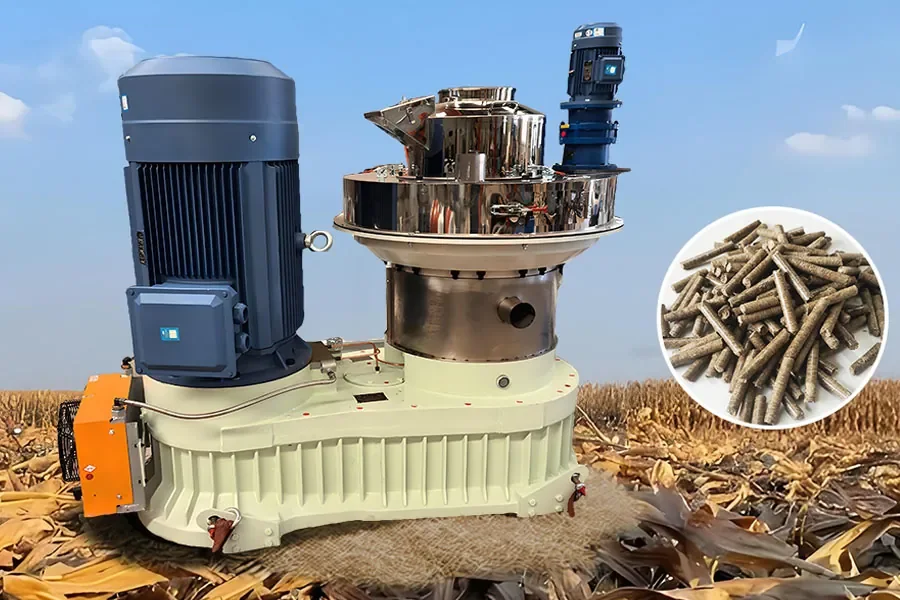
Below 800 kg/h a flat die pellet mill is the only one of the two we build; above 1.5 t/h it is a vertical ring die pellet mill. Between those figures both run on about 90 kW, and the choice stops being about which pellet mill and becomes about die changes, headroom and how many units you want to feed and maintain.
- Eight dimensions side by side — output, power per tonne, die cost, die change, footprint, feed, materials, maintenance
- The crossover table: what to buy at 80 kg/h, 600 kg/h, 1 t/h and 5 t/h
- 60–66 kW per tonne on a vertical ring die pellet mill, 62–94 on a flat die pellet mill
- Why a ring die needs 4.5 m of headroom and a flat die pellet mill does not
Both types built here since 2006 · 80 kg/h to 2.5 t/h per unit · Diesel and PTO drives on the flat die range only
Where each one stops
Two numbers decide most of this page, and neither is a price.
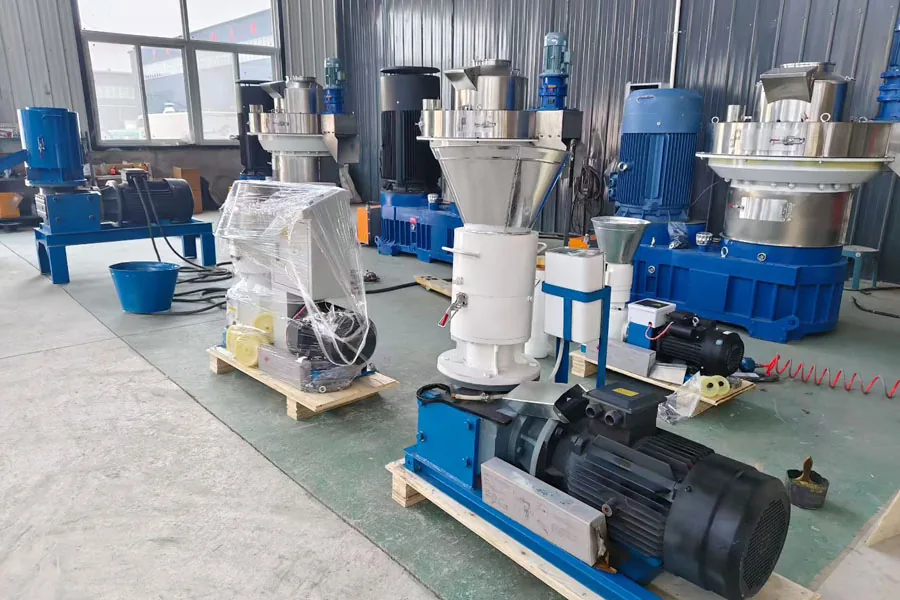
A flat die pellet mill is the right machine below 800 kg/h and a vertical ring die pellet mill is the right machine above 1.5 t/h. Between those two figures both will do the job on about 90 kW, and the decision stops being about which pellet mill and becomes about how many die changes you want to do and how much height you have in the shed. None of this is about pellet quality: on the same material at the same compression ratio both types make the same pellet, which is why the die compression ratio chart applies to both.
Outputs are the rated figures for our own models on sawdust at 12–15 % moisture; a harder material moves every row down together, so the crossover holds.
The two machines, dimension by dimension
Read the last column first. It is the only one that tells you which of these eight rows will actually decide your purchase — for most buyers it is the second row or the fourth.
| Dimension | Flat die pellet mill | Vertical ring die pellet mill | What it decides |
|---|---|---|---|
| Output per machine | 80–800 kg/h | 1.0–2.5 t/h | Above 800 kg/h there is no single flat die pellet mill in our range |
| Motor per tonne of output | 62–94 kW per t/h, rising as the plate grows | 60–66 kW per t/h, holding as the ring grows | Your power bill, and the size of transformer you need |
| Die cost | A flat die plate — the cheapest wear part we sell | A ring die — several times the price of a flat die plate | Budget the die plate or ring die monthly, not yearly |
| Die change | 20 minutes, one man, a spanner | 2–3 hours, a hoist, two men | Two materials week about: flat die, every time |
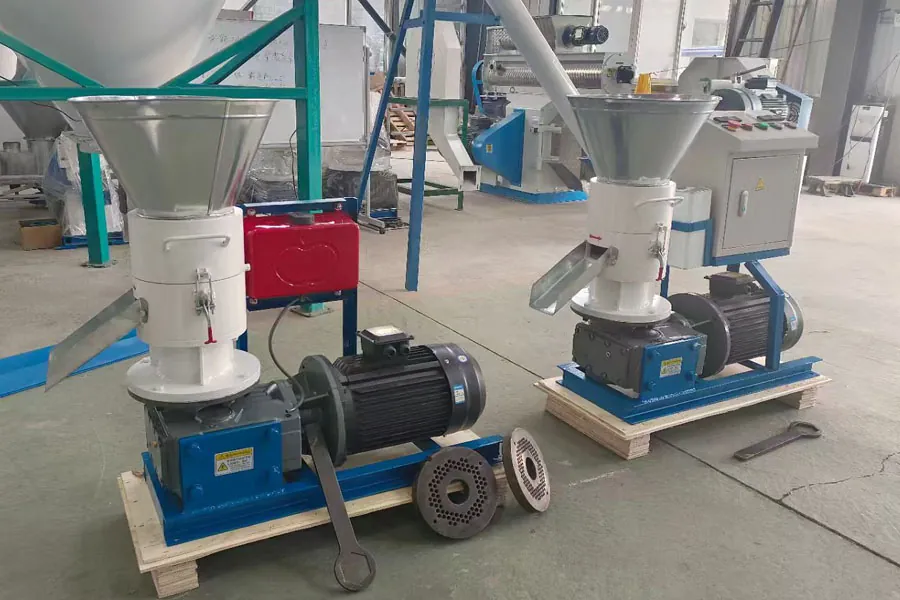
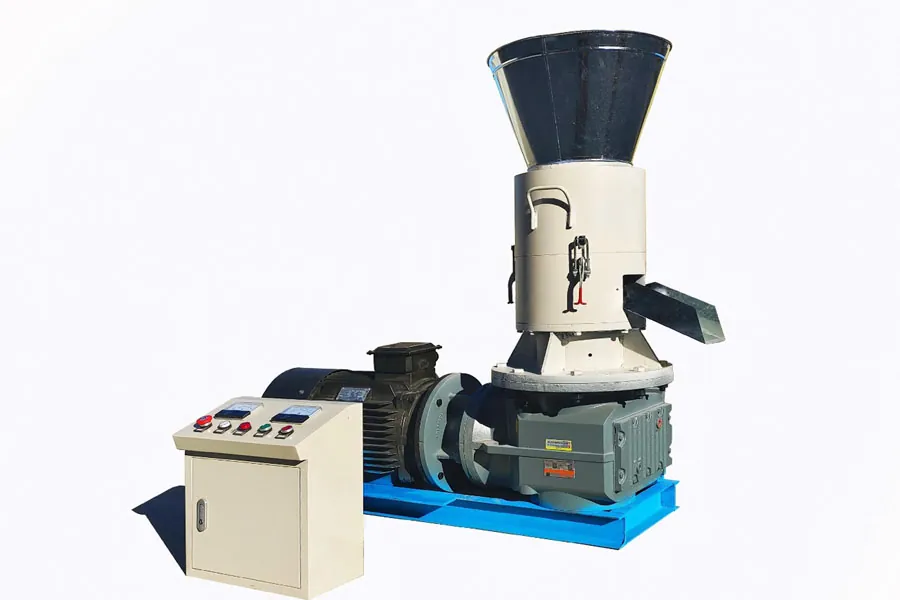
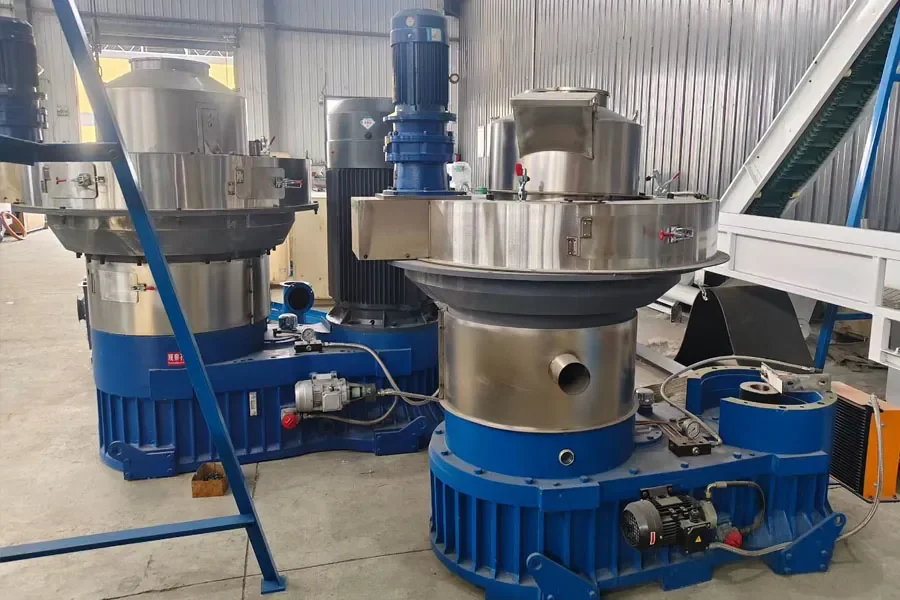
| Footprint and headroom | One unit on a skid, about 1.5 m tall. Fits under a 3 m roof and you can walk round it | A cast base with the ring die housing on top. The ring die comes out upwards, so you need a hoist and clear space above it — 4.5 m of shed, not 3 | A low shed decides this before the price does |
| How material is fed in | Gravity, from a hopper onto a horizontal die plate, rollers running on top of it | Forced, by centrifugal force — the rollers run inside the ring and press outwards | A ring die tolerates a surge in feed; a flat die pellet mill tolerates a stop |
| Materials | Short fibre, feed, straw, husk — and anything you will change weekly | Long fibre such as palm fibre and bark, high-capacity wood, single-material plants | Long fibre bridges a flat die plate; it will not bridge a ring |
| What goes wrong | Roller slip on wet material, and pellets re-pressed on the plate | A dry ring glazes and blocks, and the main bearing is a bigger job when it goes | Both are operator problems before they are machine problems |
Outputs are for sawdust at 12–15 % moisture on a die cut for wood. Rice husk runs at about 60 % of these figures and poultry manure at 60 %, which moves the crossover down with it — the 24-material pelleting guide has the figures per material. Die cost and die life are covered in the compression ratio chart.
Four columns of sentences do not fit a phone. Swipe the table sideways to compare the two machines dimension by dimension.
The motor per tonne row is the one that surprises buyers. A PM-D225B flat die pellet mill makes 120 kg/h on 7.5 kW, which is 62 kW per tonne — as good as anything on this page. A PM-D580B makes 800 kg/h on 75 kW, which is 94. The flat die gets less efficient as the plate grows, because the plate area rises with the square of the diameter while the pressure you can put on it does not. A HML-560 vertical ring die pellet mill goes the other way: 1.5 t/h on 90 kW is 60 kW per tonne, the best figure we quote.
That is the whole economic argument, and it only bites above about 1 t/h. Below that a flat die pellet mill is not just adequate, it is the better buy: one motor, one die, one operator, and a die change you can do yourself in the time it takes to drink a coffee. Nobody should buy a vertical ring die pellet mill for 400 kg/h — you would be paying for a cast base and a gearbox sized for three times the work.
What to buy at each output
Find your output capacity in the first column. The two middle columns are what it takes to reach that output with each type, at rated capacity on sawdust.
| Target output | Flat die pellet mill | Vertical ring die pellet mill | What we build |
|---|---|---|---|
| 80–350 kg/h | 1 × PM-D225B to PM-D300B, 7.5–22 kW | not built at this size | Flat die |
| 350–600 kg/h | 1 × PM-D400B or PM-D450B, 30–45 kW | not built at this size | Flat die — our 500 kg/h line |
| 600–800 kg/h | 1 × PM-D580B, 75 kW | not built at this size | Flat die |
| 0.9–1.2 t/h | 2 × PM-D450B, 90 kW | 1 × HML-560, 90 kW | Either — our 1000 kg/h line |
| 1.35–1.8 t/h | 3 × PM-D450B, 135 kW | 1 × HML-600, 132 kW | Ring die |
| 1.8–2.4 t/h | 4 × PM-D450B, 180 kW | 2 × HML-560, 180 kW | Ring die — our 2000 kg/h line |
| 2.7–3.6 t/h | 6 × PM-D450B, 270 kW | 1 × HML-700, 160 kW | Ring die |
| 4.5–6.0 t/h | 10 × PM-D450B, 450 kW | 3 × HML-600, 396 kW | Ring die — our 5000 kg/h line |
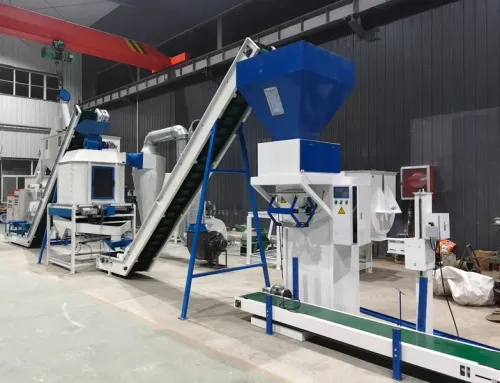
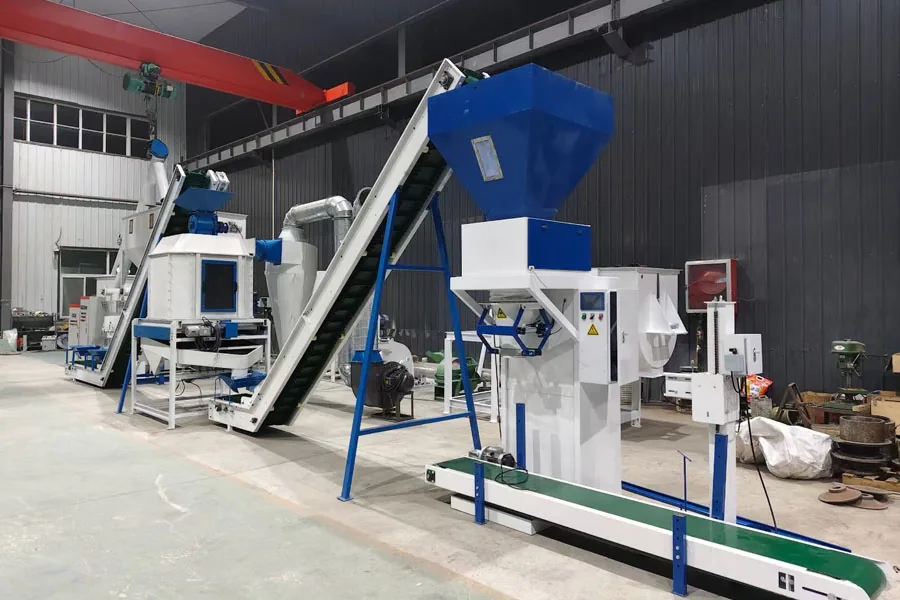
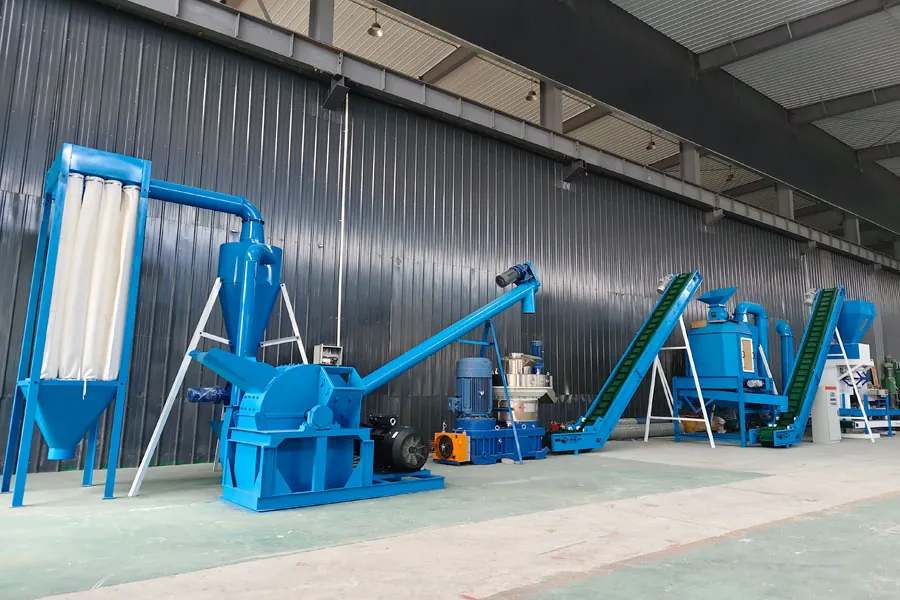
Bands are the rated output of the build in that row, not a promise about your material — husk and manure run at about 60 % of these figures and the crossover moves down with them. Two of these rows are the builds our own lines use: the 1000 kg/h wood pellet production line is two PM-D450B flat die pellet mills and the 5000 kg/h wood pellet production line is three HML-600 vertical ring die pellet mills. The 2000 kg/h line sits between them on two HML-560.
Ten flat die pellet mills is not a build we would quote, and the last row says so. It is in the table because it is the honest arithmetic: ten feed points, ten die changes, ten motors to grease and ten chances for one of them to be down while the other nine wait for it. The crossover is not a law of physics, it is the point where the number of machines you have to look after becomes the problem rather than the output.
The 0.9–1.2 t/h row is the only genuinely close call on the page, and both options draw 90 kW. Two PM-D450B flat die pellet mills cost less to buy and much less per die plate, and either one can be serviced while the other runs. One HML-560 vertical ring die pellet mill costs more up front, needs a hoist for a die change, and gives you one machine to watch instead of two. If you run one material and have the headroom, the ring die is the calmer plant.
Four questions, in this order
Ask them in this order and most buyers are down to one machine before they reach the fourth.
What is your output capacity?
Not the pellet mill — the capacity. Below 800 kg/h this page is over and you are buying a flat die pellet mill. Above 1.5 t/h it is over the other way.
How many materials, and how often?
One material: either type works. Two or more, changed weekly: a flat die plate comes off in twenty minutes and a ring die does not, so you would be buying two rings.
How high is the shed?
A ring die comes out upwards and needs a hoist above it. If the roof is at 3 m, that decides before the price does — and it is cheaper to build higher than to buy the wrong machine.
Who is going to run it?
A flat die pellet mill forgives a stop, a bad load and an operator who is learning. A ring die rewards steady feed and punishes a gap in it by glazing the ring.
The question we ask that is not on this list is what you are going to do in three years. A buyer who starts at 500 kg/h and expects to be at 2 t/h in two years is better served by two PM-D450B flat die pellet mills now and an HML-600 later, than by one oversized ring die running at a quarter of its capacity — a vertical ring die pellet mill at 30 % load makes a worse pellet than a flat die at 90 %, because it cannot build die temperature.
The other one is what happens when it breaks. Both types are simple machines, but the flat die pellet mill can be stripped and rebuilt by a fitter with hand tools, and the parts that wear — roller, die plate, bearing — are on a shelf. A ring die needs a hoist, a torque wrench and, for the main bearing, a press. In a country where the nearest crane is a day away, that is a real difference and we say so before the order rather than after.
Three cases, and the one that is genuinely close
Two of these are decided before you finish the sentence. The third is where we spend the most time on the phone.
-
Buy a flat die pellet mill — under 800 kg/h
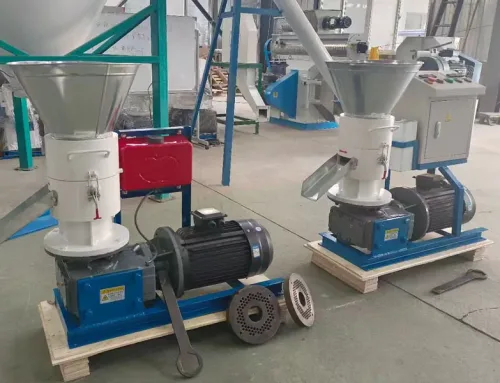
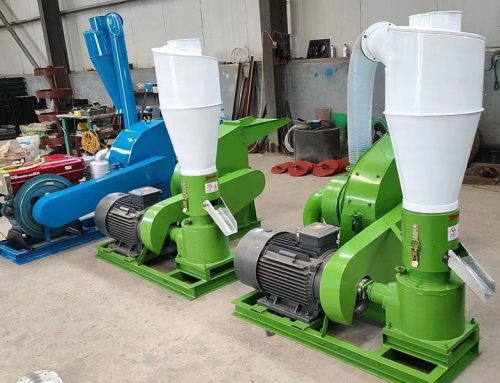
One unit, 7.5–75 kW, from a PM-D225B flat die pellet mill to a PM-D580B. It is the cheaper machine per kW, the die plate is the cheapest wear part we sell, and the change takes twenty minutes with a spanner. This is also the only half of the range available with a diesel pellet mill engine or a PTO flat die pellet mill drive, which matters on a farm with no three-phase supply.
-
Buy a vertical ring die pellet mill — 1.5 t/h and up
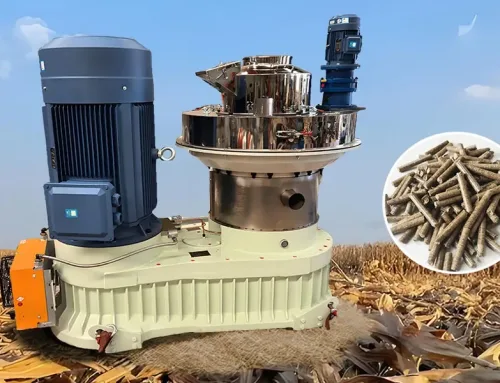
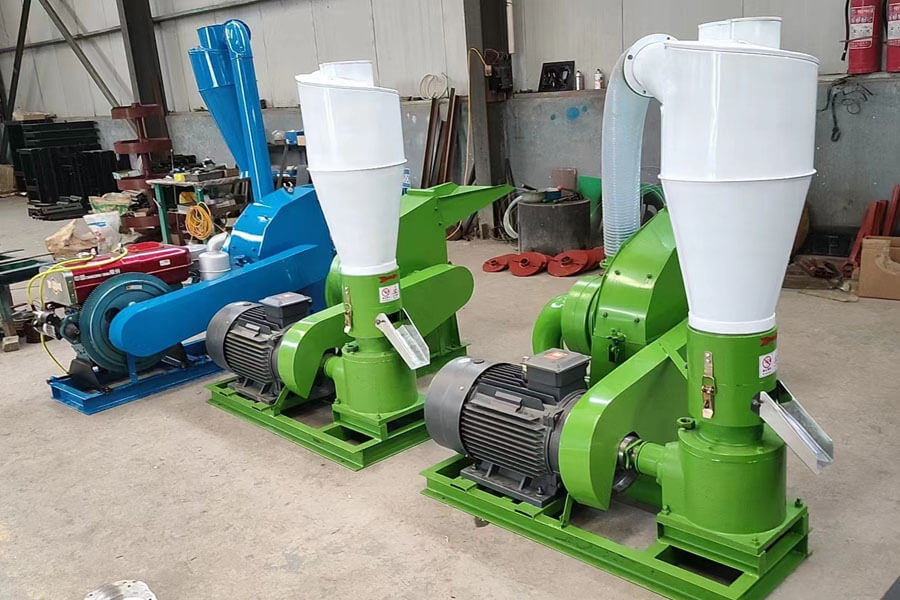
One unit, 90–160 kW, HML-560 to HML-700. It is the cheaper machine per tonne, it holds die temperature better at load, and it handles long fibre such as palm fibre and bark that bridges across a flat die plate. You need the headroom, a hoist, and a material you are not going to change every week.
-
The 1 t/h middle — either, on 90 kW
Two PM-D450B flat die pellet mills or one HML-560 vertical ring die pellet mill. Same 90 kW and overlapping output, different shape of plant. Take the flat dies if you change material often, if you want to service one while the other runs, or if the shed is low. Take the ring die if you run one material and want one machine to watch.
One thing we will not do is sell you a ring die for 500 kg/h. A vertical ring die pellet mill at that output runs at a fifth of its capacity, cannot build die temperature, and makes a softer pellet than a PM-D450B flat die pellet mill doing the same job at 90 % load. It also costs several times as much. If a supplier quotes you a ring die for a small output, ask what load it will run at — the answer is usually the reason the quote is hard to compare with ours.
What buyers ask before choosing between the two
Eight questions, answered the way we answer them on the phone.
Which is better, a flat die or a vertical ring die pellet mill?
Neither, at the wrong size. Below 800 kg/h a flat die pellet mill is the better buy because it is cheaper, simpler and its die plate costs a fraction of a ring die. Above 1.5 t/h a vertical ring die pellet mill is better because it makes the same output on 60–66 kW per tonne instead of 62–94. Between those figures they are the same machine with a different shape.
Is a vertical ring die pellet mill more efficient than a flat die?
Per tonne, above 1.5 t/h, yes — 60–66 kW per t/h against 62–94. At 1 t/h the two figures nearly coincide, so the ring only becomes decisive above about 1.5 t/h, where one HML-700 does the work of four flat die pellet mills. Below 1 t/h you would never recover the extra capital cost of the ring die.
Can a flat die pellet mill make one tonne per hour?
One unit cannot — the largest we build is a PM-D580B at 600–800 kg/h. Two PM-D450B flat die pellet mills reach 900–1,200 kg/h on 90 kW, which is exactly what one HML-560 vertical ring die pellet mill does on the same 90 kW.
Why does a ring die cost so much more?
A cast base, a heavy-duty gearbox, a ring die that is several times the price of a flat die plate, and a vertical ring die pellet mill built to run 6,000 hours a year rather than 2,000. You are also paying for the efficiency in the second row of the table, which is only worth paying for at scale.
How long does it take to change a die?
Twenty minutes on a flat die pellet mill with one man and a spanner. Two to three hours on a vertical ring die pellet mill, with a hoist and two men, and the ring goes back in with a torque wrench. If you change material weekly, that difference is the whole decision.
Do I need a hoist for a vertical ring die pellet mill?
Yes, and clear headroom above it. The ring die comes out upwards, so the roof over the vertical ring die pellet mill has to be higher than the pellet mill plus the ring die plus the hoist — plan 4.5 m. A flat die plate lifts off the top of a 1.5 m flat die pellet mill by hand.
Can one machine run wood and straw?
Yes, with a second die. On a flat die pellet mill that is a second flat die plate and a twenty minute change. On a vertical ring die pellet mill it is a second ring, which costs several times as much, and you would usually keep the second ring on a second machine instead.
Which one should I buy for 500 kg/h?
A flat die pellet mill — a PM-D450B at 45 kW covers 450–600 kg/h and is what our own 500 kg/h wood pellet production line is built around. A vertical ring die pellet mill at that output runs at a fifth of its capacity, cannot hold die temperature, and makes a softer pellet for several times the price.
Tell us your output capacity and we will quote both
Send the output you need, the material and the height of your shed. We will come back with the flat die pellet mill build and the vertical ring die pellet mill build for the same duty, with the installed power and the die plate or ring die cost for each.
What happens next
We reply with both builds side by side — models, motors, die cost and installed power — and say which one we would buy in your position. If the answer is the cheaper machine, that is the answer you get.
Your details are not shared. One follow-up, no mailing list.