Dust, Sparks and Silo Fires: Safety on a Pellet Plantthe dust cloud and the smouldering silo are two different fires
A wood pellet plant burns in one of two ways. A dust cloud inside a silo, a bin or a bag filter explodes at 30–40 g/m³ — a 1 mm layer across a 200 m² floor, disturbed, is 25 g/m³. Or a hot spot inside a silo self-heats for a week and then breaks through. The first needs five things at once, so removing any one of them stops it. The second cannot be removed at all, so it has to be watched.
- 30–40 g/m³ is all the dust a cloud needs
- 0.8 mm on the floor is the housekeeping limit
- Eight places a spark starts, in order of frequency
- 60 °C in a silo means act, not watch
We quote the protection with the production line · Detection, venting, isolation, priced line by line so you can see the minimum
The short answer
Two fires, two different defences, and only one of them is equipment.
A dust explosion needs five things at the same time: fuel, oxygen, an ignition source, a cloud and a confined space. Wood dust supplies the fuel at 30–40 g/m³, which is a haze you can still see through, and a silo, a day bin or a bag filter supplies the confinement. Remove any one of the five and nothing happens — which is why cleaning the layer is the cheapest protection on this page, and why a spark detector on the dryer outlet is the second cheapest. A silo fire is a different problem: the fuel is the product, it is already inside the vessel, and the ignition source is the heat the pellets brought in with them. That one is not prevented, it is watched — carbon monoxide at the headspace and temperature at three depths, alarmed at 60 °C.
The concentrations and ignition temperatures here are the published figures for wood dust, and they are properties of the material, not of our equipment — a plant built to them is safer than one built to a supplier’s opinion. Where a figure depends on the build, it says so: the layer arithmetic uses 150 kg/m³ for settled dust and the floor area of the capacity in question. Nothing on this page replaces a local code or an insurer’s requirement, and in the EU both apply.
What a dust explosion needs, and where each one is on a wood pellet line
Five conditions, all at once. Take any one away and the other four do nothing.
| Element | Where it is on a wood pellet line | The figure | What removes it |
|---|---|---|---|
| Fuel — the dust itself | Wood hammer mill, pellet mill and pellet cooler exhaust; 2–8 % of what goes through a mill leaves as fines | 30–40 g/m³ in air | Collection at the hood, and no layer left on a beam |
| Oxygen | The air in a silo headspace, a bag filter or a duct — the only closed volumes on a production line | 21 % normally; below 8 % nothing burns | Nitrogen or CO₂ inerting, or a design that vents instead of containing |
| Ignition | Dryer flame, a wood hammer mill strike, die friction, a hot bearing, a weld spark, static | 250–300 °C on a surface, 400–470 °C in a cloud | Spark detection, magnets, grounding, temperature probes |
| Dispersion | A slide opening, a bin dump, a compressed-air blow-down, a choked duct clearing itself | 1 mm across 200 m² is 25 g/m³ in a 6 m room | Vacuum, not compressed air; enclosed transfer points |
| Confinement | Silo, day bin, bag filter housing, duct, pellet cooler body | 8–10 bar peak in a vessel built for 0.5 bar | Explosion venting, an isolation valve, a weak roof panel |
Wood dust is St 1 — a Kst of 100–200 bar·m/s and a peak pressure of 8–10 bar. A silo is a thin steel shell sized for the weight of the pellets and perhaps 0.5 bar of air pressure from a blowing line; the same shell sees 8 bar in a dust explosion, which is why venting is not a nicety added at the end. The two rows that a plant can attack for nothing are fuel and dispersion, and housekeeping hits both at once: a floor swept and vacuumed is dust that is not there and cannot be thrown into the air.
Four columns will not fit a phone. Swipe the table sideways for the figure and the control, which are the two columns worth reading together.
The first explosion is rarely the one that does the damage. A puff inside a filter or a bin is enough to shake the layer off every beam, ledge and duct top in the building, and that cloud — now in a room rather than a vessel — is the second explosion, which is the one that takes the roof off. This is why the housekeeping rule is written about layers and not about air: the air is clean for 363 days a year, and the layer is what turns a small event into a large one.
The fifth element is the one buyers forget, because a silo does not look like a pressure vessel. It is one, for a tenth of a second. A vent panel sized to the volume of the vessel, and an isolation valve between the vessel and the next one, are the two items that decide whether an explosion stays inside one piece of equipment. Neither is in a pellet mill quotation unless it is asked for, and neither can be added to a silo that has already been fabricated without cutting it.
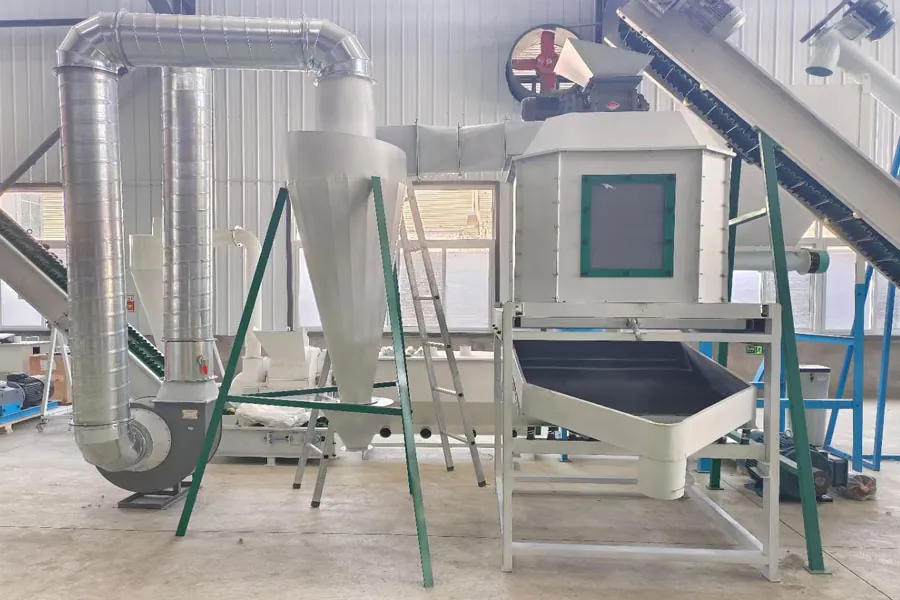
Eight places a spark starts, in the order they happen
Ranked by how often they start a fire on a wood pellet line, not by how dramatic they look. The last two are the ones a plant does to itself.
| Source | How it starts | The first sign | What to fit |
|---|---|---|---|
| Sawdust dryer | A flame or a glowing particle from the furnace carried into the duct and on to the cyclone | Sparks at the cyclone outlet, a rise in outlet temperature | Spark detection with water extinguishing at the dryer outlet |
| Wood hammer mill | A stone, a nail or a piece of screen struck by the hammers — sparks at over 1,000 °C | A burst of sparks, a flicker in the amps, a burnt smell | Magnet in the feed chute, spark detection on the mill outlet |
| Pellet mill die | A foreign object in the die, or a die run dry with nothing to carry the heat away | Smoke at the die, motor current climbing, a glazed die face | A screen before the die, no dry run, die temperature |
| Pellet cooler | Pellets that left the die too hot, or fines smouldering in the pellet cooler body | Smoke at the pellet cooler exhaust, a hot patch on the casing | Temperature probe in the pellet cooler, detection on the exhaust |
| Bucket elevator | A slipping belt or a choked boot running metal on metal | A hot casing, burnt rubber, a stalled belt | Belt slip and speed switch, bearing temperature, vented head |
| Silo | Pellets loaded hot and self-heating; a smoulder carried in from the dryer | CO rising in the headspace, then temperature | CO and temperature at three levels, and no load above 60 °C |
| Static | Pellets falling into a silo, pneumatic conveying, an ungrounded duct section | A spark nobody sees | Bonding and grounding under 10 Ω, no plastic in the dust path |
| Hot work | Welding a bracket on a duct during a shutdown, slag falling through a gap | Nothing, for four hours | Permit, isolation, a fire watch for 60 minutes after |
The order matters because it is the order to spend money in. A dryer and a wood hammer mill account for most fires; a pellet mill die accounts for most smoke and very little fire; a silo accounts for most of the damage, because a silo fire is measured in days and in cubic metres of water rather than in one burnt filter bag. The last two rows cost almost nothing and are the two that a plant adds to itself: an ungrounded duct and a welder with a permit are both entirely avoidable.
Four columns will not fit a phone. Swipe sideways for the control column, which is the one to take to a supplier.
Every one of the first five is caught by the same device in the same place — a spark detector on the outlet of the vessel, looking at the duct, with a water nozzle a metre downstream. The detector sees the spark in under a millisecond and the water is in the duct before the spark has travelled two metres, which is why one system with four zones covers a whole production line rather than one machine.
What a detector cannot do is catch a spark that starts downstream of it. If the last zone is on the pellet cooler exhaust and the duct to the silo is 20 m long, a spark that starts in that duct — from a hot bearing on the fan, say — arrives at the silo with nothing in its way. That is the argument for the fourth zone being at the silo inlet and not at the pellet cooler, and it is the argument for an isolation valve as well as a detector.
What to measure on a silo, and when to act
A silo fire is not detected, it is trended. Four readings, three of which a plant can have for the price of a probe and a gland.
| What you measure | Normal | Alarm | What to do |
|---|---|---|---|
| Headspace temperature | Ambient + 5 °C | 60 °C, or ambient + 20 °C | Stop loading, sample the top, prepare to inert |
| Temperature at three depths | Within 5 °C of each other | A 10 °C spread between depths | That is a hot spot against a wall, not a warm silo |
| Carbon monoxide in the headspace | 0–10 ppm | 20 ppm above your own baseline | A smoulder — this is the alarm that comes days early |
| Condensation on the roof and walls | Dry | Water running down the inside wall | Cold pellets into a warm silo: mould first, then heat |
| Wall temperature by hand or IR gun | Ambient | A warm patch on one side | The hot spot is against that wall — do not open it |
Carbon monoxide is the reading that earns its money. A smoulder makes CO long before it makes smoke or a measurable rise in temperature, and 20 ppm above the baseline you recorded when the silo was empty is enough to act on. Temperature is a lagging indicator: by the time the top of a 460 m³ silo reads 60 °C the fire underneath has been burning for a day, and by the time the casing is warm to the hand it has been burning for three.
Four columns will not fit a phone. Swipe sideways for the alarm column, which is the one to write on the wall of the control room.
The three depths are not a luxury. A single probe at the top of a silo reads the headspace, which is the coolest part of the vessel and the part furthest from where a smoulder usually starts — the wall, at the point where the incoming pellets land. Three cables at 1 m, half depth and two-thirds depth, or three discrete probes on one wall, will show the 10 °C spread that a single reading hides.
The cheapest protection on a silo is a rule about what goes into it: no pellets above 60 °C, and none that came off a die that ran hot or a dryer that tripped. A pellet that leaves the die at 90 °C and goes straight into a silo is carrying the heat that will start the fire, and no amount of monitoring prevents that — it only tells you when it has started. Cool first, then store.
The protection, item by item
Six items, indicative prices, FOB. They are separate from a pellet mill quotation because they are separate from the pellet mill.
| Item | Where it goes | What it stops | Indicative price |
|---|---|---|---|
| Spark detection and water extinguishing, four zones | Dryer outlet, wood hammer mill outlet, pellet cooler exhaust, silo inlet | A spark reaching the bag filter | 8,000–15,000 |
| Explosion vent panels | Silo roof, filter housing, duct | A silo splitting along a weld | 1,500–4,000 each |
| Explosion isolation — rotary valve or flap | Under the filter, on the duct to the silo | Flame travelling back up the duct | 1,200–3,000 |
| Magnetic separator | Feed chute before the wood hammer mill | Tramp metal reaching the hammers | 400–900 |
| Bonding and grounding set | Silo, duct, filter, conveyors | Static | 300–800 |
| CO and temperature monitoring, three levels | Silo | A smoulder becoming a fire | 2,500–6,000 |
For a 1,000 kg/h build the whole list is 15,000–30,000, against a silo that costs 20,000 to replace and a fire that writes off the store and the season. The vent panels and the isolation valve are the two a fabricator will not add unless somebody specifies them, and they are the two that decide whether an explosion stays inside one vessel. Prices are indicative and FOB; a European installation with Ex-rated equipment and a zone drawing is a different order of magnitude.
Four columns will not fit a phone. Swipe sideways for the price column.
The order to buy in is the order in the table, not the order of the price. A magnet at 400 that keeps tramp metal out of a wood hammer mill prevents the spark the 12,000 detection system would otherwise have to catch, and the grounding set at 300 prevents the one neither of them can see. Buy the cheap rows first and the expensive rows stop earning their keep less often.
What cannot be retrofitted is the silo. Vent panels need a flange welded into the roof, the monitoring needs bosses and cable glands at three levels, and the isolation valve needs a spool piece between the silo and the duct. All three are a morning’s work at the fabrication stage and a shutdown with a crane afterwards, so the time to specify them is on the drawing.
What is on your floor
Four fields. The answer is the concentration the dust on your floor would make if something shook it into the air.
200 m² of floor with 1.0 mm of dust on it holds 30 kg. Spread through 1,200 m³ of air that is 25 g/m³ — 0.8 × the 30 g/m³ wood dust needs, and 1.2 mm on this floor would put it over.
The arithmetic is a layer of settled dust fully dispersed into the volume of the room: mass = area × depth × density, concentration = depth × density ÷ height. It assumes nothing escapes and nothing stays on the beams — a real shed is worse, not better, because the dust on the beams comes down too. Bulk density is the figure to argue about: 150 kg/m³ is loose sawdust, and fines that have settled for a year are nearer 300.
The arithmetic is deliberately simple, because the point is not precision — it is the order of magnitude. A layer of settled dust, fully dispersed into the volume of the room, is the worst case, and it is the case that happens: the first small explosion in a filter is what does the dispersing, and it does it to every ledge in the building at once.
The figure to take away is the last one. Whatever you type, it comes back with the layer depth that would put the room over 30 g/m³ — and on almost every shed that number is between 1 and 2 mm, which is a fortnight of production and not a visible mess. The layout page has the floor area for each capacity if you do not know yours.
The order to do this in
Two of these cost nothing, one costs a few thousand, and the last one has to be decided before the silo is fabricated.
Clean the layer, not the air
A vacuum and a brush on a schedule is the only control that removes two of the five elements at once. Compressed air does the opposite: it takes the layer off the beam and turns it into the cloud. 0.8 mm across 5 % of the floor is the threshold, and in a shed with a wood hammer mill in it that is a week of production.
Close the ignition sources you can buy for
A magnet before the wood hammer mill, spark detection after the dryer and the mill, no dry run on a die, and a hot work permit. None of these is expensive and every one of them is cheaper than the fire it prevents.
Vent and isolate the vessels
A silo, a filter housing and a duct are the only confined spaces on a production line, and they are where an explosion becomes a burst. Vent panels sized to the volume, and an isolation valve between the vessel and the next one, so the pressure has somewhere to go that is not the wall.
Watch the silo, not the flame
CO at the headspace and temperature at three depths, alarmed where somebody is rather than in a cabinet. A silo fire is fought with water from the top over days, or by emptying the silo and letting it burn out under control — neither is a decision to make at 2 a.m. with no data.
The most common mistake is treating this as an equipment purchase. Spark detection, venting and monitoring are the third layer; the first two are a floor somebody can clean and a mill that does not swallow metal. A site with 30,000 of detection and 5 mm of dust on the beams is less safe than a site with a broom and a magnet, and it is the one that will be surprised.
The second mistake is buying the silo before deciding how it will be monitored. A silo with no access to the headspace, no cable glands for probes and no way to sample the top cannot be monitored afterwards without cutting it open. Ask for three levels of temperature and one CO point at the design stage, when they cost a boss and a gland rather than a shutdown and a crane.
Three levels of protection, and which build needs which
Not a ladder — a set. A large build needs all three, a small one can live with the first, and the middle one is what most sites stop at.
-
Housekeeping and interlocks
The minimum, and the cheapest. A cleaning schedule with a written standard, a magnet in the feed, no dry run on a die, a hot work permit, and grounding on every vessel. It costs almost nothing and it removes four of the five elements often enough that most small plants run for years on it. What it does not do is tell you anything: the first sign of a problem is the fire.
-
Spark detection and venting
The practical middle, and what we quote on anything above 500 kg/h. Detectors on the dryer, the mill and the pellet cooler outlet with water extinguishing, vent panels on the silo and the filter, an isolation valve between them. It catches the spark before the filter and it lets the pressure out in a direction you chose. It does not stop a smoulder that started inside the silo.
-
Inerting and full ATEX
The export grade, and what a European insurer will ask for. Nitrogen or CO₂ inerting on the silo and the filter, Ex-rated motors and instruments in the zones, documented zone drawings, and monitoring that is alarmed and logged rather than displayed. It is the only level that addresses a smoulder inside a sealed silo, and it roughly doubles the electrical scope of a production line.
What decides the level is the size of the silo and whether anyone is on site at night. A silo holding a week of production is a fire with a week to start, and nobody is there to smell it; a day bin feeding a shift is a fire that somebody notices. The 5,000 kg/h build with 460 m³ of storage needs all three levels. A 300 kg/h flat die pellet mill with a day bin needs the first and a silo that can be emptied.
What buyers ask about dust and fire
Eight questions, answered the way we answer them on the phone.
Can wood dust really explode?
Yes, and at a lower concentration than most people expect. Wood dust explodes at 30–40 g/m³, which is a haze you can still see through, and it reaches 8–10 bar in a closed vessel. The first explosion is usually small — a puff inside a filter or a day bin — and it shakes the layer off every beam in the building. The second one is the one that takes the roof off.
How much dust on the floor is too much?
0.8 mm, or 1/32 of an inch, across 5 % of the floor area is the threshold most standards use. In a 200 m² shed that is 30 kg of dust, and dispersed through a 6 m room it is 25 g/m³ — just under the 30 g/m³ wood dust needs. Nobody can see the difference between 25 and 35 g/m³ in the air, which is why the rule is written about the layer on the floor.
What is the most common cause of a pellet plant fire?
The dryer, then the wood hammer mill. A direct-fired dryer carries a glowing particle into the duct and it arrives at the cyclone still alight; a mill that swallows a stone throws sparks at over 1,000 °C. Both are caught by a spark detector on the outlet, and both are cheap to prevent and expensive to survive.
Can a silo of wood pellets catch fire on its own?
Yes. Pellets leave the die at 70–90 °C and a silo holds that heat; loaded above 60 °C, or with moisture condensing on a cold wall, the pile self-heats and a smoulder starts inside it. It can take days to show and weeks to put out. Cool below 60 °C before storing, monitor CO, and never store pellets that came off a die that ran hot.
Do I need ATEX equipment?
If the site is in the EU or the UK, yes, and a zone drawing is part of the file. Outside those markets the equipment is usually standard industrial and the protection is detection and venting. What does not change is the dust: a standard motor in a zone 22 area is a risk wherever the site is, and specifying the Ex version at the order costs about 15 % more than changing it afterwards.
Is a spark detection system worth the money?
On a production line above 500 kg/h, yes. It is 8,000–15,000 for four zones, it reacts in under a second, and it stops the spark that would have reached the bag filter — which is where a small fire becomes a large one, because a filter is a box of dust with air blowing through it.
How often should a pellet plant be cleaned?
Every shift for the floor and every casing, weekly for the beams, ledges and the tops of ducts, and after every die change. The test is not the schedule, it is a finger: if you can write your name in the dust on a ledge, it has been too long. Use a vacuum rated for dust, never compressed air.
What do I do if a silo is already hot?
Do not open it. Opening a silo that is smouldering lets air in and can turn a smoulder into a fire in seconds. Close the inlet, stop the discharge, keep the CO and temperature log running, and get water to the top if there is a hatch designed for it. Then call somebody who has done it before — the decision to empty a silo is made on the trend, not on one reading.
Tell us the capacity and we will price the protection with the production line
The capacity, the material, whether there is a silo and how big, and whether anyone is on site at night. We come back with the detection zones, the vent areas, the isolation points and what each one adds.
What happens after you send it
We reply with the protection we would fit on that build — the zones, the vent areas, the isolation points — and the price of each item separately, so you can see what the minimum is and what the full set adds. If the silo is already fabricated we say what can be retrofitted and what cannot, before you order anything.
Your details are not shared. One follow-up, no mailing list.