


Biomass Sawdust DryerFlash pipe dryers at 200 to 600 kg/h · rotary drum dryers at 500 to 2,500 kg/h
A biomass sawdust dryer takes sawdust, rice husk, wood shavings or straw powder at 25–50 % moisture and hands it to the pellet mill at 8–12 %. We build two kinds: the flash pipe sawdust dryer, which dries in seconds in a stream of hot air, and the rotary drum sawdust dryer, which dries in a drum over minutes and takes coarser, wetter material at larger capacities. Both are built around your heat source, your material and the space you have.
- Flash pipe sawdust dryer HG-Q260 to HG-Q350 — 4 to 11 kW, 200–600 kg/h, 25–30 % in, 10–15 % out
- Rotary drum sawdust dryer HG-G 650 to HG-G 1800 — 500 to 2,500 kg/h
- Heat source: biomass furnace, gas or diesel burner, or waste heat from a boiler
- Furnace, fan, cyclone, airlock, ducting and control panel in the same scope
Reply in 12 working hours · Sized on your material and moisture · Delivered to 40+ countries
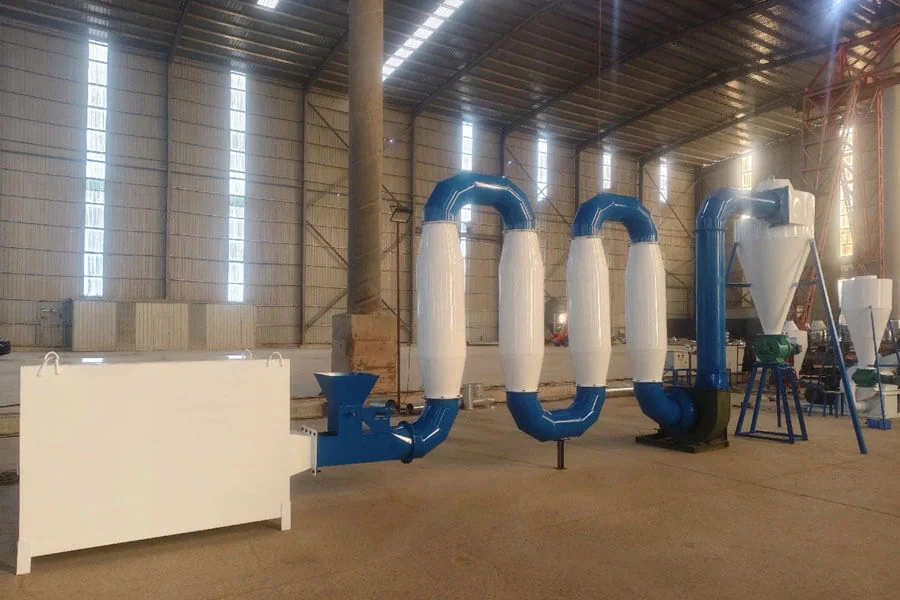
The machine that decides whether the pellet holds together
A pellet press cannot make a dense pellet out of wet sawdust. It is not a question of power: the lignin in the wood has to soften and flow, and it only does that in a narrow moisture window. Everything upstream of the press exists to put the material inside that window.
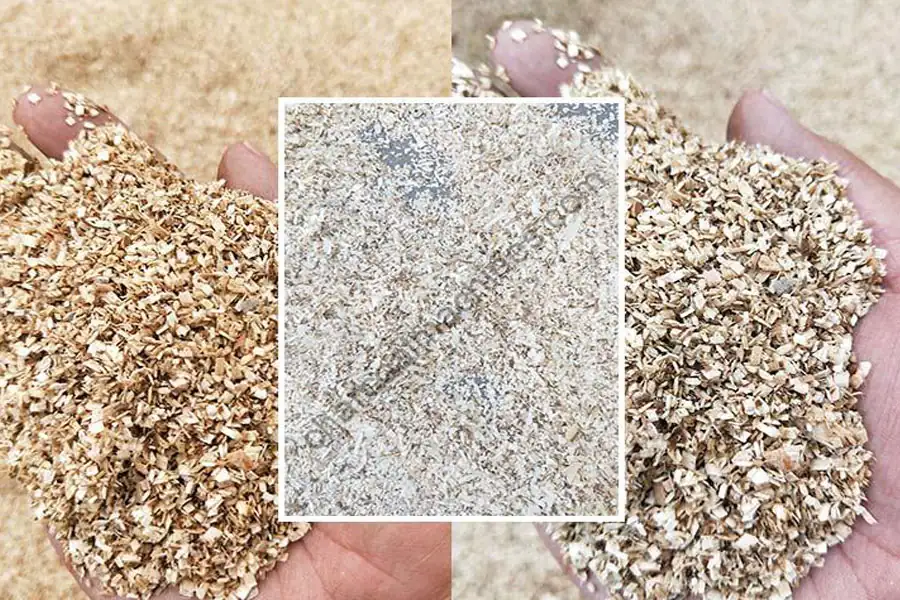
Sawdust leaves a sawmill or a furniture shop at 25–40 % moisture, and material that has been standing in the rain runs higher. A flat die pellet mill or a vertical ring die pellet mill wants 8–12 %. Below 8 % the lignin will not plasticise, the pellet comes out laminated and dusty and the die wears fast; above 15 % the rollers slip on the material, the die holes blind over and the press starts to steam instead of extruding.
There are two ways to close that gap, and they are not interchangeable. A flash pipe sawdust dryer suspends the material in hot air at 180–250 °C and dries it in one to three seconds — cheap, compact, and limited to powder and small particles under about 5 mm. A rotary drum sawdust dryer tumbles the material through a rotating drum for 8–25 minutes, which handles wetter and coarser material and scales to 2,500 kg/h, at twice the footprint and a higher price.
What we do not sell is a catalogue machine with your name on the invoice. The furnace is sized on the water you have to evaporate, the discharge height is set by the machine that comes next, the ducting is routed around your building, and the fuel is whatever you can actually buy — firewood offcuts, rice husk, gas or diesel. That is what the sections below are for.
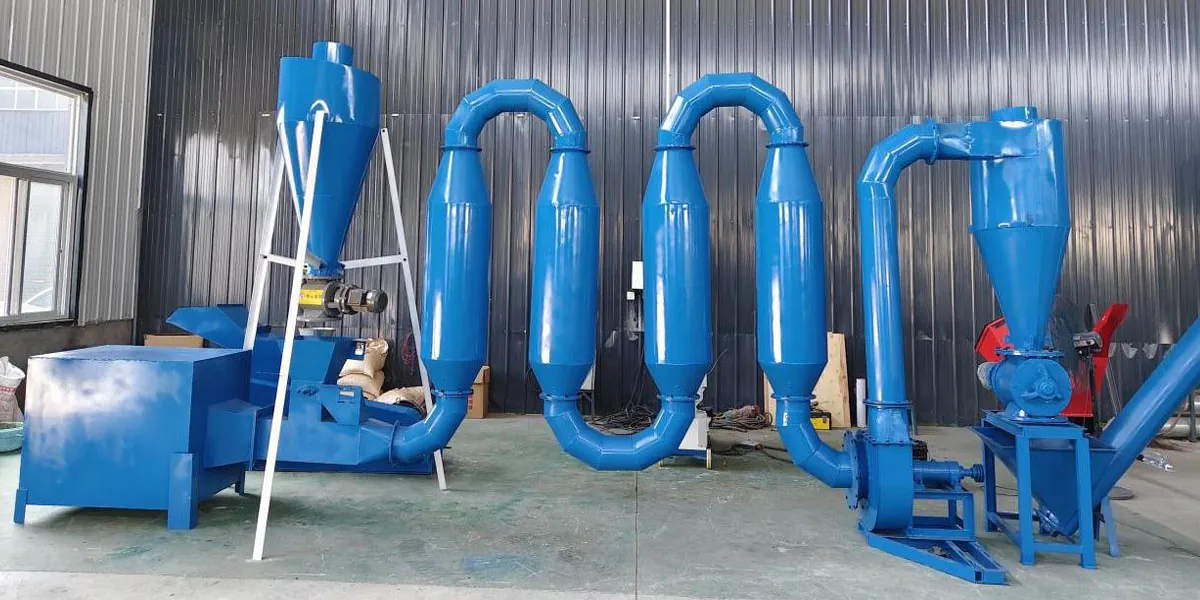
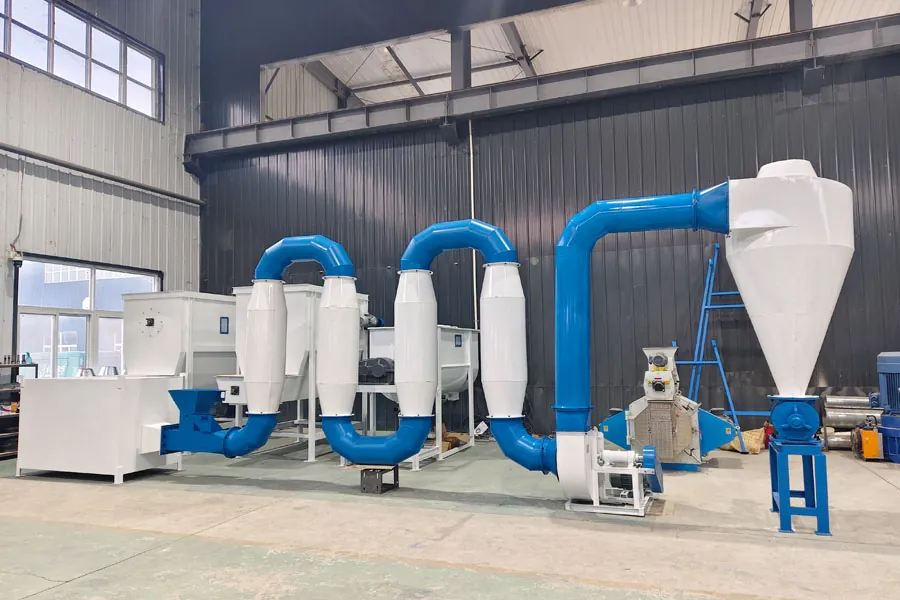
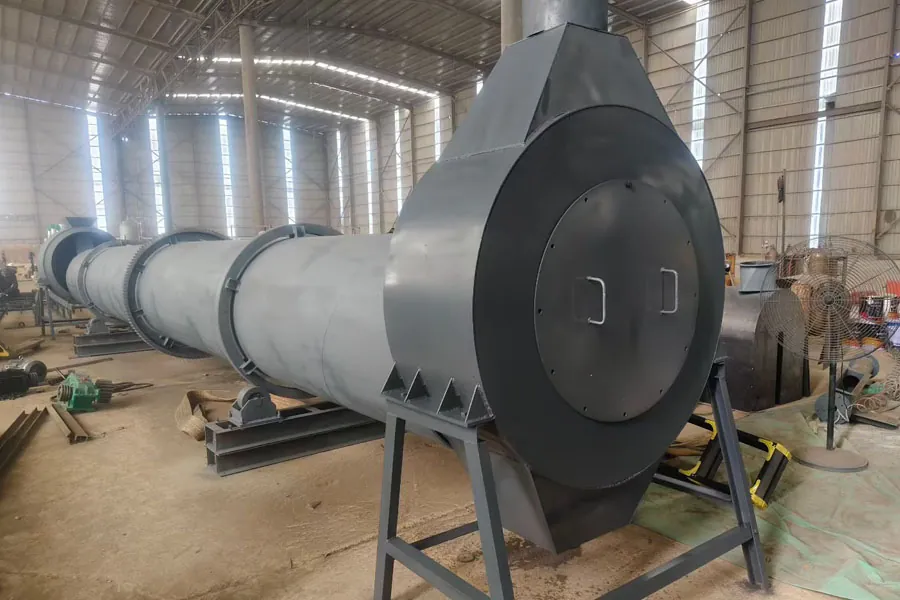
Two ways to dry, and one rule for choosing between them
Both machines do the same job and neither one is better. The difference is what the material looks like, how wet it is, and how many kg/h a shift you have to get through.
| Flash pipe sawdust dryer | Rotary drum sawdust dryer | |
|---|---|---|
| Drying time | 1–3 seconds in the air stream | 8–25 minutes in the drum |
| Capacity | 200–600 kg/h | 500–2,500 kg/h |
| Moisture in | 25–30 %, and up to 40 % with the furnace sized for it | 30–50 %, and it tolerates wetter patches |
| Moisture out | 10–15 %, set by feed rate and air temperature | 8–12 %, set by gas temperature and retention time |
| Particle size | Powder and small particles, up to about 5 mm | Chips and shavings up to 20–30 mm |
| Footprint | Long and narrow — 9 × 2.5 m for the HG-Q260, 18 × 3 m for the HG-Q350 | 12–20 m long, on a concrete foundation |
| Heat source | Biomass furnace, gas or diesel burner | The same, fired into the drum inlet |
| Investment | The cheaper machine to buy and to install | Roughly twice the capital, less fuel per tonne |
| Best for | Pellet plants under about 1 t/h, wood powder, rice husk | 1 t/h and up, wet chips, coarse material |
The rule we use: under about 1 t/h of pellets the flash pipe sawdust dryer is the cheaper answer, and above that the rotary drum sawdust dryer pays the difference back in fuel and in labour. A plant that runs both — pipe dryer for sawdust, drum for chips — is not unusual either.
Tell us the material and the water in it
Four answers size a biomass sawdust dryer: what the material is, how wet it arrives, how many kg/h of dry material you need, and what you can burn for heat. Everything else — pipe or drum, furnace size, ducting route — follows from those.
What happens after you send this
We answer with the type, the model, the furnace size and a price — and with the fuel figure per tonne, which is the number that decides whether the dryer pays for itself.
Reply within one working day. No obligation.
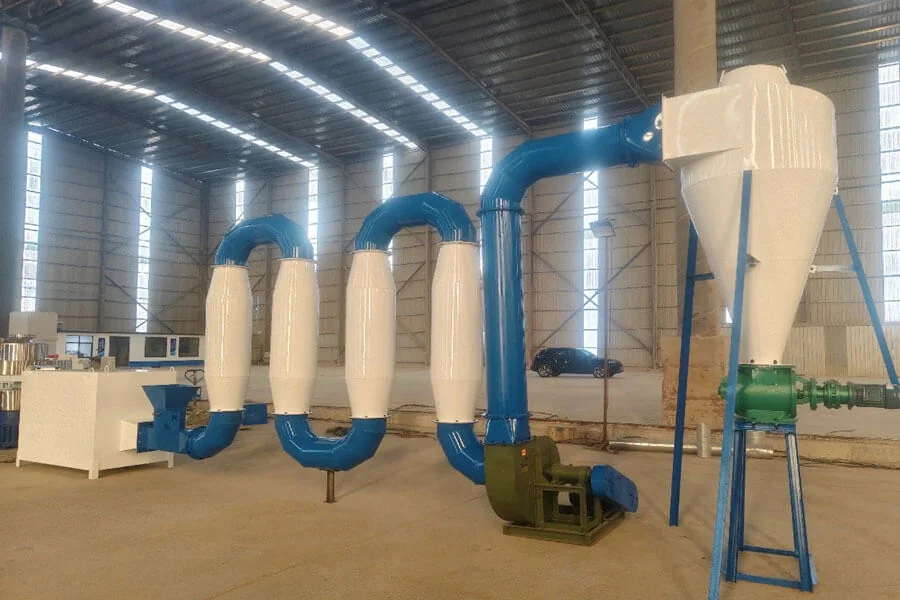
Five steps, one to three seconds
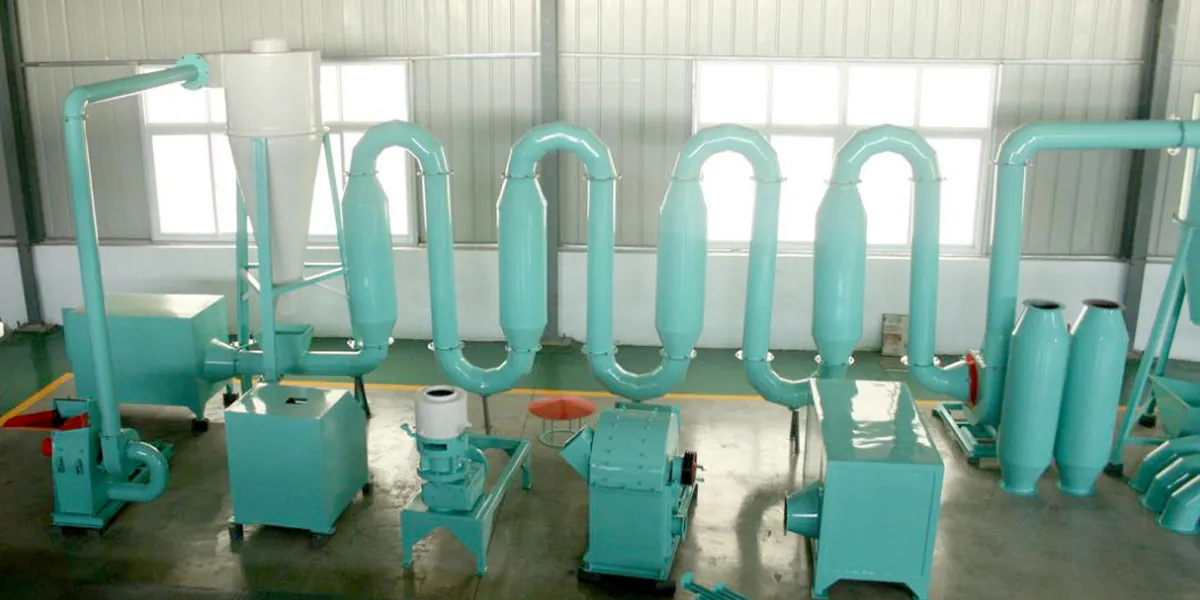
The material never sits still. It is picked up by hot air at the bottom of the first riser and carried through the loop, and the drying happens on the way — which is why the whole machine is pipes and a cyclone rather than a vessel.
Screw conveyor
Wet sawdust is metered into the base of the first riser by a screw conveyor. The feed rate is the control: it sets the final moisture more than any other setting on the machine.
Hot air furnace
A biomass, gas or diesel furnace delivers 180–250 °C into the same riser. Too hot scorches the surface of the particle and leaves the core wet; the temperature is set against the material, not run flat out.
The pipe loop
Four columns joined by U-bends give 12 m of path in a 3 m rise. The material is suspended, every particle sees the same air, and the water leaves in one to three seconds.
Cyclone and airlock
The cyclone drops the dried sawdust out of the air stream and the airlock discharges it without breaking the pressure in the system. Discharge height is built to your next machine.
Fan and exhaust
A centrifugal fan on the clean side pulls the whole circuit. Exhaust goes to a dust collector or a filter bag — optional on paper, close to mandatory anywhere with an emission inspector.
Five steps, eight to twenty-five minutes
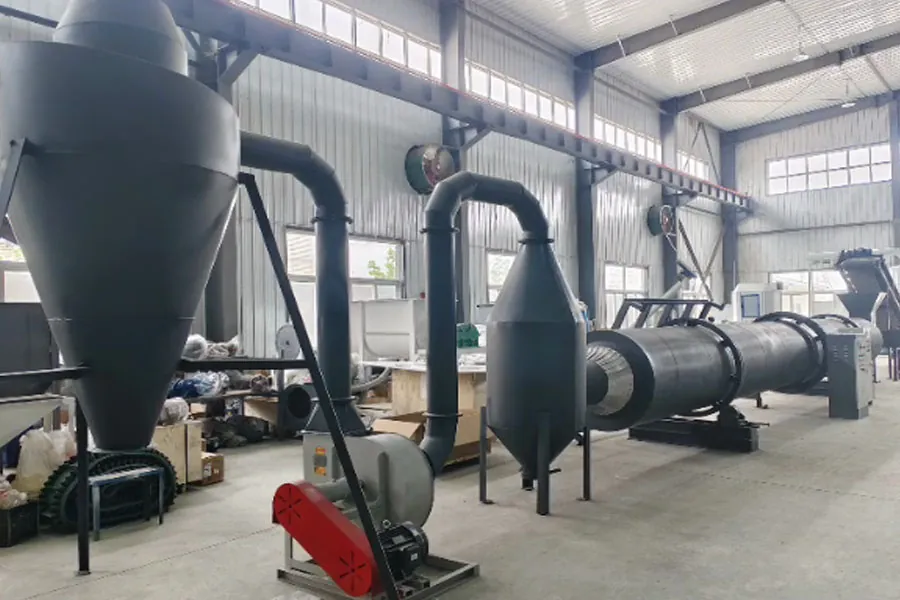
The drum does with time what the pipe does with speed. Material is lifted and dropped through the hot gas again and again, so a wet chip that would never dry in three seconds still gets there in fifteen minutes.
Feed. A hopper and a belt or screw conveyor put the material into the drum inlet. Chippers and wet shavings go in as they are — no grinding first, which is the main reason people choose the drum over the pipe.
Combustion chamber. The furnace fires into a chamber at the inlet end and the hot gas enters the drum at 400–700 °C, dropping to 80–120 °C at the outlet. A drum dryer runs hotter than a pipe dryer because the contact time is longer and the material is coarser.
The drum. A welded shell 650 to 1,800 mm across, on two tyre rings, turned at 3–5 rpm by a girth gear. Internal lifters pick the material up and drop it through the gas stream — that flight, not the rotation, is what does the drying.
Separation. Dried material leaves the outlet end into a settling chamber or a cyclone; the gas goes on to a fan and a dust collector. Discharge. A conveyor takes the dried material to a buffer bin or straight to the hammer mill or the press.
Eight sizes, 200 kg/h to 2,500 kg/h
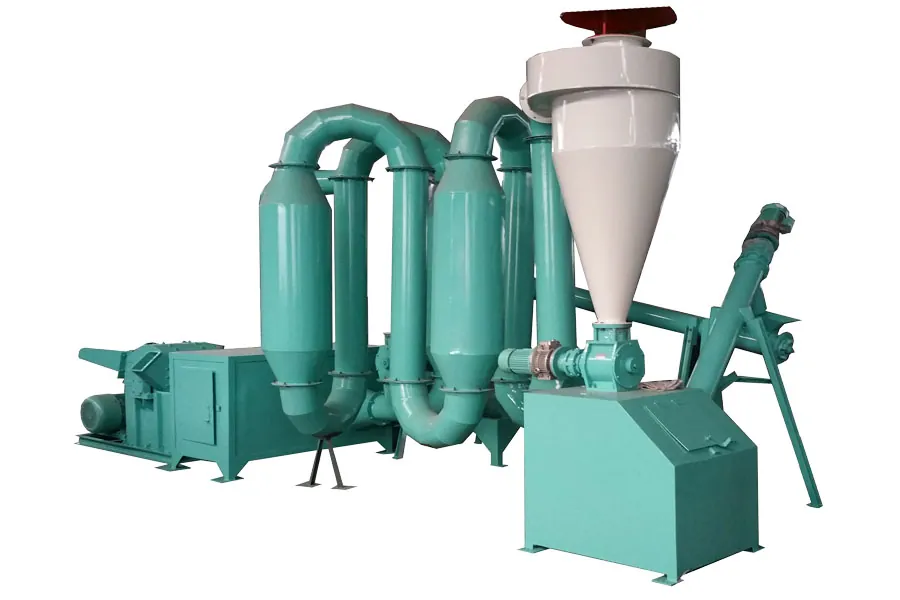
Capacity is quoted on sawdust at the moisture in the table — 25–30 % in and 10–15 % out on a pipe dryer, 30–40 % in and 10–12 % out on a drum. Rice husk and wood powder run close to the figure; wet chips and high-moisture hardwood run below it, because the limit is the water to be evaporated and not the machine.
Flash pipe sawdust dryer, HG-Q series three models
| HG-Q260 | HG-Q300 | HG-Q350 | |
|---|---|---|---|
| Moisture in | 25–30 % | 25–30 % | 25–30 % |
| Moisture out | 10–15 % | 10–15 % | 10–15 % |
| Main motor | 4 kW | 7.5 kW | 11 kW |
| Airlock motor | 1.1 kW | 1.1 kW | 1.5 kW |
| Pipe diameter | 260 mm | 300 mm | 350 mm |
| Cyclone diameter | 700 mm | 900 mm | 1,050 mm |
| Overall size L×W×H | 9 × 2.5 × 3 m | 16 × 3 × 3.2 m | 18 × 3 × 3.2 m |
| Hot air furnace L×W×H | 1,600 × 900 × 1,150 mm | 2,000 × 1,000 × 1,300 mm | 2,100 × 1,000 × 1,300 mm |
| Fuel consumption | 40–50 kg/h | 60–80 kg/h | 80–100 kg/h |
| Drying capacity | 200–250 kg/h | 400–500 kg/h | 500–600 kg/h |
| Weight | 1,700 kg | 2,600 kg | 3,200 kg |
The model number is the pipe diameter in millimetres: HG-Q260 runs a 260 mm riser, HG-Q350 a 350 mm one. One furnace, one fan, one airlock and one cyclone per frame — the four things that have to be sized together. Fuel figures are firewood at about 4,000 kcal/kg; gas and diesel change the running cost but not the air volume.
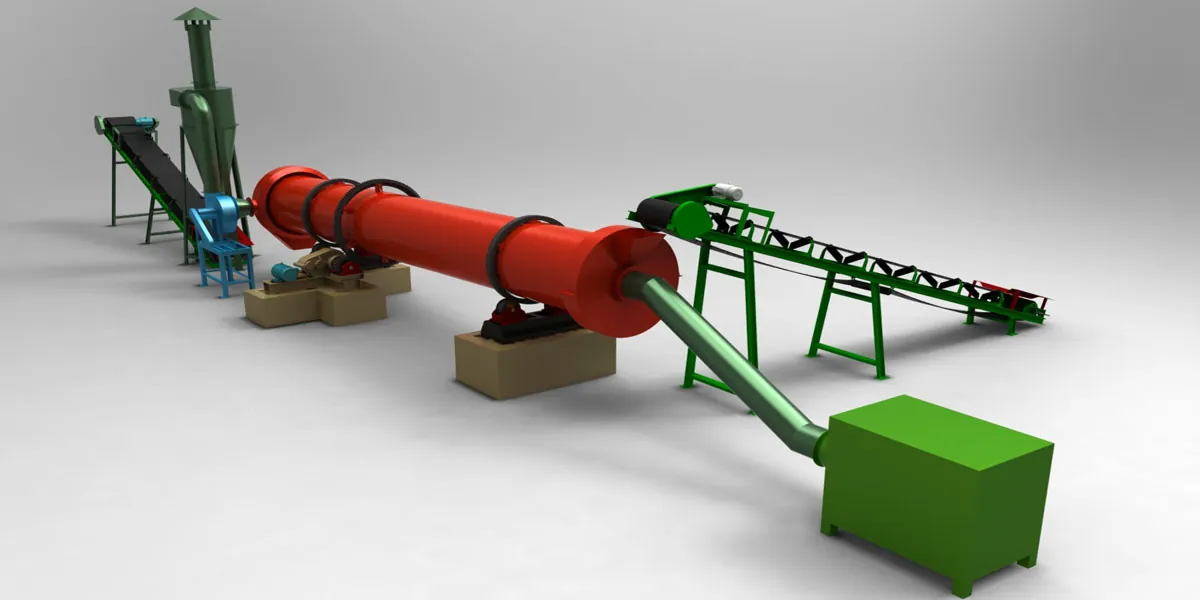
Rotary drum sawdust dryer, HG-G series three motors
| Model | Power | Capacity | Drum diameter | Weight |
|---|---|---|---|---|
| HG-G 650 | 7.5 + 7.5 + 1.5 kW | 500–800 kg/h | 650 mm | 3.7 t |
| HG-G 1000 | 7.5 + 7.5 + 1.5 kW | 800–1,200 kg/h | 1,000 mm | 4.3 t |
| HG-G 1200 | 7.5 + 15 + 1.5 kW | 1,300–1,500 kg/h | 1,200 mm | 7.4 t |
| HG-G 1500 | 11 + 22 + 1.5 kW | 1,500–2,000 kg/h | 1,500 mm | 12 t |
| HG-G 1800 | 11 + 37 + 2.2 kW | 2,000–2,500 kg/h | 1,800 mm | 23.8 t |
Three motors on every frame: the drum drive, the induced-draught fan and the airlock. Capacity is on sawdust at 30–40 % in and 10–12 % out; the HG-G 1500 and HG-G 1800 are shipped in two sections and assembled on site.
The number the whole line is built around
Two percentages decide the size of the furnace, the length of the pipe loop and the price of the machine: what the material arrives at, and what the press needs. Everything between them is water you are paying to evaporate.
| Material | Typical moisture in | Target moisture out | What it means |
|---|---|---|---|
| Sawdust, softwood | 25–40 % | 10–12 % | Dries fastest; the usual flash pipe material |
| Sawdust, hardwood | 30–45 % | 10–12 % | Slower — more heat per tonne, same machine |
| Rice husk | 10–15 % | 8–10 % | Often needs no drying at all before pelleting |
| Wood shavings | 20–35 % | 10–12 % | Grind to under 5 mm before a pipe dryer |
| Straw, grass, forage powder | 15–25 % | 10–12 % | Light material — watch the fan setting |
| Chips and hog fuel | 35–50 % | 10–12 % | Rotary drum sawdust dryer only |
These are working figures on material straight from a sawmill or a chipper, not laboratory averages. Tell us the moisture you actually measure and we size the furnace on that — a dryer sized on 30 % when the material runs 45 % will not make its capacity, whatever the table says.
Between the hammer mill and the pellet mill
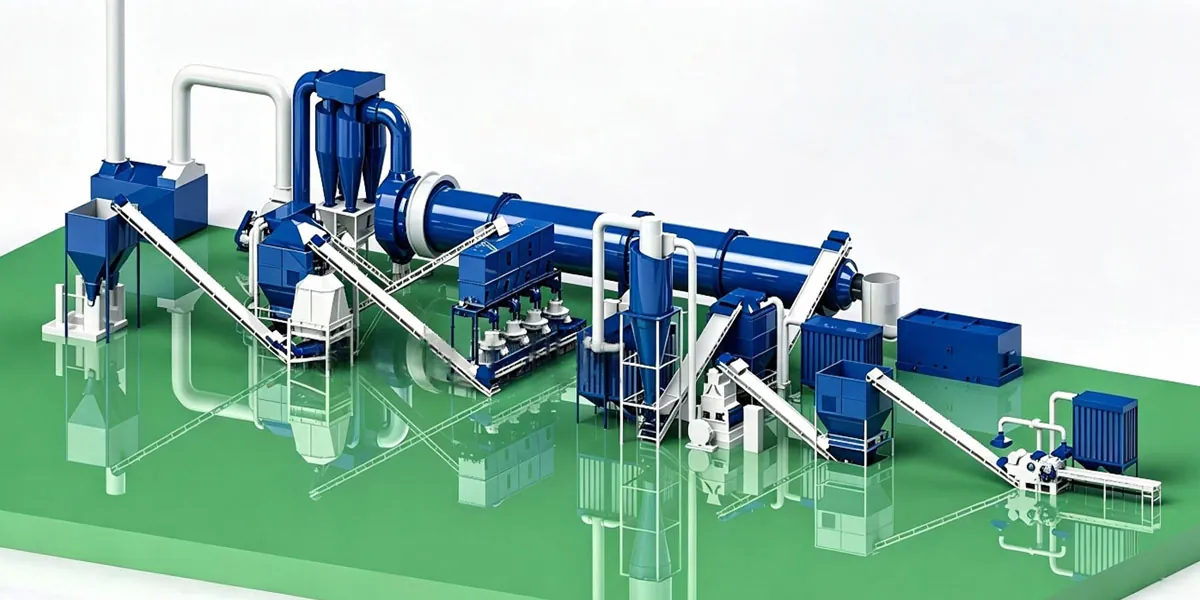
A biomass sawdust dryer is never bought on its own. It sits in the middle of a wood pellet line, and the two machines either side of it decide how it is built.
In a wood pellet line the order is wood chipper machine, wood hammer mill, biomass sawdust dryer, pellet mill, cooler, bagging. The dryer sits after the mill because a hammer mill is easier to feed wet than dry, and before the press because nothing else in the line can remove water.
Where the line starts from whole timber the two machines at the front are both needed: a wood chipper machine cannot make powder and a wood hammer mill cannot take a log. What comes out of the mill is 3–5 mm sawdust at 30–40 % moisture, which is exactly what a flash pipe sawdust dryer is built for.
On the press side, a flat die pellet mill or a diesel flat die pellet mill at 100–1,200 kg/h pairs with the HG-Q260; a vertical ring die pellet mill at 1–2.5 t/h pairs with the HG-G 1000 and up. For a complete plant see the 500 kg/h wood pellet plant, and for a small combined unit the combined pellet mill and hammer mill — which needs a dryer in front of it just the same.
The dryer is standard. The package around it is not
Two customers order the same HG-Q260 and get two different machines: one fires it with rice husk and discharges at 2.4 m into a buffer bin, the other fires it with diesel and blows straight into a cyclone above the press. Both are the same dryer underneath.
-
Heat source
A biomass furnace on firewood, rice husk or pellets is the cheapest per tonne and the usual choice where the material is free. A gas or diesel burner costs more to run but starts at the push of a button and needs no fireman — the answer for a plant with one operator. Waste heat from an existing boiler can be ducted in instead of a furnace.
-
Furnace size
Sized on the water you have to evaporate per hour, not on the capacity figure. A dryer asked to take 45 % down to 10 % needs roughly twice the furnace of the same machine taking 30 % down to 12 %.
-
Discharge height and ducting
The airlock discharges where your next machine wants it — over a buffer bin, into a mixer, or straight into the press hopper. The pipe route is drawn around your building; a pipe sawdust dryer can be turned to any angle, which is most of the reason it fits where a drum will not.
-
Dust collection
A cyclone takes the bulk out of the exhaust; a bag or cartridge filter behind it takes the rest. On sawdust the second stage is worth having — the fines that escape a bare cyclone settle on everything within fifty metres.
-
Foundation and power
A pipe dryer stands on a level floor and needs no foundation. A drum dryer needs a concrete block for the tyres and the drive. Both are quoted with the motor voltages you specify — 380 V three-phase as standard, 415 V / 60 Hz to order.
In the crate, on the frame
A flash pipe sawdust dryer leaves in one crate with the loop bolted together. A rotary drum sawdust dryer above HG-G 1000 leaves in two sections and is assembled on your foundation.
-
Furnace
Biomass, gas or diesel, with the burner, the refractory lining and the ash door. Sized to the evaporation duty you specify.
-
Drying pipe and columns
Flanged sections with the U-bends, gaskets and bolts. The loop is numbered for assembly and the drawing goes in the crate.
-
Cyclone and airlock
Cyclone with the stand, and a rotary airlock with its own geared motor — the airlock is what keeps the system under negative pressure.
-
Fan and motor
Centrifugal fan on the clean side, V-belt drive, guard, and the starter matched to the supply you name.
-
Screw conveyor and control panel
Feed screw with a variable speed drive, and a panel with the furnace, fan, airlock and conveyor controls interlocked. A set of spanners and the spare parts list — bearings, belts and airlock vanes.
Where the biomass sawdust dryer sits in the range
A dryer is one machine in a wood pellet line: something has to make the sawdust and something has to press it. Below are both ends, and the other machines that come with a dryer in the same order.
Tell us the material and the water in it
The material, the moisture you measure, the kg/h of dried material and what you can burn for heat. We reply with the type, the model and a price.
Reply within one working day. No obligation.
The dryer running, and what it feeds
The dryer running on sawdust, the rotary drum dryer on site, and the pellet lines the dried material goes into.

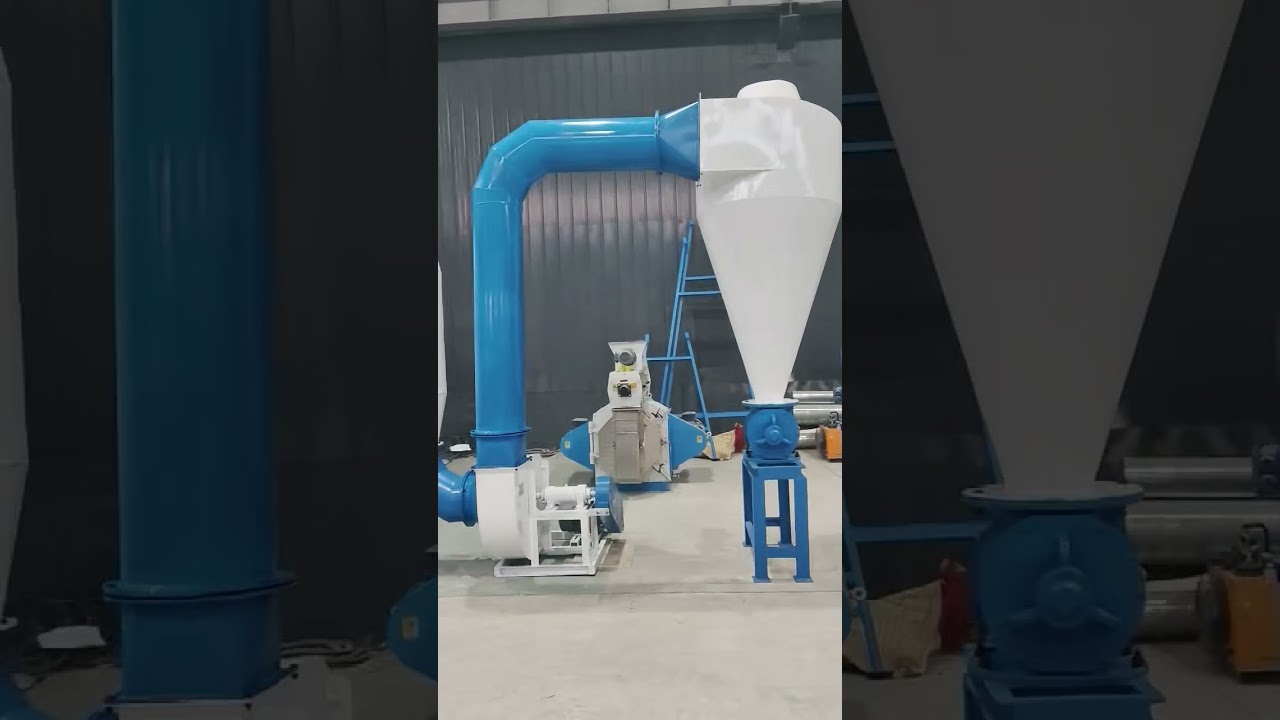
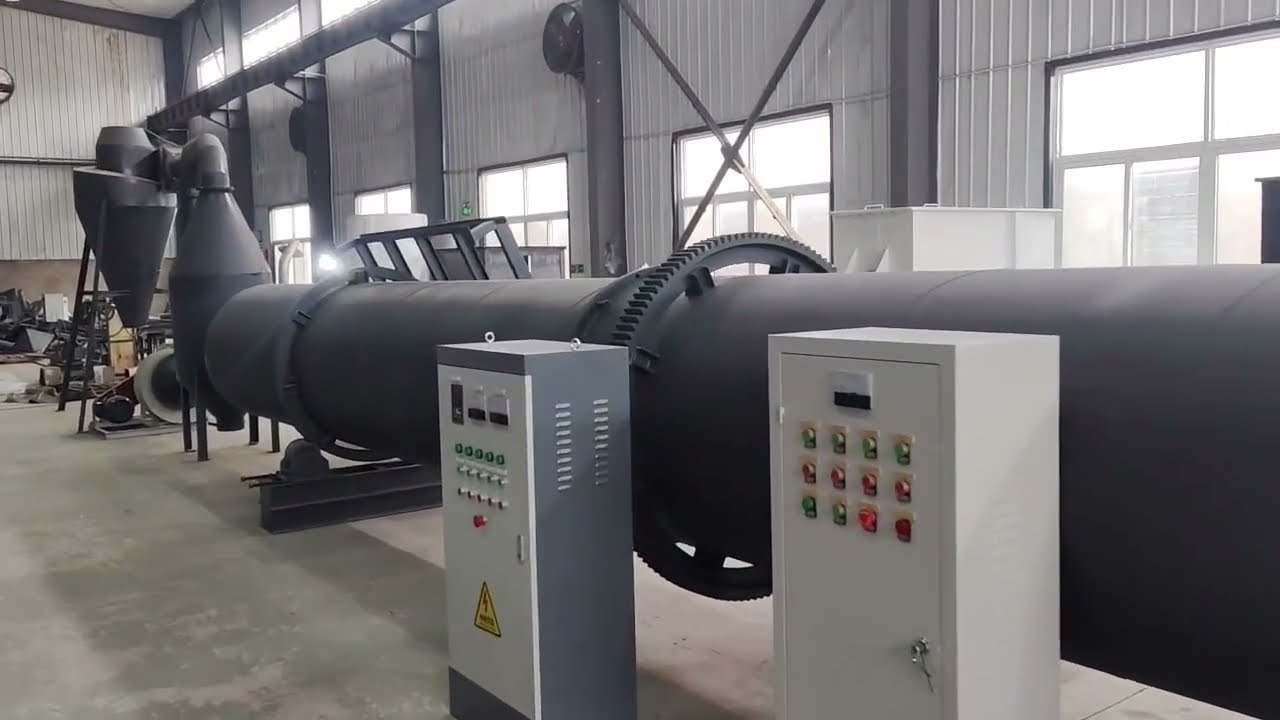
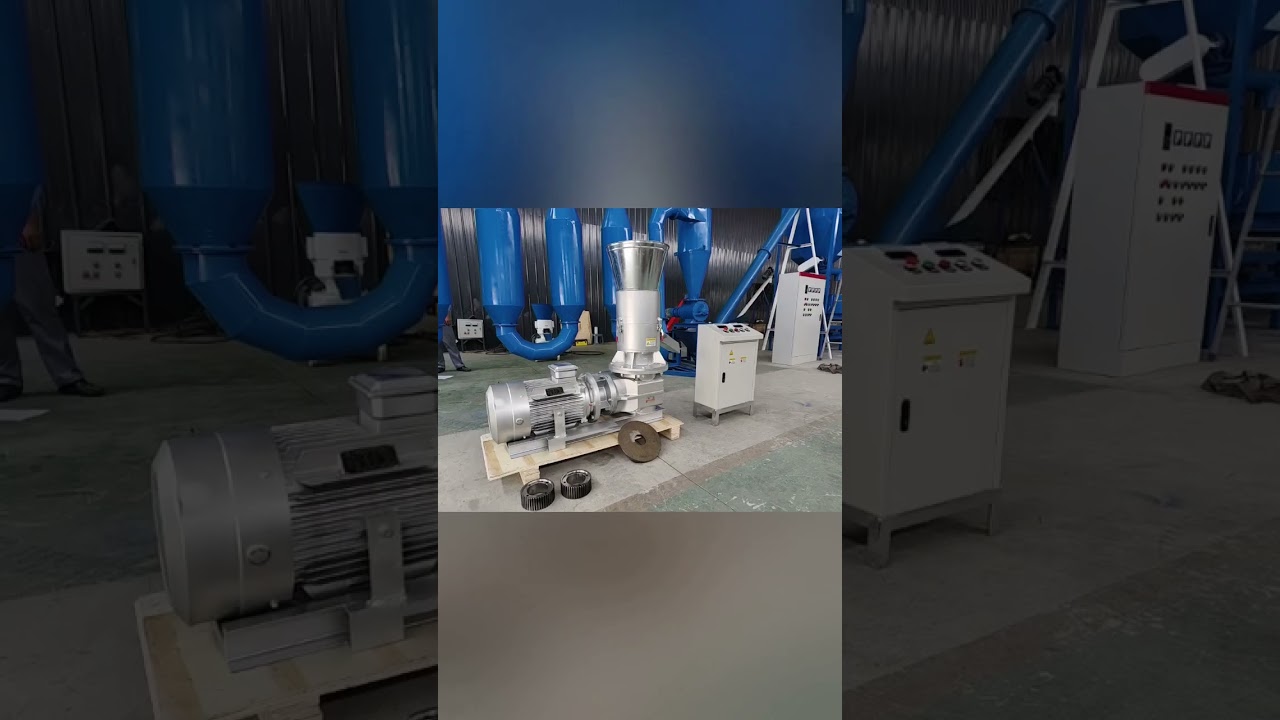


More test runs, shipping records and installation footage on our YouTube channel, and the whole Biomass Pellet Machines playlist.
What buyers ask before ordering a biomass sawdust dryer
What does a biomass sawdust dryer do?
It takes sawdust, rice husk, wood shavings or straw powder at 25–50 % moisture down to 8–12 % before pelleting. A pellet press cannot make a dense pellet from wet material: below 8 % the lignin will not bind, above 15 % the rollers slip and the die blinds over. The dryer is the only machine in a wood pellet line that removes water.
Should I buy a flash pipe sawdust dryer or a rotary drum sawdust dryer?
Under about 1 t/h of pellets, the flash pipe sawdust dryer: it is cheaper, smaller, dries in one to three seconds and handles sawdust and wood powder down to 5 mm. Above that, or if the material is chips and hog fuel at 40 % and up, the rotary drum sawdust dryer — it takes 20–30 mm material as it comes, and scales to 2,500 kg/h.
How much moisture can a biomass sawdust dryer take out?
A flash pipe sawdust dryer is usually specified from 25–30 % in to 10–15 % out in one pass, and will take 40 % on sawdust if the furnace is sized for it. A rotary drum sawdust dryer takes 30–50 % down to 8–12 %. The limit is the water to be evaporated per hour, so a dryer asked to remove more water runs at a lower capacity on the same motor.
What can I burn in the furnace?
Firewood and wood offcuts, rice husk, sawdust pellets, or gas and diesel through a burner. Biomass is the cheapest per tonne and the usual choice where the fuel is free; gas and diesel cost more to run but start instantly and need no attendance. Waste heat from an existing boiler can be ducted in instead of firing a furnace at all.
How much fuel does it use?
The HG-Q260 burns 40–50 kg/h of firewood at about 4,000 kcal/kg when it is running at its 200–250 kg/h capacity; the HG-Q350 needs 80–100 kg/h for 500–600 kg/h. Per tonne of dried sawdust that is roughly 150–250 kg of wood, or about a fifth of that in diesel. The exact figure depends on the moisture you start from — which is why we ask for it before quoting.
Does the dryer need a foundation?
A flash pipe sawdust dryer does not: it stands on a level concrete floor and the frame is bolted down. A rotary drum sawdust dryer needs a concrete block under the tyres and the drive, and the HG-G 1500 and HG-G 1800 need it sized by an engineer — those two frames weigh 12 and 23.8 tonnes.
Can it run indoors?
Yes, and most do. The exhaust has to go outside through a stack, and a dust collector or filter bag on the exhaust is worth having: a bare cyclone lets the fines through and they settle on everything within fifty metres. Allow headroom for the cyclone — 2.8 m overall height — 3 m on the HG-Q260, 3.2 m on the HG-Q300 and HG-Q350.
How long is delivery?
10–20 working days after the deposit for a flash pipe sawdust dryer with a biomass furnace, 20–30 for a rotary drum sawdust dryer, which ships in sections above HG-G 1000. Payment is TT with 40 % in advance and the balance before delivery; the pipe loop, cyclone and columns are crated and numbered for assembly.
Send the material and the moisture
What the material is, how wet it arrives, the kg/h of dried material you need, and what you can burn for heat. Those four answers choose between a flash pipe sawdust dryer and a rotary drum sawdust dryer, and size the furnace behind it.
- Emailinfo@pelletmachines.net
- WhatsApp+86 186 0385 1787
- HoursMon–Sat, 08:00–20:00 (GMT+8)
Send a photo of the material and a moisture reading if you have one, and a photo of the site. We will tell you which type fits, which model, and what the furnace has to do.
What happens after you send this
We answer with the type, the model, the furnace size and a price — and with the fuel cost per tonne of dried sawdust, which is the number that decides whether the dryer pays for itself.
Your details are not shared. One follow-up, no mailing list.