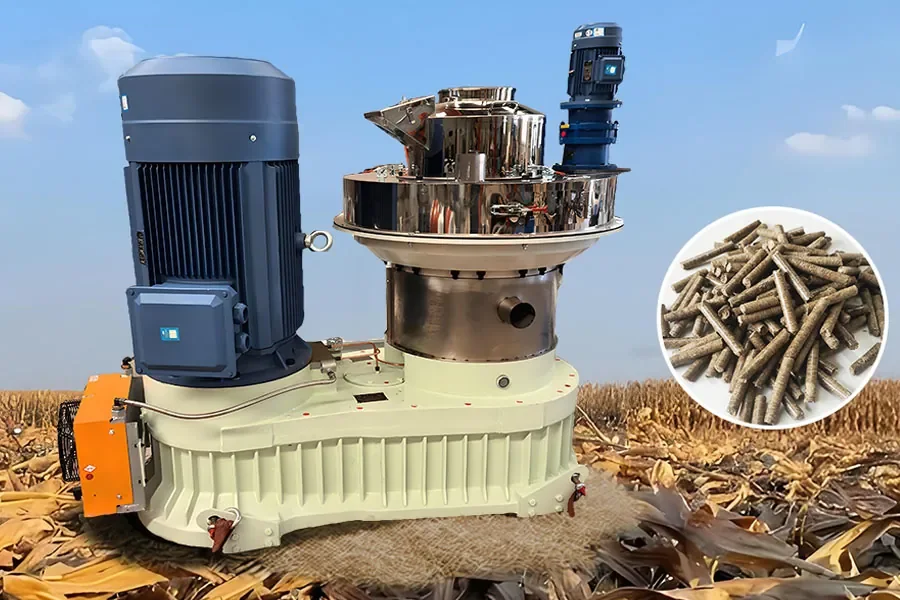
How Many Pellet Mills Do You Need?two flat die pellet mills, or one vertical ring die pellet mill
At 1 t/h there are two ways to get there and they draw the same 90 kW at the die: two 45 kW flat die pellet mills, or one 90 kW vertical ring die pellet mill. What separates them is not efficiency — it is what happens on the day one of them has to stop, and how much floor you have. This page is the comparison at six output capacities, the arrangement our own production lines actually use, and a calculator for what a stopped machine costs.
- 90 kW at the die either way, at 1 t/h
- 10.0–13.3 against 11.1–16.7 kg/h per kW
- One die change costs half the output, or all of it
- A calculator: what a stoppage costs you
We quote the arrangement, not just the model · Two flat die pellet mills or one vertical ring die pellet mill, with the die and the power for each
The short answer
Below 1.5 t/h, two machines. Above it, one — and then a second one.
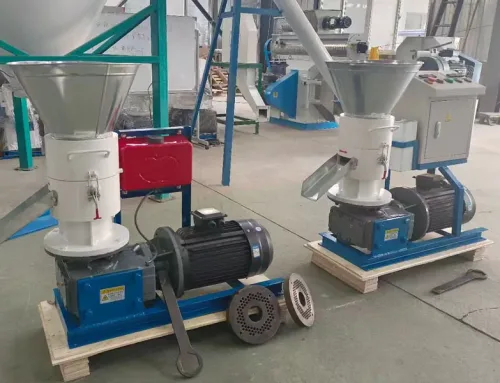
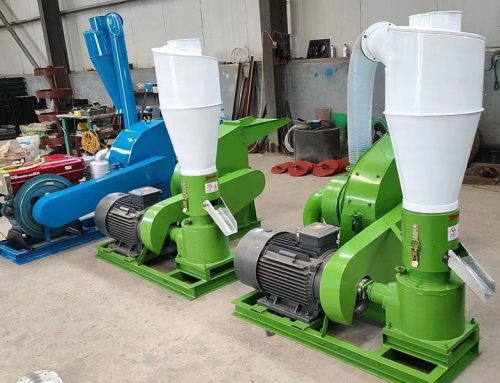
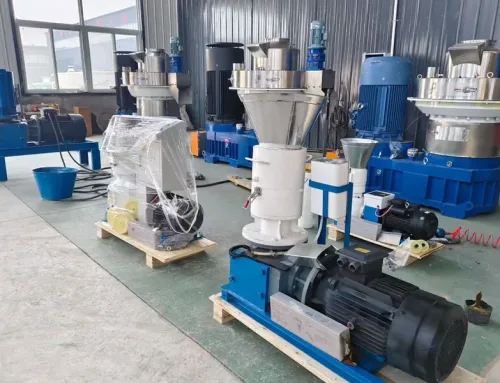
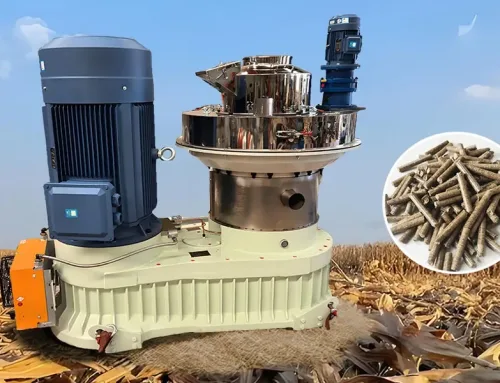
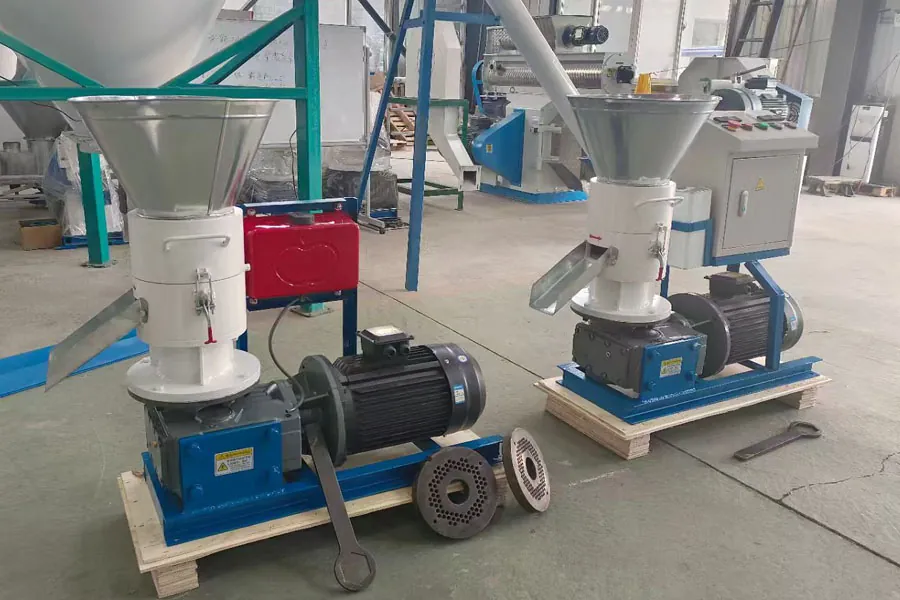
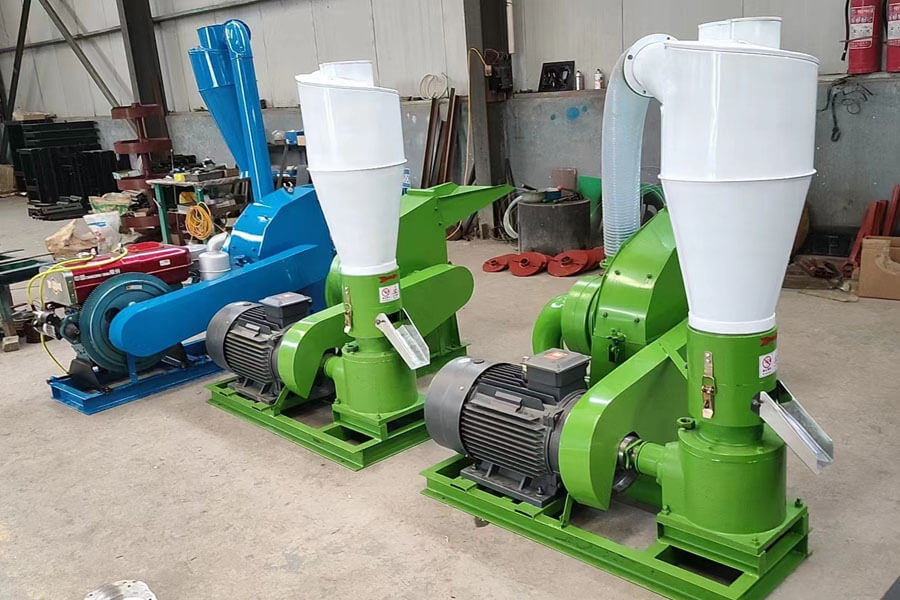
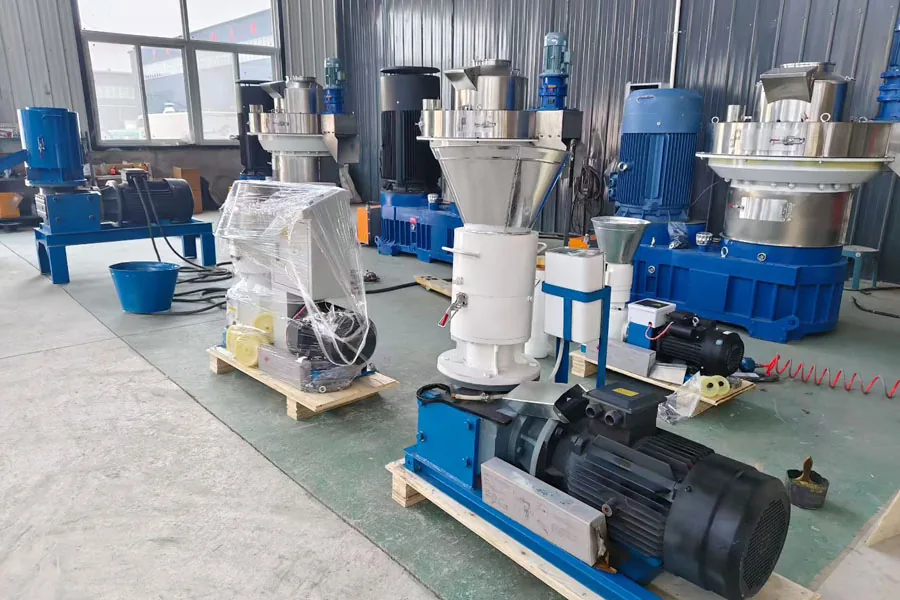
At 1 t/h both arrangements are right, and they draw the same 90 kW at the die. Two 45 kW flat die pellet mills make 900–1,200 kg/h between them; one 90 kW HML-560 vertical ring die pellet mill makes 1,000–1,500 kg/h on its own. The vertical ring die makes 25 % more per kW, so it wins on power and it wins on floor space. The two flat die pellet mills win on everything else: the die is cheaper, it comes out in one to two hours with one person, and while it is out the other pellet mill keeps running at half output instead of nothing. Below about 1.5 t/h we build two flat die pellet mills. Above it, one vertical ring die pellet mill — and past 2.5 t/h, two or three of them, because there is no single machine that covers it.
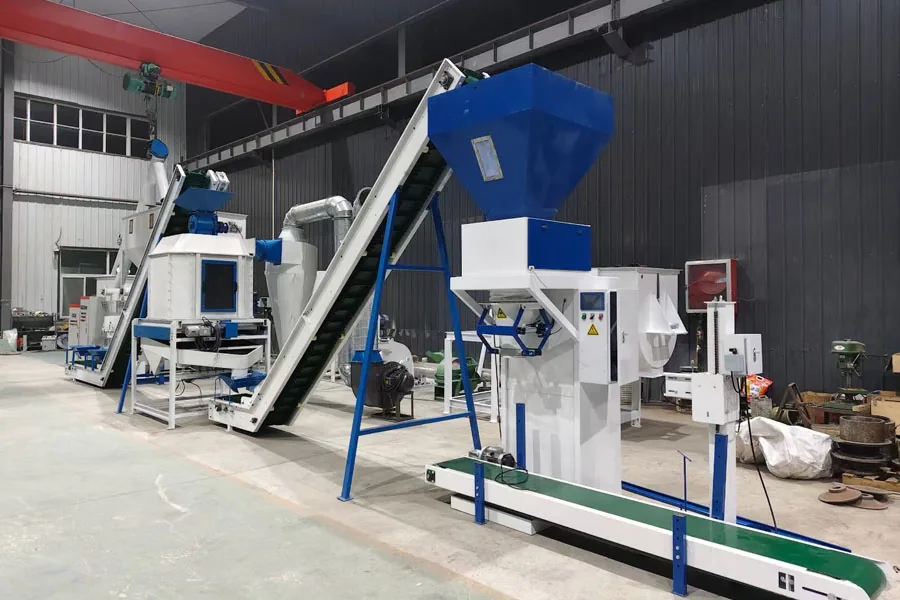
The figures here are the ones on our own model sheets: PM-D450B at 45 kW and 450–600 kg/h, HML-560 at 90 kW and 1.0–1.5 t/h. Installed power for a production line includes the chipper, the wood hammer mill, the dryer and the pellet cooler, so it is always more than the figure at the die.
Two flat die pellet mills against one vertical ring die pellet mill
The same 1 t/h, compared on the nine things that decide it. The first three are the ones a quotation shows; the rest are the ones you live with.
| Dimension | Two PM-D450B flat die pellet mills | One HML-560 vertical ring die pellet mill |
|---|---|---|
| Output capacity | 900–1,200 kg/h | 1,000–1,500 kg/h |
| Motor at the die | 2 × 45 kW = 90 kW | 1 × 90 kW |
| kg/h per kW | 10.0–13.3 | 11.1–16.7 |
| The die | Flat plate, 450 mm, one person, 1–2 h to change | Ring die, 560 mm, two people, 2–4 h to change |
| What a die costs | The cheaper of the two, and it is a plate of steel | About twice as much, and it is a cylinder with a flange |
| When one stops | 50 % of output, and the other keeps running | 0 % of output, and the site is quiet |
| Floor space | Two machines, two feeders, two starters, two die sets | One machine, one feeder, one starter, one die set |
| Operators | One person can watch both | One person, with nothing else to watch |
| Spare parts to stock | Two sets of rollers, two die plates, two of everything small | One set of rollers, one ring die, and a heavier crane to lift it |
Read the first three rows and the vertical ring die pellet mill wins: more output, the same power, better efficiency. Read the last four and the two flat die pellet mills win, because they are the only arrangement on this page where a maintenance job does not stop the site. The eight-dimension comparison covers the machines themselves; this page is about how many of them to put side by side.
Three columns of sentences will not fit a phone. Swipe the table sideways, or read the first two rows, which are the numbers a quotation shows.
The efficiency gap is in the shape of the die, not in the motor. A ring die is a cylinder and the rollers press from inside it, so the whole working face is under load and there is no edge for material to escape from. A flat die plate is a disc with two rollers running on top of it: the material near the rim travels further than the material at the centre, the pressing area is smaller for the same motor, and some of the energy goes into pushing material outwards rather than through the hole. That is the 25 % in the kg/h per kW row.
The downtime gap is in the shape of the die too, for a different reason. A flat plate lifts off the top with the rollers still in place, and one person can do it with a hoist and a spanner. A ring die comes out of the front of the chamber, needs two people, and on the larger models needs the roller assembly out first. Two flat die pellet mills turn that job into a half-capacity hour; one ring die turns it into a stopped site. Neither is a fault — it is the trade you make when you buy the more efficient machine.
What we actually fit, at each output capacity
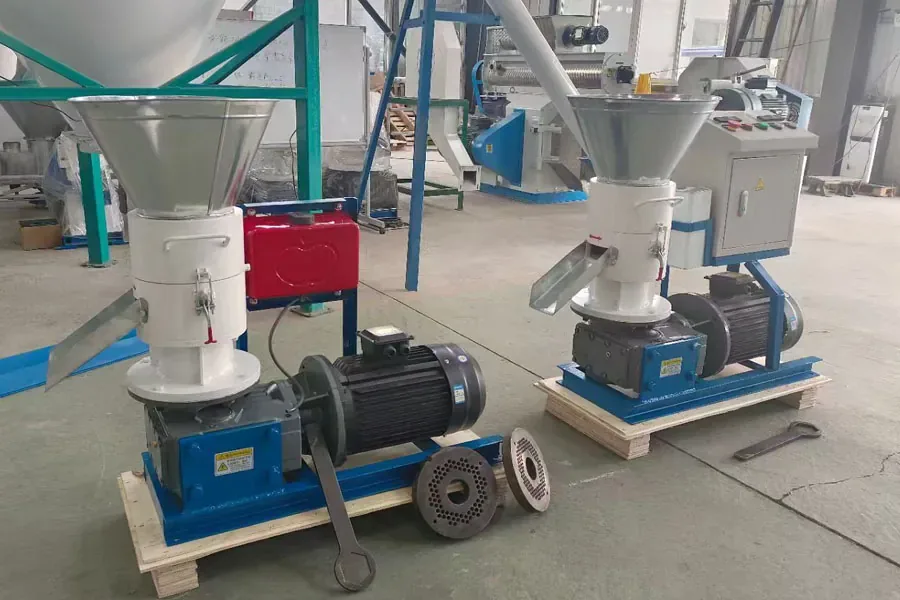
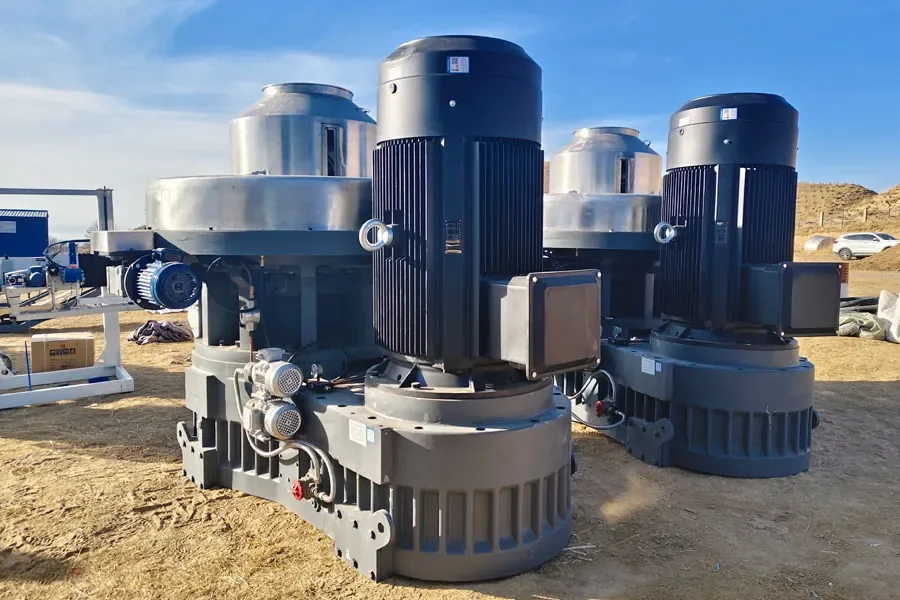
Five production lines, five arrangements. The two 1,000 kg/h builds are the interesting pair: the same output and almost the same power, reached two different ways.
| Output capacity | What we fit | Installed power | Why that arrangement |
|---|---|---|---|
| 500 kg/h | 1 × PM-D450B flat die pellet mill | 99 kW | One machine. A second would idle, and 45 kW of idle is 45 kW on your electricity bill |
| 1,000 kg/h | 2 × PM-D450B flat die pellet mills | 190 kW | Two, one operator, die changes off-shift. This is the build we sell most of |
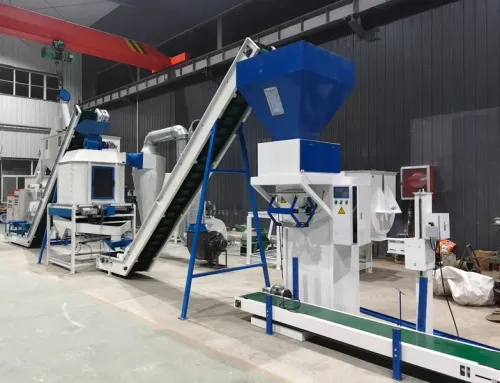
| 1,000 kg/h, biomass | 1 × HML-560 vertical ring die pellet mill | 194 kW | The same power in one machine, for a site with no floor to spare for two |
| 2,000 kg/h | 2 × HML-560 vertical ring die pellet mills | 354 kW | Past the ceiling of the flat die range, so it is two vertical ring die pellet mills rather than four flat die pellet mills |
| 5,000 kg/h | 3 × HML-600 vertical ring die pellet mills | 775 kW | Three, not one bigger: HML-700 tops out at 2.5 t/h and there is nothing above it |
The two 1,000 kg/h builds are the honest comparison. The 1,000 kg/h wood pellet production line is two PM-D450B flat die pellet mills at 190 kW installed; the 1,000 kg/h biomass pellet production line is one HML-560 vertical ring die pellet mill at 194 kW. Four kilowatts apart, same output capacity, and the choice between them is floor space against downtime — not efficiency.
Four columns will not fit a phone. Swipe the table sideways for the reason column, or read the first two, which name the machines.
Read the third column and the pattern is that installed power barely moves between the two arrangements at the same output. What moves is everything else: 190 kW spread over two machines means two feeders, two starters, two die sets and one operator; 194 kW in one machine means one of each and a site that stops when it stops. That is why the biomass build exists as a separate line rather than as an option on the wood build — it is for the site that has the power but not the floor.
The 5,000 kg/h row is where parallel stops being a compromise and becomes the only answer. Three HML-600 at 132 kW each is 396 kW at the die and 775 kW installed with the chipper, the wood hammer mill, the dryer and the pellet cooler. There is no single pellet mill in the catalogue that makes 5 t/h, and there is no plan to build one — above about 2.5 t/h every manufacturer answers with more units.
How many machines each route needs, at six output capacities
Whole machines, rounded up, at the top of each model’s rated capacity. The last column is the number that decides your electricity bill.
| Output capacity | PM-D450B units | HML-560 units | kW at the die, flat / ring |
|---|---|---|---|
| 500 kg/h | 1 | — | 45 / — |
| 1,000 kg/h | 2 | 1 | 90 / 90 |
| 1,500 kg/h | 3 | 1 | 135 / 90 |
| 2,000 kg/h | 4 | 2 | 180 / 180 |
| 3,000 kg/h | 5 | 2 | 225 / 180 |
| 5,000 kg/h | 9 | 3 × HML-600 | 405 / 396 |
Units are rounded up to whole machines at the top of each rating — PM-D450B at 600 kg/h, HML-560 at 1,500 kg/h, HML-600 at 2,000 kg/h. A dash means that model is oversized for that output capacity: one HML-560 would run at a third of its rating, which is a bad way to buy 500 kg/h. The sizing guide has the kg/h per kW for every model in the catalogue, and the compression ratio chart has the die each of them runs.
Two things fall out of this table. The first is that the crossover is at 1.5 t/h, not at 1 t/h: at 1,000 kg/h the two routes are identical in power, and at 1,500 kg/h the flat die pellet mill route needs three machines and 45 kW more than the vertical ring die route needs. The second is that the flat die pellet mill column stops being a sensible plan somewhere around 3,000 kg/h — five machines is a workshop, not a production line, and the labour and the conveying start to cost more than the power you saved.
The 500 kg/h row is the other end of the same argument. A single PM-D450B at 45 kW is the right answer there, and one HML-560 at 90 kW is not, because a vertical ring die pellet mill running at a third of its rating makes a worse pellet than a flat die pellet mill running at its maximum: the die needs pressure to build a mat, and pressure comes from material, not from a bigger motor.
What a stopped machine costs you
This is the number that decides two machines against one, and it is the one nobody puts in the business plan. Six fields, no currency.
With 2 machines in parallel, one stoppage takes 50 % of the output with it: 4 t and 240 of margin. On a single machine the same stoppage is 8 t and 480 — 5,760 a year at 12 a year, which is 2.4 % of the year’s output at 4,000 hours.
Output capacity is the site total, so a stoppage costs only the share of it that the stopped machine was carrying. A stoppage here is anything that takes one machine out of production for the hours you enter — a die change, a blocked die, a motor or a starter. The margin figure comes from the cost per tonne page; if you do not know it, 60 a tonne is a working default for a wood pellet line in most markets.
The figure to watch is the last one, the margin a year. A single stoppage looks trivial — eight hours, four t, 240 of margin on a 1 t/h site. Twelve of them a year is 5,760, and that is before you count the bagging you missed, the truck that went away empty and the customer who found another supplier. On a 5 t/h site the same arithmetic is 28,800 a year, which is a meaningful share of the capital difference between two machines and one.
Two things follow. First, the calculation is only worth running if you know your margin per tonne — the cost per tonne page is where that comes from, and the payback page is where the answer goes. Second, redundancy is not free: the second machine is capital, and the calculation only justifies it when the stoppages are real. A site running 500 hours a year should not buy a second machine to protect 4 t a stoppage.
From an output capacity to an arrangement
In this order. The first step decides whether the other three matter.
Count the hours, not the capacity
A 1 t/h build running 2,000 hours a year makes the same t as a 500 kg/h build running 4,000. Before comparing arrangements, decide which of the two numbers you are actually buying.
Add up what the second machine really costs
Two flat die pellet mills is two feeders, two starters, two die sets, two sets of rollers and about double the floor. The pellet mill is the cheap part of the second one.
Price the stoppage
Hours lost, times output capacity, times margin a tonne, times how often it happens. That is the only figure on this page that argues for two machines over one.
Then pick the arrangement, not the model
Below 1.5 t/h, two flat die pellet mills. Above it, one vertical ring die pellet mill, and past 2.5 t/h two or three of them. The model follows from the arrangement, not the other way round.
The thing to hold on to is that this is not really a question about equipment. A buyer who starts from "which pellet mill is best" ends up with one good machine and a site that stops every time a die comes out. A buyer who starts from "how many, and what happens when one is down" ends up with the right number of machines, and the model is then almost obvious — the flat die pellet mill below 1.5 t/h, the vertical ring die above it.
The second thing is that the arrangement is much harder to change later than the model. Adding a second flat die pellet mill to an existing build is a feeder, a starter and a bit of floor; adding a vertical ring die pellet mill to a site built around flat die pellet mills is a new foundation and a new conveying layout. If there is any chance the site doubles in the next five years, the floor plan should say so now — the 2,000 kg/h wood pellet production line and the 5,000 kg/h line are the same argument one and two steps further on.
Three ways to get more output, cheapest first
Not three machines — three decisions. Most sites try the first one and are surprised how far it goes.
-
Run what you have for more hours
Two shifts instead of one doubles the output for the cost of the labour and the electricity, with no capital at all. The limit is the die: a 500-hour die becomes a 1,000-hour die a year, and the die budget moves with it. This is the cheapest output on any site and it is almost always the first thing to look at.
-
Add a second machine of the same size
The flat die pellet mill route, and the only one that buys you redundancy. Capital is roughly double the pellet mill plus a feeder and a starter, floor is roughly double, and the operator is the same person. What you get is 50 % of output during any maintenance job and the ability to run one machine on a small order without burning fuel on two.
-
Buy one bigger machine
The vertical ring die route. It is the more efficient machine — 11.1–16.7 kg/h per kW against 10.0–13.3 — and it takes less floor for the same output. What it does not give you is a second production line: when the ring die comes out, the site stops, and past 2.5 t/h you are back to buying two or three of them anyway.
The order matters because the three are not alternatives to each other so much as a sequence. Hours first, because they are free. Then a second machine, because it is the cheapest form of redundancy. Then a bigger machine, when the floor and the power bill have become the constraint rather than the capital. A site that skips straight to the third one usually ends up buying the first two afterwards.
What buyers ask about running more than one
Eight questions, answered the way we answer them on the phone.
Can you run two pellet mills in parallel?
Yes, and it is the normal way to build anything above 1.5 t/h. Each machine has its own feeder, its own starter and its own die; they do not need to be synchronised, and they can discharge onto one conveyor or two. What they do need is a floor plan that leaves room to change a die on either of them without moving the other.
Is one big pellet mill better than two small ones?
Above 1.5 t/h, yes — more output per kW and less floor for the same capacity. Below it, two small ones usually win, because the only thing that really separates them is what happens when a die has to come out. Two machines keep half the output; one machine keeps none.
How many pellet mills do I need for 1 ton an hour?
Two PM-D450B flat die pellet mills at 45 kW each, or one HML-560 vertical ring die pellet mill at 90 kW. Same power at the die, same output capacity. Our own 1,000 kg/h wood build uses the two flat die pellet mills; the biomass build at the same output uses the single vertical ring die pellet mill.
What happens when one pellet mill stops?
With two in parallel you keep half the output and half the margin, and the other machine carries the order. With one you keep nothing — the site is quiet, the operator is idle and the truck that was booked goes away empty. That difference, multiplied by how often it happens, is the whole case for two machines.
How long does it take to change a die?
A flat die plate comes out of the top with the rollers still in place: one person, one to two hours. A ring die comes out of the front of the chamber and on the larger models the roller assembly comes out first: two people, two to four hours. Both are routine jobs, done on a schedule — the question is whether the site is making pellets while they happen.
Do two machines need two operators?
No. Two flat die pellet mills side by side are watched by one person, and that is part of why the arrangement works: the labour cost does not double with the number of machines. What does go up is the walking — the two machines should be within a few metres of each other, not at opposite ends of the building.
Can I add a second pellet mill later?
With flat die pellet mills, usually yes: it is a feeder, a starter, a bit of floor and a decision about conveying. With a vertical ring die pellet mill it is harder, because the foundation, the feed arrangement and the clearance for a die change all have to have been planned for. If the site might double, say so when the floor plan is drawn, not when the order comes.
Is a vertical ring die pellet mill more efficient?
Yes — 11.1–16.7 kg/h per kW against 10.0–13.3 for a flat die pellet mill, so 25 % more output for the same motor. It is why the crossover is at 1.5 t/h and not at the price: the efficient machine wins on power, and the two-machine arrangement wins on the day the die has to come out.
Tell us the output capacity and the hours, and we will tell you the arrangement
Not just the model. How many machines, what each one is rated at, what the site does when one of them is down, and what the floor plan has to leave room for. If one machine is the right answer we will say so — and if two are, we will show you the arithmetic rather than the brochure.
What happens after you send it
We reply with the number of machines, the model for each, the die ratio for your material, the installed power and the floor it needs — and the t you lose per stoppage at each arrangement, so the redundancy decision is made on your numbers rather than ours. If your output capacity is under 1.5 t/h we will usually quote one flat die pellet mill first and tell you what a second one would buy you.
Your details are not shared. One follow-up, no mailing list.