


Wood Powder MachineWP series — 10 to 500 mesh from chips, husk and straw
A wood powder machine takes what a wood hammer mill leaves at 3–5 mm and grinds it down to the fineness the buyer asks for — 40 to 325 mesh for incense and mosquito coil, up to 500 mesh on the finer frame. Three cutter stages in one chamber, water-cooled, with the cyclone, the bag filter and the control cabinet in the crate.
- WP500, WP800 and WP900 — 22 to 55 kW
- 10–500 mesh on the WP800, 40–325 mesh on the WP900
- Coarse, fine and re-crushing blades in one chamber, air-classified on the way out
- Cyclone, bag filter, ducting and control cabinet with every unit
Reply in 12 working hours · Blades and one spare set ship with every unit · Delivered to 40+ countries
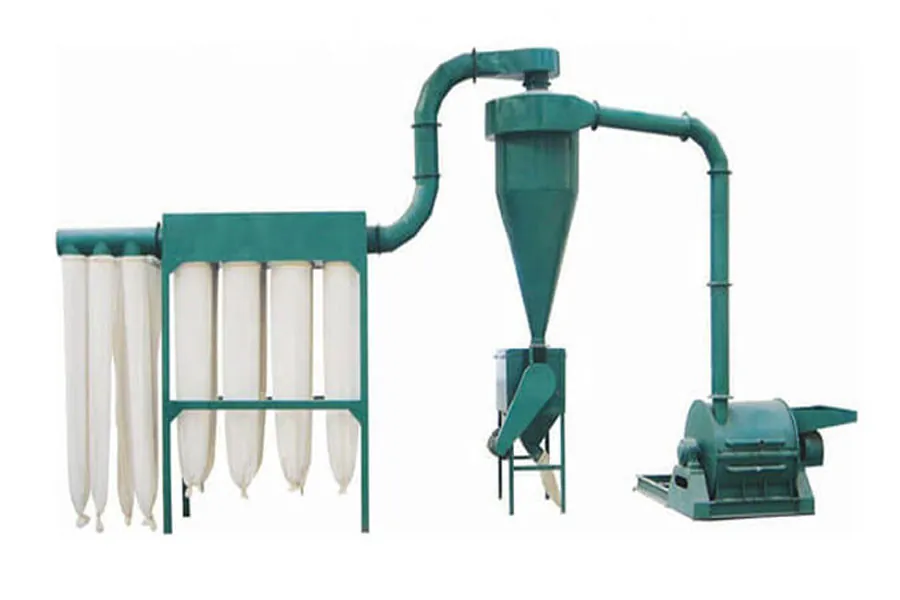
A hammer mill stops at millimetres — this one works in mesh
Both machines break wood down. The difference is where they stop: a wood hammer mill hammers material through a screen and hands it over at 3–5 mm. A wood powder machine keeps going, cutting in an air stream until the particles pass a classifier, and that is a different machine with a different bill.
The chamber holds three sets of blades, not one rotor of swinging hammers. Coarse blades break the chips, fine blades cut what is left, and centrifugal blades throw the material against the liner for the last pass. Powder fine enough to pass the classifier leaves with the air; anything coarser drops back into the chamber and is cut again. That is why the machine is sold on a mesh range rather than a hole size — you are not selecting a screen, you are setting how long the material stays under the blades.
The chamber and the bearing housing are water-cooled. Blades that stay cool keep their hardness, and hardness is the whole economics of this machine: a set of blades at 300 mesh is working much harder than the same set at 80 mesh, and a set that overheats is a set you replace twice as often.
What it is not: a chipper, and not a dryer. Material goes in under 40 mm and under 6 % moisture. Logs, pallets and branches need a wood crusher first, and wet chips need drying — a wood powder machine fed damp material coats its own chamber and blocks. On a site that only needs 3–5 mm sawdust for pellets, a wood hammer mill does the job for a fraction of the power.
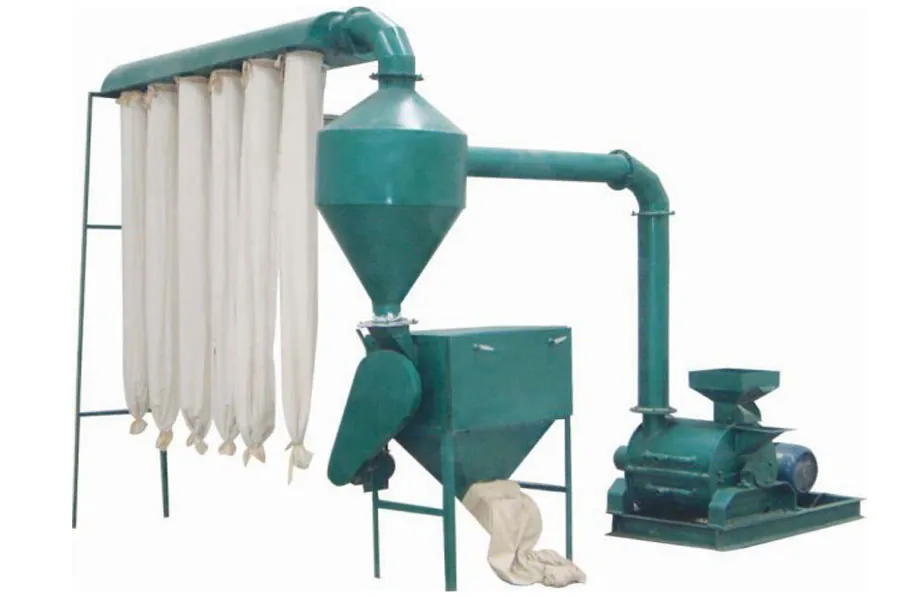
Two frames, 22 to 55 kW
Output is set by the fineness you sell, not by the frame alone — the same machine at 300 mesh moves a fraction of what it moves at 80 mesh. Tell us the mesh and we quote the capacity for that mesh.
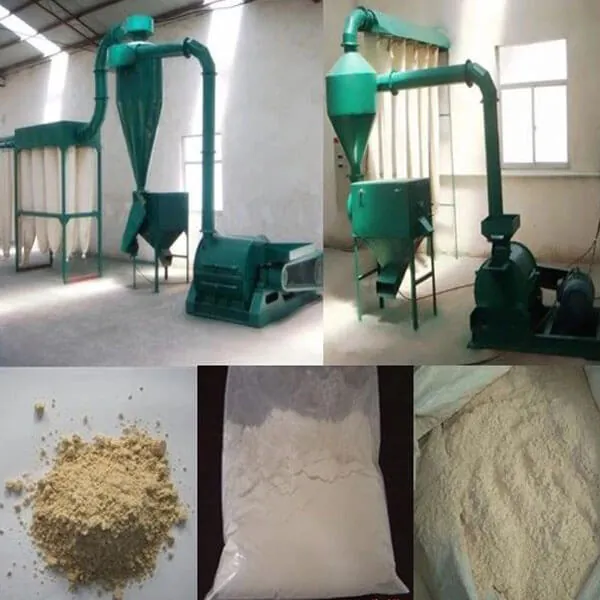
Wood powder machine, WP series water-cooled chamber
| Model | Fineness | Blades | Motor | Weight |
|---|---|---|---|---|
| WP800 | 10–500 mesh | 72 pcs | 22–30 kW | 2,600 kg |
| WP900 | 40–325 mesh | 96 pcs | 45–55 kW | 3,800 kg |
Raw material under 40 mm (under 40–50 mm on the WP900), moisture under 6 %. Rotor speed 3,300 rpm on the WP800 and 2,900 rpm on the WP900; floor area 700 × 250 × 430 cm and 700 × 200 × 430 cm respectively, cyclone and bag filter included in that footprint. A third, smaller frame — the WP500 — uses the same chamber on a shorter body; its blade count and motor follow the fineness you sell, so it is quoted against the material rather than printed as a row that would not hold for every order. Delivery is 7–15 working days; TT with 40 % deposit, balance before delivery; wooden or steel case.
Two frames, and the mesh you sell decides between them
The wood powder machine is bought on mesh, not on kilograms. WP800 covers 10 to 500 mesh on 22–30 kW; WP900 does 40 to 325 mesh on 45–55 kW with more blades.
Send the mesh and the material
The mesh you sell at, the material and the kg/h of that mesh are what we need. We reply with the model, the blade set, the screen and a price.
Reply within one working day. No obligation.
Five steps, one chamber, no screen to change
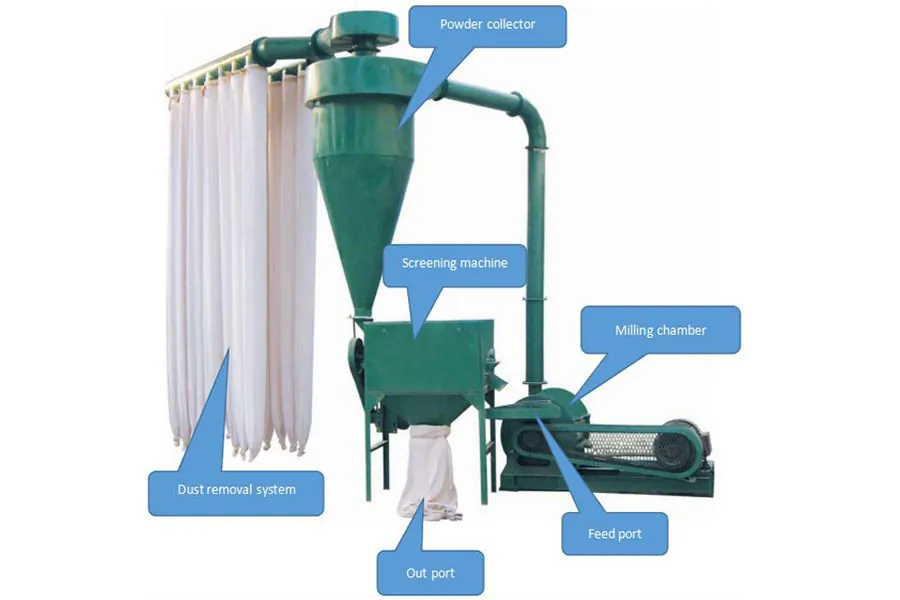
The material is cut, lifted, classified and returned inside the same housing. Nothing is adjusted by fitting a different screen — fineness is set at the classifier and at the feed rate.
Feed port
The inlet is self-suction: the air stream pulls material in, so there is no auger to jam. A slide gate sets the rate — too fast and the chamber overloads before the classifier can clear it.
Coarse blades
The first set breaks chips and husk down to a few millimetres. This is the stage that takes the shock, which is why the blades here are the ones you inspect first.
Fine and centrifugal blades
The second and third sets cut and throw the material against the liner. Powder is made here, in the air stream, not against a screen.
Classifier
Fine powder passes and leaves with the air. Coarse particles are too heavy to be carried and fall back for another pass — the reason the acceptance rate runs close to 100 % with no residue to re-feed by hand.
Cyclone and bag filter
Powder drops out of the cyclone into a bag at the out port. What is left in the air goes into the filter bags, so the exhaust is dust-free enough to run indoors.
Mesh is the specification, so buy on mesh
A buyer asking for wood powder is asking for a sieve size. Mesh counts wires per inch, so the number and the opening run in opposite directions — 40 mesh is 380 µm, 325 mesh is 44 µm, and the machine that makes one is not working at the same rate as the machine that makes the other.
What each grade is sold as sieve opening, not average particle
| Mesh | Opening | What it is sold as | Note |
|---|---|---|---|
| 40–60 | 380–250 µm | Briquette and pellet filler | Coarse and cheap to make |
| 80–100 | 180–150 µm | Incense base, wood flour for board filler | The volume grade in most incense plants |
| 120–200 | 125–74 µm | Mosquito coil, fine incense | Where the WP800 spends most of its life |
| 300–325 | 45–44 µm | Filler, coatings, premium incense | Slow — a fraction of the 100 mesh rate |
Figures are the nominal sieve opening; a real sample always carries a spread either side of it, and the spread is what your buyer will test. Send the sieve you are judged on and we set the classifier to it. Capacity falls steeply as the mesh rises: on the WP800 the 80–100 mesh grade is the working rate, 300 mesh is a speciality order.
What the machine will not take
Almost every complaint about a wood powder machine traces back to one of four things — wet material, oversize pieces, a feed gate opened too wide, or a chamber run past the point where the blades were still sharp.
Moisture, as received
Above that the powder sticks to the chamber wall and the classifier, and the machine spends its power moving paste instead of cutting wood. Wet chips have to be dried first — a drum dryer, or a day spread on a concrete floor for small volumes.
Particle size in
A wood powder machine is a grinder; feeding it anything it has to saw is how blades chip and the chamber goes out of balance. Logs, pallets and branch wood go through a wood crusher first, then a wood hammer mill if the crusher output is still coarse.
Blades are a consumable
Dry hardwood and nutshell wear blades faster than softwood or straw; sand and grit wear them faster still. Budget a set a year on clean material and keep a spare on the shelf — a worn set is re-ground, not thrown away.
Feed rate, not hopper level
Load the machine once it is at speed and watch the current draw rather than the hopper. Overloading is the one fault that damages the motor instead of the blades.
Where the powder machine sits
It is the third machine in a wood powder line, not the first: size, then moisture, then fineness. Getting that order wrong is the most common way a powder plant under-performs on paper and in practice.
If the powder is for pellets, the next machine is a flat die pellet mill or, above 800 kg/h, a vertical ring die pellet mill. If the whole sequence has to come sized and quoted together, a 500 kg/h wood pellet plant is the same machines on one quotation.
One crate, one motor, no separate dust kit to buy
The cyclone and the bag filter are part of the machine. That is worth checking when you compare quotes — a powder machine sold without them is a machine that cannot legally run indoors.
- Milling chamber on its base frameCoarse, fine and centrifugal blade sets fitted, liner plates in place.
- Motor and belt guard22–30 kW on the WP800, 45–55 kW on the WP900, three-phase 380 V. Tell us your voltage before the crate is built.
- Cyclone and bag filter setFilter bags with cages, shaker gear and the out port under the cyclone.
- Bolted ductingCut to the discharge height you name — into a bag, a bin or the next machine’s hopper.
- Control cabinetStarter, overload protection and ammeter, wired to the motor.
- One spare blade set and the manualWith the clearance figures for re-grinding and the bolt torque for the chamber.
What goes before and after a wood powder machine
The powder machine is one step in a chain. These are the machines it is bought with — the two in front of it and the ones that take its output.
Tell us the mesh and the material
The mesh your buyer tests, the material, its moisture as received and the kg per shift. We reply with the frame, the blade set, the classifier setting and a price.
Reply within one working day. No obligation.
The two machines in front of it, and the line behind it
Four clips from the machines either side of the wood powder machine — the sizing step that makes its feed, the dryer that takes the moisture down to 6 %, and the press the powder ends up in.
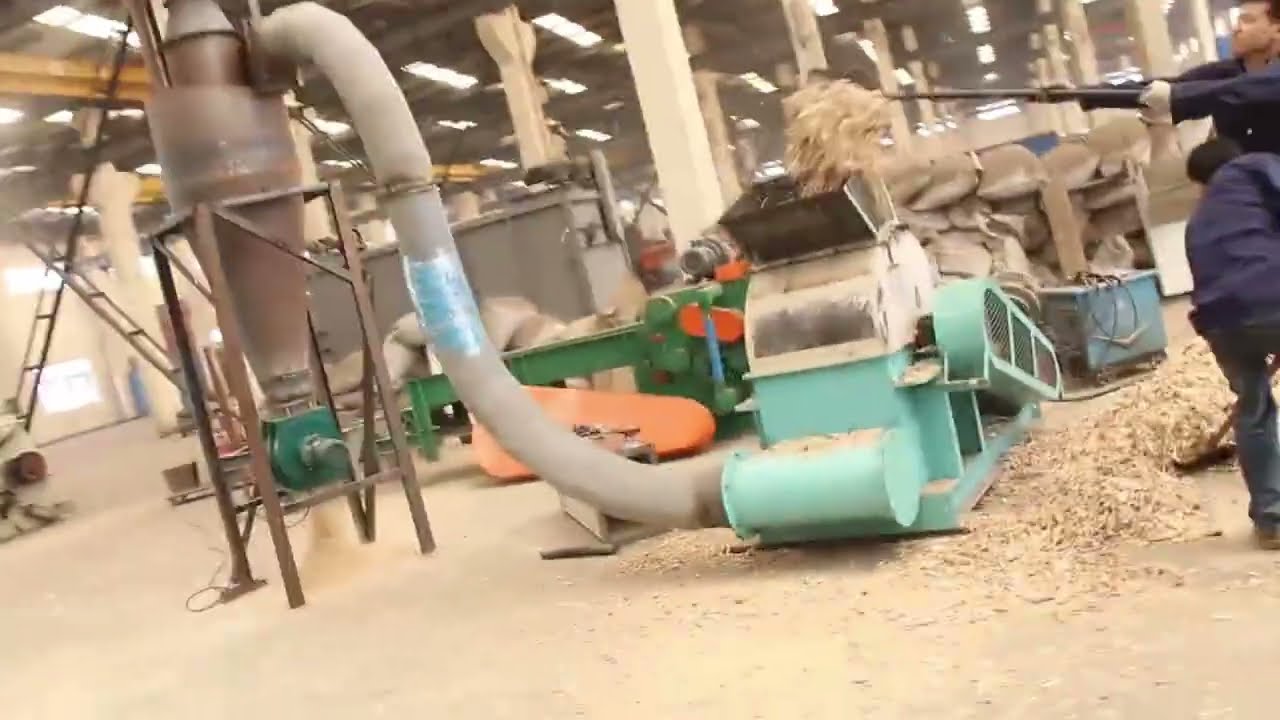

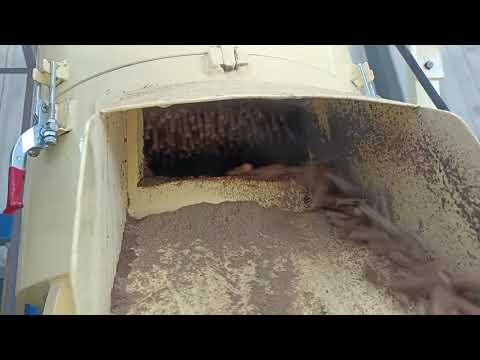

More test runs, shipping records and installation footage on our YouTube channel.
What buyers ask before ordering a wood powder machine
What is a wood powder machine used for?
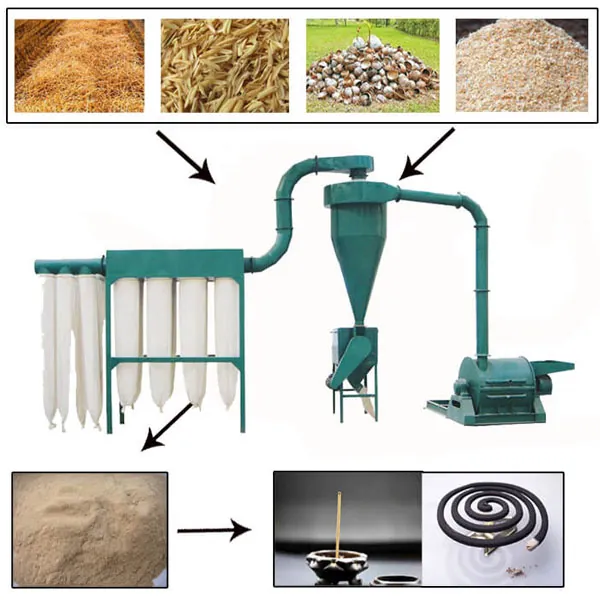
Grinding wood chips, sawdust, rice husk, straw, nutshell and bamboo down to 10–500 mesh — the fineness used for incense, mosquito coil, wood flour for board and MDF filler, briquette filler and, at the coarse end, the feed for a pellet press. The same chamber also handles herbs, spices, bark, tea and other dry brittle material.
What is the difference between a wood powder machine and a wood hammer mill?
A wood hammer mill hammers material through a screen and stops at 3–5 mm. A wood powder machine cuts in an air stream and classifies the result, so it reaches 40–325 mesh and finer. The powder machine costs more per tonne and needs drier material; if 3–5 mm sawdust is all you need for pellets, the hammer mill is the cheaper machine.
How fine can it grind?
10–500 mesh on the WP800 and 40–325 mesh on the WP900. Capacity is quoted at the mesh you order, because the same frame at 300 mesh moves a fraction of what it moves at 80 mesh. Send the sieve your buyer tests with and the classifier is set to it.
What moisture does the material need?
Under 6 %, as received. Damp material coats the chamber and the classifier and the machine stops cutting. Wet chips need a dryer in front of the powder machine, or a day spread on a concrete floor for small volumes.
What size material can go in?
Under 40 mm on the WP800, under 40–50 mm on the WP900. Logs, pallets and branch wood need a wood crusher first, and coarse crusher output is often run through a wood hammer mill before the powder machine.
Does it come with a cyclone and a dust collector?
Yes. Cyclone, bag filter with cages, bolted ducting and the control cabinet are part of the machine, not extras. That is what lets the unit run indoors — the exhaust is filtered, not blown into the shed.
How much does a wood powder machine cost?
It depends on the frame, the motor and the blade sets, and the WP900 is not in the same bracket as the WP800. Send the material, the mesh and the kg per shift and we quote the set: chamber, motor, blades, cyclone, filter, ducting and cabinet.
How long is delivery?
7–15 working days after the deposit, depending on the frame and the motor voltage. Payment is TT with 40 % in advance and the balance before delivery; packing is a wooden or steel case, and the bag filter ships as a separate bundle inside it.
Send the mesh, not a model number
The mesh your buyer tests, the material, its moisture as received and the kg per shift. Those four answers decide between the 22 kW frame and the 55 kW one — and whether a wood powder machine is the right machine at all.
- Emailinfo@pelletmachines.net
- WhatsApp+86 186 0385 1787
- HoursMon–Sat, 08:00–20:00 (GMT+8)
Send a photo of the material and the sieve you are judged on and we will tell you which frame fits, which blade set to order, and what the capacity will be at that mesh.
What happens after you send this
We answer with the frame, the motor, the blade sets and a price — then send a test-run video on your material before you pay a deposit.
Your details are not shared. One follow-up, no mailing list.


