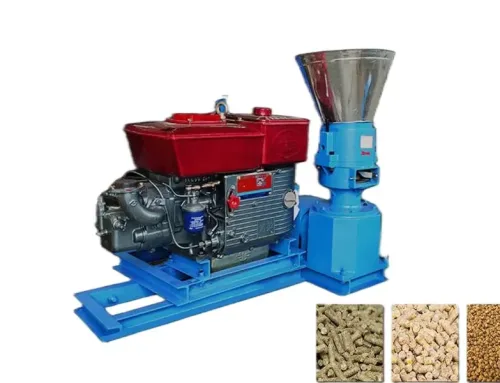
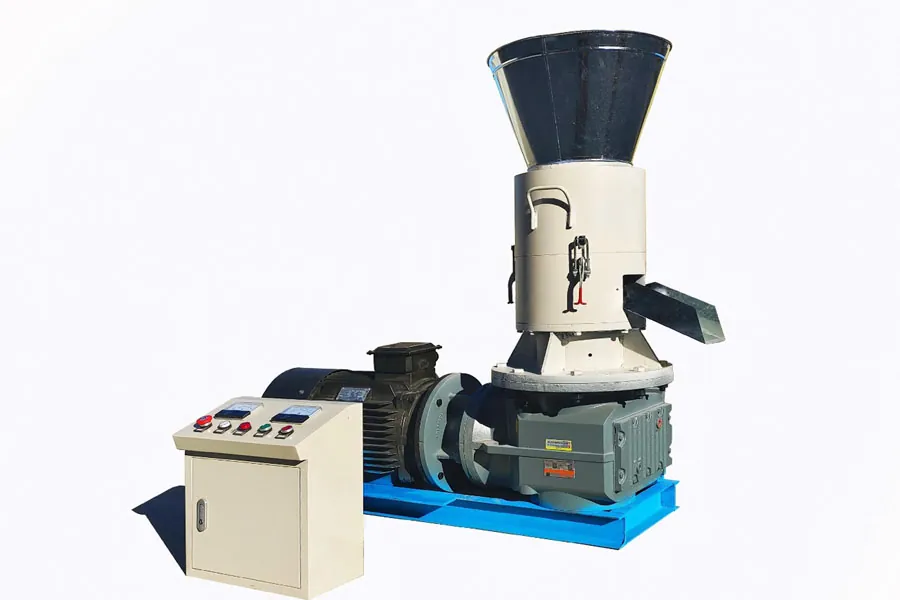
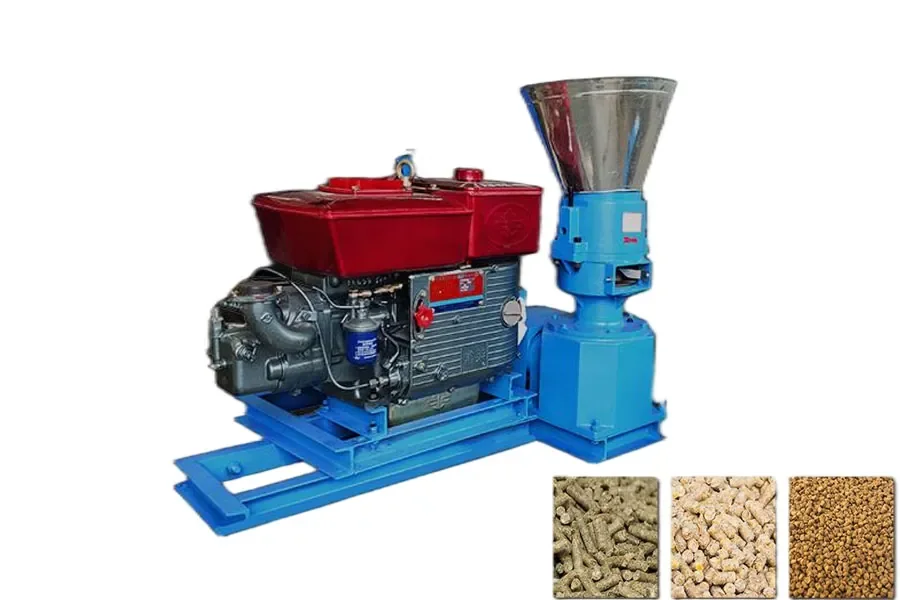
Flat Die Feed Pellet MillPM-150B to PM-400B — 80 to 1,200 kg/h of poultry, cattle and fish feed
A flat die feed pellet mill presses ground maize, soybean meal, bran and fibre into pellets through a horizontal die. Ten models share one pelleting head: five electric from 4 to 30 kW, five diesel from 10 to 55 hp. Dies are cut Ø2 to Ø8 mm to the pellet size you sell, and the whole machine goes out in one wooden case.
- 80–1,200 kg/h on dry grain mash at 12–15 % moisture
- 4–30 kW three-phase motor, or 10–55 hp diesel with clutch and reduction gearbox
- Ø2, 3, 4, 6 or 8 mm die — chicken, cattle, rabbit and sinking fish pellets
- Die, spare roller set, knife and setting gauge inside the crate
Reply in 12 working hours · Die cut to your material · Delivered to 40+ countries
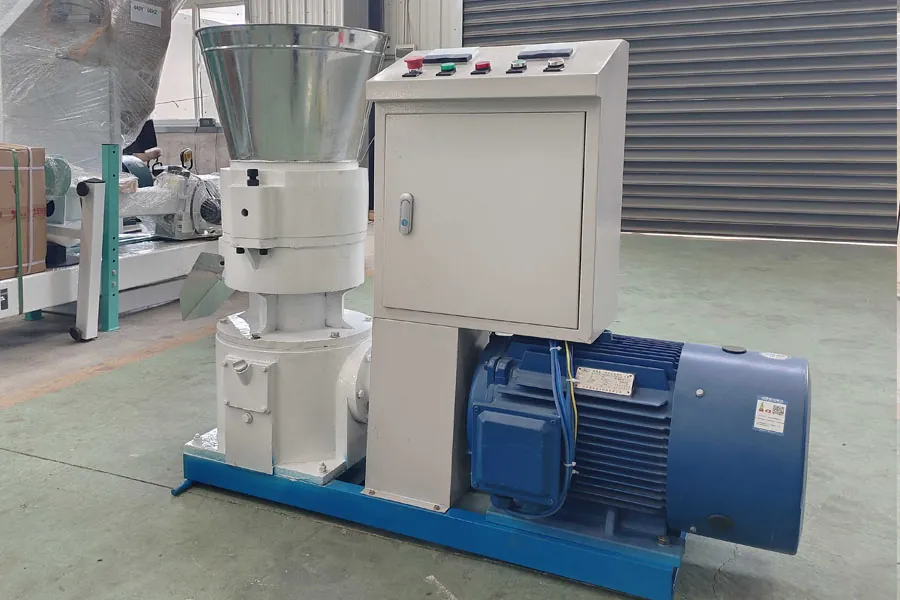
Feed is the cheapest pellet you will ever make
A farmer who buys compound feed pays for grinding, mixing, pelleting, bagging and three margins. A farmer with a flat die feed pellet mill pays for grinding and electricity, and owns the rest.
The arithmetic is simple on any poultry or cattle unit: maize and soybean meal cost a fraction of the finished compound feed, and the difference is mostly the pelleting step. A PM-200B at 7.5 kW makes 200–300 kg/h of pellets from mash that costs you the grain price. Even running a few hours a week, the machine pays for itself inside a season.
Pellets also stop the ration from being sorted. Hens, goats and cattle pick the maize out of a mash and leave the fines and the minerals; in a pellet every mouthful is the same mix. Pellets flow through an auger instead of bridging in it, take a third less space per tonne, and keep for months in a dry shed instead of weeks.
The pressing itself does a little of the work of a conditioner. Material passes the die at 60–80 °C under pressure, which gelatinises part of the starch and knocks down mould and bacteria load — not sterilisation, but enough that pellets keep better than the same mash would.
What a flat die will not do is float. Sinking pellets for pond fish, yes; floating feed needs an dry type fish feed extruder, because floating depends on expansion, not on pressure. Everything else — poultry, cattle, sheep, rabbit, shrimp sinking feed — is a flat die job, and this page is about doing it properly.
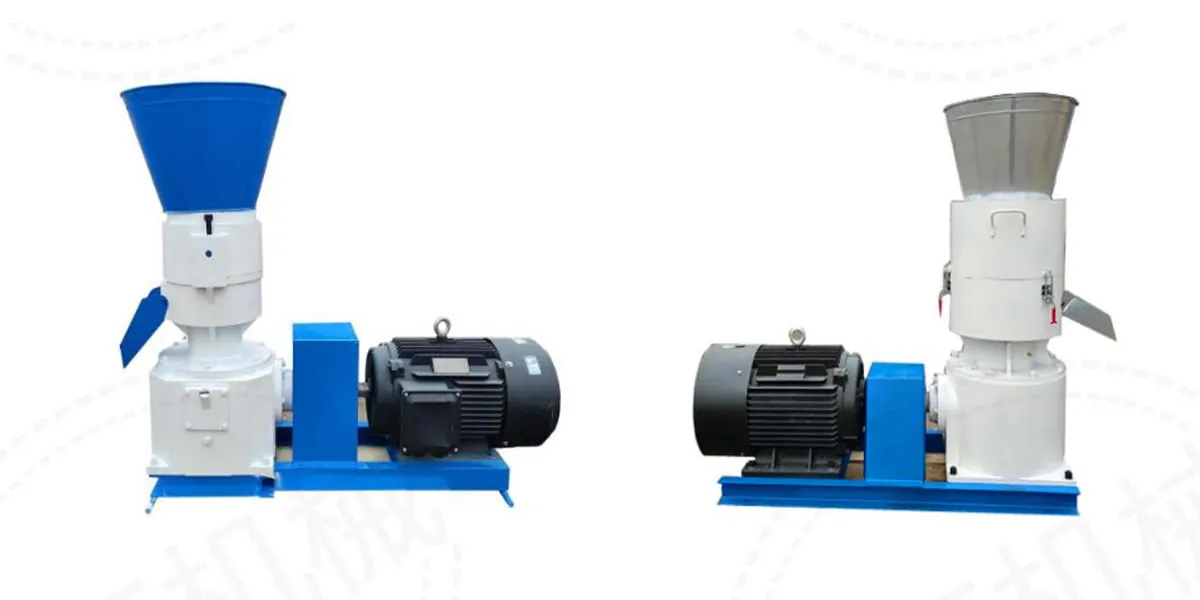
Five electric models, one pelleting head
The B series is the belt-driven electric range. Output is quoted on dry grain mash at 12–15 % moisture with a Ø4 mm die — the honest figure for feed, not the sawdust figure some catalogues print next to it.
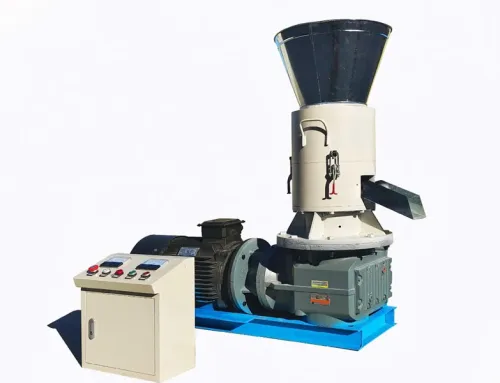
Flat die feed pellet mill, B series electric, three-phase
| Model | Output | Motor | Die diameter | Dimensions L×W×H | Weight net / gross |
|---|---|---|---|---|---|
| PM-150B | 80–120 kg/h | 4 kW | Ø150 mm | 800 × 350 × 670 mm | 95 / 110 kg |
| PM-200B | 200–300 kg/h | 7.5 kW | Ø200 mm | 1050 × 480 × 1000 mm | 200 / 230 kg |
| PM-260B | 400–600 kg/h | 15 kW | Ø260 mm | 1240 × 530 × 1070 mm | 320 / 360 kg |
| PM-300B | 600–800 kg/h | 22 kW | Ø300 mm | 1360 × 560 × 1160 mm | 410 / 450 kg |
| PM-400B | 800–1,200 kg/h | 30 kW | Ø400 mm | 1500 × 760 × 1210 mm | 660 / 700 kg |
Three-phase 380 V / 50 Hz as standard; 415 V, 440 V and 60 Hz to order — tell us before the crate is built. Weight is net / gross packed for export. Output falls by roughly half on sawdust and other woody material, because wood needs more pressure for the same tonne. A Ø2 mm die runs slower than a Ø6 mm die on the same motor; we quote the capacity for the die you order, not the best case.
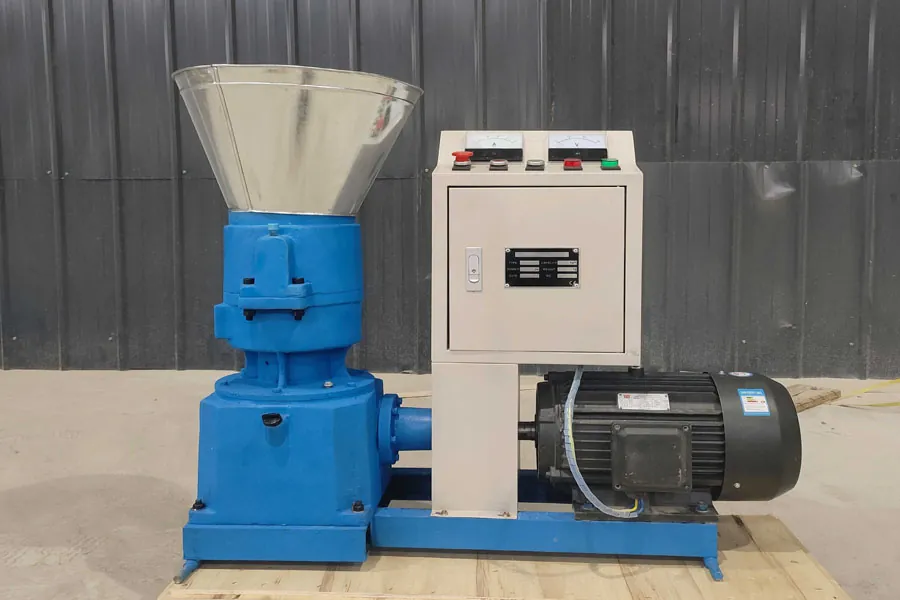
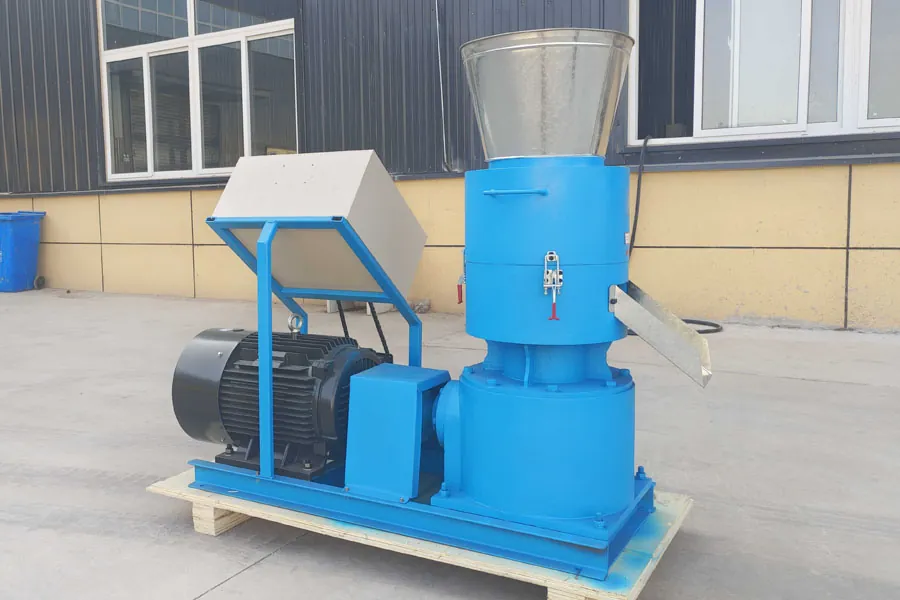
The same head on an engine, for sites with no three-phase supply
The A series is the diesel range. Identical pelleting head, identical die, identical pellet — only the drive changes. A clutch lets the engine start unloaded and a reduction gearbox lets you slow the rollers for hard, fibrous material.
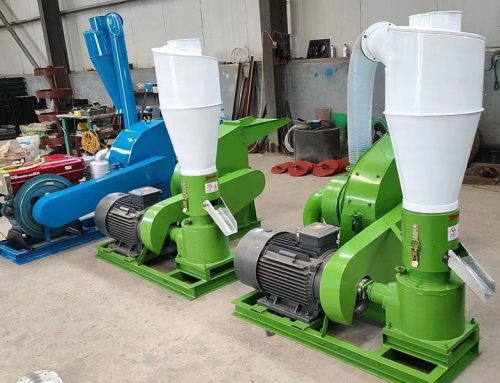
Diesel flat die feed pellet mill, A series engine driven
| Model | Output | Engine | Die diameter | Dimensions L×W×H | Weight net / gross |
|---|---|---|---|---|---|
| PM-150A | 80–120 kg/h | 10 hp | Ø150 mm | 950 × 600 × 800 mm | 165 / 190 kg |
| PM-200A | 200–300 kg/h | 15 hp | Ø200 mm | 1240 × 800 × 900 mm | 350 / 380 kg |
| PM-260A | 400–600 kg/h | 30 hp | Ø260 mm | 2000 × 770 × 1100 mm | 480 / 520 kg |
| PM-300A | 600–800 kg/h | 41 hp | Ø300 mm | 2300 × 700 × 1250 mm | 850 / 890 kg |
| PM-400A | 800–1,200 kg/h | 55 hp | Ø400 mm | 2300 × 700 × 1250 mm | 1050 / 1,100 kg |
Single-cylinder engines on the small models, multi-cylinder on the larger ones, air- or water-cooled according to model; the engine actually fitted is stamped on the nameplate. Electric start, battery and a two-wheel trailer frame are options. Models up to PM-300A can be trailer mounted and towed behind a pickup or tractor; the PM-400A is normally skid-mounted and moved by truck.
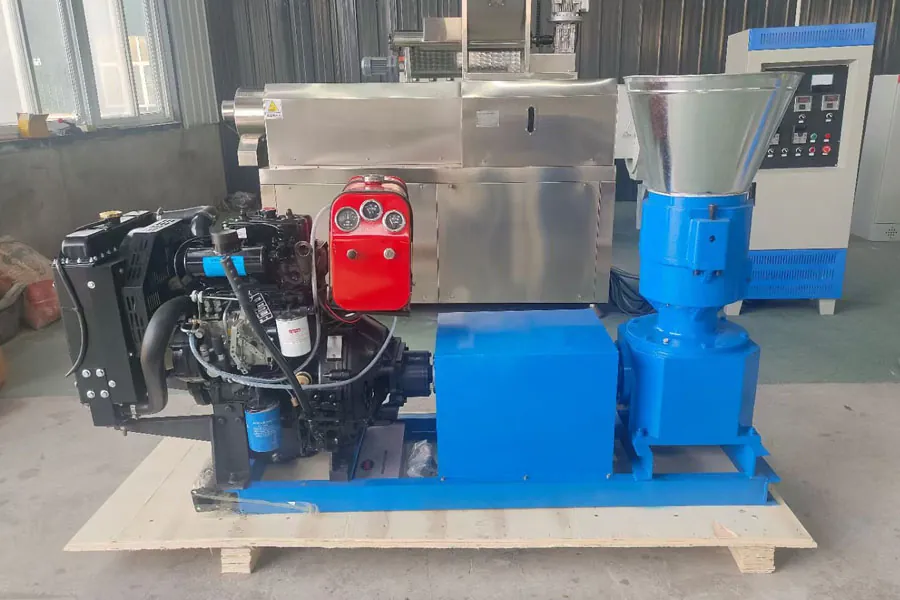
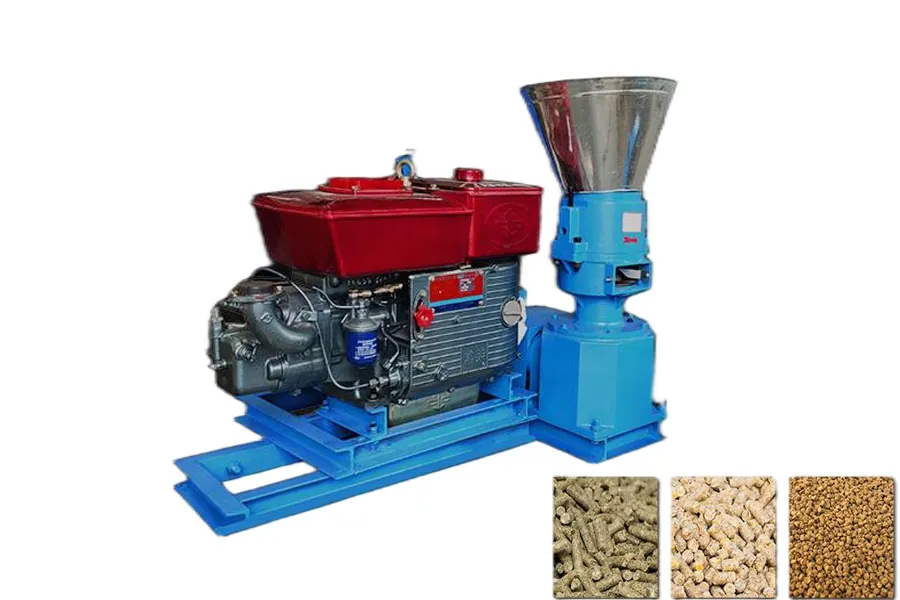
Fuel per hour and per tonne A series
| Model | Output | Diesel use | Fuel per tonne | Operators |
|---|---|---|---|---|
| PM-200A | 200–300 kg/h | 1.2–1.5 L/h | 5–6 L | 1 |
| PM-260A | 400–600 kg/h | 1.6–1.9 L/h | 3–4 L | 1 |
| PM-300A | 600–800 kg/h | 2.0–2.3 L/h | 3 L | 1–2 |
| PM-400A | 800–1,200 kg/h | 2.3–2.5 L/h | 2–3 L | 2 |
Figures assume dry grain mash at 12–15 % moisture with a correctly matched die. Fuel use rises with high-fibre material, a worn die, or moisture above 16 %. Bigger models are more efficient per tonne — the PM-400A burns about twice the fuel of a PM-200A but makes four times the pellets.
Which drive to buy — decided by the site, not by the pellet
Both machines make the same pellet to the same specification. What separates them is what happens at 4 pm when the power goes off, and whether the machine has to move.
Diesel or electric flat die feed pellet mill same head, different drive
| Item | Diesel flat die feed pellet mill | Electric flat die feed pellet mill |
|---|---|---|
| Power source | Diesel engine 10–55 hp | Electric motor 4–30 kW |
| Grid dependency | None | Three-phase supply required |
| Running cost | Diesel, 1.2–2.5 L/h | Electricity — cheaper where the grid is stable |
| Mobility | Trailer mountable, moved daily | Fixed installation |
| Noise | Higher — engine plus pelleting | Lower |
| Maintenance | Engine service: oil, filters, belts | Motor is near maintenance-free |
| Purchase price | About 20–30 % higher for the same output | Lower |
| Best for | Remote farms, mobile service, unstable power | Fixed site with reliable power |
If you have reliable three-phase power and a fixed site, take the electric machine — it is cheaper to buy and far cheaper per hour. If power cuts are routine, if the nearest three-phase line is a kilometre away, or if the machine has to serve several villages on a rota, the diesel pays the difference back quickly. Plenty of customers keep one diesel unit beside an electric line as backup.
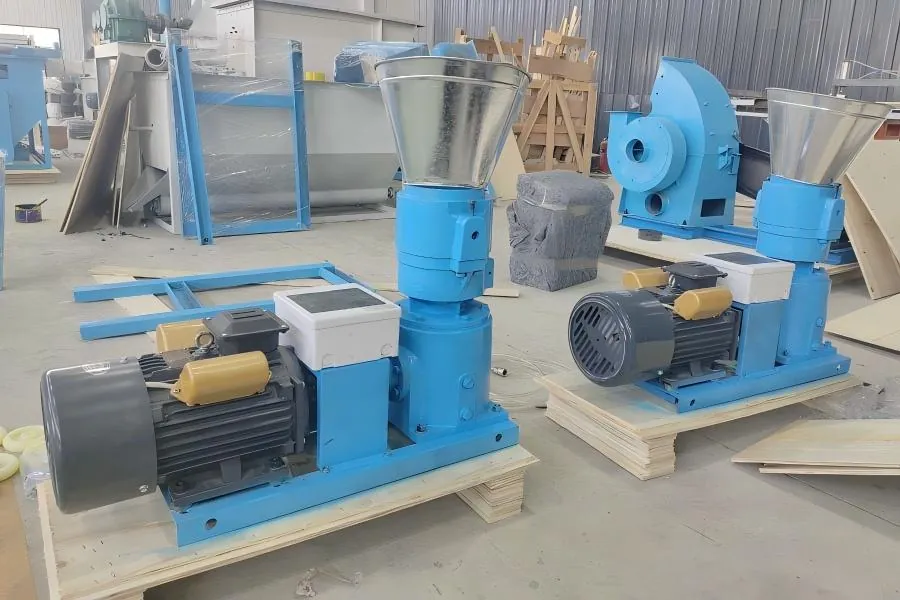
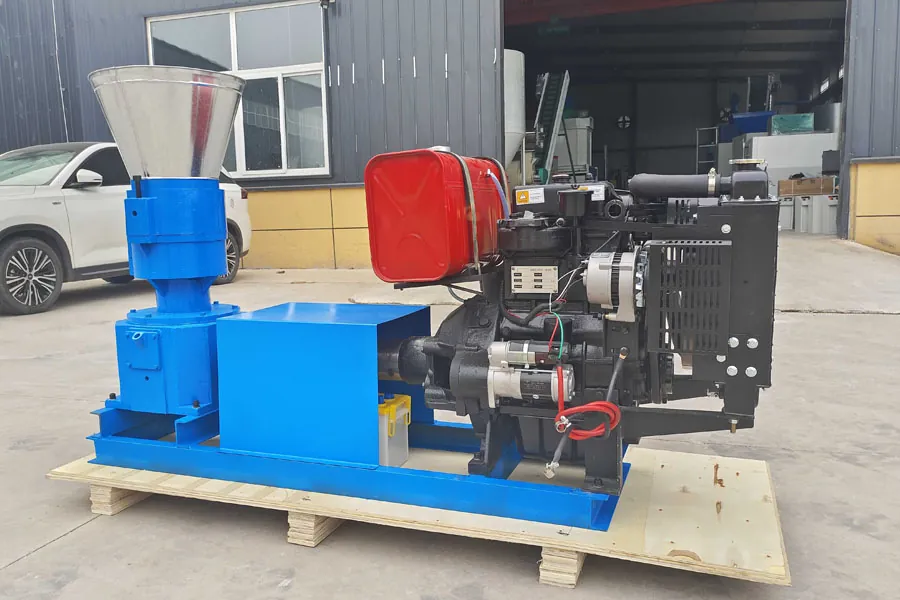
The die is the specification — everything else is a frame around it
Two numbers decide whether a flat die feed pellet mill works on your material: the hole diameter, which sets the pellet, and the hole length divided by that diameter, which sets how hard the machine has to press.
Compression ratio by material hole length : hole diameter
| Material | Compression ratio | Typical die | Note |
|---|---|---|---|
| Maize and soybean meal | 1:5 – 1:6 | Ø4 mm | The standard compound feed ration |
| High-fibre mash, bran, husk | 1:4 – 1:5 | Ø4 – 6 mm | Shorter hole, less pressure, faster wear |
| Alfalfa, grass, straw meal | 1:4 – 1:5 | Ø6 mm | Fibrous; needs a slower feed rate |
| Sawdust and wood waste | 1:6 – 1:8 | Ø6 – 8 mm | A wood die — never run feed through it |
A die matched to sawdust blocks on maize mash and a feed die crumbles on sawdust — the ratio is not a preference, it is what the material needs to bind. This is the single question we ask before quoting: what goes in. Order the ratio with the material, and order a second die if you intend to run two materials.
Die holes for feed same frame, five products
| Die hole | What it is for | Pressing | Note |
|---|---|---|---|
| Ø2 mm | Day-old chicks, small fish, shrimp | Slowest | Highest pressure, lowest output |
| Ø3 mm | Growing poultry, rabbit, pond fish | Slow | The common sinking fish-feed size |
| Ø4 mm | Broiler, layer, goat, sheep | Standard | The die most machines leave with |
| Ø6 mm | Cattle, horse, adult pig | Fast | Best output per kW on feed |
| Ø8 mm | Large ruminants, bedding, fuel | Fastest | Lowest density; rarely used for feed |
One die ships with the machine and a second can be ordered with it — the second die costs a fraction of a second machine, which is why units feeding broilers and pond fish usually take a Ø3 and a Ø4 together. A die is a wear part: expect 300–600 hours on abrasive mash, longer on clean grain. Rollers wear with it, and a roller gap that has opened up is the second most common cause of soft pellets after wet material. Spare dies, rollers and clamps are kept in stock — see spare parts.
Moisture and grind decide the output, not the motor
Almost every flat die feed pellet mill that disappoints on site was fed mash that was too coarse, too wet, or both. These are the numbers worth writing on the wall next to the machine.
Material, moisture and preparation for a Ø4 mm die
| Material | Moisture in | Preparation | Note |
|---|---|---|---|
| Maize, wheat, sorghum | 12–15 % | Grind to 2–3 mm | The base of most rations |
| Soybean meal, rapeseed meal | 12–15 % | Already meal | Binds well; adds protein |
| Wheat bran, rice bran | 12–15 % | Grind if lumpy | Bulky; watch the feed rate |
| Rice husk, peanut shell | 10–14 % | Grind to 3 mm | Abrasive — die life drops, output is high |
| Alfalfa, grass, straw meal | 12–15 % | Grind to 3–5 mm | Fibrous; expect 10–20 % less output |
| Fish meal, bone meal | 10–12 % | Already fine | Strong smell; pellets keep well |
Moisture is measured on a meter as received, not by squeezing a handful. Mash above 16 % gives soft pellets that smear in the die; below 12 % it will not bind without molasses or a binder, and the die runs hot. Grind matters as much: a wood hammer mill or a feed grinder in front of the press is what turns whole grain into something the die can take, and 2–3 mm is the usual screen for feed.
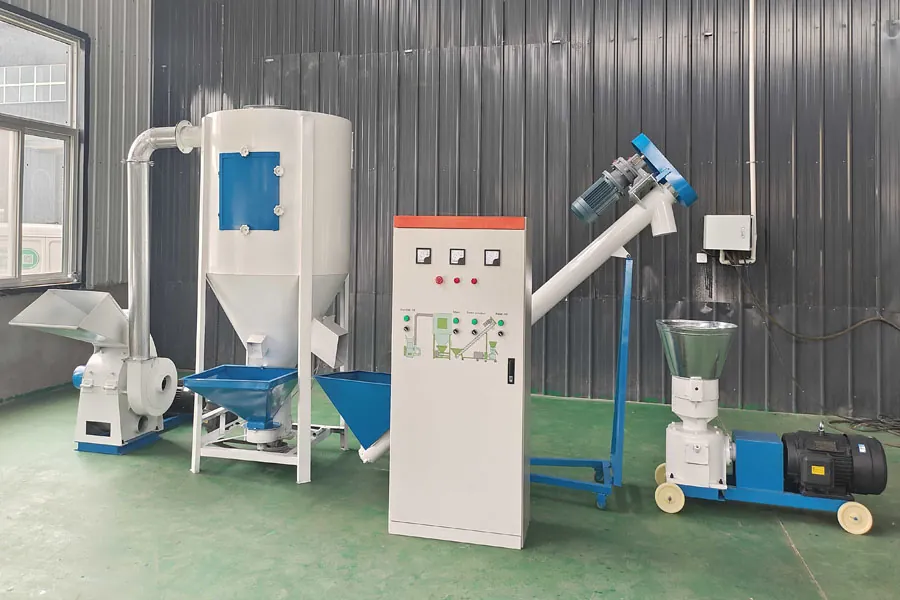
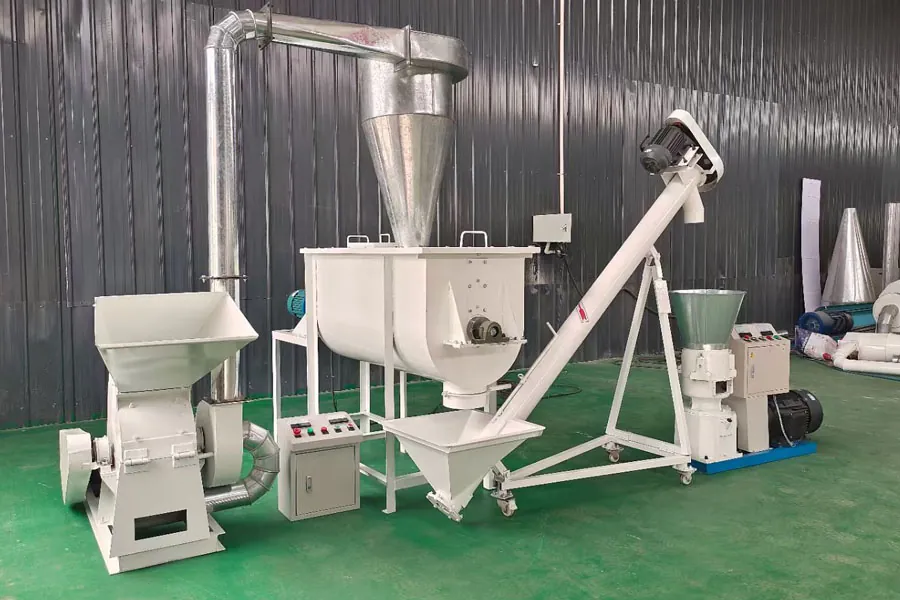
Five steps from grain to bag
A flat die press is the simplest pellet machine there is: a horizontal die with holes in it, rollers running over the top, and a knife cutting what comes through. Everything else on the frame exists to feed it evenly.
Grind
Whole grain goes through a hammer mill to 2–3 mm. Coarse mash will not fill the die holes evenly and the pellets come out crumbly.
Mix and set moisture
Meal, protein and minerals into a mixer; water or molasses up to 12–15 %. Too dry and the die scorches, too wet and the pellet smears.
Feed the die
The hopper drops mash into the chamber through a slide gate. The die wants a steady trickle — feeding faster than the motor can pull is how belts slip.
Rollers press
Rollers run round the flat die and squeeze the mash into the holes at 60–80 °C. Pressure comes from the roller gap, set with a feeler gauge.
Cut and cool
A knife under the die sets pellet length. Pellets leave warm and soft — spread them or run a cooler before bagging, or they sweat and mould in the bag.
A press on its own makes pellets from mash that is already ground and mixed
Most buyers need two or three machines in front of the press. That is the difference between a machine and a plant, and it is the step people under-budget.
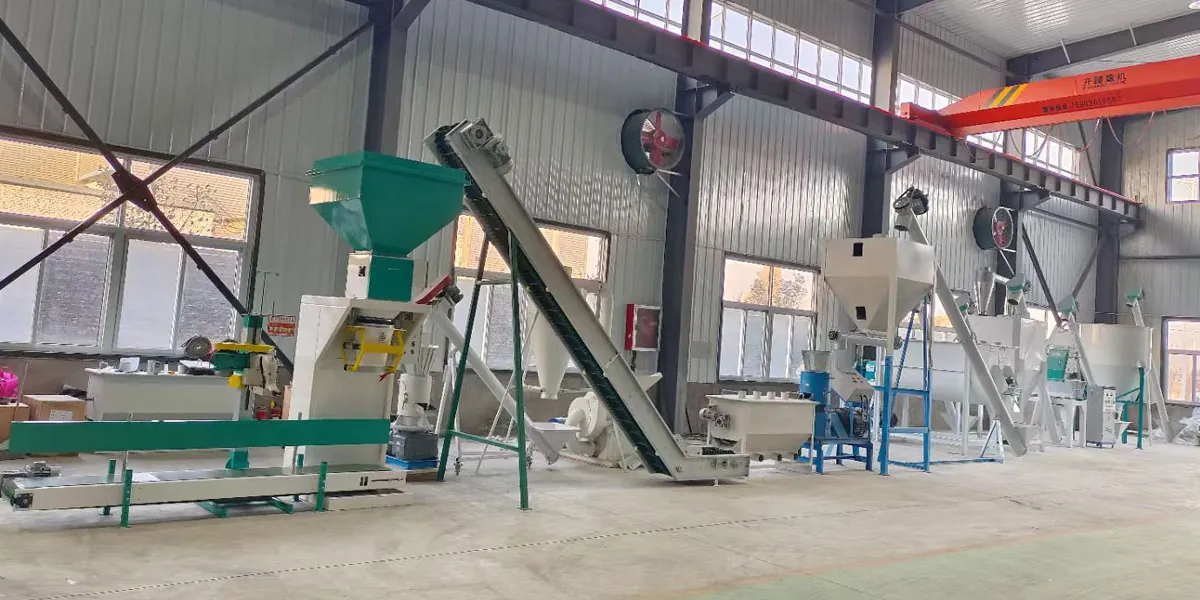
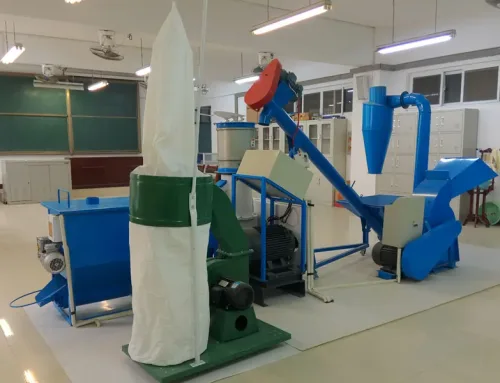
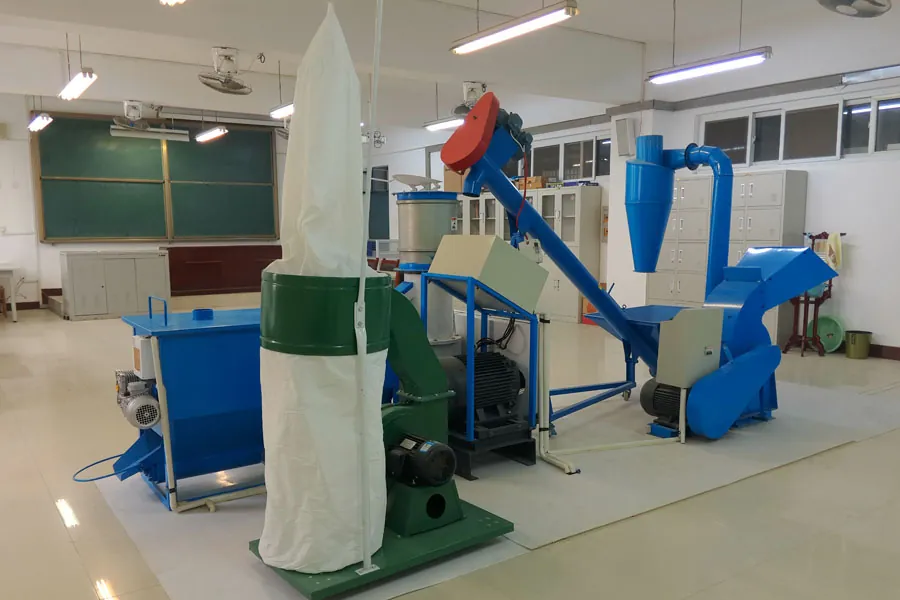
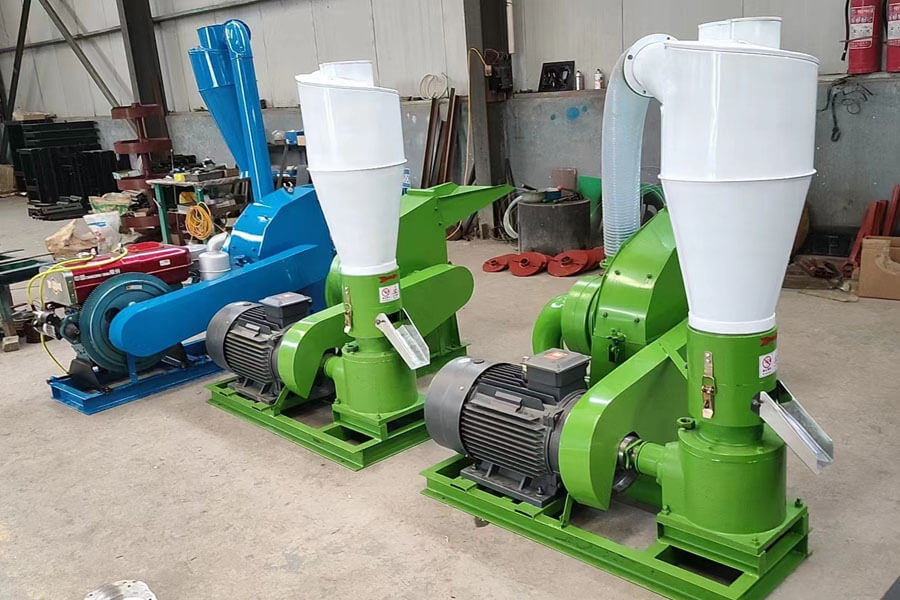
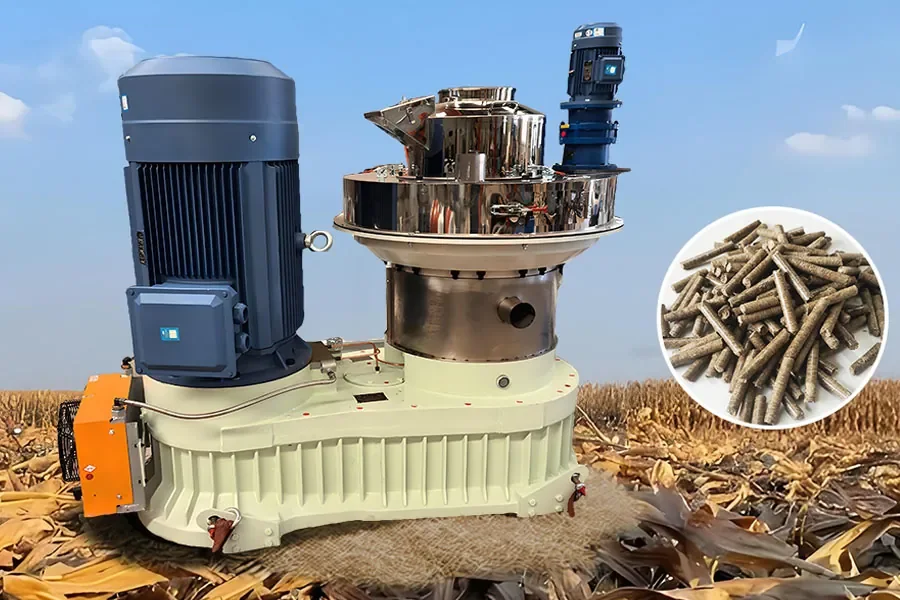
The machines in front of the press are a wood hammer mill (or a diesel hammer mill where there is no power), a ribbon mixer, and screw or belt conveyors. Behind it: a cooler, and a bagging scale if you sell rather than feed your own stock. Above about 1.2 t/h the flat die frame runs out of die diameter and a vertical ring die pellet mill takes over. Below that, a small pellet plant or a 500 kg/h wood pellet plant is the same machine with crusher, cooler and bagging quoted together, and the combined pellet mill and hammer mill puts the crusher and the press on one base plate under one drive for 100–350 kg/h. Grass and straw rations follow the same line with a grass pellet mill in the press position.
One wooden case, and the wear parts inside it
The machine is small enough to ship as a single case. What people forget to compare when they weigh up quotes is whether the die, the spare rollers and the knife are in that case or on the next invoice.
- Milling chamber on its base frameRollers fitted, die clamp and knife in place, guard bolted on, hopper mounted.
- Motor and starter, or diesel engineThree-phase 380 V / 50 Hz on the electric models; clutch and reduction gearbox on the diesel ones.
- One flat die, cut to orderØ150 to Ø400 mm, holes Ø2–8 mm at the compression ratio you name on the order — not a stock die.
- Spare roller set and die clampRollers are a wear part; the set ships with the machine so a worn pair does not stop the week.
- Knife and setting gaugeThe gauge is what keeps pellet length consistent after the knife is re-ground.
- Manual and packing listRoller gap, belt tension and the die break-in procedure — the first hour on a new die matters more than any other.
What goes with a flat die feed pellet mill
Grind it, mix it, press it, cool it, bag it. These are the machines that do the other four steps, and the ranges either side of this one.
Tell us the ration and the output
What the feed is (poultry, cattle, fish), the grind you can achieve, the moisture and the pellet diameter. We reply with the model, the die ratio and a price.
Reply within one working day. No obligation.
The head at work, and the lines it feeds
A PM300 flat die feed pellet machine on feed, then a feed line with a ring die at a larger size, a set of line configurations, and flat die presses crated for export.


More test runs, shipping records and installation footage on our YouTube channel.
What buyers ask before ordering a feed pellet mill
What is a flat die feed pellet mill?
A pellet machine that presses ground feed through a horizontal die with rollers running over the top. It is the cheapest way to turn maize, meal and fibre into pellets, and it tolerates wetter and coarser material than a ring die. We build ten models: PM-150B to PM-400B electric, 4 to 30 kW, and PM-150A to PM-400A diesel, 10 to 55 hp, 80 to 1,200 kg/h.
How many kg/h will it actually make?
80–120 kg/h on the PM-150B up to 800–1,200 kg/h on the PM-400B, quoted on dry grain mash at 12–15 % moisture with a Ø4 mm die. A Ø2 mm die, wet mash or coarse grind all pull that down — a Ø2 mm die at 18 % moisture will not reach half the figure. Tell us the ration and we quote the capacity for it, not the best case.
Which model do I need for a poultry farm?
For a few hundred birds, the PM-150B or PM-200B at 4–7.5 kW covers a day’s feed in an hour. A commercial layer or broiler unit at 2–5 t a day needs the PM-300B or PM-400B, or two of them on separate dies. As a rule, work out the tonnes per week, divide by the hours you are willing to run, and add 20 %.
What die size should I order?
Ø2 mm for day-old chicks and shrimp, Ø3 mm for growing poultry and pond fish, Ø4 mm for broilers, layers, goats and sheep, Ø6 mm for cattle, horses and adult pigs, Ø8 mm for bedding and fuel. Most farms take a Ø4 and add a Ø3 or Ø6 later — a second die costs a fraction of a second machine.
Does the feed have to be ground first?
Yes. A flat die takes mash at 2–3 mm; whole grain or coarse crush will not fill the holes evenly and the pellets come out crumbly. An electric hammer mill in front of the press does that. Feeding unground grain straight in is how dies block and rollers get flat-spotted.
What moisture does the mash need?
12–15 %, measured on a meter. Above 16 % the pellets come out soft and smear in the die; below 12 % the mash will not bind on its own and needs molasses or a binder, and the die runs hot. This is the most common reason a feed pellet mill under-performs on site.
Can it make floating fish feed?
No. A flat die makes sinking pellets of 2–4 mm, which suits pond and cage farming. Floating feed depends on expansion, which needs a dry type fish feed extruder. Many fish farms run both: extruded floating feed for the surface, flat die sinking feed for the bottom.
Diesel or electric, and how long is delivery?
Electric if you have reliable three-phase power and a fixed site — cheaper to buy, far cheaper per hour. Diesel if power is unreliable or the machine has to move; models up to PM-300A can be trailer mounted. Standard models ship in 10–20 working days, TT with 40 % deposit and the balance before delivery, one wooden case with the die, spare rollers and knife inside.
Send the ration, not a model number
What the feed is, the grind you can achieve, the moisture and the pellet diameter you sell. Those four answers decide the die, the compression ratio, the model, and whether a flat die frame is the right press at all.
- Emailinfo@pelletmachines.net
- WhatsApp+86 186 0385 1787
- HoursMon–Sat, 08:00–20:00 (GMT+8)
Send a photo of the material and the moisture reading and we will tell you which die to order, what the hourly output will be, and what has to stand in front of the press.
What happens after you send this
We answer with the model, the die ratio, the motor and a price — then send a test-run video on your material before you pay a deposit.
Your details are not shared. One follow-up, no mailing list.