What It Costs to Make a Tonne of Wood Pelletssix formulas, and the two numbers that are yours
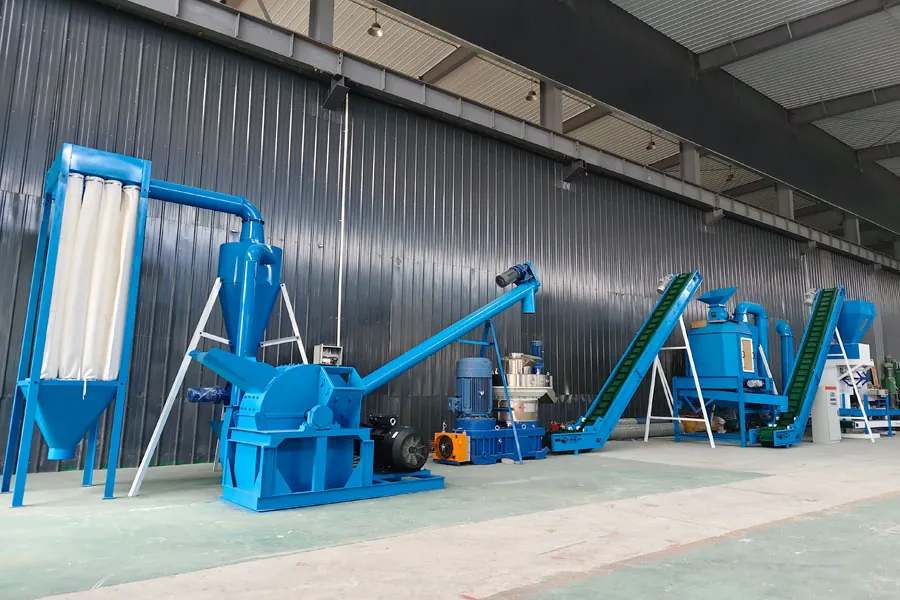
The pellet mill is not the expensive part. Raw material is usually the largest line, electricity is the second, and the electricity is the one we can give you outright: 198 kWh per tonne on a 500 kg/h line, 190 on a 1,000 kg/h line, 177 on 2,000 and 155 on 5,000. This page gives the formula for each of the six lines, the figures we can supply from our own builds, and a calculator for the one that changes most with where you are — the tariff.
- Six cost lines, each with the formula rather than a price
- 155–198 kWh per tonne on our own builds, and where that goes
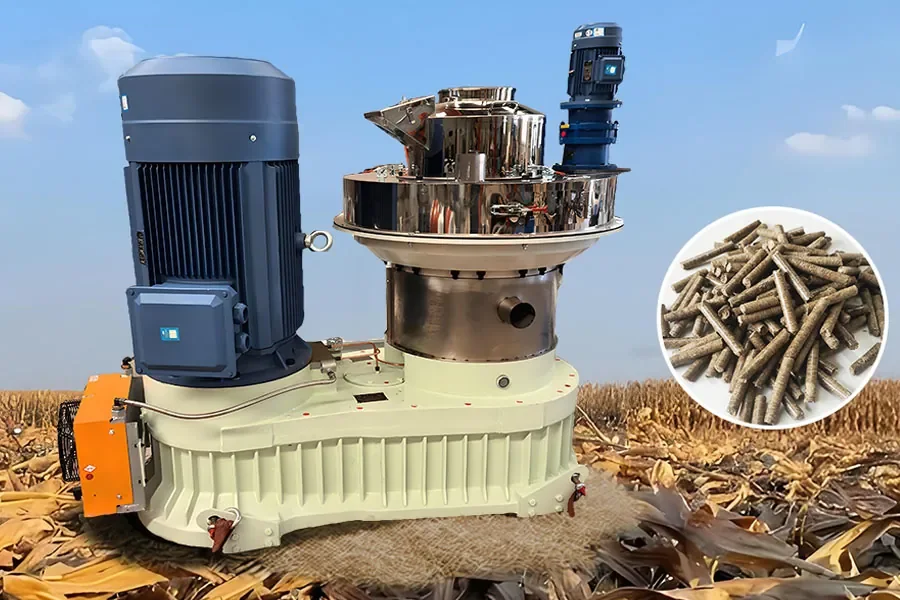
- How many t of pellets one die plate or ring die makes
- A calculator: your tariff, your hours, your cost per tonne
Costed on installed power and rated capacity, not on a best month · No price list — the two figures we cannot know are yours
The short answer
Six lines, added up. Five are arithmetic you can do; one is your material price.
The cost of a tonne of wood pellets is raw material, electricity, labour, dies and rollers, maintenance and bagging, added together. Five of the six you can work out from your own site and your own invoices. The one figure we can give you outright is electricity, because it comes straight off the installed power of the production line: 198 kWh per tonne on a 500 kg/h line, 190 on a 1,000 kg/h line, 177 on 2,000 and 155 on 5,000. Multiply that by your tariff and you have the second-largest line in the cost — and the only one that is the same arithmetic for a factory in Ghana and a factory in Vietnam.
No price is written on this page, on purpose. A tariff in Nigeria and a tariff in Chile are not the same number, and a page that quotes one is out of date the month it is published. What does not change is the arithmetic, and that is what is below.
Six cost lines, and the formula for each
Every row is per tonne of finished pellets. Work down the table with your own invoices in front of you — the third column is what you have to look up, and it is usually one number per row.
| Cost line | Formula | The number you need | What moves it most |
|---|---|---|---|
| Raw material | price per t as received × (1 − 0.08) ÷ (1 − moisture) | The price at the gate, and the moisture it arrives at | Moisture. 30 % needs 1.31 t in for 1 t out; 50 % needs 1.84 t |
| Electricity | installed kW × hours × tariff ÷ output | The tariff, and the installed power of the production line | The tariff first, then the size of the build — 198 kWh per tonne at 500 kg/h, 155 at 5,000 |
| Labour | people on shift × hours × cost of an hour ÷ output | Headcount per shift, and a fully loaded hourly cost | How many people the production line needs, and whether they load the front end as well as run it |
| Dies and rollers | die price ÷ (die hours × output per hour) | The die price, and the hours it lasts | Ash. A ring die runs 500–800 hours on wood and 200–300 on rice husk |
| Maintenance and spares | equipment value × 3–5 % a year ÷ annual output | What the factory cost, and the t you run in a year | Running hours, and whether a spare die and roller set sits on the shelf |
| Bagging and handling | (bag price + filling labour) ÷ t per bag | Bag size, bag price, and who fills them | Bag size. A 15 kg bag costs more per tonne than a 1,000 kg bulk bag, in bag and in labour |
The second row is the only one that needs nothing from you but a tariff, which is why it gets its own table below. The first row is the largest on most sites and the one we cannot put a number on: free sawdust from a mill next door and bought-in chips at the port are two different businesses on the same pellet mill. The sizing guide has the kg/h per kW figures the second row is built on.
Four columns of sentences do not fit a phone. Swipe the table sideways for the formula and the figure to look up, or read the first column and the last, which is what moves each line.
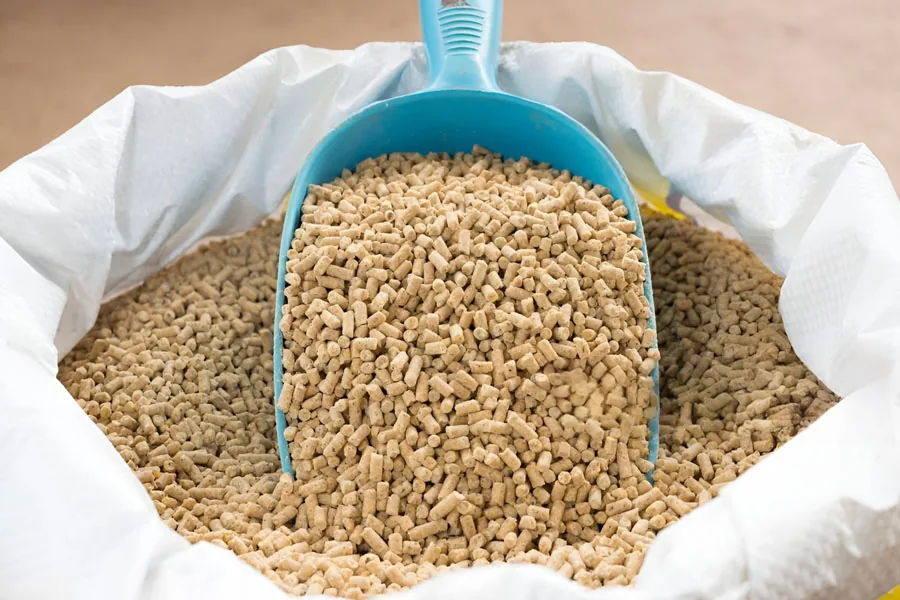
Watch the units. Every row above is per tonne of pellets out, not per tonne of material in, and those are not the same tonne. Material at 30 % moisture loses 24 % of its mass on the way to an 8 % pellet, so 1.31 t goes in for every 1 t that comes out; at 50 % it is 1.84 t. A material price quoted per t as received has to be multiplied by that ratio before it goes in the first row, or the cost per tonne comes out a quarter too low.
The other thing that catches people is the difference between a cost and a price. This page is a cost: what leaves your account to make a tonne. It does not include the capital repayment on the factory, the interest on the money, or the margin you need to sell at. Those are three more lines and they belong in a different calculation: a payback calculation starts from the cost figure you arrive at here, not from the price of the pellet mill.
155–198 kWh per tonne, and why the big builds are cheaper
Installed power divided by rated capacity. This is the second-largest line in the cost, and the only one where a bigger plant is unambiguously cheaper per tonne.
| Build | Installed power | kWh per tonne, whole line | kWh per tonne, pellet mills |
|---|---|---|---|
| 500 kg/h wood pellet production line | 99 kW | 198 | 90 |
| 1000 kg/h wood pellet production line | 190 kW | 190 | 90 |
| 2000 kg/h wood pellet production line | 354 kW | 177 | 90 |
| 5000 kg/h wood pellet production line | 775 kW | 155 | 79 |
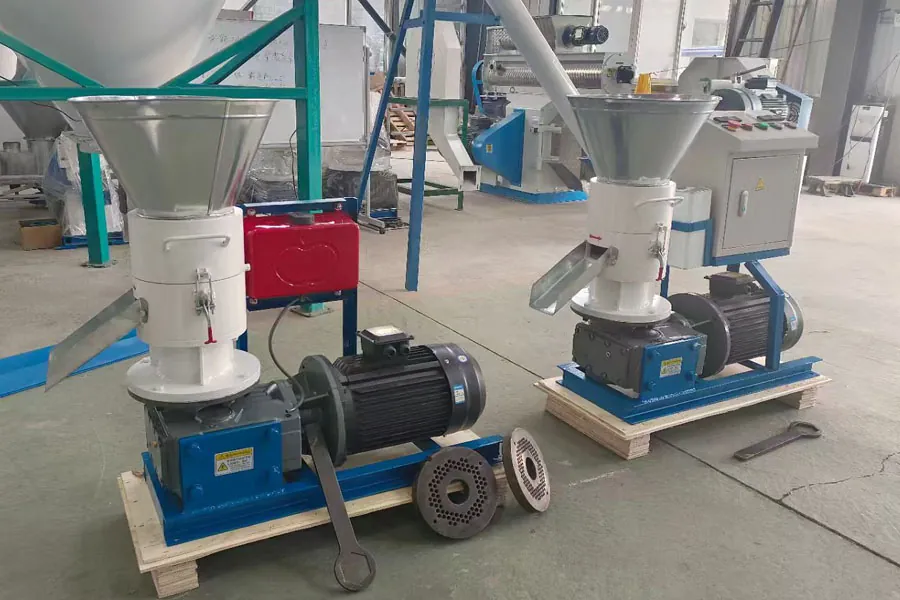
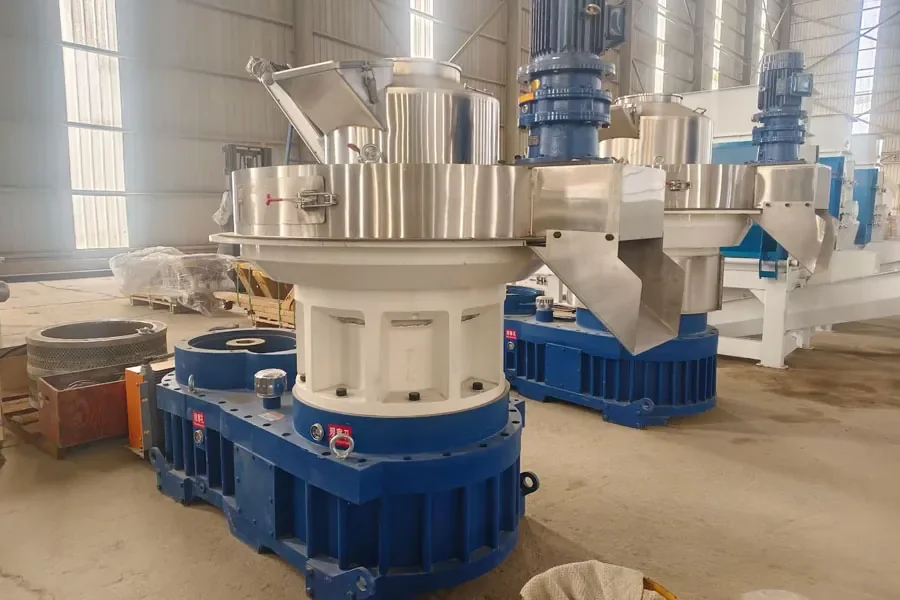
Installed power ÷ rated capacity, on sawdust at 12–15 % moisture. In practice the meter reads 70–85 % of nameplate and the production line makes less than its rated capacity — the two roughly cancel, which is why we quote the nameplate figure rather than a measured one. The last column is the pellet mills alone: 60–66 kWh per tonne on a vertical ring die wood pellet mill and 62–94 on a flat die pellet mill, from the flat die vs vertical ring die comparison.
The saving is not in the pellet mill — it is in everything around it. The pellet mills column is flat at 90 kWh per tonne across three of the four builds, because a pellet mill’s power per tonne is set by its die, not by the size of the factory it sits in. What falls is the rest: one dryer serves a bigger output, one set of fans, one control room, one loader. That is where 198 becomes 155.
Which is also why a small plant cannot compete on electricity and should not try. A 500 kg/h line uses 28 % more kWh per tonne than a 5,000 kg/h one, and there is nothing to be done about it at that size. What a small plant can do is run fewer hours at a fuller load — a 500 kg/h line at 85 % load beats the same line at 50 % load by a wider margin than the size difference.
How many t of pellets one die plate or ring die makes
Divide the price of the die by the figure that matches your capacity and you have the fourth line in the table. No price needed until you have this number.
| Output capacity | A 500-hour die makes | An 800-hour die makes |
|---|---|---|
| 500 kg/h | 250 t | 400 t |
| 1 t/h | 500 t | 800 t |
| 2 t/h | 1,000 t | 1,600 t |
| 5 t/h | 2,500 t | 4,000 t |
Die life on clean wood at 12–15 % moisture. On rice husk the same die runs 200–300 hours, so a 1 t/h line makes 200–300 t instead of 500–800 — which is why a husk line quotes a higher cost per tonne than a wood line on the same pellet mill. The compression ratio chart covers the die itself; the 24-material guide has the ash figure that decides it.
Two things make a die last longer, and neither is the die. The first is moisture: material at 18 % compresses badly, the die runs cold and the holes polish out early. The second is the grind — fibre longer than 6 mm bridges the hole and puts a bending load on the inlet that nothing in the die is designed for. Both are upstream of the pellet mill, which is why the wood hammer mill screen and the biomass sawdust dryer end up on a cost page.
A die is also the one wear part where cheap is expensive. A die cut from softer steel costs less and lasts 40 % fewer hours, so the cost per tonne goes up, not down — and the hours lost to the change go up with it. Ask for the hours, not the price, and multiply.
Put your own tariff in
Three inputs and no currency: enter the tariff in whatever you pay in, and the answers come back in the same one. This is the electricity line only — the other five are in the table above.
A 1000 kg/h wood pellet production line at 4,000 hours a year draws about 760,000 kWh, which is 190 kWh for every tonne it makes.
Installed power, not a meter reading. The production line draws 70–85 % of nameplate on average and makes less than its rated capacity, and the two roughly cancel. Raw material, labour, dies and bagging are the other five lines on the table above, and none of them is in this figure.
The number that surprises people is the annual one. A 1000 kg/h line at 4,000 hours a year is about 760,000 kWh, and at a tariff of 0.12 that is roughly 91,000 a year before a single bag is filled. It is also the number that decides whether a solar array or a generator is worth discussing, and the number to take to your electricity supplier if you are building a new factory.
If your tariff has a demand charge — a fixed monthly charge based on peak kW rather than kWh — the calculator does not see it, and on a factory running one shift it can be a third of the bill. Add it separately: peak kW × the demand rate × 12, divided by the t you make in a year. The sizing guide explains why the peak kW is what it is.
Building your own cost per tonne
The order matters, because the first step changes every row after it.
Fix the wet-to-dry ratio
1.31 t of 30 % material makes 1 t of 8 % pellets; at 50 % it is 1.84 t. Every row below is per tonne out, so get this wrong and the largest line on the page comes out a quarter too low.
Put your tariff in, not ours
Installed kW ÷ capacity gives the kWh per tonne — 155 to 198 on our builds. Multiply by what you actually pay. The two figures are independent, which is the point.
Count the die hours, not the die price
A die is a price divided by the t it makes. Ask for hours, multiply by your capacity, then divide. On rice husk halve it before you start.
Add the three lines that are not on the list
Drying fuel, the people who are not on the production line, and the money sitting in stock. On a wet-material site the first of those is bigger than the electricity.
Worked once, with a tariff of 0.12 and a 1000 kg/h line: 190 kWh per tonne is 22.8 of electricity per tonne. A ring die that makes 500 t costs its price divided by 500. Two operators at 3 an hour each, over 4,000 hours, is 24,000 a year — which on 4,000 t is 6 a tonne. Those three together are the whole arithmetic — the other three lines need your invoices, and the first of them is the biggest.
The figures in that paragraph are an example with the assumptions written down, not a quotation. Change the tariff to 0.06 and the electricity halves; change the production line to 5,000 kg/h and it drops to 155 kWh per tonne. The reason this page has formulas instead of prices is that both of those changes happen to real buyers every month.
Three costs the six lines leave out
All three are real, all three are per tonne, and none of them appears in the table above. On a wet-material site the first one is bigger than the electricity.
-
Drying fuel
If your material arrives at 40–60 % moisture, the burner is a cost line of its own — wood waste, gas or diesel, and it takes 1.1–1.4 kg of water out of every kg of pellets you make. A biomass sawdust dryer on green sawdust can cost more to run than the pellet mill does. Sites that buy kiln-dried sawdust at 10–15 % skip this line entirely, which is why they can undercut a green-material plant.
-
The people who are not on the production line
The sixth line counts operators. It does not count the loader at the front end, the person who sews bags, the fitter, or the supervisor — and on a 500 kg/h plant those four are most of the payroll. A one-shift plant with five people making 2,000 t a year is carrying labour that a three-shift plant spreads over three times the output.
-
Money sitting in stock
Bags, spares, a spare die, and finished pellets waiting for a truck. None of it is a cost per tonne until you count the interest on it, and then it is: three months of bags and a month of finished stock at 8 % is a real number per tonne. It is also the cost line that decides how much working capital a new factory needs, which is usually the reason a project stalls.
One warning about comparing your figure with someone else’s. A cost per tonne quoted by a factory that buys dry sawdust, runs three shifts and sells in bulk bags is not comparable with one from a factory that dries green chips on one shift and bags in 15 kg. Ask which of the six lines are in the number and which three are not before you compare them — the spread between two honest answers is usually bigger than the spread between two pellet mill suppliers.
What buyers ask about the cost of a tonne
Eight questions, answered the way we answer them on the phone.
How much does it cost to make a tonne of wood pellets?
Six lines added together: raw material, electricity, labour, dies and rollers, maintenance and bagging. Electricity is 155–198 kWh per tonne on our own builds, so at a tariff of 0.12 that line alone is 18.6–23.8. Raw material is usually larger and depends entirely on what you pay for material. No honest answer to this question has a single number in it.
How many kWh does it take to make a tonne of wood pellets?
155–198 kWh for the whole production line at rated capacity, falling as the build gets bigger: 198 at 500 kg/h, 190 at 1,000, 177 at 2,000 and 155 at 5,000. The pellet mills alone are 60–94 kWh of that, depending on whether they are flat die pellet mills or vertical ring die wood pellet mills.
What is the biggest cost in a pellet factory?
Raw material, on almost every site, and it is the cost line that varies most — sawdust from a mill next door and bought-in chips at a port are not the same business. After that it is electricity, then labour. The pellet mill itself is a capital cost, not a large running cost.
How much electricity does a pellet mill use per tonne?
62–94 kWh on a flat die pellet mill and 60–66 on a vertical ring die wood pellet mill, at rated capacity. The flat die pellet mill figure gets worse as the model grows, from 62 on the 225 frame to 94 on the 580, and the ring die holds between 60 and 66, which is the argument for the ring above 1.5 t/h.
How long does a pellet die last?
500–800 hours on clean wood at 12–15 % moisture, and 200–300 hours on rice husk, because silica polishes the holes out rather than carbon. At 1 t/h that is 500–800 t per ring die on wood and 200–300 t on husk.
Does a bigger line make cheaper pellets?
On electricity, yes, and by a measurable amount: 155 kWh per tonne at 5,000 kg/h against 198 at 500 kg/h, a 28 % difference. On everything else the saving is smaller, and the capital cost and the minimum output you need to keep it fed usually decide the question.
How many people does a pellet line need?
Fewer than most buyers expect, and the number matters less than the shifts. The operators on the production line are one cost line; the loader, the bagger, the fitter and the supervisor are not, and on a small one-shift plant those four are most of the payroll. Spread over three shifts the same people cost a third as much per tonne.
Should I count the dryer in the cost per tonne?
Yes, if you dry. The six lines on this page assume material arrives at 12–15 %, which is what kiln-dried sawdust does. Green chips at 50 % need a biomass sawdust dryer and its fuel, and on a wet-material site that fuel is a bigger line than the electricity.
Tell us your tariff and your material
Three figures — what you pay per kWh, what your material costs per t as received, and the moisture it arrives at. With those we will work through the six lines with you and tell you where your number is going to be high before you buy anything.
What happens next
We reply with the kWh per tonne for the build that fits, the die life you should budget for, and the two lines we cannot know. If the honest answer is that your material cost makes the project marginal, we say that too.
Your details are not shared. One follow-up, no mailing list.