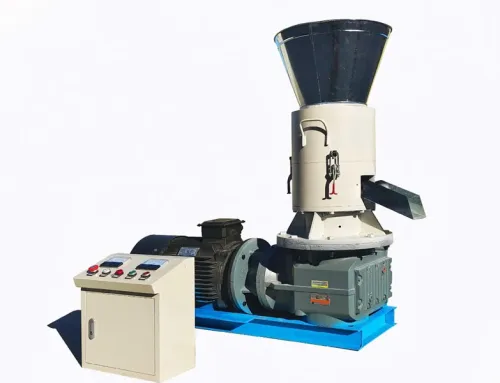
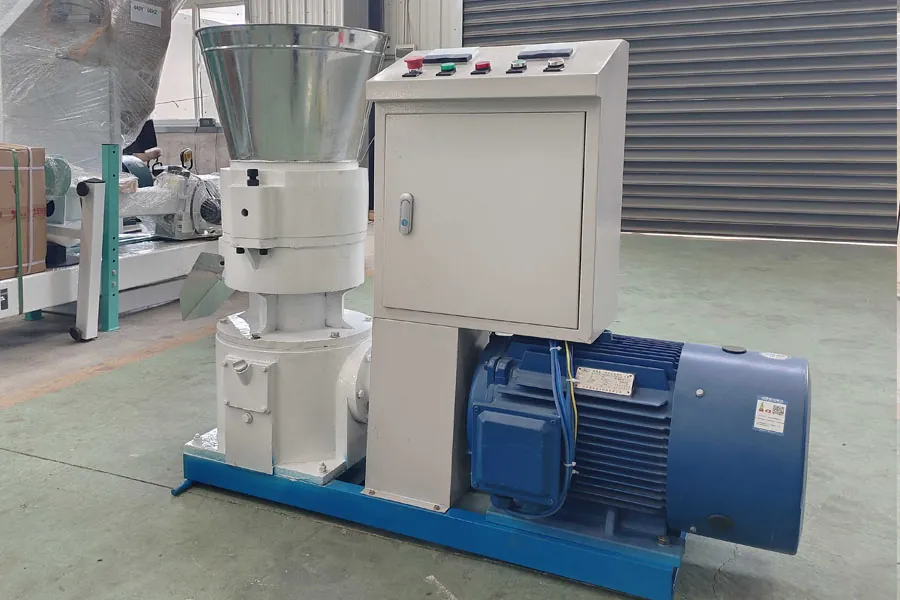
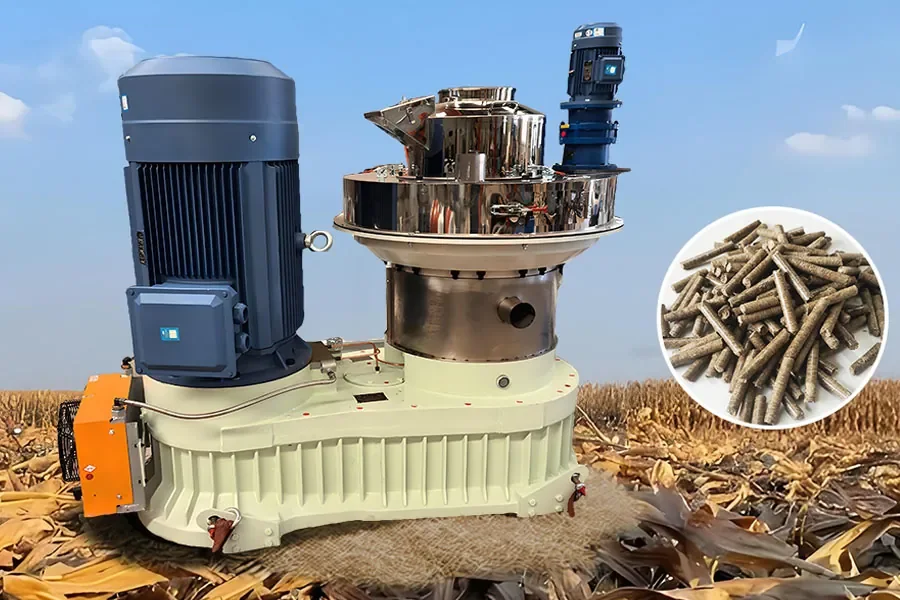
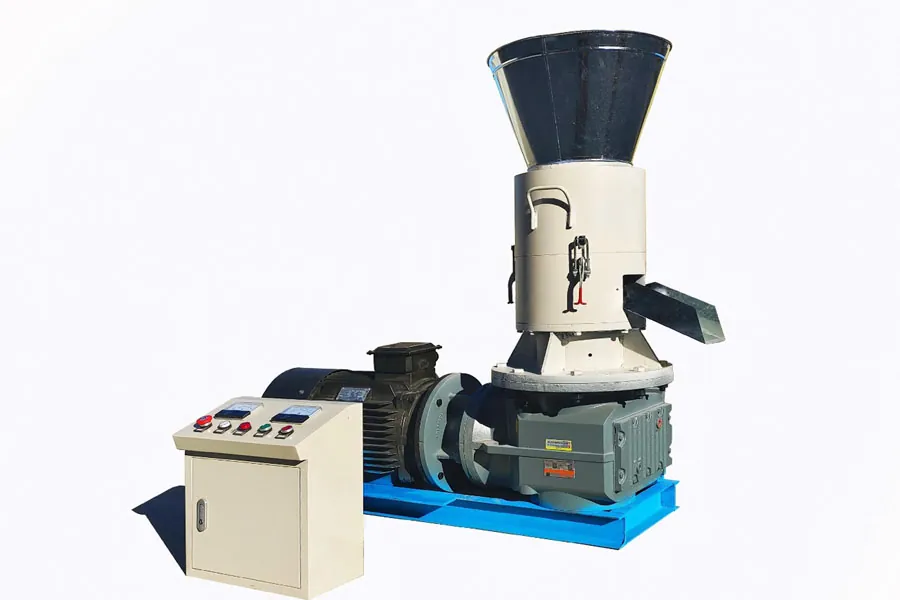
PTO Flat Die Pellet MillThree-point hitch, 540 rpm, 80 to 600 kg/h — no engine, no power line
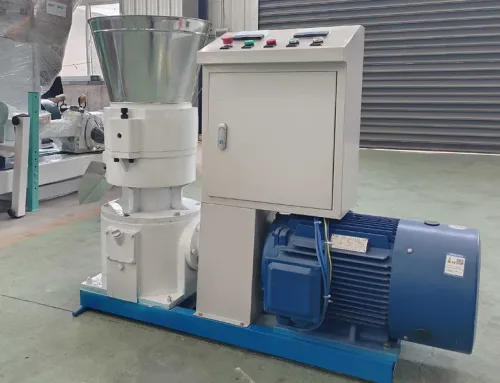
A PTO flat die pellet mill is driven by the tractor you already own. The press hangs on the three-point hitch, a shaft takes the drive from the 540 rpm power take-off, and the machine goes wherever the tractor goes. Five models from 15 to 75 hp, 80 to 600 kg/h on compound feed, one wooden case on delivery.
- 15–75 hp at 540 rpm — no separate engine to buy, fuel or service
- 80–600 kg/h on compound feed at 12–14 % moisture
- Ø6, 8, 10 or 12 mm die in 20CrMnTi, cut to the pellet you sell
- One PTO flat die pellet machine can serve several farms on a rota
Reply in 12 working hours · Die cut to your material · Delivered to 40+ countries
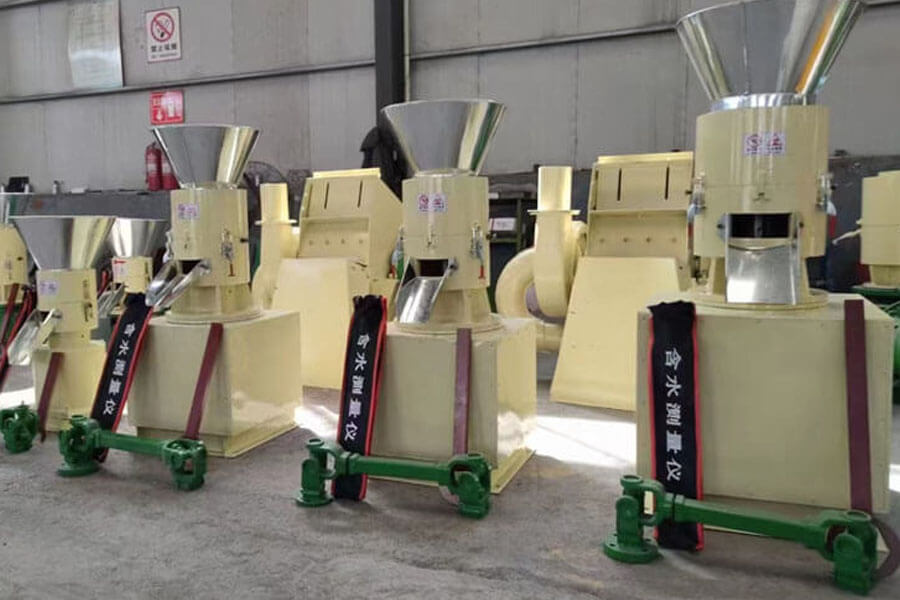
The cheapest drive there is — because you already own it
A diesel flat die pellet mill carries an engine you have to buy, fuel and service. An electric one needs three-phase power at the spot where the material is. A PTO flat die pellet mill needs neither: the tractor is the engine.
That single fact changes the economics. There is no second engine to buy, no oil and filter schedule to keep, no battery to go flat in winter. The tractor already burns fuel to move material, and hitching a PTO flat die pellet machine to the back of it adds no capital cost beyond the press itself. On a farm that already runs a 30–50 hp tractor, this is the least expensive way into pelleting there is.
The second advantage is that the machine travels. One PTO flat die pellet machine on a three-point hitch can pellet at the woodpile on Monday, at a neighbour’s straw stack on Wednesday and back in the yard on Friday. Many customers buy PTO pellet machines for exactly that reason: the tractor moves the PTO pellet machine, and the machine never has to be fed material hauled to it.
The third is where it works. No three-phase line reaches the back of a woodlot, and a diesel engine sitting unused for months is a maintenance liability. A tractor is designed to stand and then start, so a PTO flat die pellet machine is the one pellet press that fits a seasonal, mobile, off-grid job.
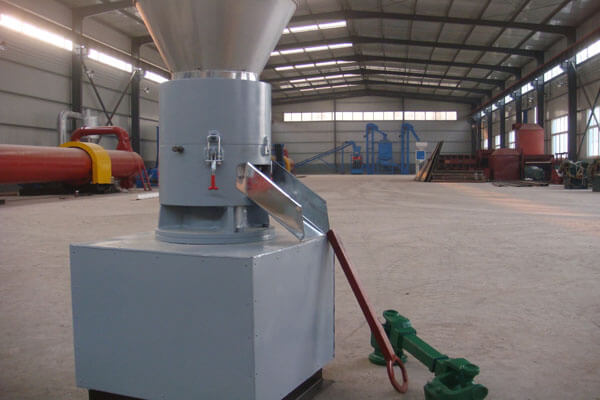
A PTO flat die pellet mill is the same pelleting head as our electric and diesel models. What changes is where the torque comes from — and that is the only part of the machine a tractor can replace.
What it does not give you is independence. Every hour of pelleting is an hour on the tractor clock, and a 540 rpm shaft is unforgiving of a blocked die. The rest of this page is about matching the model to the tractor, the die to the material, and the shaft to the job.
Five PTO flat die pellet mill models, 15 to 75 hp
The PM-P series is the tractor-driven range. Output is quoted on compound feed at 12–14 % moisture; sawdust, straw and husk are lighter and less plastic, so they run at roughly 60–70 % of the feed figure on the same PTO flat die pellet machine.
PTO flat die pellet mill, PM-P series tractor driven, 540 rpm
| Model | Tractor PTO power | Output, compound feed | Output, sawdust | Weight |
|---|---|---|---|---|
| PM-225P | 15 hp at 540 rpm | 80–120 kg/h | 50–80 kg/h | 260 kg |
| PM-250P | 30 hp at 540 rpm | 120–200 kg/h | 80–130 kg/h | 320 kg |
| PM-300P | 41 hp at 540 rpm | 250–350 kg/h | 160–230 kg/h | 450 kg |
| PM-400P | 55 hp at 540 rpm | 350–450 kg/h | 230–290 kg/h | 600 kg |
| PM-450P | 75 hp at 540 rpm | 450–600 kg/h | 290–390 kg/h | 700 kg |
PTO power is what the tractor has to deliver at the shaft, not its engine rating — a 35 hp tractor at the flywheel is roughly 30 hp at the PTO. Weight is the machine with hopper and hitch frame, without the shaft. Every model can be supplied with a die cut to Ø6, 8, 10 or 12 mm and a second die ordered with it; the die and roller material is 20CrMnTi, hardened, because a PTO flat die pellet machine is usually run on the abrasive material a farm has rather than the clean material a feed mill buys.
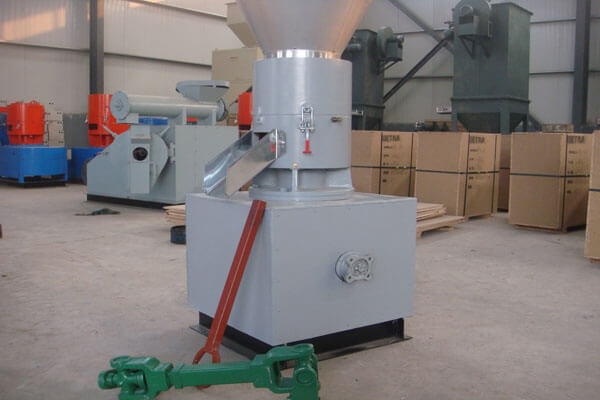
Five PTO models, 15 to 75 hp at the shaft
A PTO flat die pellet mill is bought on the tractor, not on the model list. The shaft power you have picks the frame, and the material picks the die.
Send the tractor and the material
Tell us the tractor’s PTO power, the material and the kg/h you need. We reply with the model, the die and a price — and say plainly if the tractor is too small for the frame you were looking at.
Reply within one working day. No obligation.
What the tractor has to provide
A PTO flat die pellet mill is only as good as the shaft driving it. These six numbers are what to check on your tractor before you order a model.
Tractor requirement for a PTO flat die pellet mill
| Item | Requirement | Note |
|---|---|---|
| PTO power | 15–75 hp at the shaft | Match the model, not the engine badge |
| PTO speed | 540 rpm | 1000 rpm tractors need a different gearbox — tell us |
| Shaft | 6-spline, 1-3/8 in | Standard ASAE shaft; adapter available for 21-spline |
| Hitch | Three-point, two lower links + top link | The machine is carried, not trailed |
| Hydraulics | None needed | No lift rams, no spool valve, no oil flow |
| Fuel | Tractor diesel only | No second engine to fuel or service |
The one mistake we see is sizing on the tractor’s engine rating instead of its PTO rating: a tractor sold as 35 hp delivers about 30 hp at the shaft, and a PM-300P rated at 41 hp will labour on it. The second mistake is a 1000 rpm-only tractor — the gearbox on a 540 rpm PTO flat die pellet machine is not interchangeable, so tell us before the crate is built. If your tractor has a 21-spline shaft, order the adapter with the machine.
rpm at the shaft
The standard PTO speed. The gearbox on a PTO flat die pellet machine is built for it and nothing else.
hp at the PTO
From a compact tractor on the PM-225P to a full-size utility on the PM-450P.
point linkage
Two lower links and a top link carry the machine. No trailer, no skid, no foundation.
extra engines
One engine on the farm does the hauling and the pelleting — that is the whole point.
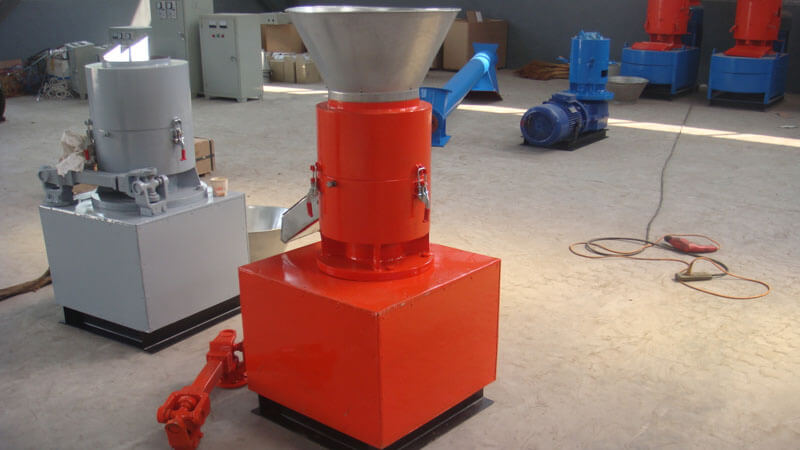
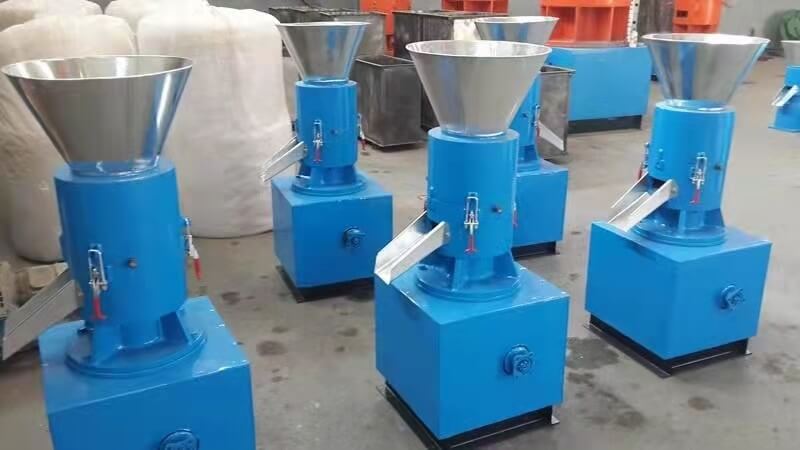
Which drive to buy — decided by what is already in the yard
The three drives make the same pellet. The choice is about what you already own and where the material is.
PTO, diesel or electric flat die pellet machine same head, three drives
| Item | PTO flat die pellet mill | Diesel flat die pellet mill | Electric flat die pellet mill |
|---|---|---|---|
| Power source | Tractor PTO, 15–75 hp at 540 rpm | Diesel engine 10–110 hp | Electric motor 4–30 kW |
| Engine to buy | None — uses the tractor | Yes, built into the price | No |
| Running cost | Tractor fuel only | Diesel 1.2–2.5 L/h | Electricity, cheapest per hour |
| Where it works | Anywhere the tractor can reach | Anywhere, self-contained | Where three-phase power reaches |
| Mobility | Carried on the three-point hitch | Skid frame or trailer | Fixed installation |
| Servicing | Tractor service only | Engine plus machine | Motor is near maintenance-free |
| Best for | Farms with a tractor, contract pelleting, several sites | No tractor and no power | A fixed site with reliable power |
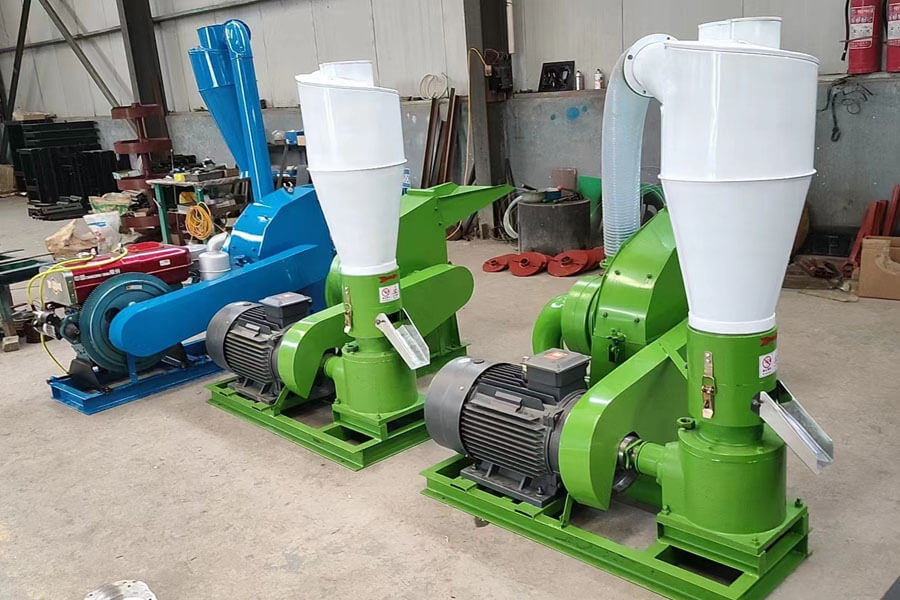
If there is a tractor in the yard, the PTO flat die pellet mill wins on capital cost and on mobility — there is simply nothing extra to buy. If there is no tractor and no power line, take the diesel flat die pellet mill. If the machine will stand in one shed with three-phase power, the electric flat die pellet mill is cheapest to run and quietest. Plenty of customers run a PTO unit alongside an electric one: the electric machine does the weekly tonnage, the PTO machine does the sites.
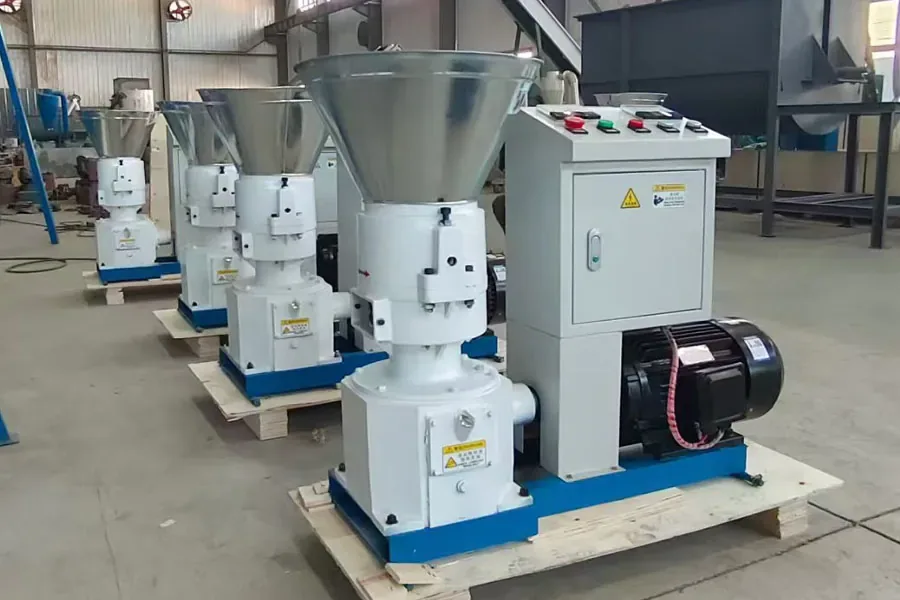
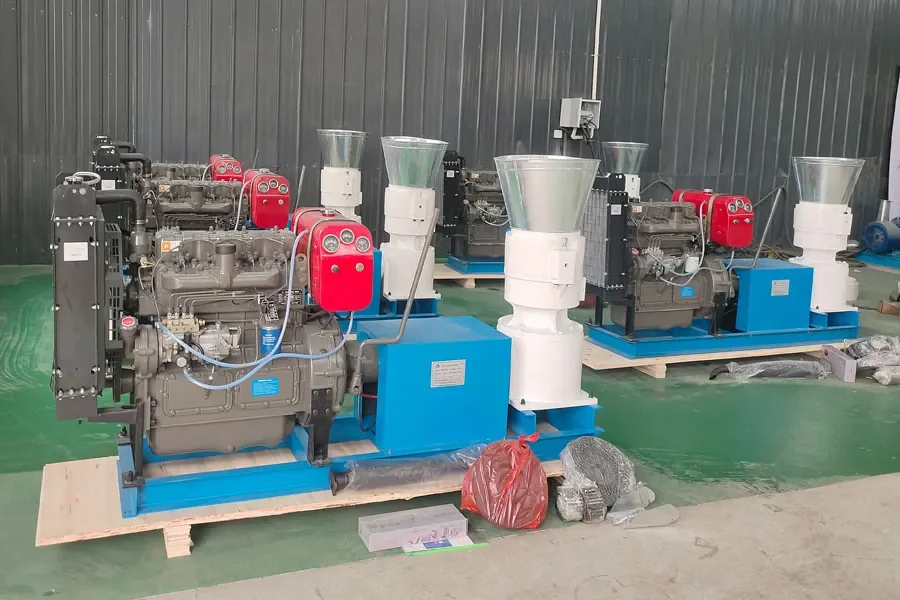
The die is the specification on a PTO flat die pellet mill too
Two numbers decide whether the machine works on your material: the hole diameter, which sets the pellet, and the hole length divided by that diameter, which sets how hard the tractor has to pull.
Die holes for a PTO flat die pellet machine Ø6 to Ø12 mm
| Die hole | Pellet | What it is for | Note |
|---|---|---|---|
| Ø6 mm | 6 mm | Wood fuel pellets, poultry and cattle feed | The default for mixed use |
| Ø8 mm | 8 mm | Wood fuel, bedding, large ruminants | Highest output on a PTO flat die pellet machine |
| Ø10 mm | 10 mm | Bedding, coarse biomass | Lower density, faster rate |
| Ø12 mm | 12 mm | Bedding and coarse straw | Easiest to press, lowest density |
Dies and rollers are 20CrMnTi, hardened, and cut to the compression ratio your material needs — a die matched to sawdust blocks on feed mash and a feed die crumbles on sawdust. One die ships with the machine and a second can be ordered with it. A die is a wear part: expect 300–600 hours on abrasive material, longer on clean grain, and expect the rollers to wear with it. Spare dies, rollers and clamps are kept in stock — see spare parts.
The compression ratio is not a preference. On a PTO flat die pellet machine it is also a limit on the tractor: a die with a long hole in a hard material needs more torque than a 30 hp PTO can hold at 540 rpm, and the shaft will stall before the die blocks. Tell us the material and we match the die to both.
Moisture and grind decide the output, not the tractor
Almost every PTO flat die pellet machine that disappoints on site was fed material that was too wet, too long, or both. These are the numbers worth writing on the wall of the shed.
Material, moisture and preparation for a Ø8 mm die
| Material | Moisture in | Preparation | Note |
|---|---|---|---|
| Sawdust, sander dust | 12–14 % | Under 5 mm | The main job — 60–70 % of the feed figure |
| Wood chips, shavings | 12–14 % | Crush to 5 mm | Needs a hammer mill in front of the press |
| Straw, stalk, husk | 12–15 % | Chop to 3–5 mm | Harder fibre; slower than sawdust |
| Rice husk, peanut shell | 10–14 % | Already short | Abrasive — die life drops, output is high |
| Alfalfa, grass meal | 12–15 % | Grind to 3–5 mm | Fibrous; expect 10–20 % less |
| Compound feed mash | 12–14 % | Grind to 2–3 mm | The highest output on any PTO flat die pellet mill |
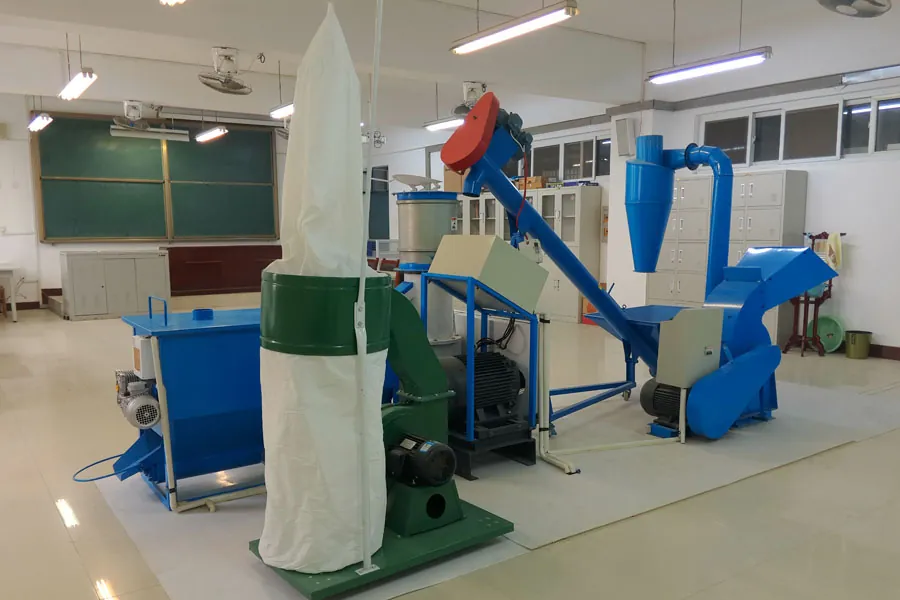
Moisture is measured on a meter as received, not by squeezing a handful. Above 16 % the pellets come out soft and smear in the die; below 12 % the material will not bind without a binder and the die runs hot. Grind matters as much: a wood hammer mill or a diesel hammer mill in front of the press is what turns chips and straw into something the die can take, and it is the machine most PTO buyers need alongside the press.
Five steps from hitching up to a bag of pellets
A PTO flat die pellet mill is the simplest drive there is: no engine to start, no fuel to check, no electrical panel. What it does need is a tractor lined up square and a shaft at the right speed.
Hitch on
Reverse to the frame, pin the two lower links and the top link. The machine is carried, so the tractor takes its weight — no foundation and no levelling.
Line up the shaft
Couple the PTO shaft, check the guard is intact and that the shaft is not bottoming out on the splines when the lift is raised.
Bring it to 540 rpm
Engage the PTO at low engine revs, then bring the shaft to 540 rpm. Never engage the PTO with the hopper full and the die cold.
Feed the die
The hopper drops material into the chamber through a slide gate. Watch the tractor note, not the hopper level — a PTO flat die pellet machine tells you it is overloaded by lugging.
Cut and cool
A knife under the die sets pellet length. Pellets leave at 60–80 °C — spread them or run a cooler before bagging, or they sweat and mould.
Six habits that keep a PTO flat die pellet mill working
A tractor PTO is a 540 rpm shaft with a lot of torque behind it. Every one of these is a five-minute habit that prevents a repair.
- Guard the shaft, alwaysThe PTO shaft on a PTO flat die pellet machine must have its guard fitted and its chains anchored before the PTO is engaged. No exceptions, ever.
- Never engage under loadStart the shaft with an empty chamber and a warm die. Engaging at 540 rpm with the die packed is how shafts shear and gearboxes lose teeth.
- 540 rpm, not moreRunning the PTO fast to raise output raises die temperature and destroys the compression ratio. The gearbox is built for 540 rpm.
- Set the roller gap weeklyA gap that has opened up is the second most common cause of soft pellets after wet material. Feeler gauge, every week, both rollers.
- Break a new die inAn hour on oily sawdust at half rate before production material — a new die that is loaded dry will polish shut and block.
- Store it under coverNo engine means nothing to winterise, but a bare die rusts. Empty the chamber, oil the die face and park the machine out of the rain.
One wooden case, and the wear parts inside it
A PTO flat die pellet machine ships as a single case — smaller and lighter than the diesel unit at the same output, because there is no engine in it.
- Pelleting chamber on the hitch frameRollers fitted, die clamp and knife in place, guard bolted on, hopper mounted.
- PTO driveshaft with guard6-spline 1-3/8 in as standard; 21-spline adapter to order. Guard and safety chains included.
- One die, cut to orderØ6, 8, 10 or 12 mm holes at the compression ratio your material needs — 20CrMnTi, not a stock die.
- Spare roller set and die clampRollers are a wear part; the set ships with the machine so a worn pair does not stop the week.
- Knife and setting gaugeThe gauge is what keeps pellet length consistent after the knife is re-ground.
- Manual and packing listHitching, shaft alignment, roller gap and the die break-in procedure.
What goes with a PTO flat die pellet mill
Chop it, dry it, press it, cool it, bag it — and the same head on the other two drives, if a tractor is not the answer.
Tell us the tractor and the material
Tractor PTO horsepower, the PTO speed (540 or 1000 rpm), the material, its moisture and the pellet diameter. We reply with the model, the die and a price.
Reply within one working day. No obligation.
The same pelleting head, on the drives either side of it
A PTO flat die pellet mill uses the identical die, roller and knife assembly as the engine and electric models — these four clips show that head doing the work.


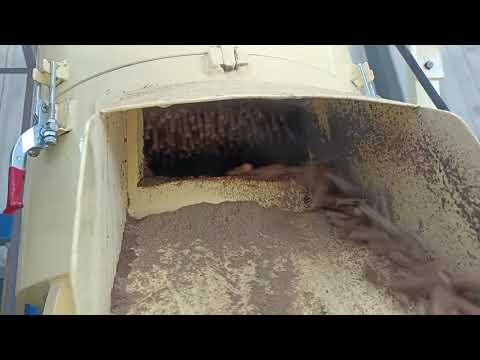

More test runs, shipping records and installation footage on our YouTube channel.
What buyers ask before ordering a PTO flat die pellet mill
What is a PTO flat die pellet mill?
A flat die pellet machine driven by a tractor’s power take-off instead of its own engine or motor. The press hangs on the three-point hitch, a shaft takes 540 rpm from the tractor, and the machine has no engine, fuel tank or starter of its own. We build five models, 15 to 75 hp, 80 to 600 kg/h on compound feed.
How much tractor power does a PTO flat die pellet machine need?
15 hp at the shaft for the PM-225P up to 75 hp for the PM-450P. Size on the PTO rating, not the engine badge — a tractor sold as 35 hp delivers about 30 hp at the PTO, and a model rated above that will labour and stall in hard material.
Does it run at 540 or 1000 rpm?
540 rpm. The gearbox on a PTO flat die pellet machine is built for the standard 540 rpm shaft and is not interchangeable with a 1000 rpm tractor. If your tractor is 1000 rpm only, tell us before the machine is built.
Can a small compact tractor drive one?
Yes, up to a point. A compact tractor with 15–20 hp at the PTO will run the PM-225P at 80–120 kg/h on feed or about 50–80 kg/h on sawdust. Above that the frame needs more torque than a compact can hold at 540 rpm.
What can a PTO flat die pellet mill make?
Wood pellets from sawdust and crushed chips, straw and husk pellets, grass and alfalfa pellets, and compound animal feed. The die and the compression ratio change with the material, not the machine — sawdust runs at roughly 60–70 % of the feed figure on the same PTO flat die pellet machine.
Is it cheaper than a diesel flat die pellet mill?
Substantially, for the same output, because there is no engine in the price. It is also cheaper to own: nothing to service but the die and rollers. The trade-off is that every hour of pelleting is an hour on the tractor, so it suits a farm that already runs one.
Do I need a hammer mill as well?
For sawdust, no. For chips, shavings, straw or whole grain, yes — material has to be under 5 mm for wood and 2–3 mm for feed before it reaches the die. An electric hammer mill or a diesel hammer mill in front of the press is the usual pairing.
How long is delivery and how do I pay?
7–10 working days for standard models, longer if the die has to be cut for an unusual material. Payment is TT with 40 % deposit in advance and the balance before delivery, one wooden case with the die, spare rollers, knife and PTO shaft inside.
Send the tractor and the material
Tractor PTO horsepower, the PTO speed, the material, its moisture and the pellet diameter. Those five answers decide the model, the die and whether a PTO flat die pellet mill is the right drive for your site at all.
- Emailinfo@pelletmachines.net
- WhatsApp+86 186 0385 1787
- HoursMon–Sat, 08:00–20:00 (GMT+8)
Send a photo of the tractor hitch and of the material, and we will confirm the model, the shaft and the die before you pay a deposit.
What happens after you send this
We answer with the model, the die, the shaft specification and a price — then send a test-run video on your material before you pay a deposit.
Your details are not shared. One follow-up, no mailing list.