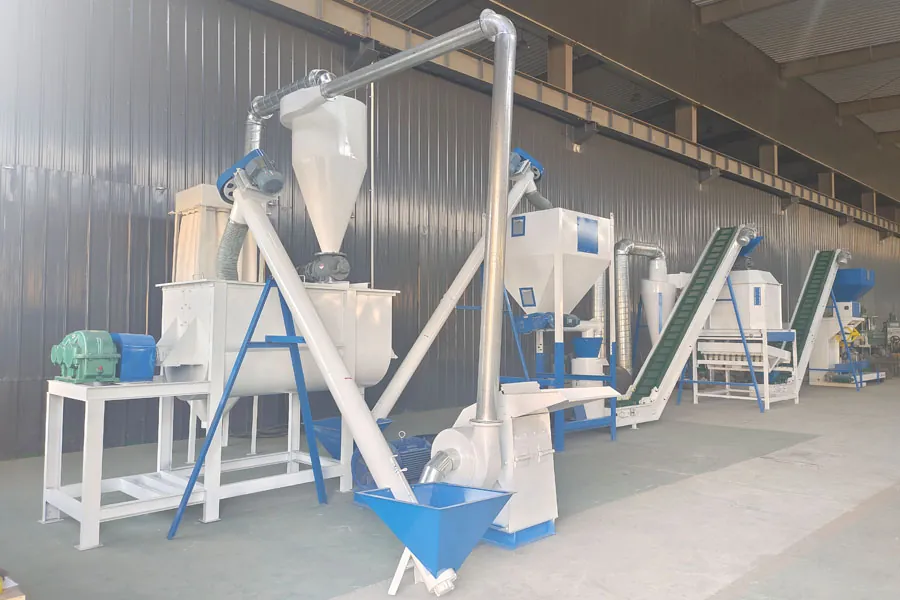
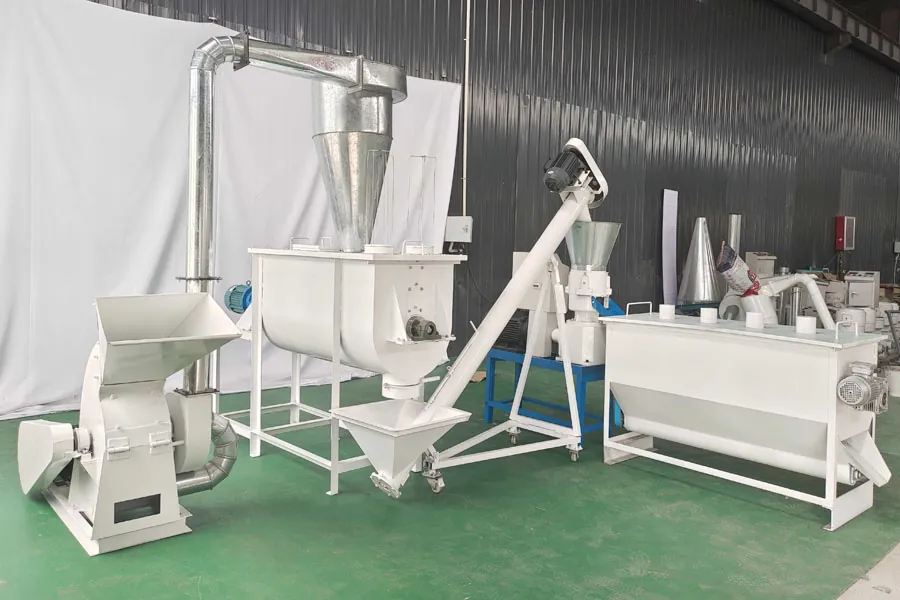
500 kg/h Feed Pellet Production LineFour machines, 27 kW, and 24 m² of floor
A 500 kg/h feed pellet production line built around flat die feed pellet mill PM-260B at 15 kW, rated 400–600 kg/h. Six stages from the feed hammer mill to the pellet packing machine, 27 kW of motors, 24 m² of floor.
- PM-260B flat die feed pellet mill — 15 kW, 400–600 kg/h on a 4 mm feed die
- 27 kW installed across all six stages, 63 A three-phase supply, 380 V / 50 Hz
- Feed hammer mill, feed mixer, screw conveyor and buffer, pellet cooler, pellet packing machine — one quotation, one layout drawing
- 2–8 mm pellets, 10–50 kg bags or bulk, delivered to 40+ countries
Reply in 12 working hours · Sized on your ration and pellet size · Layout drawing included
Start Making Your Own Feed On 27 kW
A 500 kg/h feed pellet production line turns maize, soybean meal and bran into 400–600 kg/h of feed pellets, in bags, on 6 × 4 m of floor.
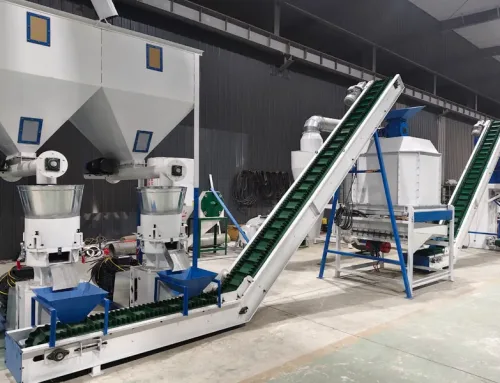
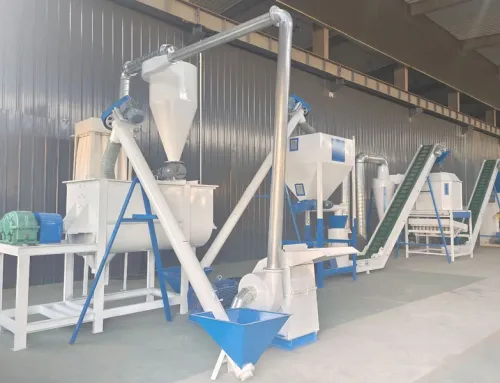
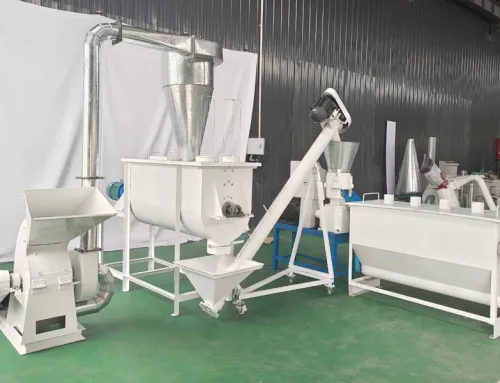
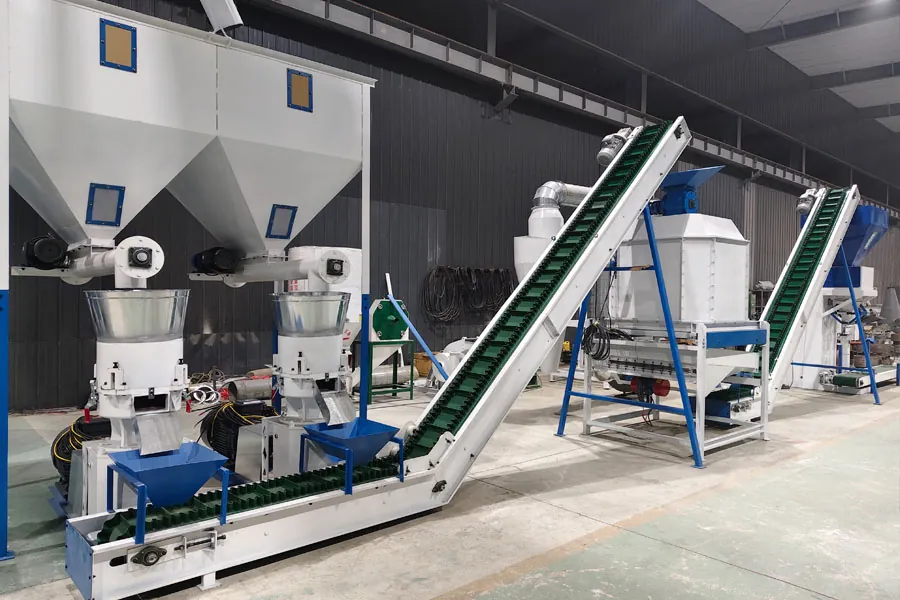
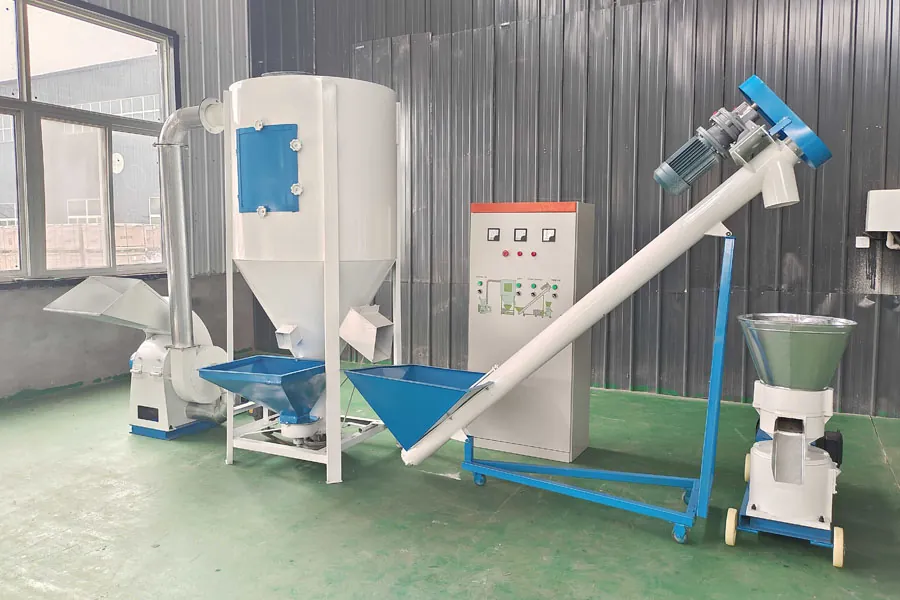
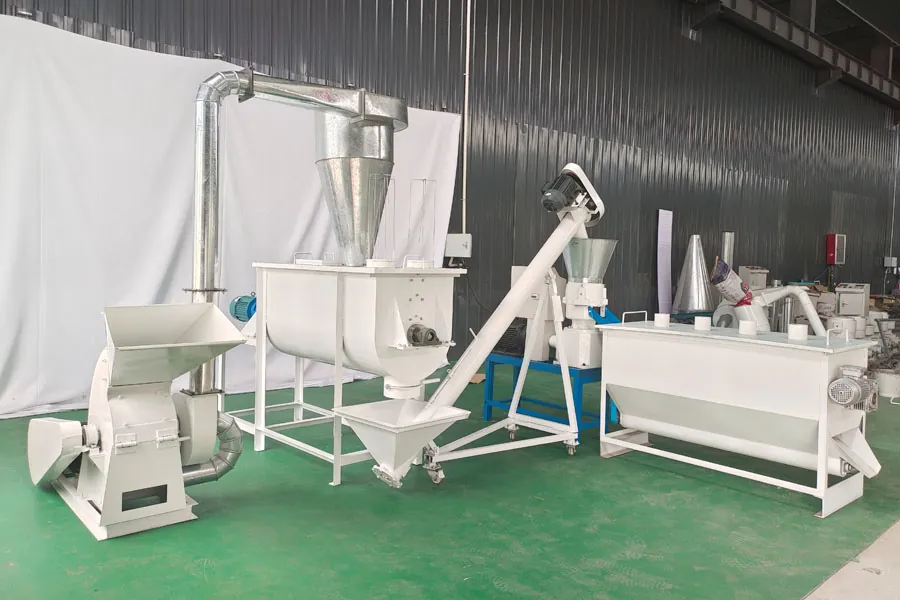
A 500 kg/h feed pellet production line is four machines and one control cabinet: a feed hammer mill, a vertical feed mixer, a screw conveyor with a buffer, and a flat die feed pellet mill. That is the whole line, and it fits on 24 m² of concrete.
It is the build we quote to a poultry farm that is tired of buying bagged feed, to a co-operative that wants to pellet for twelve members, and to feed mills in the 300–600 kg/h band where a ring die line would never pay for itself. Everything on it is a machine we also sell on its own, so a replacement die, roller or screen is quoted against the part number and shipped to you — by air when the part is small, by sea when it is not.
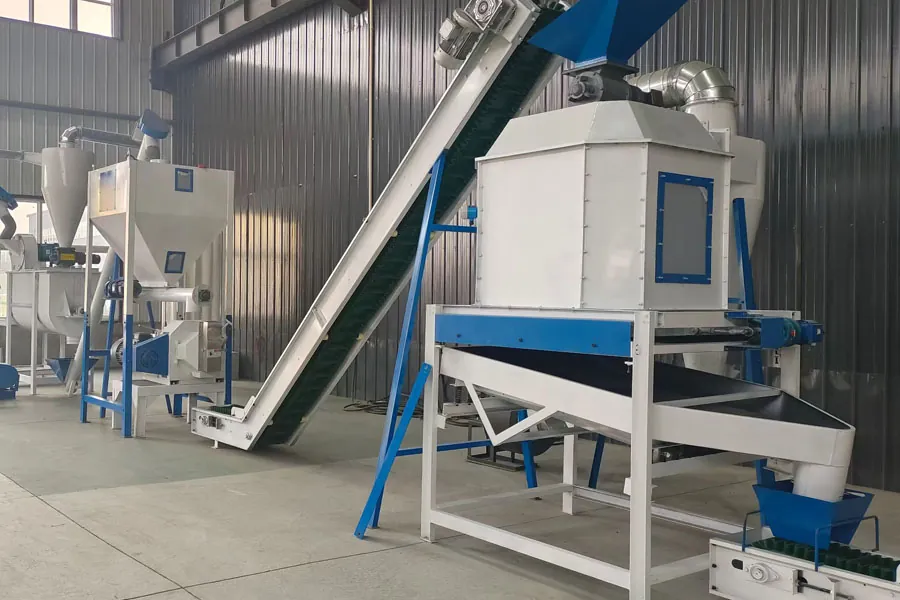
What it does not have is a pellet cooler and a pellet packing machine. Pellets leave a flat die feed pellet mill at 70–85 °C and soft, and they have to be cooled before they go into a bag or the bag sweats and the top sets into a lump. On this build you either tip them into a heap to cool and bag them the next morning, or you add the LQ-50 pellet cooler and the BZ-50 pellet packing machine and the line becomes a complete six-stage feed pellet production line for another 4 kW.
Flat die feed pellet mill · Feed hammer mill · Feed mixer — every machine on this feed pellet production line is also sold on its own, and the dies, rollers and screens for them are shipped as spares: by air when the part is small, by sea when it is not.
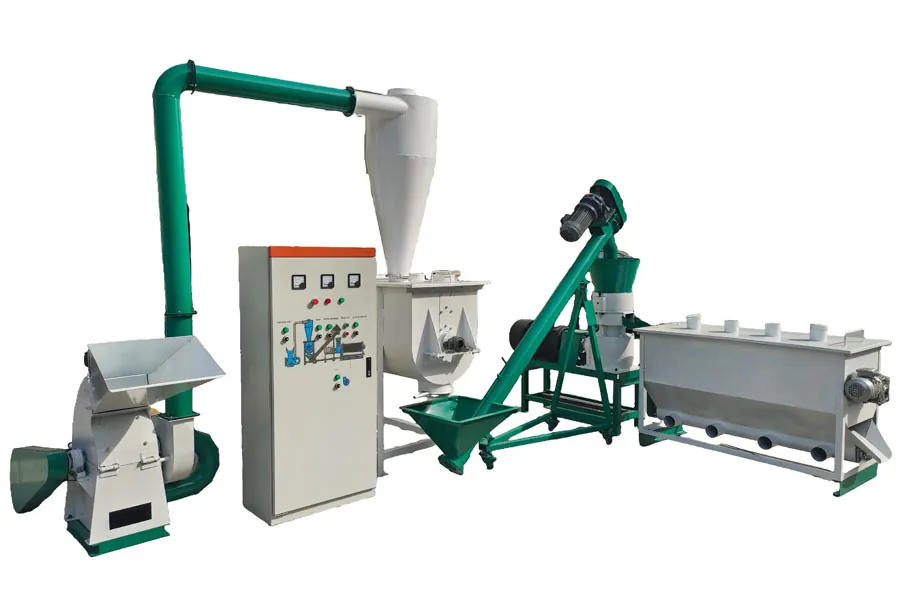
A 500 kg/h feed pellet production line 27 kW installed
| Stage | Model | Motor | What it does | |
|---|---|---|---|---|
| 01 | Feed hammer mill | FS-420 | 7.5 kW | Maize, soybean meal and bran down to the 2–3 mm mash a feed pellet mill wants |
| 02 | Feed mixer | LJ-500 | 3 kW | One batch every 8–12 minutes, 3–5 % CV on a dry mash |
| 03 | Screw conveyor and buffer bin | LX-140 | 1.5 kW | Carries the mash up to the buffer and keeps the pellet mill fed at a steady rate |
| 04 | Flat die feed pellet mill | PM-260B | 15 kW | 400–600 kg/h on a 4 mm feed die |
| 05 | Pellet cooler | LQ-50 | 2.95 kW | 0–500 kg/h through a cooling box with the screen deck underneath (optional on this build) |
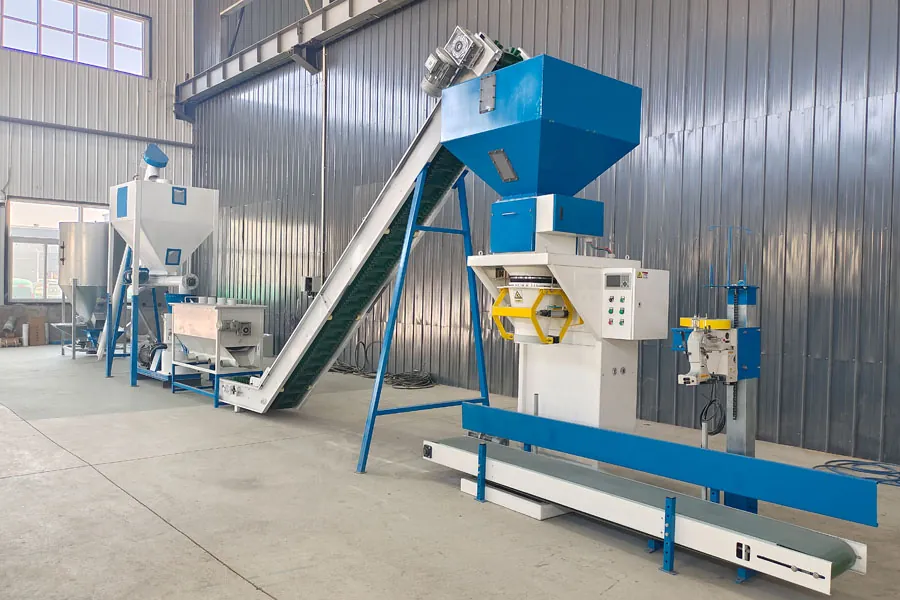
| 06 | Pellet packing machine | BZ-50 | 1 kW | 10–50 kg woven bags, weighed and sewn (optional on this build) |
Motors are the machine drives only. Add the control cabinet, the interlocking and the cable between them and the line draws 27 kW without the cooling and bagging end, 31 kW with it.
The order is fixed and the reason is the pellet mill. A flat die feed pellet mill wants mash at a constant rate and a constant size: too coarse and the die wears on one side, too fine and the mill slips, and a surge either way shows up as a bag of soft pellets an hour later. Everything upstream exists to deliver mash at an even rate, and everything downstream exists to stop the pellet from turning back into a lump in the bag.
The figure that surprises buyers is the power, not the output. A 500 kg/h feed pellet production line is 27 kW of motors, and the pellet mill is only 15 kW of it — the crusher and the mixer take as much as the machine that makes the pellet. That is why the crusher is deliberately oversized: a hammer mill running at 70 % of its rating gives an even mash and does not heat it, and hot mash pellets badly.
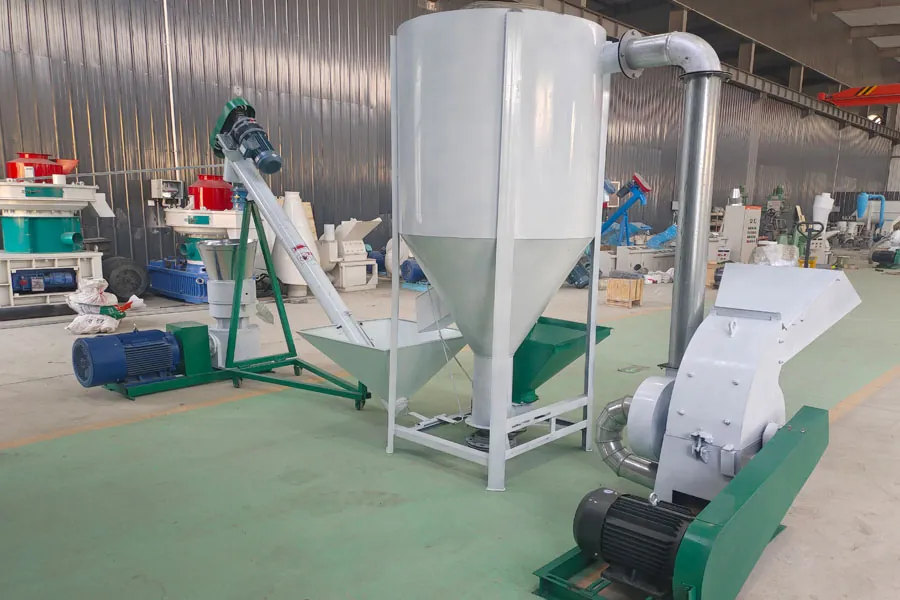
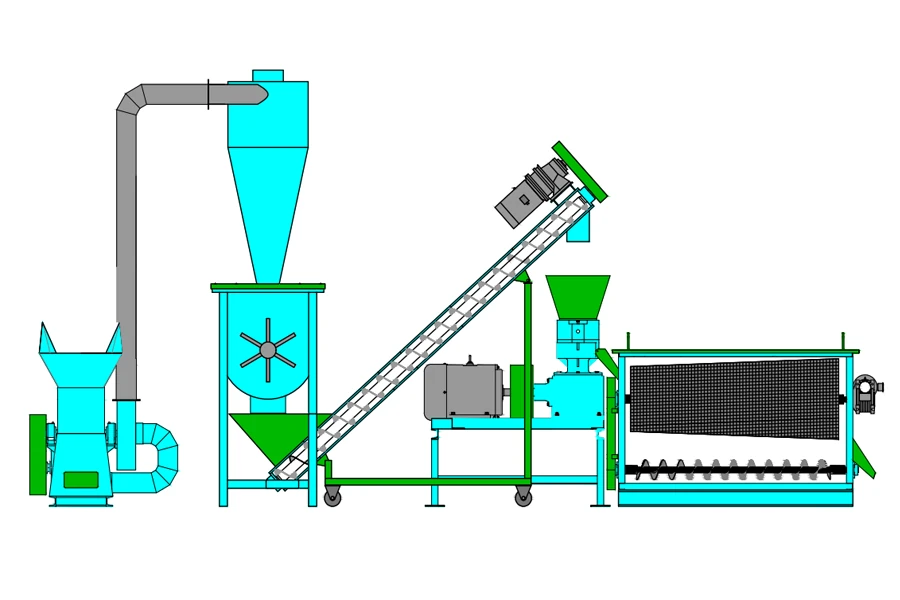
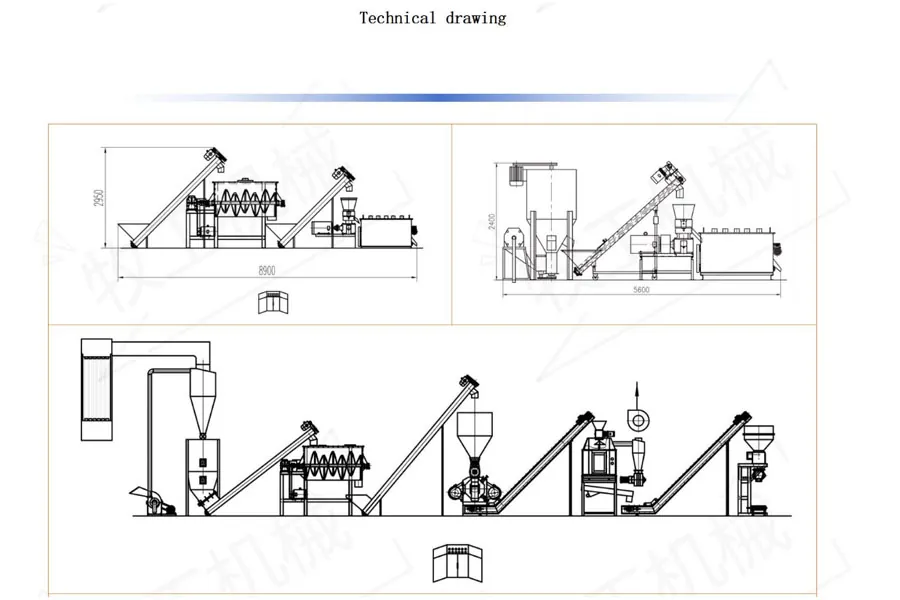
What each stage does, and what we quote at 500 kg/h
Six stages, and the last two share a bay. Read them in order — the material only moves one way through a feed pellet production line.
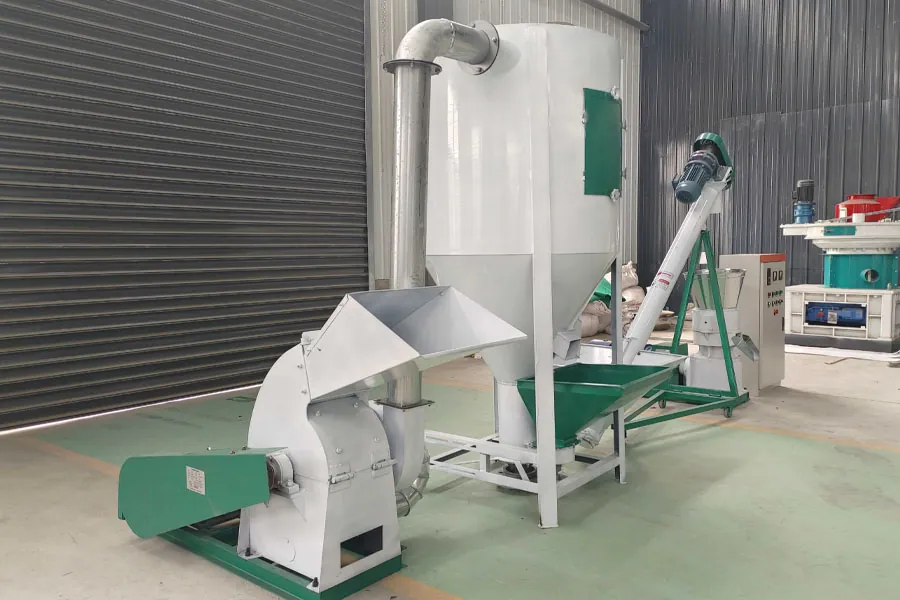
Feed hammer mill
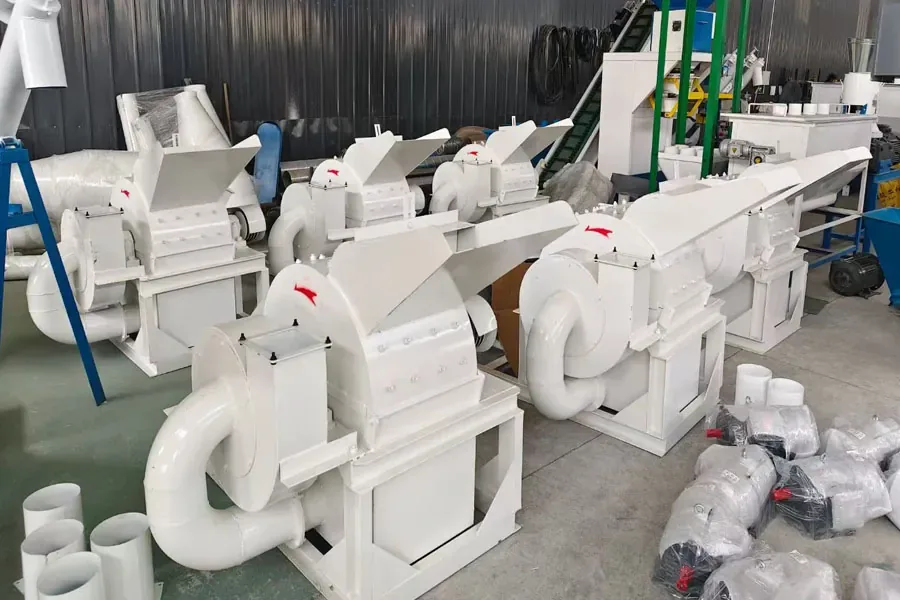
The feed hammer mill is where the mash size is made. Maize, soybean meal, bran and the rest go in whole and come out through a screen; a 2 mm screen gives the fine mash a broiler starter needs, a 3 mm screen is the usual setting for a grower or a layer ration, and 4 mm is as coarse as a flat die feed pellet mill will take comfortably.
We quote FS-420 at 7.5 kW on this line. Maize, soybean meal and bran down to the 2–3 mm mash a feed pellet mill wants. The screen is the cheapest thing to change and the thing that changes output most — dropping from 3 mm to 2 mm can cost a third of the throughput.
Feed hammer mill — FS and SD series, 120 kg/h to 10 t/h, 4 to 90 kW.
Vertical feed mixer
A vertical feed mixer lifts the mash to the top of a cone with a screw and lets it fall back down the sides. It is the cheapest way to mix two or three ingredients and it discharges straight into a bag or a conveyor without another machine under it.
We quote LJ-500 at 3 kW here. One batch every 8–12 minutes, 3–5 % CV on a dry mash. The mixer is the stage that decides whether the bag the customer opens next month is the bag you filled, so it is the last place to save money.
Feed mixer — vertical, horizontal and paddle, 0.5 to 5 t/h a batch.
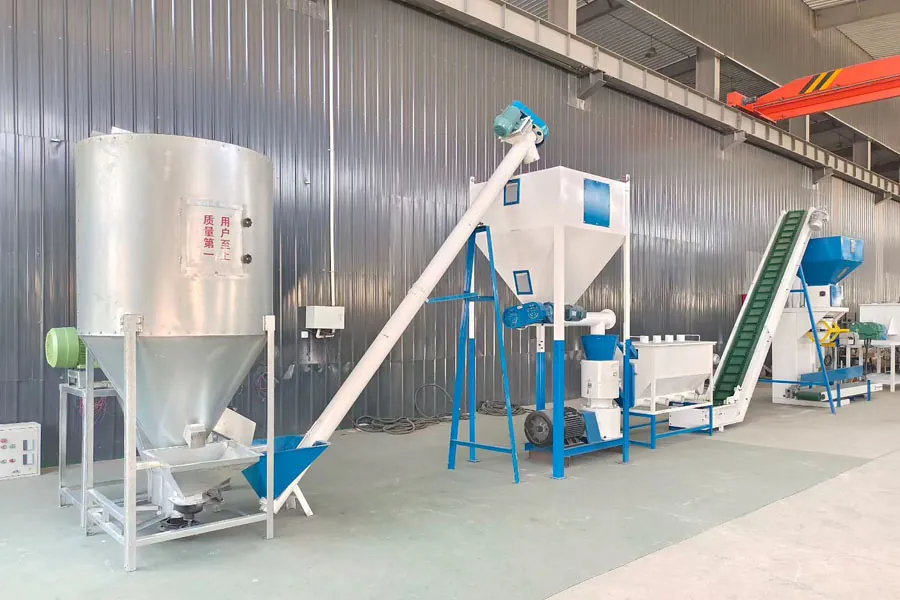
Screw conveyor and buffer bin
The screw conveyor is the machine nobody asks about and the one that decides whether the line runs smoothly. It lifts the mash from the mixer into a buffer bin over the pellet mill, and the bin is what absorbs the difference between a mixer that works in batches and a pellet mill that wants a constant rate.
We quote LX-140 at 1.5 kW for the lift. Carries the mash up to the buffer and keeps the pellet mill fed at a steady rate. Below the bin there is a variable speed feeder — on the smaller builds it is a slide gate and a short screw, on the larger ones a proper frequency-controlled feeder — and that is the control the operator actually uses all day.
Screw conveyors, buffer bins and feeders are quoted with the line rather than as separate machines, cut to the layout drawing.
Flat die feed pellet mill
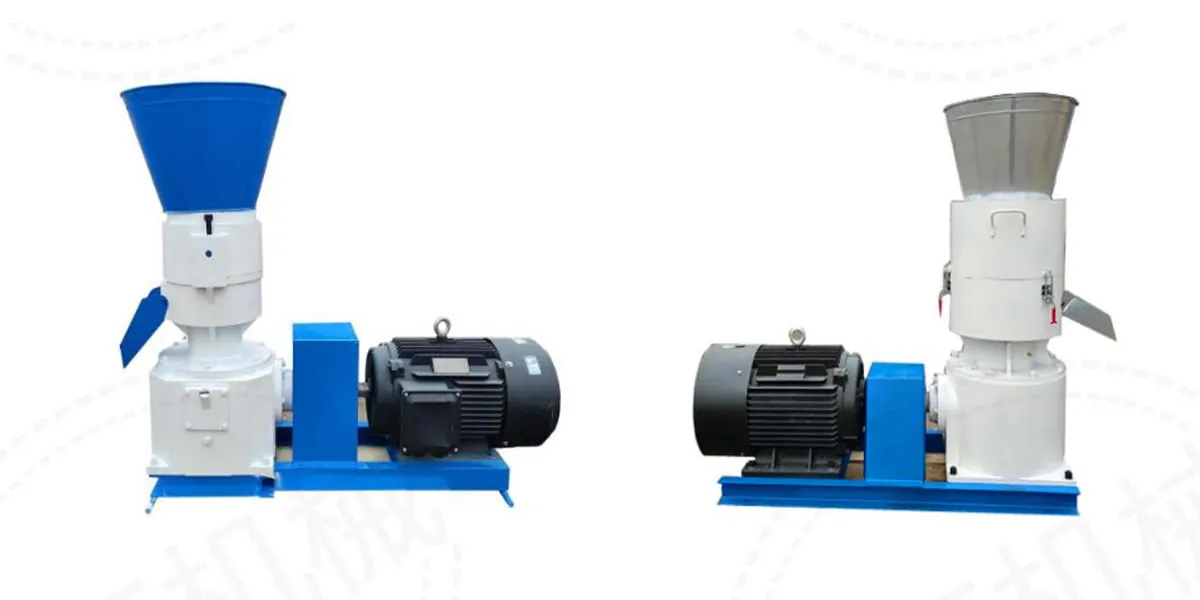
This is the stage the whole feed pellet production line is built around, and the one the capacity is named after. We quote PM-260B flat die feed pellet mill at 15 kW total, rated 400–600 kg/h on a 4 mm feed die.
At 500 kg/h the flat die feed pellet mill is not a compromise, it is the right machine. A 260 mm die with three rollers on top of it, 15 kW, and a die plate that costs a fraction of a ring die to replace. It will run a mash that is a little coarse or a little damp without choking, which is exactly what happens on a farm that weighs its own ingredients.
Flat die feed pellet mill — PM-150B to PM-400B, 4 to 30 kW, 80 to 1,200 kg/h each.
Pellet cooler and pellet packing machine
Feed pellets leave the die at 70–85 °C and soft. The pellet cooler drops them to within a few degrees of room temperature and the screen deck underneath takes out the fines, which go back into the next batch. Bag them warm and the bag sweats on the pallet, the pellets cake together and the customer sends a photograph.
The pellet packing machine is the last stage. We quote BZ-50 at 1 kW, 10–50 kg woven bags, weighed and sewn. If you sell in bulk bags or tip straight into a truck, delete it and put the money into a bigger buffer.
Pellet cooler · Pellet packing machine — the last two stages, and the screen deck under the pellet cooler is what takes the fines out before the bag.
Price a 500 kg/h feed pellet production line
Send the ration, the pellet diameter and the building you have. We answer with a model list, a layout drawing at 1:50 and a price.
Tell us the ration and the output
The ingredients, the pellet size and the kg/h you need. We come back with a model list, a die specification and a price.
Reply within one working day. No obligation.
From a bag of maize to a sealed bag of pellets in six steps
The sequence is the same at 500 kg/h and at 2 t/h. What changes is the size of each machine and the number of pellet mills in the row.
Crushing
Maize, soybean meal and bran through the feed hammer mill to 2–4 mm. The screen sets the size and the throughput.
Mixing
Weighed and mixed to 3–5 % CV. A vertical mixer, 8–12 minutes a batch.
Buffering
The screw conveyor lifts the mash into a bin over the pellet mill. Twenty minutes of mash is what keeps the die loaded evenly.
Pelletising
Mash is forced through the die and cut off by a blade. Feed pellets form on compression and starch, not on lignin.
Cooling
70–85 °C down to room temperature in a counterflow air stream, and the screen deck takes the fines out on the way.
Bagging
10–50 kg woven bags, weighed, sewn and counted. Or bulk, if you tip straight into a truck.
Feed pellets are not wood pellets, and the difference is the whole reason a feed pellet production line has no dryer on it. Wood pellets are held together by lignin, which softens at 80 °C and sets as it cools; feed pellets are held together by starch and by the physical compression of the die. That means the mash has to arrive at 12–14 % moisture and it has to be the right size — a feed pellet production line is a size and moisture problem, not a heat problem.
The number that decides everything is the die. A 4 mm die with a 1:8 compression ratio makes a hard pellet for a broiler finisher; the same die at 1:5 makes a softer pellet that breaks in the bag. On a 15 kW flat die feed pellet mill the compression ratio, not the motor, is what you change when a customer says the pellet is too hard or too crumbly.
The second number is the knife. A blunt knife makes long pellets and doubles, a knife set too close makes fines that go round the line again. It is a five-minute adjustment and it is the one we ask you to check every shift.
One die, three rollers, 4 to 30 kW
At 500 kg/h the flat die feed pellet mill is not a compromise, it is the right machine. A 260 mm die with three rollers on top of it, 15 kW, and a die plate that costs a fraction of a ring die to replace. It will run a mash that is a little coarse or a little damp without choking, which is exactly what happens on a farm that weighs its own ingredients.
A flat die feed pellet mill is a horizontal die plate with two or three rollers running on top of it. Mash falls into the middle, the rollers push it out through the holes and a blade cuts the pellet off as the die turns. It is the oldest design in the industry and still the cheapest way to make feed pellets at small and medium scale.
What it buys you is tolerance. A flat die feed pellet mill will run a mash at 14 % moisture where a ring die machine chokes, it starts under load on a modest supply, and the die is a flat plate that costs a fraction of a ring die to replace. What it costs you is scale: the largest flat die we build is the PM-400B at 30 kW and 1,200 kg/h, so 2 t/h means two mills rather than one bigger one.
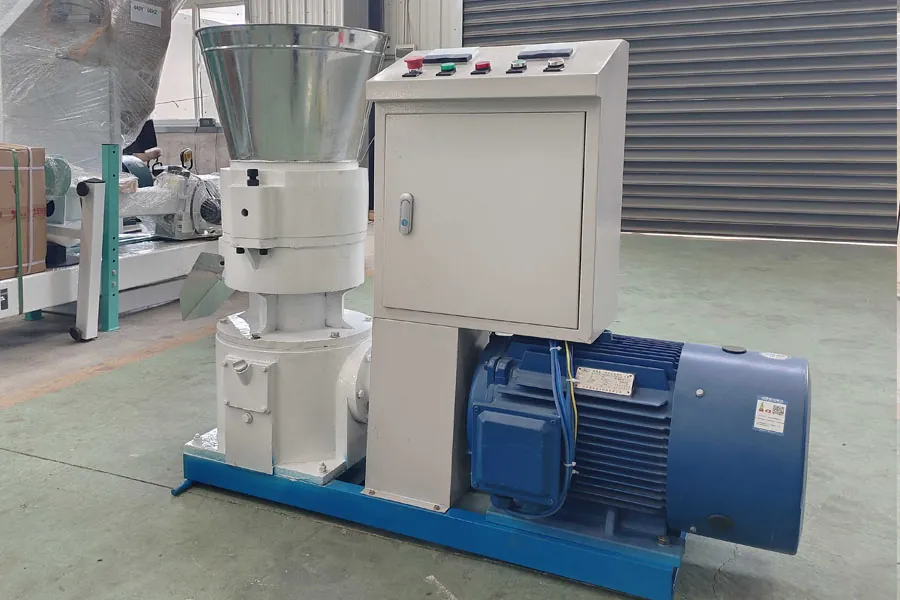
Flat die feed pellet mills 4 to 30 kW, one die each
| Model | Motor | Output on feed | Where it fits |
|---|---|---|---|
| PM-150B | 4 kW | 80–120 kg/h | The smallest flat die feed pellet mill we build |
| PM-200B | 7.5 kW | 200–300 kg/h | A farm mill for one ration |
| PM-260B — this page | 15 kW | 400–600 kg/h | The 500 kg/h feed pellet production line |
| PM-300B | 22 kW | 600–800 kg/h | The 800 kg/h feed pellet production line |
| PM-400B | 30 kW | 800–1,200 kg/h | The 1000 kg/h line, and twice over at 2000 kg/h |
Output is quoted on a 4 mm feed die with a mash at 12–14 % moisture. A finer grind or a softer ration runs below the figure; a 6 mm die runs above it.
The die on a feed pellet mill is matched to the ration, not to the machine. A high compression ratio (1:10 and up) makes a hard, durable pellet for a broiler finisher; a low one (1:5) makes a softer pellet for a young bird or a ruminant. We send one die set to your ration with the line and a second one as a spare.
Rollers wear before dies do. Three rollers on a 400 mm die give a longer service life than two on the same plate because the load is spread over three contact points, and a roller change is a workshop job rather than a factory job. That is why every mill on these pages is a three-roller machine.
What the building has to provide
A 500 kg/h feed pellet production line is 27 kW of motors on 24 m² of floor, under a roof 2.5 m high.
| Item | Figure | Note |
|---|---|---|
| Installed power | 27 kW (31 kW with the cooling and bagging end) | All six stages, motors only |
| Largest single motor | 15 kW on the pellet mill | The figure that sizes the transformer |
| Electrical supply | 63 A three-phase supply, 380 V / 50 Hz | Three-phase, 50 Hz, four-wire |
| Footprint | 24 m² of covered floor | 6 × 4 m under the roof |
| Building height | 2.5 m | Under the buffer bin, at the pellet mill |
| Operators | 2 per shift | One of them on the bagging end |
| Water | Not required | The pellet cooler is air cooled |
| Compressed air | 0.4 m³/min at 7 bar | For the bag clamp and the cylinder valves |
The supply figure is the one to take to an electrician before anything else. A feed pellet mill motor starts under load, so the starting current is five to six times the running current for a few seconds, and a supply sized on the running total will trip every time the mill comes up. Size on the largest single motor, not on the sum.
Height is the second figure people underestimate. The cyclone over the mixer and the buffer bin over the pellet mill both stack vertically, and 2.5 m of clear height is what a 500 kg/h feed pellet production line needs before anyone starts pouring concrete. A 500 kg/h feed pellet production line needs 2.5 m of clear height and 24 m² of floor, which is a corner of an existing shed rather than a new building. The one figure that catches people out is the supply: the pellet mill motor starts under load, so a 63 A three-phase supply has to be there before the machines arrive.
Foundations are ordinary reinforced concrete at 200 mm for everything except the pellet mill, which wants a separate block isolated from the slab so the vibration does not travel into the bagging end. We send the block dimensions with the layout drawing.
What ships, and what the site has to build
A feed pellet production line is quoted as a set, not as six separate machines. The list below is what is inside the price.
-
All six stages
Every machine in the table above, with its motor, starter and guards, tested as a set before it leaves.
-
Conveyors
The screw conveyor from the mixer to the buffer, the belt conveyors between the cooler and the packing machine, cut to the layout drawing.
-
Control cabinet
One panel for the line, with the interlock that stops the feed when the pellet mill stops.
-
Dies and rollers
One die set to your ration and pellet diameter, plus a spare die and a spare roller set.
-
Layout drawing
1:50 plan and elevation, with the foundation blocks and the cable runs marked.
-
Commissioning
One engineer on site for the first run, at our cost, for feed pellet production lines of this size.
Not included, and quoted separately if you want them: the building and the civil works; the transformer; a molasses tank and spray bar; a pellet crumbler for chick starter and piglet feed; and the bulk load-out. Delivery is 25–35 days from deposit for the two smaller feed pellet production lines and 35–45 days for the two larger ones, FOB Qingdao. Spare parts are on the shelf at spare parts.
Where this build sits in the range
We build four feed pellet production lines on the same six stages, from 500 kg/h to 2000 kg/h. The pellet mill count is what changes.
| Capacity | Pellet mills | Installed power | Footprint |
|---|---|---|---|
| 500 kg/h — this page | PM-260B ×1 | 27 kW | 24 m² |
| 800 kg/h | PM-300B ×1 | 46 kW | 72 m² |
| 1000 kg/h | PM-400B ×1 | 71 kW | 72 m² |
| 2000 kg/h | PM-400B ×2 | 110 kW | 150 m² |
Capacity is on feed pellets with a 4 mm die and a mash at 12–14 % moisture. The number of pellet mills is what separates the four builds — the stages either side of them are the same six stages, sized to match.
Where the next step is
Below 500 kg/h the answer is usually a combined flat die pellet mill and hammer mill on one frame, 100–350 kg/h, for a farm that pellets its own grain and nothing else. Above 500 kg/h the vertical feed mixer gives way to a horizontal one, because a horizontal feed mixer can take molasses and oil and a vertical one cannot.
Whichever build you take, the same three numbers decide the quotation: the ration, the pellet diameter and the hours a day you want to run. Send those three and we will tell you which line is the cheapest way to make them, including the case where the answer is a smaller line running two shifts.
All pellet machines — the single machines, the combined units and every line we build.
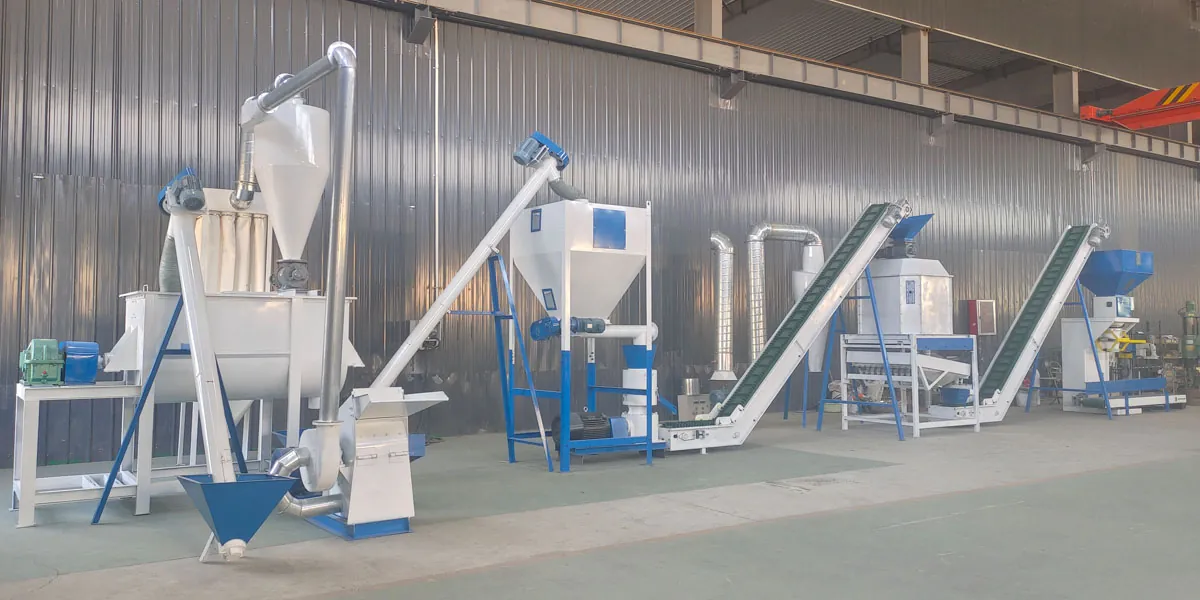
The line, and the machines inside it, running
6 clips: the feed pellet production line end to end, then the pellet mill, the mixer and the cooler on their own.

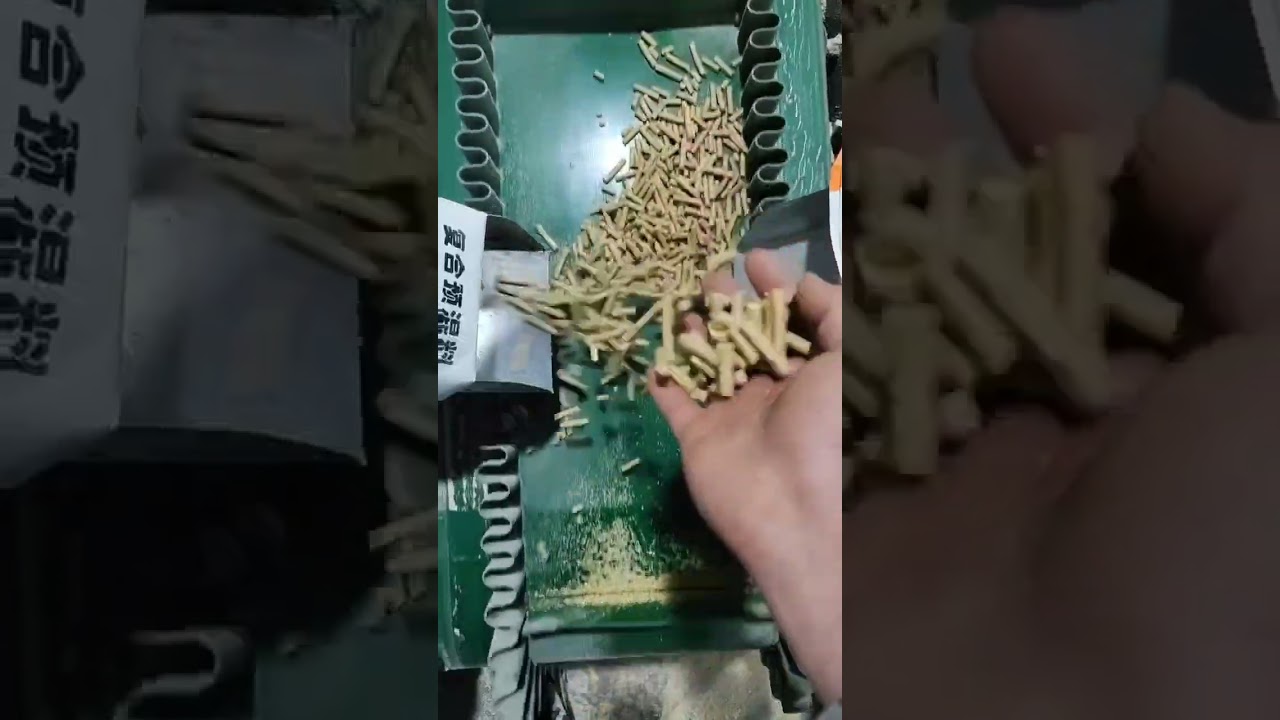


More on the PelletHills channel — the feed playlist is where the feed pellet production line and feed pellet machine clips go up first.
What buyers ask before ordering a 500 kg/h feed pellet production line
10 questions we answer on the phone most weeks.
What does a 500 kg/h feed pellet production line include?
Six stages: a feed hammer mill (FS-420), a feed mixer (LJ-500), a screw conveyor and buffer bin (LX-140), PM-260B flat die feed pellet mill, a pellet cooler (LQ-50) and a pellet packing machine (BZ-50). Installed power is 27 kW and the footprint is 24 m², 6 × 4 m.
Is there a dryer on a feed pellet production line?
No. Feed pellets are bound by starch and compression, not by lignin, so the mash goes into the die at 12–14 % moisture and there is nothing to dry. That is the single biggest difference between this line and a wood pellet production line, and it is why a feed pellet production line is cheaper to run.
Which pellet sizes can this line make?
2–8 mm, and the die decides it. Poultry growers and layers run 3–4 mm, pigs 4–6 mm, cattle and sheep 6–8 mm. Below 2 mm the output drops sharply and a pellet crumbler is usually the better answer for chick starter.
How long does it take to change a die?
About an hour on a flat die feed pellet mill, with two people and no crane. The head lifts off, the old plate comes out, the new one goes in and the rollers are re-set to it. On a ring die machine the same job is a day.
Can it run on a generator?
It can, but the generator has to be sized on the starting current of the largest motor, not on the 27 kW total — allow three times the running load. Tell us at the quotation stage if the site is off-grid, because the starter type changes.
What is the mixing uniformity, and does it matter?
3–5 % CV on a dry mash, which is what the LJ-500 holds. It matters as soon as you put a premix or a medication in at under 1 % — a mixer that leaves 10 % CV gives some birds the vitamin and some none.
Do I need a pellet crumbler?
Only for chick starter and piglet feed, where the pellet has to be broken back down to a crumble. A pellet crumbler sits between the pellet cooler and the pellet packing machine and is quoted separately.
How many people does it take to run?
2 per shift. One loads the crusher and the mixer, one runs the pellet mill and checks the knife and the die, and on the larger builds one is on the bagging end. The line is interlocked, so one person can start and stop it.
Do I need a pellet cooler on a 500 kg/h feed pellet production line?
Only if you bag the same day. Pellets come off the die at 70–85 °C and stay soft for twenty minutes; tipped into a heap they cool on their own overnight and can be bagged the next morning. If you want to bag straight off the line, add the pellet cooler (LQ-50, 2.95 kW) and the pellet packing machine (BZ-50, 1 kW) — 4 kW and about 3 m of extra floor.
Can this line make fish feed?
It can make sinking fish feed at 2–4 mm, but the die and the conditioner are different and the output drops. Floating fish feed is a different machine altogether — an extruder, not a flat die feed pellet mill. Tell us the species and the pellet size before we quote.
Request a quotation for a 500 kg/h feed pellet production line
Tell us the ration, the pellet diameter and the building you have. We reply with a model list, a layout drawing and a price.
What happens after you send this
We answer with the model list, the die compression ratio and a price, then send a test-run video on your ration before you pay a deposit.
Your details are not shared. One follow-up, no mailing list.