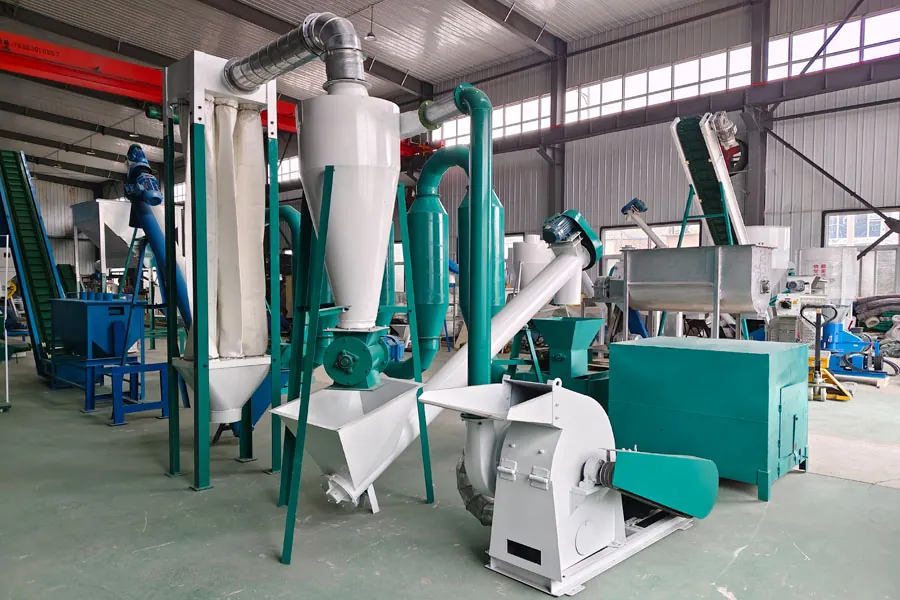
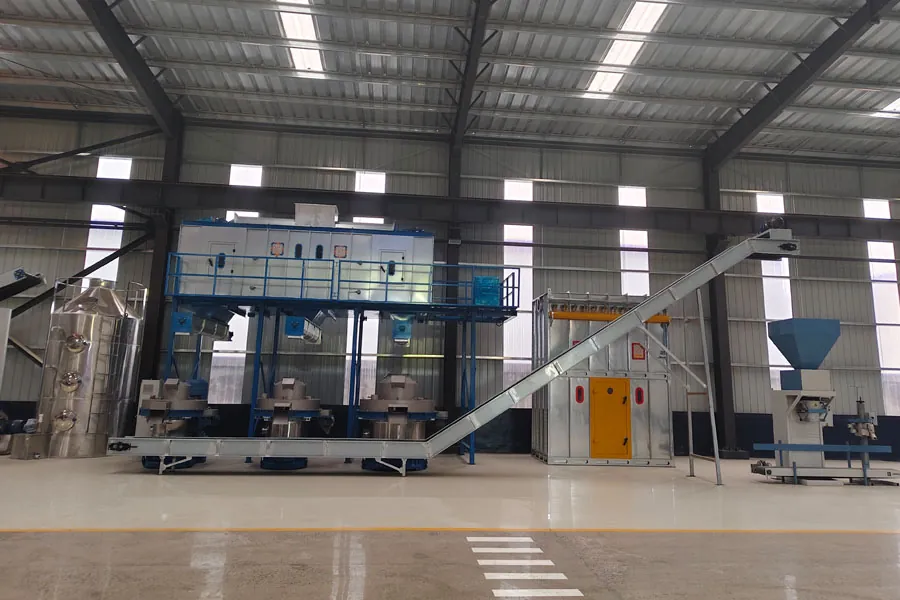
1000 kg/h Biomass Pellet Production LineOne vertical ring die pellet mill, 194 kW, and 220 m² of floor
A 1000 kg/h biomass pellet production line built around one vertical ring die pellet mill — the HML-560 at 90 kW, rated 1.0–1.5 t/h. Six stages from the wood chipper machine to the pellet packing machine, 194 kW of motors, 220 m² of floor.
- HML-560 vertical ring die pellet mill — 90 kW, 1.0–1.5 t/h on biomass
- 194 kW installed across all six stages, 400 A three-phase supply, 380 V / 50 Hz
- Wood chipper machine, wood hammer mill, biomass sawdust dryer, pellet cooler, pellet packing machine — one quotation, one layout drawing
- Runs husk, straw, stover, bamboo, palm fibre, EFB and sawdust; 6, 8 or 10 mm pellets
Reply in 12 working hours · Die quoted on a sample of your material · Layout drawing included
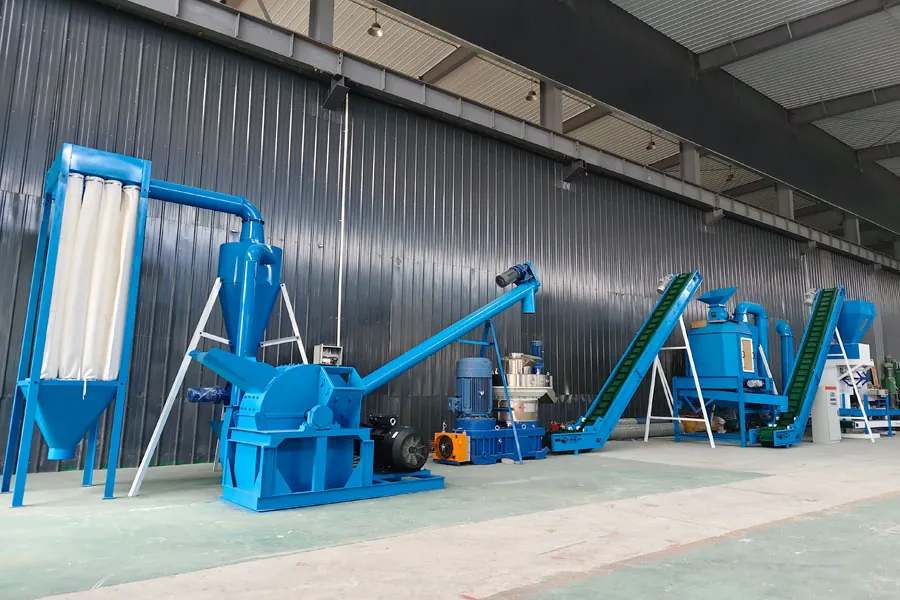
High-efficient Biomass Pellet Production Line Solution
A 1000 kg/h biomass pellet production line turns husk, straw, stover, bamboo or sawdust into 1.0–1.5 t/h of pellets, in bags, on 220 m² of floor.
A 1000 kg/h biomass pellet production line is six machines in a fixed order, and the vertical ring die pellet mill is the one that makes the pellet. The other five exist to hand it biomass at the right particle size, at 12–15 % moisture, at a rate it can swallow — and to take the pellet away cool, screened and bagged.
Biomass is a wider word than wood. The same six stages run rice husk, wheat straw, corn stover, bamboo, palm fibre, EFB and spent coffee grounds; what changes between them is the die compression ratio, the screen in the wood hammer mill and how much water the biomass sawdust dryer has to take out. That is why this build is quoted on the pellet mill rather than on the material: the pellet mill does not change, the tooling inside it does.
Capacity is 1.0–1.5 t/h on the HML-560 with a 90 kW main motor. Read that as 1 t/h of bagged pellets on straw and husk and 1.5 t/h on clean dry wood sawdust. The figure on your quotation is the one your material runs at, and we ask for a sample before we quote the die.
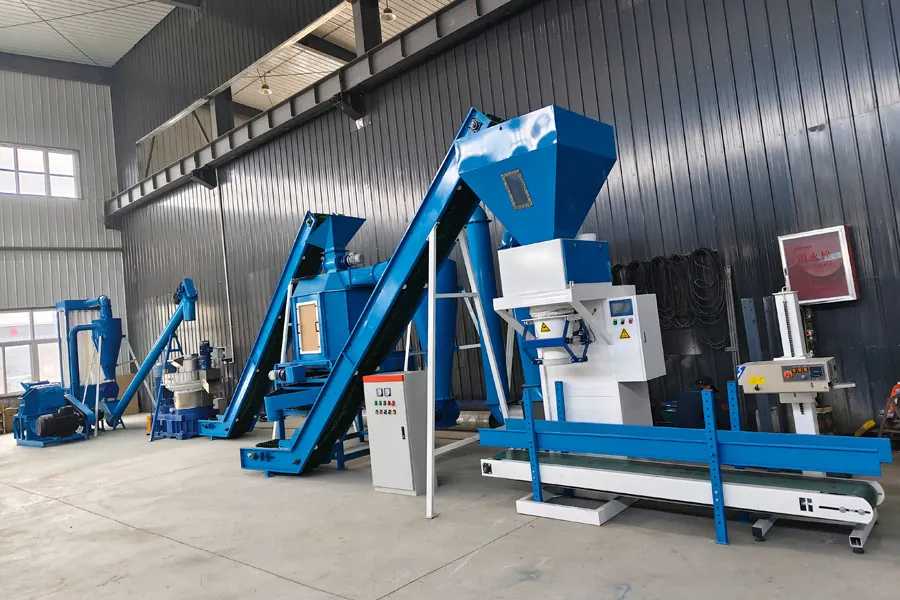
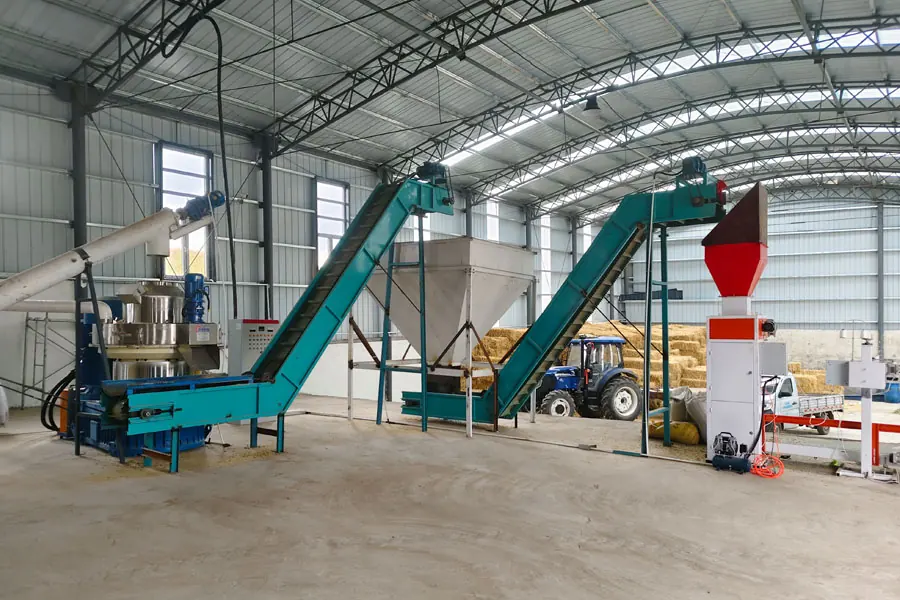
A 1000 kg/h biomass pellet production line 194 kW installed
| Stage | Machine | Model | What it does |
|---|---|---|---|
| 01 | Wood chipper machine | DP-600B | Bales, straw, stalks and slabs opened up and cut to 20–40 mm |
| 02 | Wood hammer mill | FS-50-60B | Down to the 3–5 mm particle the vertical ring die pellet mill needs |
| 03 | Biomass sawdust dryer | HG-G 1000 | Down to 12–15 % moisture, which is the figure the pellet mill is set for |
| 04 | Vertical ring die pellet mill | HML-560 | The only machine on the biomass pellet production line that makes a pellet |
| 05 | Pellet cooler | NL-11 | Hot, soft pellets down to room temperature, with the fines screened out |
| 06 | Pellet packing machine | DCS-Z-D-50 | Weighs and closes the bag, or loads a bulk bag if you sell loose |
Installed power is 194 kW across all six stages. The vertical ring die pellet mill accounts for 90 kW of that, and the 12 kW of conveyors is the figure that grows if the layout is long. There is no pellet crumbler on a biomass pellet production line: the screen deck under the pellet cooler takes the fines out and returns them to the pellet mill.
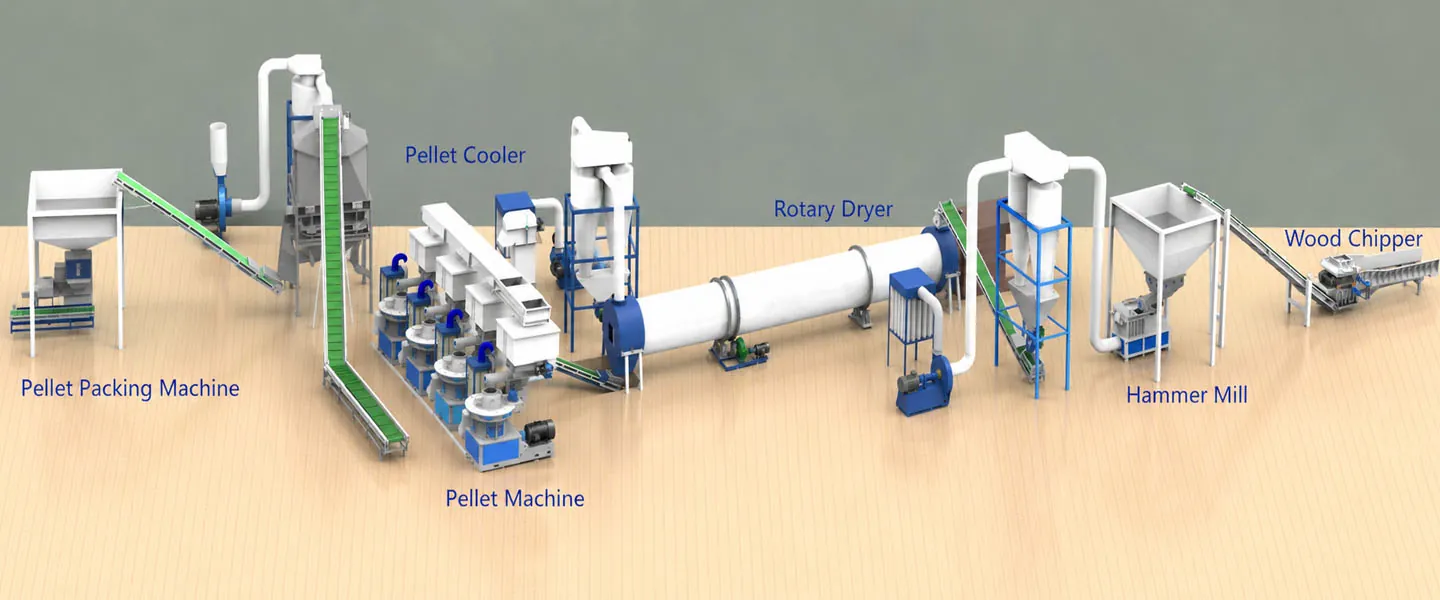
Layout matters more on a biomass pellet production line than on a wood one, because the raw material arrives in a different shape. Straw and husk arrive baled or loose and need a receiving area in front of the wood chipper machine; sawdust arrives by tipper and goes straight into the wood hammer mill, and the wood chipper machine comes off the quotation. Either way stages one to three stay at the wet end of the shed and stages five and six at the dry end, where a truck can back up to the pellet packing machine.
The 1:50 drawing shows the position of every machine, the conveyor lengths between them and the ducting for the biomass sawdust dryer, and it is the drawing that changes most often before an order is signed. Send the shed dimensions and we fit the 1000 kg/h biomass pellet production line into them.
What each stage does, and what we quote at 1000 kg/h
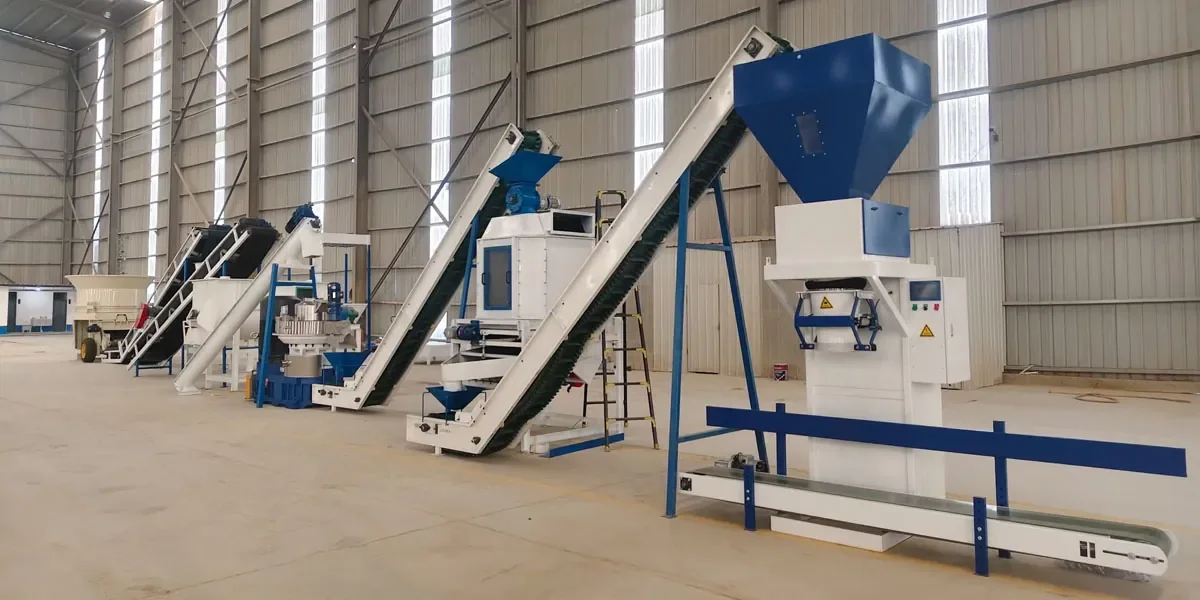
Six machines carry the work, and the last two share a bay. Read them in order — the material only moves one way through a biomass pellet production line.
Wood chipper machine
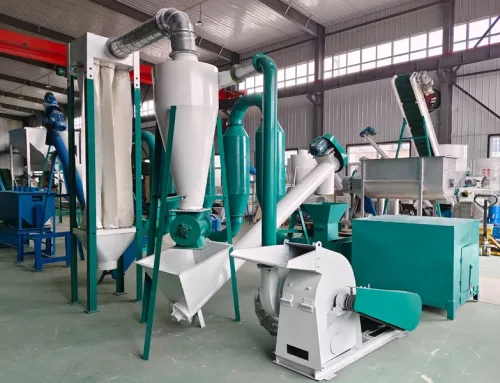
On a biomass pellet production line the wood chipper machine does a different job from the one it does on wood. Straw, corn stover and bamboo arrive as bales, stalks or lengths, and the wood chipper machine opens them up and cuts them to 20–40 mm so the wood hammer mill is fed a mat rather than a tangle.
We quote DP-600B at 30 kW, good for 1,200–1,800 kg/h. If your material already arrives as sawdust or husk, this is the first stage to delete from the biomass pellet production line — it is the one that saves the most money and the most floor space.
Wood chipper machine — disc and drum models, 500 to 2,500 kg/h, electric or diesel.
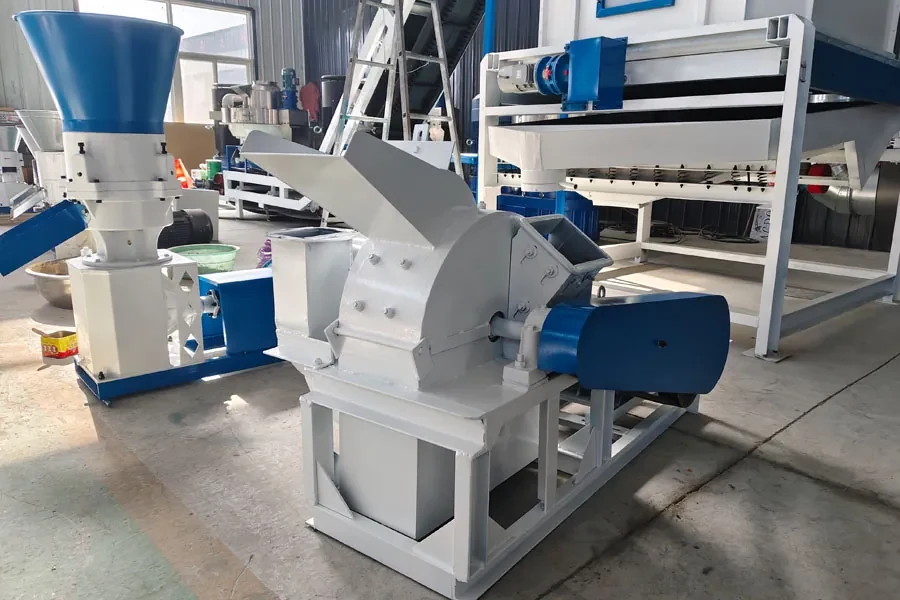
Wood hammer mill
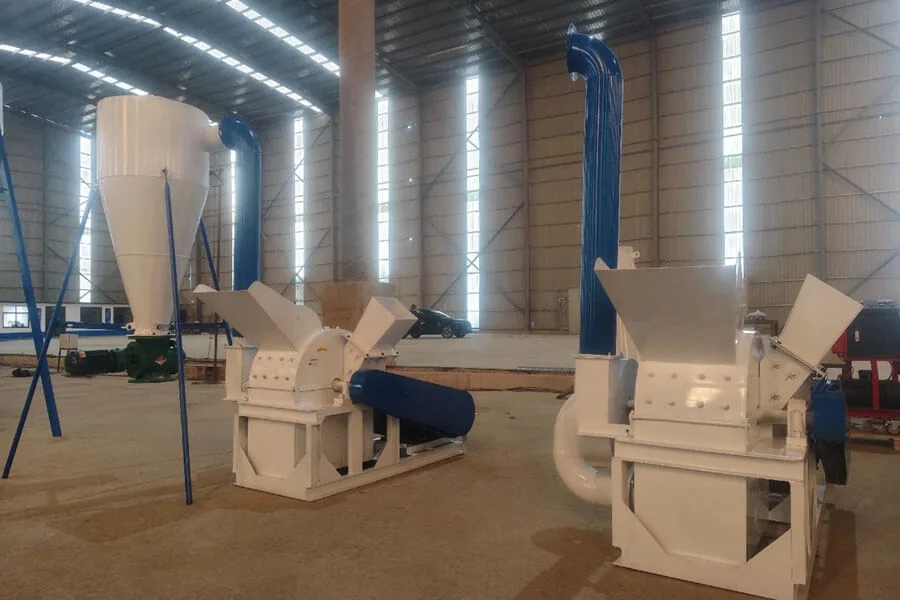
The wood hammer mill is where a biomass pellet production line is tuned to the material. Hammers swing on a rotor inside a screen, and the screen is the specification: 3 mm for rice husk and sawdust, 4 mm for bagasse and palm fibre, 5 mm for straw and stover. Go finer than the material needs and you pay for the grinding twice — once in kW and once in a slower pellet mill.
We quote FS-50-60B at 37 kW, 1,000–1,600 kg/h, with the screen matched to your material. A water-drop chamber keeps the dust inside and the noise down, which matters on a biomass pellet production line running two shifts.
Wood hammer mill — water-drop chamber, 600 to 3,200 kg/h, screen changed without opening the rotor.
Biomass sawdust dryer
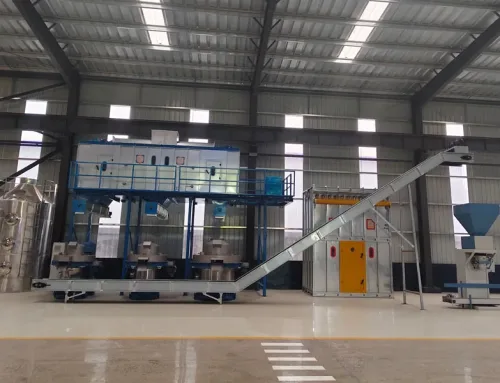
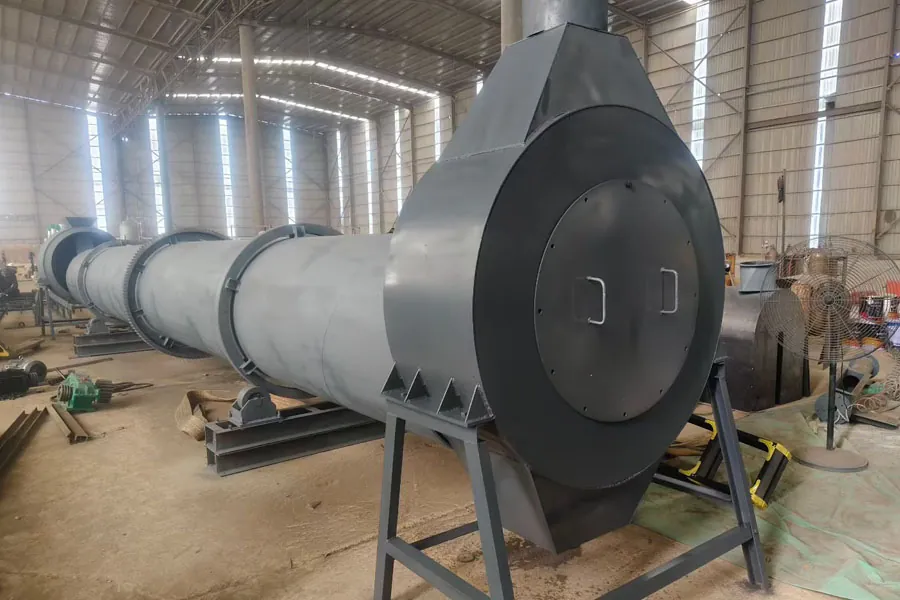
This is the stage that decides whether the biomass pellet production line runs at its quoted capacity. A rotary drum takes material at 45–60 % moisture down to 12–15 % against a hot air stream from a stove at the far end, and the cyclone after it puts the dust back into the product instead of into the sky.
We quote HG-G 1000 at 16.5 kW, sized for 800–1,200 kg/h. At 1 t/h the drum is 1.0 m across and about 11 m long, and it is the longest single item on the layout — check it against the shed before anything else.
Biomass sawdust dryer — rotary drum and flash pipe dryers, 500 kg/h to 5 t/h of water removal.
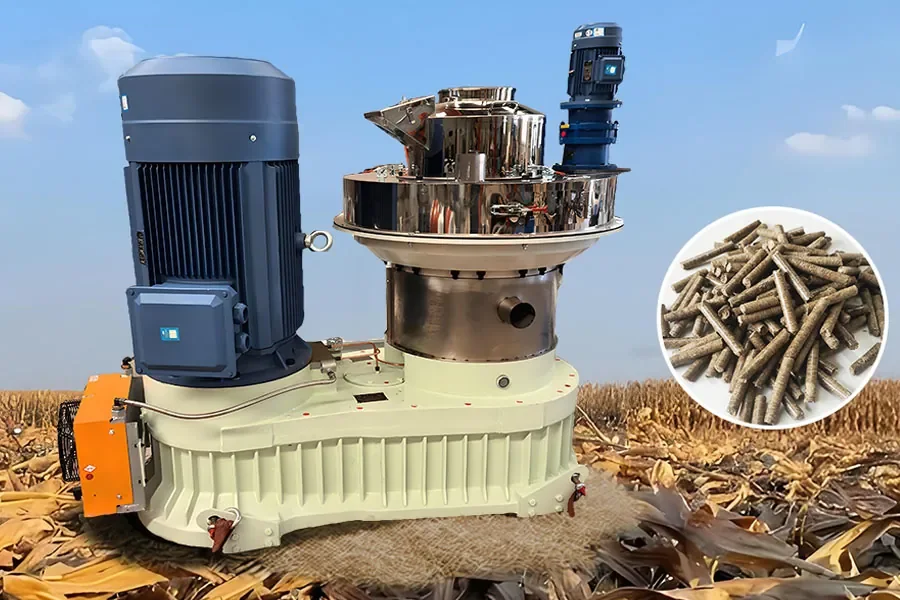
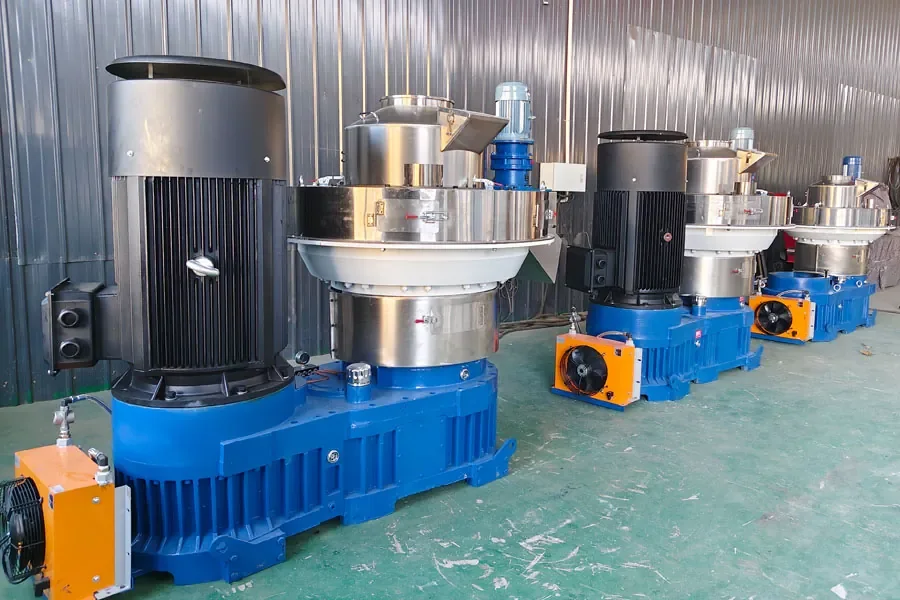
Vertical ring die pellet mill
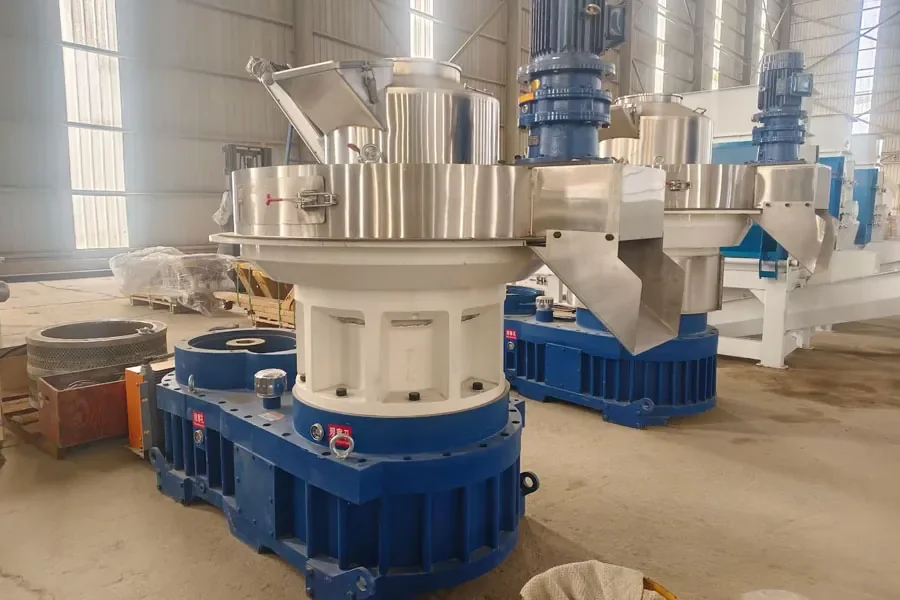
The HML-560 stands the die on its side and turns the rollers inside it. Material is thrown outwards against the die, the pellet forms on the outside and drops away downwards instead of being flung across the chamber, which is what lets the frame carry a 90 kW motor without the die distorting.
What the vertical ring die pellet mill buys you at 1 t/h is headroom. It holds 1.0–1.5 t/h on a die matched to your material, it will still be running at 1 t/h when the material is 3 % wetter than the specification, and the same frame stands in pairs on the 2000 kg/h wood pellet production line. What it costs you is a die that has to be lifted rather than carried.
Vertical ring die pellet mill — HML-560, HML-600 and HML-700, 90 to 160 kW, 1.0 to 2.5 t/h each.
Pellet cooler and pellet packing machine
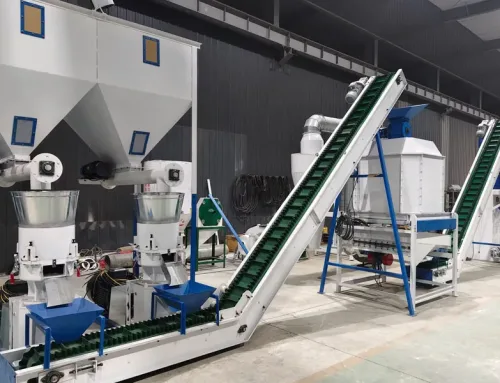
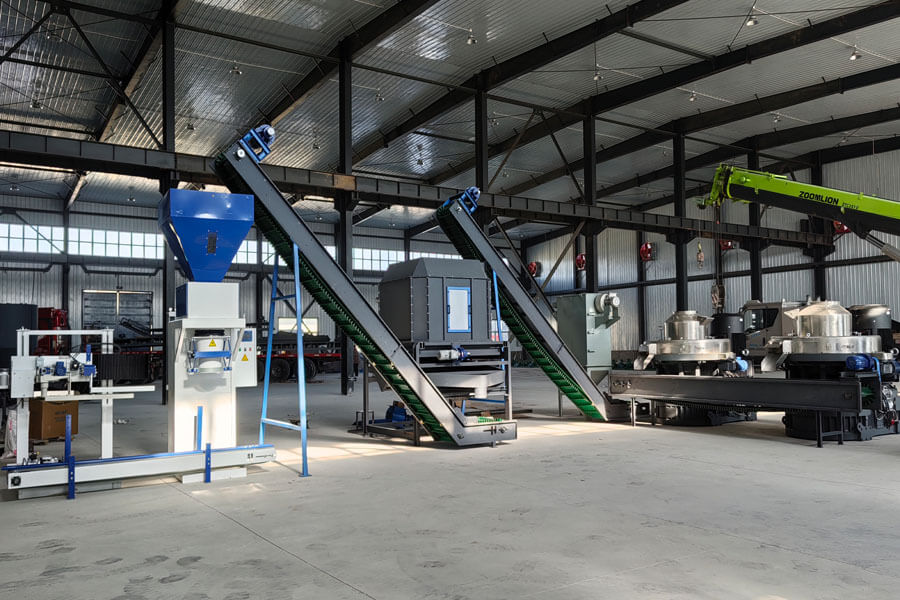
Pellets leave the vertical ring die pellet mill at 70–90 °C and soft. The pellet cooler drops them to within a few degrees of room temperature in a counterflow air stream, and the screen deck underneath takes out the fines and returns them to the pellet mill. Cool them badly and the bag arrives warm, the pellets sweat, and the top of the bag sets into a lump.
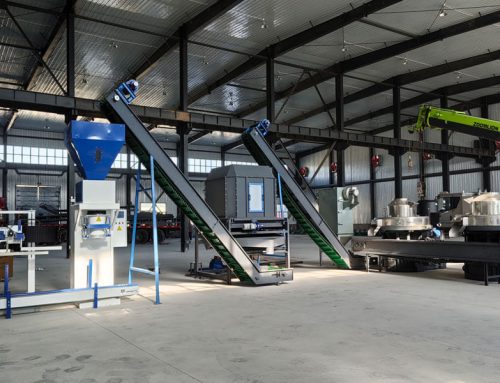
The pellet packing machine is the last stage and the one most often deferred. We quote DCS-Z-D-50 at 1.1 kW, 600–800 bags/h, for 10–50 kg woven bags. If you tip straight into a bulk truck instead, delete it and put the money into a bigger buffer silo in front of the pellet mill.
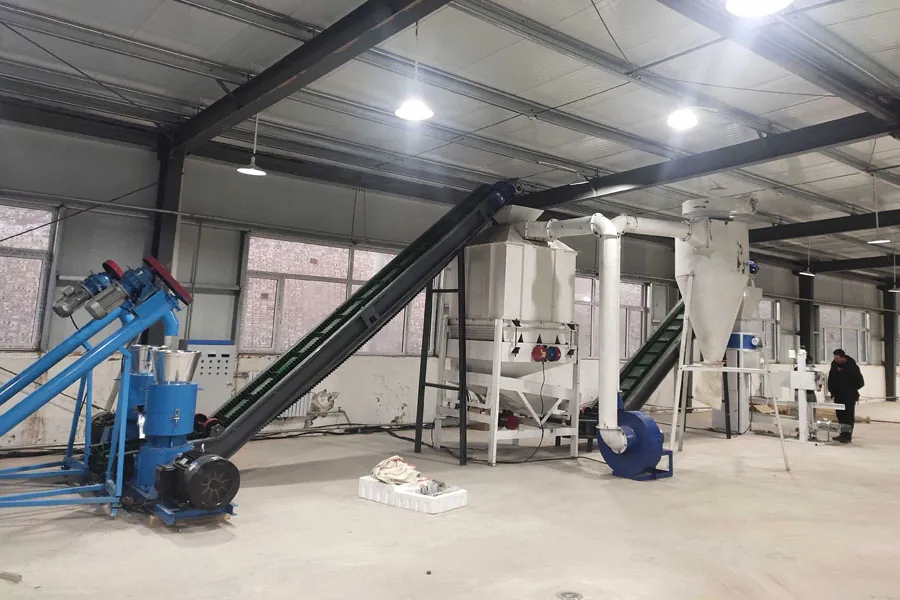
Pellet cooler · Pellet packing machine — the last two stages, and the screen deck under the pellet cooler is what takes the fines out before the bag.
Price a 1000 kg/h biomass pellet production line
Send the material, its moisture as received and the shed you have. We answer with a model list, a layout drawing at 1:50 and a price.
Tell us the material and the output
The material, its moisture, the pellet diameter and the kg/h you need. We come back with a model list, a die compression ratio and a price.
Reply within one working day. No obligation.
From a bale to a sealed bag in six steps
The sequence is the same on husk, straw and sawdust. What changes is the screen in the wood hammer mill, the die in the pellet mill and how much water the dryer takes out.
Chipping
Bales and stalks opened and cut to 20–40 mm. Skip it on husk and sawdust.
Grinding
3–5 mm through a screen in the wood hammer mill, set to the material.
Drying
45–60 % moisture down to 12–15 %. The single biggest quality variable.
Pressing
Biomass at 80–90 °C forced through the die; lignin and starch bind it.
Cooling and screening
Counterflow air to room temperature; the screen deck takes the fines back to the pellet mill.
Bagging
10–50 kg woven bags, weighed, sewn and counted.
The order is fixed, and the reason is moisture. Wet biomass will not compress; dry biomass compresses so well that a pellet mill can be overloaded by it. Everything upstream of stage four exists to deliver one tonne of material at 12–15 % moisture, every hour, at an even rate. Everything downstream exists to stop that tonne from turning back into a lump in the bag.
The number that surprises buyers most is how much water has to leave. A 1000 kg/h biomass pellet production line running material at 45 % moisture has to evaporate roughly 600 kg of water an hour before the vertical ring die pellet mill sees any of it. That is why the biomass sawdust dryer and its stove are the largest fuel cost on the site, and why a covered raw material store pays for itself in a season.
The second number is temperature. Biomass lignin softens around 80 °C, so the die has to run hot enough to reach it and cool enough not to burn it. On a vertical ring die pellet mill that balance is fixed when the die is made — it is the compression ratio, the length of the hole divided by its diameter — and it is adjusted by changing the die, not by turning a dial. That is the one specification we will not guess at.
Why this biomass pellet production line uses one HML-560
Up to about 700 kg/h a flat die pellet mill is the cheaper machine. At 1 t/h the vertical ring die pellet mill takes over, and it does it with one motor instead of two.
Above about 700 kg/h a flat die pellet mill runs out of die area and you are buying two of them instead of one bigger one. That is exactly what the 1000 kg/h wood pellet production line does — two PM-D450B side by side — and it is the right answer when the material is mixed, wet and cheap.
A vertical ring die pellet mill answers the same question with one machine. The die is a ring, so the same frame carries 90 kW instead of 45 kW; the rollers run inside the die rather than on top of a plate, so the load is spread round a circle instead of a disc; and the pellet falls out downwards instead of being thrown sideways. On uniform, dry biomass that is a more efficient way to spend a kilowatt, and on a biomass pellet production line running two shifts it is also one gearbox and one feeder to maintain instead of two.
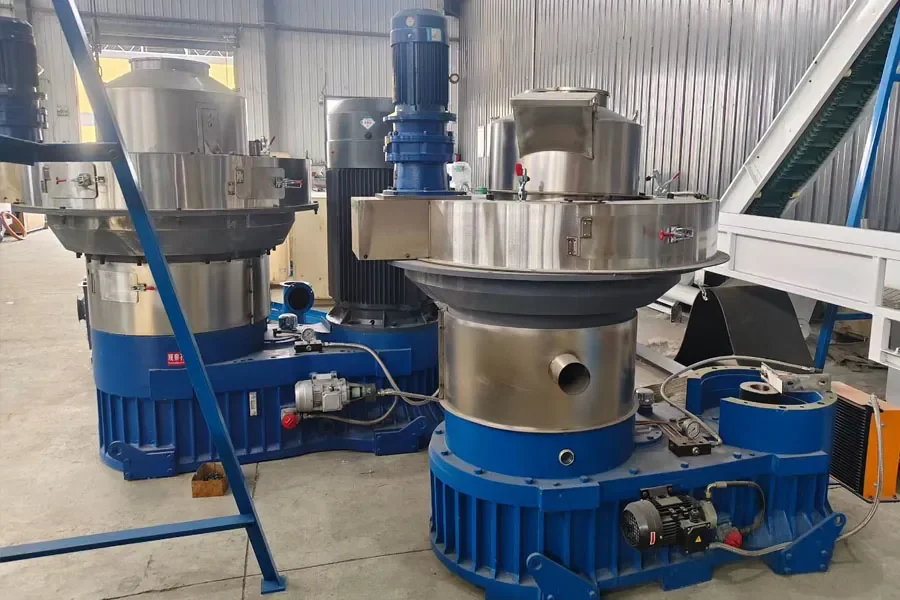
Vertical ring die pellet mills 1 to 2.5 t/h each
| Model | Main motor | Capacity on biomass | Where it fits |
|---|---|---|---|
| HML-560 | 90 kW | 1.0–1.5 t/h | One of them on this 1000 kg/h biomass pellet production line |
| HML-600 | 132 kW | 1.5–2.0 t/h | Three of them on the 5000 kg/h wood pellet production line |
| HML-700 | 160 kW | 2.0–2.5 t/h | The largest single pellet mill we build |
Capacity is quoted on dry biomass at 12–15 % moisture with a die matched to the material. Rice husk and palm fibre run below the figure because of their ash and fibre; clean wood sawdust runs at the top of it.
One pellet mill at 1 t/h has one weakness: when it stops, the biomass pellet production line stops. Every build at this capacity therefore carries a buffer silo and a variable speed feeder between the biomass sawdust dryer and the pellet mill, which buys 20–30 minutes of running while a die is changed or a roller is looked at. On a two-press build the second pellet mill is the buffer; here it is a silo, and it is cheaper.
The other half of the answer is the die. A vertical ring die pellet mill is only as good as the die in it, and the compression ratio that suits rice husk is not the one that suits wood sawdust. We quote the die on a sample of your material, and we send a test-run video on that sample before you pay a deposit.
The same six stages, seven different materials
A biomass pellet production line is quoted on the pellet mill, and the pellet mill is set up on the material. These are the materials we build for most often.
| Material | Moisture as received | What changes before the pellet mill |
|---|---|---|
| Wood sawdust | 10–15 % kiln dry, 45–60 % green | Rotary drum dryer on the wet material; 4 mm screen |
| Rice husk | 8–12 % | No dryer in most seasons; 3 mm screen and a harder die |
| Wheat straw, corn stover | 15–25 % | Wood chipper machine, then 5 mm screen; dryer in the wet season |
| Bamboo | 40–60 % green | Wood chipper machine, wood hammer mill, then the dryer |
| Palm fibre, EFB | 50–65 % | Shredded before the dryer; the hardest material on the die |
| Bagasse | 45–50 % | Dryer, then a 4 mm screen; the pellet needs a higher compression ratio |
| Spent coffee grounds | 55–60 % | Dryer only — no wood chipper machine, no wood hammer mill |
Typical figures, not a specification. Moisture moves with the season and with how the material has been stored, and the die compression ratio is set on a sample of your material rather than on the table. Send 5 kg and we will run it.
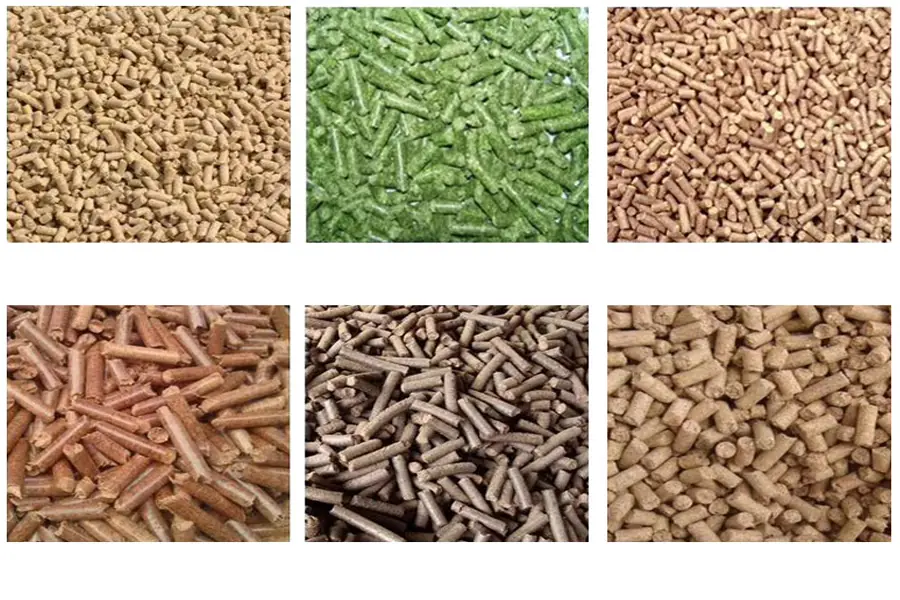
The material also decides the pellet diameter. 6 mm is the stove pellet and the bagged retail pellet; 8 mm is what most industrial boilers take; 10 mm is for a bulk buyer with a grate that will take it. On the same vertical ring die pellet mill an 8 mm die runs about 15 % more capacity than a 6 mm die, because there is more hole area open.
What we will not do is quote a biomass pellet production line for a material we have not run. Husk, straw, EFB and coffee grounds all behave differently in the die — some need steam or water added before pressing, some need the die warmed through for half an hour before they will form a pellet at all. A sample answers that in a day.
What the shed has to provide
A 1000 kg/h biomass pellet production line is 194 kW of motors on 220 m² of floor, under a roof 7 m high.
| Item | Figure | Note |
|---|---|---|
| Installed power | 194 kW | All six stages, motors only |
| Largest single motor | 90 kW on the vertical ring die pellet mill | The figure that sizes the transformer |
| Electrical supply | 400 A three-phase supply, 380 V / 50 Hz | Three-phase, 50 Hz, four-wire |
| Footprint | 220 m² of covered floor | Dryer and raw material store excluded |
| Building height | 7 m | Under the hook, at the pellet mill |
| Operators | 2 per shift | One of them on the bagging end |
| Water | Not required | The pellet cooler is air cooled |
| Compressed air | 0.6 m³/min at 7 bar | For the bag clamp and the cylinder valves |
The supply figure is the one to take to an electrician before anything else. A 90 kW pellet mill motor starts under load, so the starting current is five to six times the running current for a few seconds, and a supply sized on the 194 kW running total will trip every time the pellet mill comes up. Size on the largest single motor, not on the sum.
Height is the second figure people underestimate. The biomass sawdust dryer and its cyclone, the buffer silo and the feed drop to the pellet mill all stack vertically, and 7 m of clear height at the pellet mill is what this build needs before anyone pours concrete. A vertical ring die pellet mill is a tall machine — the motor sits on top of the die, not beside it — which is why this build asks for a metre more than the flat die pair at the same capacity.
Foundations are ordinary reinforced concrete at 200 mm for everything except the pellet mill, which wants a separate block isolated from the slab so the vibration does not travel into the bagging end. We send the block dimensions with the layout drawing.
What ships, and what the site has to build
A biomass pellet production line is quoted as a set, not as six separate machines. The list below is what is inside the price.
-
All six stages
Every machine in the table above, with its motor, starter and guards, tested as a set before it leaves.
-
Conveyors and ducting
Screw conveyors, belt conveyors and the ducting between the biomass sawdust dryer and its cyclone, cut to the layout drawing.
-
Control cabinet
One panel for the biomass pellet production line, with the interlock that stops the feed when the vertical ring die pellet mill stops.
-
Dies and rollers
One die set to your material and pellet diameter, plus a spare die and a spare roller set.
-
Layout drawing
1:50 plan and elevation, with the foundation blocks and the cable runs marked.
-
Commissioning
One engineer on site for the first run, at our cost, for biomass pellet production lines of this size.
Not included, and quoted separately if you want them: the hot air stove for the biomass sawdust dryer, which most sites build locally in firebrick; the raw material store; the civil works; and the transformer. Delivery is 30–40 days from deposit, FOB Qingdao. Spare parts are on the shelf at spare parts.
Where this build sits in the range
We build five wood pellet and biomass pellet production lines on the same six stages. The choice of pellet mill changes at 1 t/h, and at 1 t/h there are two answers.
| Capacity | Pellet mills | Installed power | Footprint |
|---|---|---|---|
| 500 kg/h | PM-D450B ×1, flat die | 99 kW | 120 m² |
| 1000 kg/h | PM-D450B ×2, flat die | 190 kW | 200 m² |
| 1000 kg/h — this page | HML-560 ×1, vertical ring die | 194 kW | 220 m² |
| 2000 kg/h | HML-560 ×2, vertical ring die | 354 kW | 380 m² |
| 5000 kg/h | HML-600 ×3, vertical ring die | 775 kW | 900 m² |
Capacity is on wood pellets at 12–15 % moisture. At 1000 kg/h there are two answers: one vertical ring die pellet mill on this page, or two flat die wood pellet mills on the 1000 kg/h wood pellet production line.
The same capacity, two ways
The two 1 t/h builds are not rivals, they are two answers to two different sites. The flat die pair is the build for mixed, wet, cheap material and a tight budget — two 45 kW motors start on a smaller supply than one 90 kW motor, and a flat die costs a fraction of a ring die to replace. The single vertical ring die pellet mill is the build for uniform dry material, two-shift running and a site that expects to be at 2 t/h in three years.
Both pages carry the same six stages and the same biomass sawdust dryer. If you are not sure which one you are, send the material and the moisture — that decides it before the budget does.
1000 kg/h wood pellet production line — the two-press build on flat die wood pellet mills, with a table comparing the two configurations side by side.
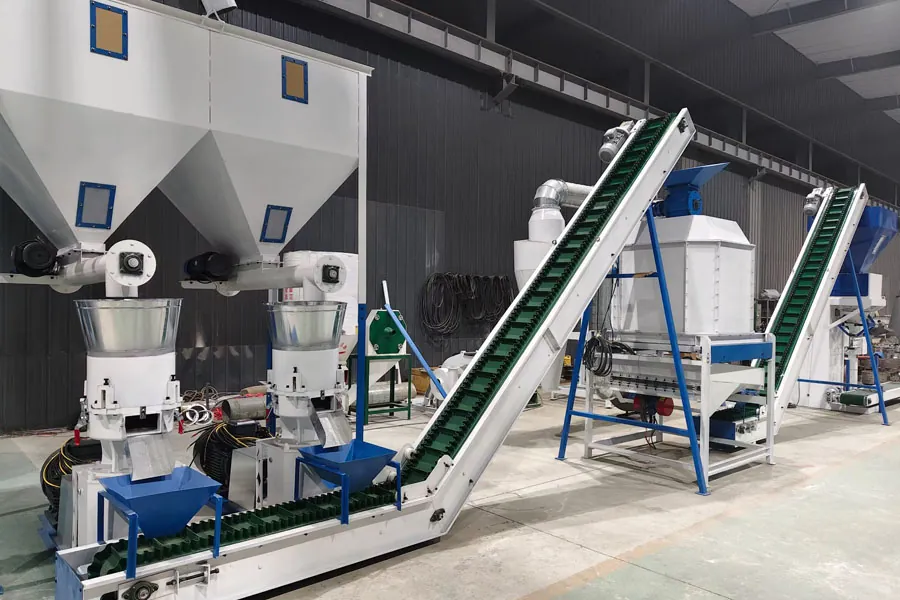
The biomass pellet production line, and the machines inside it, running
Six clips: the same six stages at three or four times the capacity, the vertical ring die pellet mill on sawdust and on grass, a whole grass pellet production line, and the pellet mill on its own.
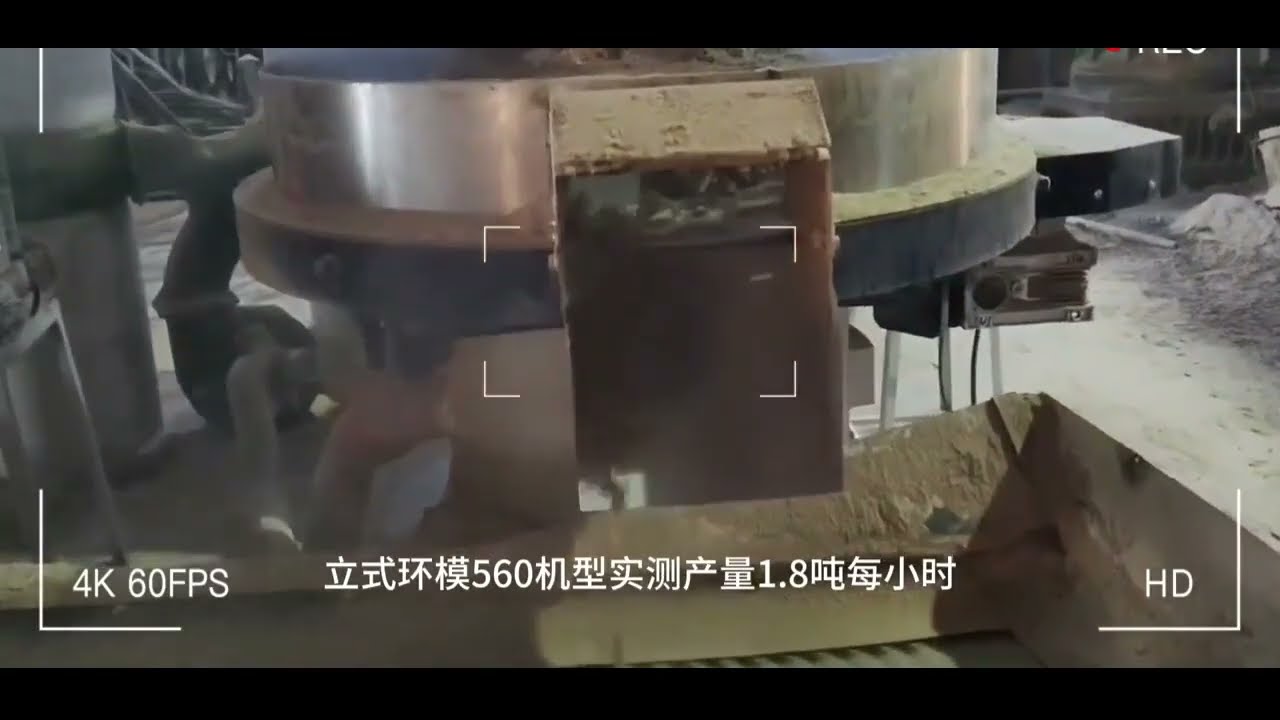


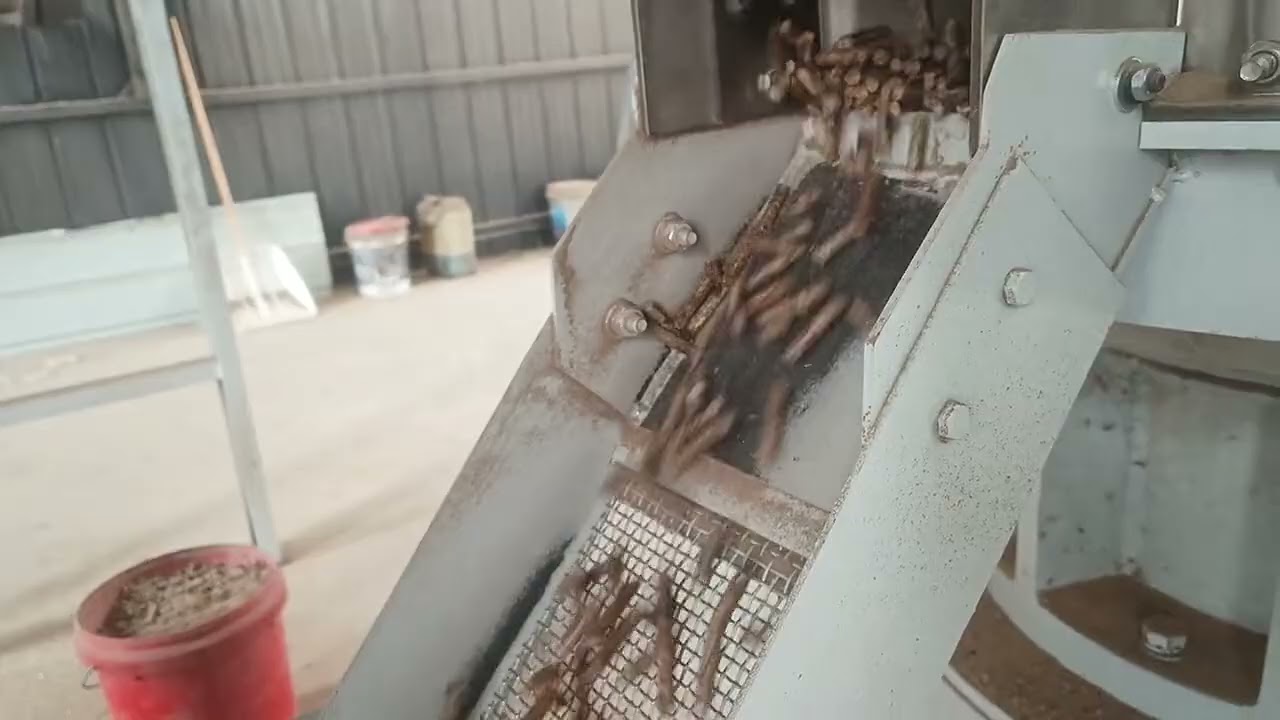

More on the PelletHills channel — the biomass playlist is where the biomass pellet production line and biomass pellet machine clips go up first.
What buyers ask before ordering a 1000 kg/h biomass pellet production line
Eleven questions we answer on the phone most weeks.
What does a 1000 kg/h biomass pellet production line include?
Six stages: a wood chipper machine (DP-600B), a wood hammer mill (FS-50-60B), a biomass sawdust dryer (HG-G 1000), one HML-560 vertical ring die pellet mill at 90 kW, a pellet cooler (NL-11) and a pellet packing machine (DCS-Z-D-50). Installed power is 194 kW and the footprint is 220 m².
What is the difference between this and the 1000 kg/h wood pellet production line?
The pellet mill. That page is two PM-D450B flat die wood pellet mills side by side at 190 kW; this page is one HML-560 vertical ring die pellet mill at 90 kW, 194 kW installed. The flat die pair is cheaper and takes wetter, coarser material; the single ring die holds a higher capacity, needs a taller shed and is the pellet mill the site grows into.
How much power does it need?
194 kW of motors, three-phase 380 V / 50 Hz. Size the supply on the largest single motor rather than the total, because the vertical ring die pellet mill starts under load — 400 A three-phase supply, 380 V / 50 Hz covers the whole biomass pellet production line with margin.
How much space does it need?
220 m² of covered floor at a clear height of 7 m, excluding the raw material store and the dryer’s fuel store. The bagging end can sit under a lean-to, which is how most sites keep a truck out of the main shed.
Do I need the biomass sawdust dryer?
Only if your material is wetter than 15 %. Kiln-dry sawdust at 10–12 % and rice husk at 8–12 % go straight from the wood hammer mill to the pellet mill and the biomass sawdust dryer comes off the quotation, which saves more than any other single stage. Straw at 20 % and palm fibre at 60 % cannot be pelletised at all without one.
Can it run more than one material?
Yes, and most sites do — a straw season and a husk season on the same line. What changes is the screen in the wood hammer mill and the die in the pellet mill, both of which are quick to change and both of which we quote as a second set. What does not change is the conveyors, the dryer and the pellet cooler.
What pellet diameter can it make?
6 mm, 8 mm or 10 mm as standard, and 4 mm to order. The die is the only part that changes. A 6 mm die gives a harder pellet for a stove; an 8 mm die gives about 15 % more capacity on the same pellet mill.
How long does it take to install?
Ten to fourteen days on site for a 1000 kg/h biomass pellet production line with our engineer present, plus the civils before that. The machines arrive tested as a set, so installation is assembly and alignment rather than commissioning from scratch.
What is the delivery time?
30–40 days from deposit, FOB Qingdao. Payment is 40 % deposit with the balance before delivery. The die is made to your material after the sample run, and that is the item that sets the date.
What wears out first?
The die and the rollers, in that order. A ring die on biomass lasts 300–600 hours depending on the ash content — husk and EFB are harder on it than wood sawdust — and rollers last about twice as long. Both are on the shelf at spare parts and both are changed in a couple of hours with the lifting frame.
Can the biomass pellet production line be expanded later?
Yes. The frame this build uses is the same one that stands in pairs on the 2000 kg/h wood pellet production line, so a second HML-560 is an addition rather than a rebuild — provided the layout left the bay for it, which is why we draw the layout with the spare bay already marked.
Request a quotation for a 1000 kg/h biomass pellet production line
Tell us the material, its moisture, the pellet diameter and the shed you have. We reply with a model list, a layout drawing and a price.
What happens after you send this
We answer with the model list, the die compression ratio and a price, then send a test-run video on your material before you pay a deposit.
Your details are not shared. One follow-up, no mailing list.