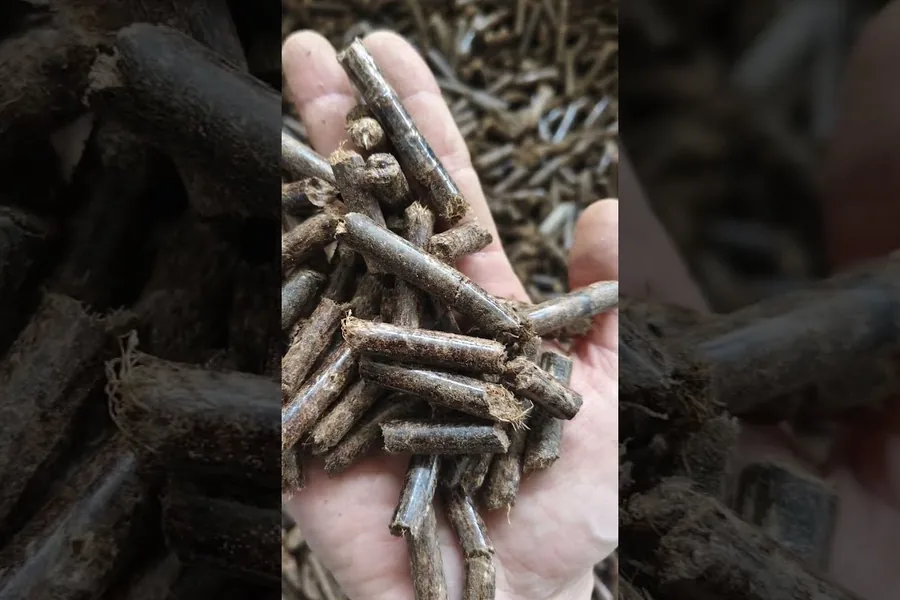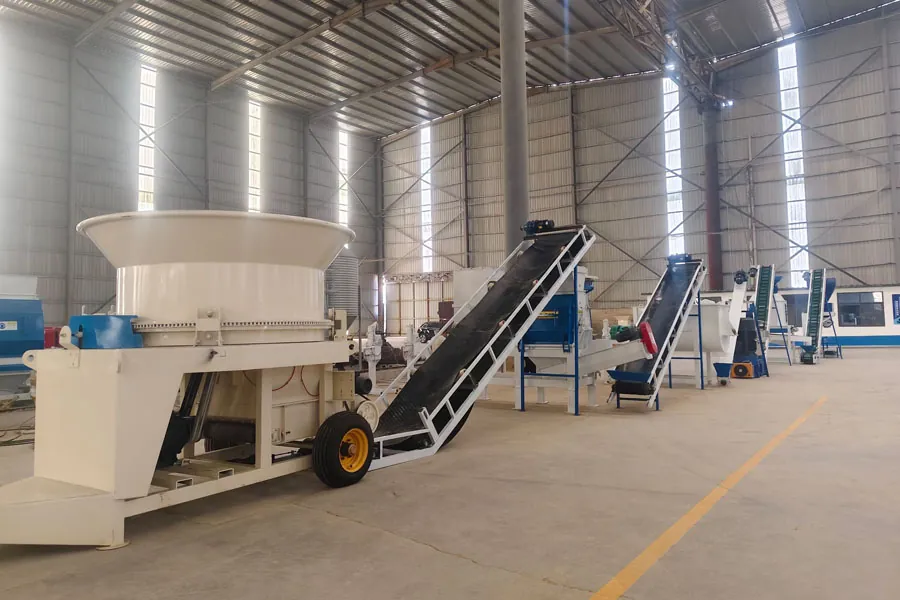
Rice and Wheat Straw Pellet Production LineRound bales in, 90 kW ring die, no dryer needed
A 1 t/h straw pellet production line built around a 90 kW vertical ring die pellet mill: a 79 kW bale shredder that takes 1.5 m round bales with the netting still on, a 75 kW wood hammer mill with 36 hammers, a counterflow pellet cooler and a pellet packing machine. 295 kW of motors on 30 × 12 m of floor — and no dryer.
- 79 kW bale shredder taking 1.5 m round bales with the netting on — no unwrapping by hand
- 75 kW hammer mill with 36 hammers and a thickened screen, for a material that is 4 % silica
- 90 kW vertical ring die pellet mill, double-layer die, four independent rollers, 58–60 rpm
- No biomass sawdust dryer on the quotation: field-dried straw arrives at 11–15 % moisture
Reply in 12 working hours · Sized on your material and its moisture · Layout drawing and die specification included
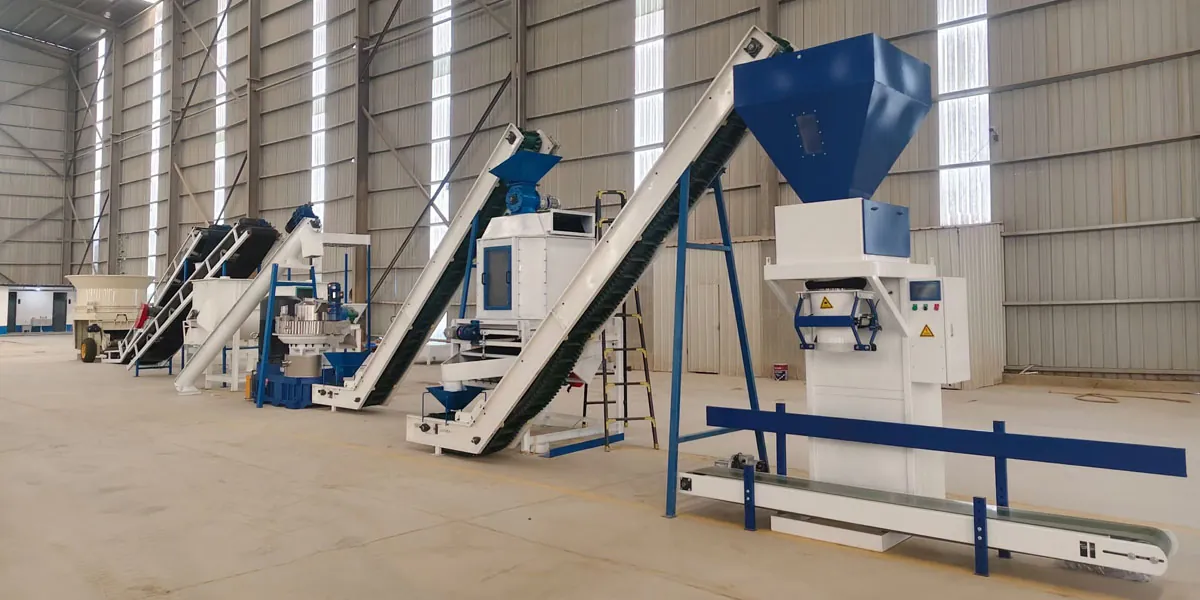
Bale to bag, and the dryer is the stage you do not need
A straw pellet production line is five machines rather than six, because field-dried straw arrives at 11–15 % moisture — already the figure the die is cut for.
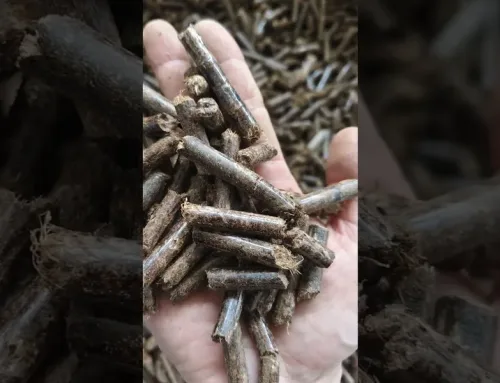
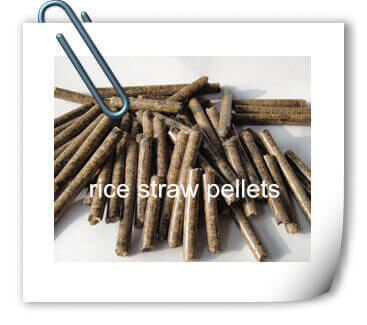
Rice straw and wheat straw come off the field in 1.5 m round bales at 11–15 % moisture, held together with net wrap or plastic twine. That is the whole reason a straw pellet production line is cheaper than a wood pellet production line of the same output: there is no wet material to dry, so there is no rotary drum, no hot air stove and no 11 kW exhaust fan.
What straw does have is silica. Rice straw carries 9–14 % ash and wheat straw 4–8 %, and most of that ash is silica, which is abrasive enough to polish a die. The vertical ring die pellet mill and the wood hammer mill on this pellet production line are specified around that single fact, and so is the die compression ratio.
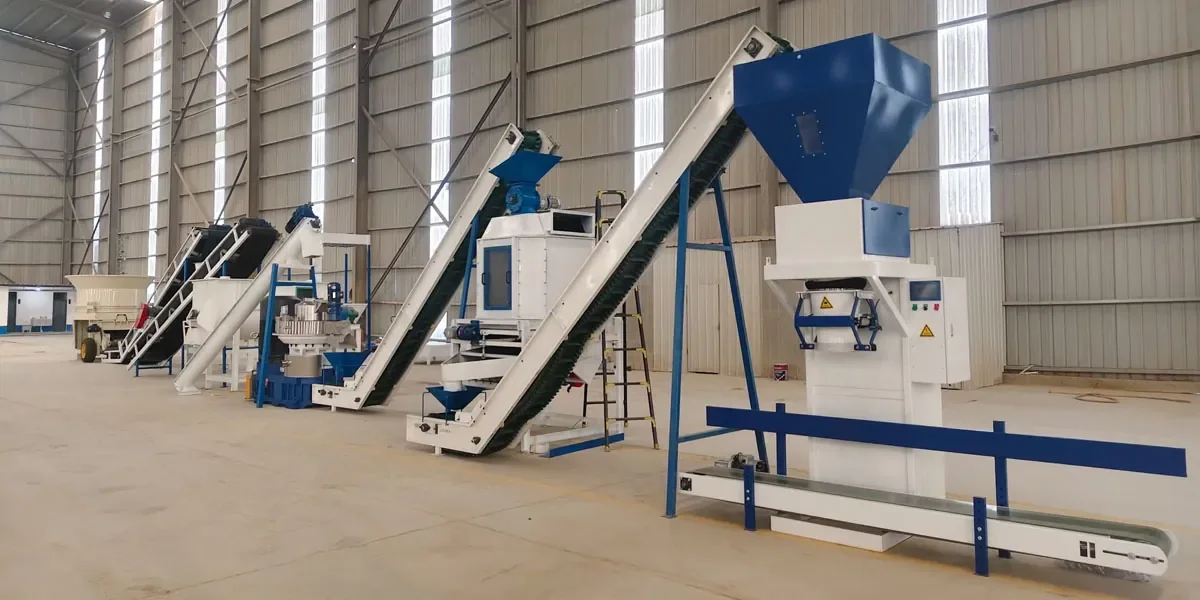
A 1 t/h rice and wheat straw pellet production line 295 kW installed
| Stage | Machine | Model | What it does |
|---|---|---|---|
| 01 | Bale shredder | 79 kW | 1.5 m round bales with the netting on, down to 30–50 mm |
| 02 | Wood hammer mill | 75 kW, 36 hammers | Straw pieces down to 3–5 mm through a thickened screen |
| 03 | Vertical ring die pellet mill | HML-560, 90 kW | Double-layer die, four independent rollers, 58–60 rpm |
| 04 | Pellet cooler | NL-11 counterflow + screen | Hot, soft straw pellets down to room temperature |
| 05 | Pellet packing machine | BZ-50 | 20–50 kg woven bags, weighed and sewn |
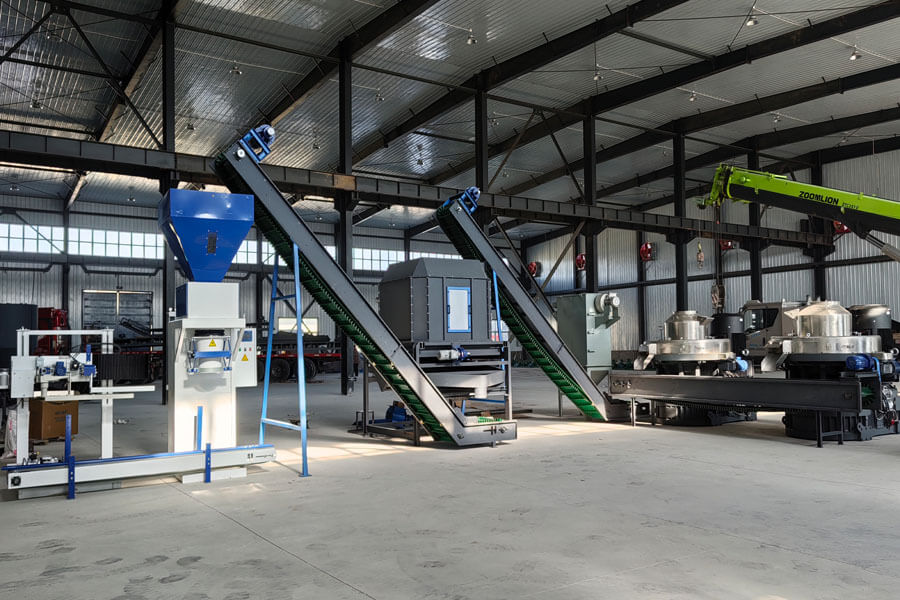
Installed power is 295 kW across all 5 stages, on 30 × 12 m of floor at 6.5 m clear. Every machine in the table is also sold on its own, and the dies, rollers and screens for them are shipped as spares.
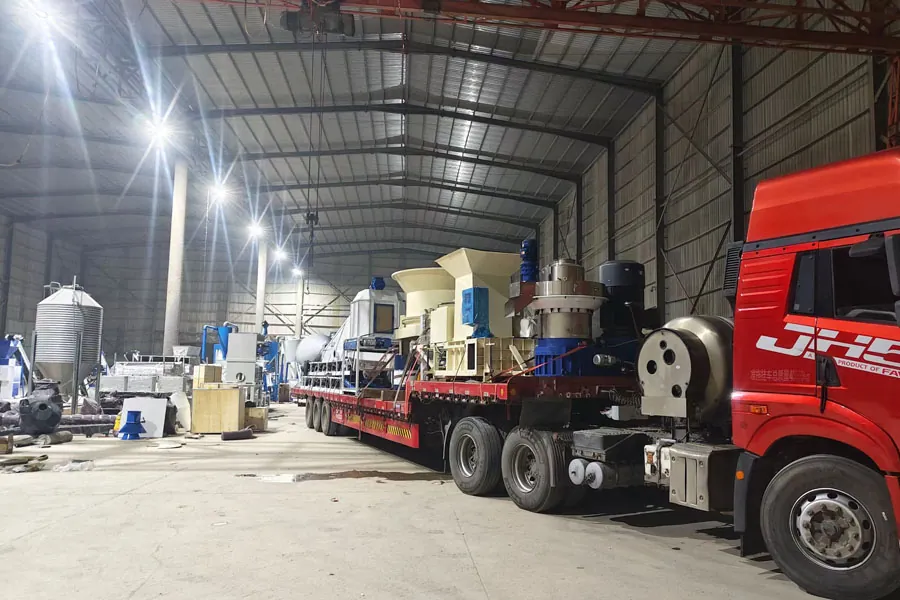
The whole pellet production line fits in 30 × 12 m at 6.5 m clear height and ships in a single 40HQ container. That is roughly a third of the shed a palm fibre pellet production line of the same output needs, and the reason is simply that there is no dryer, no hot air stove and no 12 m drum in the middle of it.
It is also the cheapest complete pellet production line we build at this capacity. A 1 t/h straw pellet production line quotes at around two thirds of a 1 t/h wood pellet production line, because the stage that costs the most — the dryer and its fuel handling — is the one straw does not need.
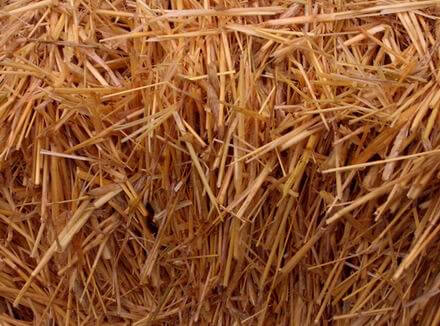

What each stage does on a 1 t/h rice and wheat straw pellet production line
Read them in order — the material only moves one way. Every stage links to its own product page, where the model range and the power figures are.
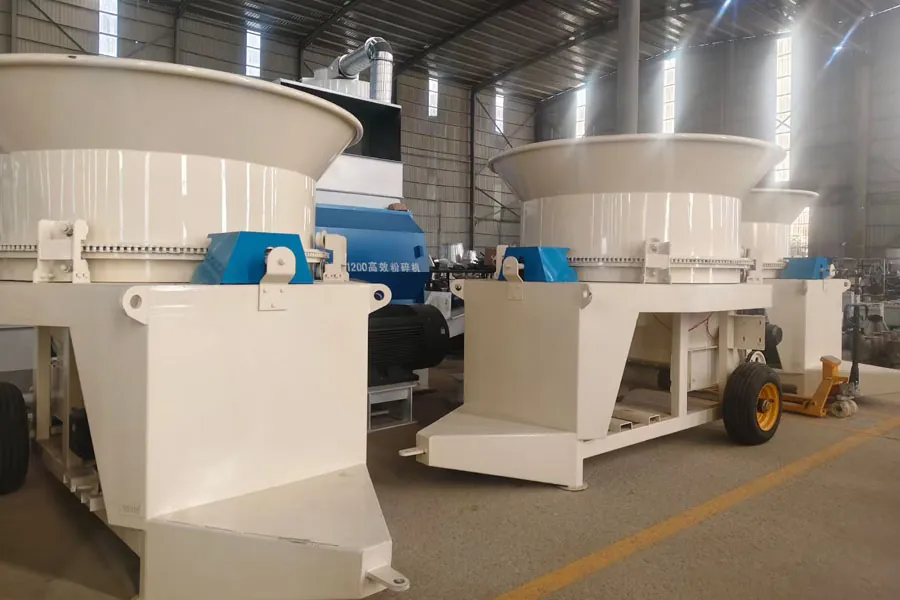
Bale shredder
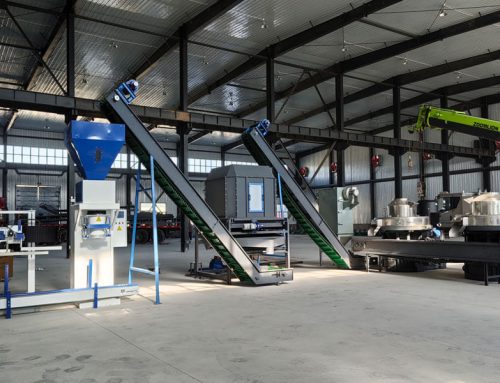
Straw arrives as a bale, and a bale will not go into a hammer mill. The bale shredder is a rotary cutter: a drum with knives inside a round hopper that tears the bale apart against a comb and drops the straw onto a belt in loose, 30–50 mm pieces. It is quoted at 79 kW for 1–1.5 t/h, and it is the loudest machine on the site.
The one specification worth arguing about is net wrap. A shredder that cannot take the netting means somebody has to unwrap every bale by hand before it goes on the belt, which is two men and a knife for a whole shift. Ours takes the bale as it comes off the field.
Bale shredder — the rotary cutter we quote on straw and grass builds; the wood chipper machine page covers the drum and disc machines we supply for wood.
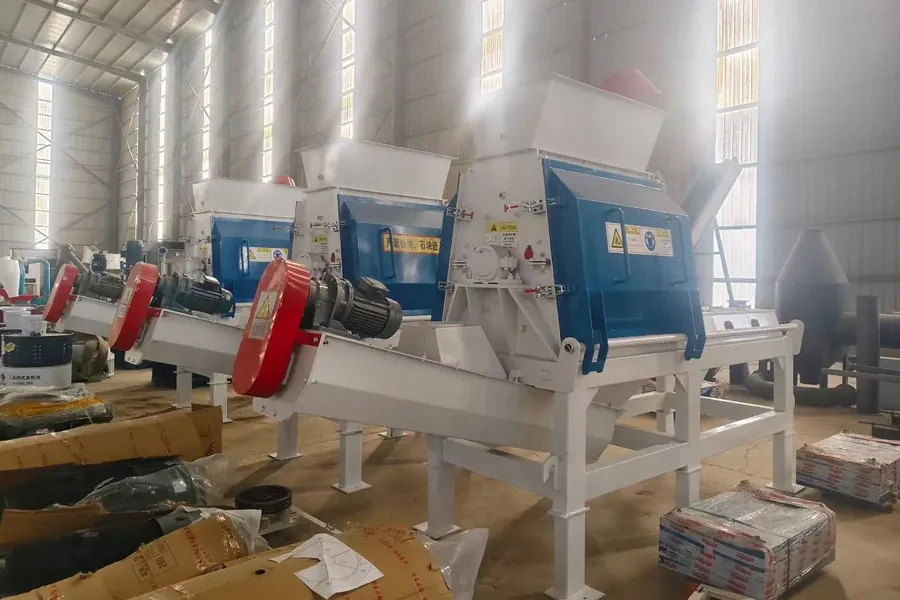
Wood hammer mill
The hammer mill is where straw becomes pelletable, and on straw it is a harder job than on wood. Straw is fibrous and springy; it does not shatter, it bends. The build we quote for it runs 36 hammers on a heavier rotor and a thickened screen, at 75 kW for 1–1.5 t/h — roughly twice the power a wood hammer mill needs for the same output.
The screen is 3–5 mm. Finer than that and the mill heats the straw and drives off the moisture it needs; coarser and the pellet has visible straw in it and crumbles at the die exit. A 15.75 kW cyclone and bag filter sit on top.
Wood hammer mill — FS series, 120 to 1,600 kg/h, 3 to 37 kW; the straw build uses the heavier rotor.
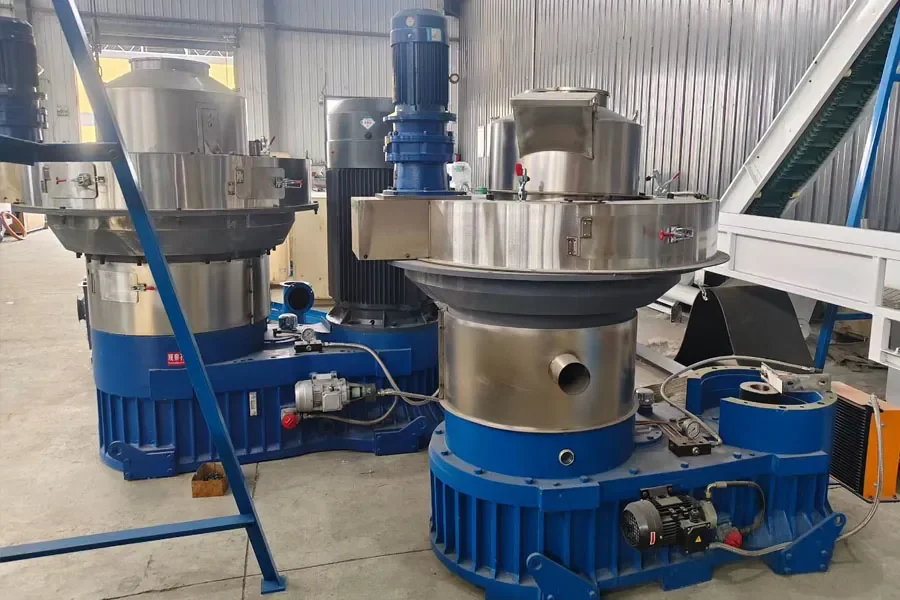
Vertical ring die pellet mill
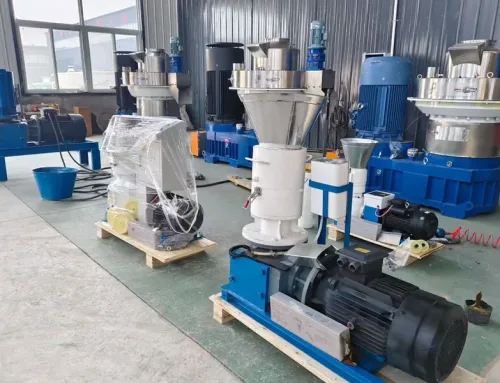
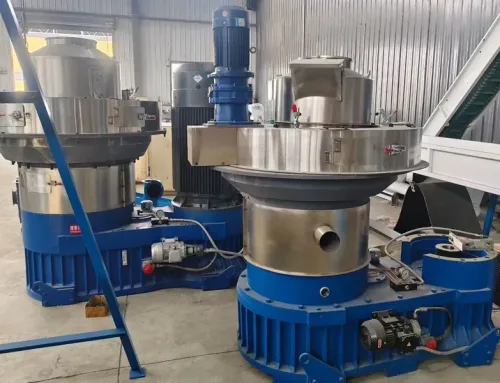
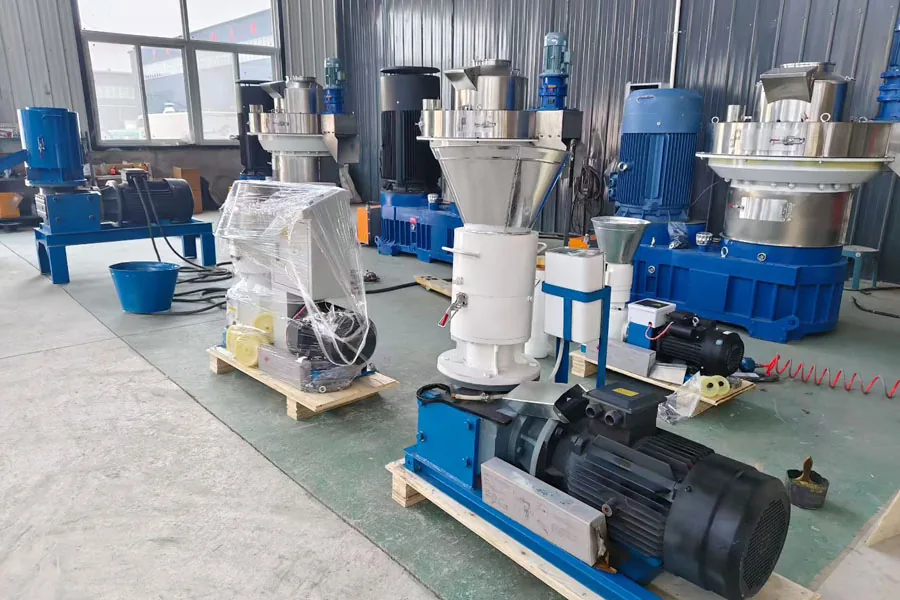
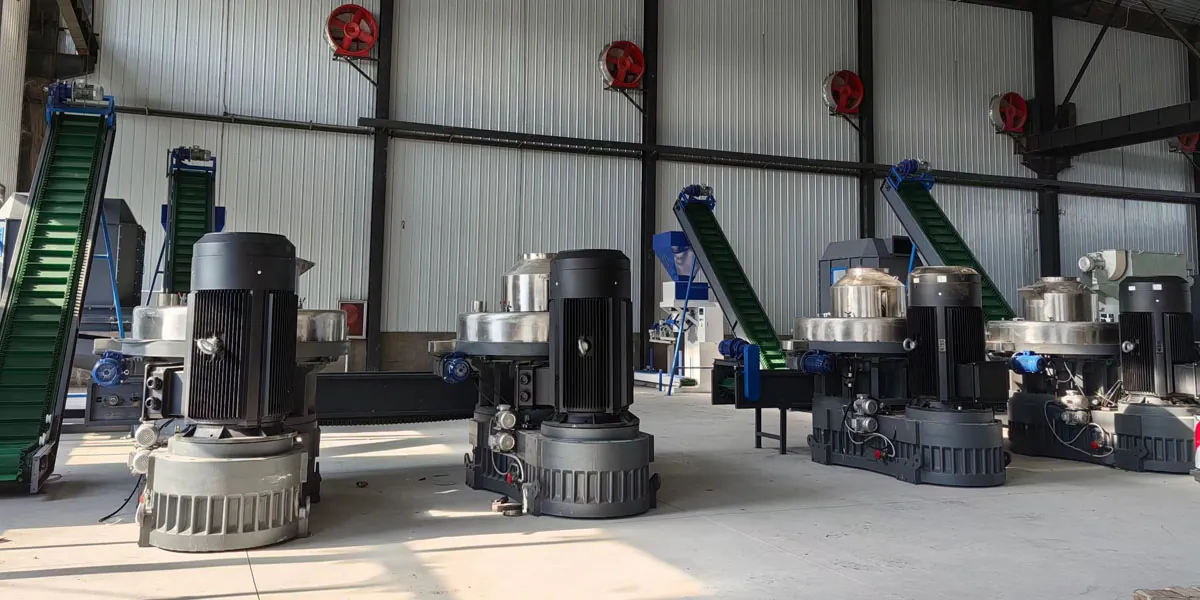
A 90 kW vertical ring die pellet mill with a double-layer die and four rollers working independently at 58–60 rpm. The double-layer die is the straw-specific part: two compression zones in one ring, so the die can be turned over and run again instead of being scrapped when the first face is polished out by silica.
On straw the die runs a 1:8 to 1:10 compression ratio — longer than wood, because straw is springy and needs more residence time to bind. That longer ratio costs power, which is why a straw pellet mill is rated lower than a wood pellet mill of the same motor size.
Vertical ring die pellet mill — HML-560 / 600 / 700, 90 to 160 kW, 1.0 to 2.5 t/h.
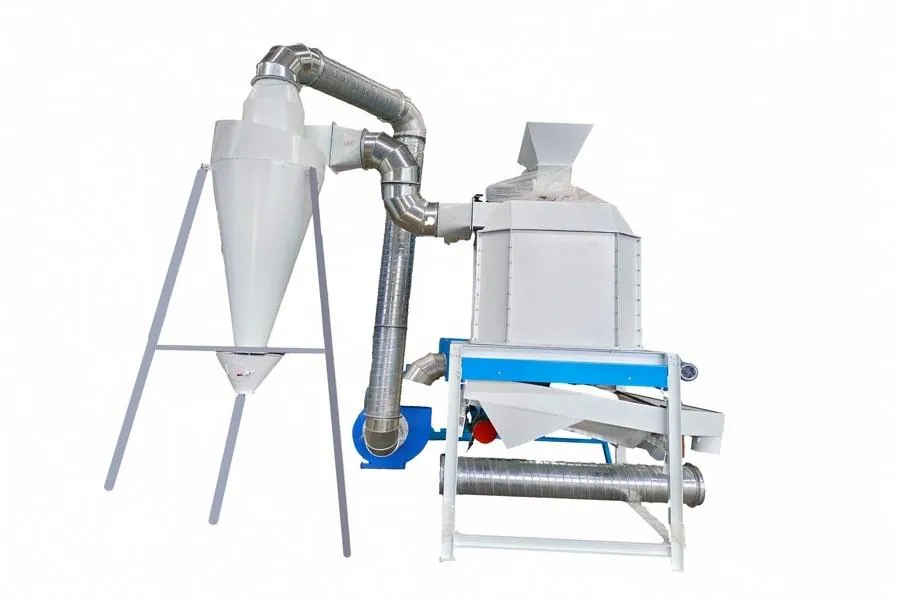
Pellet cooler
Straw pellets leave the die at 80–90 °C and are softer than wood pellets at the same temperature, because straw lignin softens lower and sets slower. The counterflow pellet cooler gives them the residence time to set: air up through a falling bed, seven to nine minutes, and they come out hard enough to bag.
The vibrating screen underneath takes out the fines and the occasional over-long pellet, and returns the fines to the pellet mill. On straw the fines fraction is higher than on wood — expect 3–5 % against 1–2 % — so the screen deck earns its keep.
Pellet cooler — NL-11 counterflow 1–2 t/h on this pellet production line, NL-14 counterflow 2–5 t/h on the bigger builds, LQ-50 and LQ-70 cooler-screeners below 1 t/h.
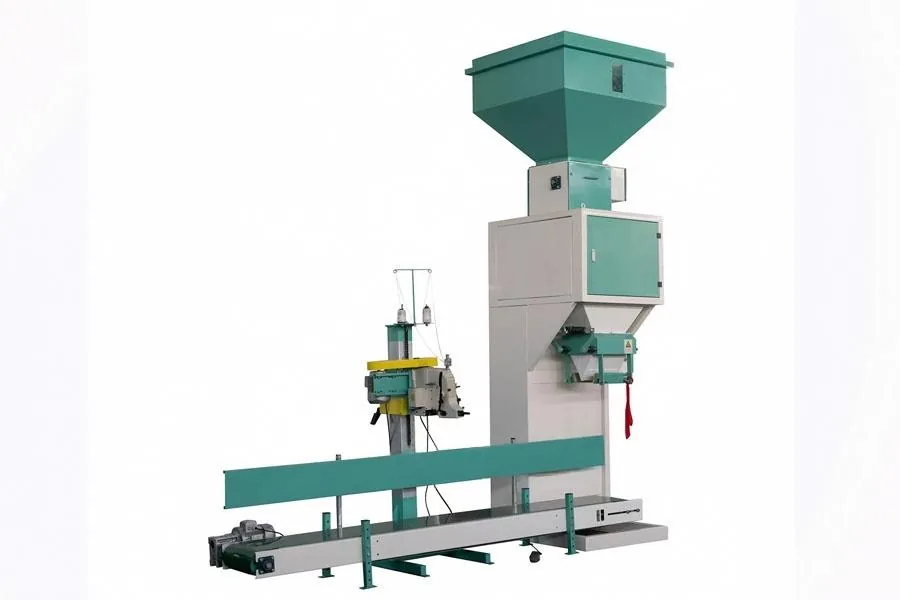
Pellet packing machine
Straw pellets are sold in 15–25 kg bags to the domestic stove market, or in 500–1,000 kg bulk bags to a biomass plant. The 1.5 kW pellet packing machine we quote covers 20–50 kg at three to five bags a minute, with a sewing head and a bag flattening belt.
It is the stage most often deferred, and on straw that is usually the right call for the first year: tip the pellets into a trailer and sell them loose until the market tells you what bag it wants.
Pellet packing machine — 10–50 kg bags or 1,000 kg bulk bags, with weighing and sewing.
Price a 1 t/h rice and wheat straw pellet production line
Send the material, its moisture as received and the shed you have. We answer with a model list, a layout drawing at 1:50 and a price.
Tell us the material and the output
The material, its moisture, the pellet diameter and the kg/h you need. We come back with a model list, a die specification and a price.
Reply within one working day. No obligation.
From a bale on the trailer to a bag on the pallet
Six steps, and the second one is where most of the electricity goes. There is no drying step — the material arrives dry.
Bale breaking
A 79 kW bale shredder tears 1.5 m round bales — netting and all — into 30–50 mm straw.
Grinding
A 75 kW hammer mill with 36 hammers takes the straw to 3–5 mm through a thickened screen.
Pressing
A 90 kW vertical ring die pellet mill forces the straw through a 1:8–1:10 die at 58–60 rpm.
Cooling
Counterflow air takes the pellet from 85 °C to ambient over seven to nine minutes.
Screening
The deck under the pellet cooler takes out the 3–5 % fines and returns them to the die.
Bagging
15–25 kg sacks for the stove trade, or a bulk bag for a biomass plant.
Straw is the one material on our list where the moisture question is already answered by the field. Baled at 11–15 % it goes straight from the hammer mill to the die, and the only moisture control left is keeping the bales under cover. A bale that has been sitting in the rain for a month is a different proposition — if yours are, tell us, because then a dryer comes back onto the quotation.
The power split is the other thing that surprises people. On a 295 kW straw pellet production line the shredder and the hammer mill together account for 154 kW — more than half — while the pellet mill is 90 kW. On a wood pellet production line the pellet mill is the largest motor. Straw is hard to size and easy to press; wood is the other way round.
Die wear is the running cost to plan for. Rice straw at 9–14 % ash will polish out a die in 200–300 hours; wheat straw at 4–8 % gives 300–450. A double-layer ring die is worth having for exactly this reason: turn it over, run the second face, then re-cut the ring.
Why a straw pellet production line runs a ring die and a long compression ratio
Straw is springy. That one property decides the die, the screen, the hammer mill rotor and the power split — and it is why a straw pellet mill is rated below a wood pellet mill of the same size.
A pellet is held together by lignin that has been softened by heat and pressure and then allowed to set. Straw carries 14–18 % lignin, less than wood, and its fibres are longer and springier. Push straw through a short die and it comes out expanded — the pellet looks right on the die face and has fallen apart by the time it reaches the cooler. The compression ratio has to be long enough to hold the pressure on the material until the lignin sets.
That is a 1:8 to 1:10 die, against 1:5 to 1:7 for sawdust. A longer die means more friction, which means more power per tonne, which is why the 90 kW pellet mill on this pellet production line is rated 1,000–1,200 kg/h on straw while the same frame is rated 1.5 t/h on wood.
Pellet mills for a rice and wheat straw pellet production line
| Model | Power | Capacity | Where it fits |
|---|---|---|---|
| HML-560 | 90 kW | 1.0–1.2 t/h on straw | The standard build for a 1 t/h straw pellet production line |
| HML-560 | 90 kW | 1.0–1.5 t/h on wood | Same frame, different die — the ratio is what changes |
| HML-600 | 132 kW | 1.4–1.8 t/h on straw | Two of them for a 3 t/h straw plant |
| HML-700 | 160 kW | 1.8–2.6 t/h on straw | The largest single straw pellet mill we build |
Capacity is quoted on field-dried straw at 11–15 % moisture with a 1:8–1:10 die. Rice straw runs at the bottom of the range because of its ash; wheat straw and barley straw run at the top.
Below about 800 kg/h there is a cheaper answer: the same five stages with a 55 kW ring die pellet mill and a 22 kW hammer mill, no bale shredder if your straw arrives chopped. That build quotes at about half the price of the 1 t/h pellet production line and fits in one 20 ft container. Ask for it if your market is a farm or a single boiler rather than a bagged product.
Above 1.5 t/h the constraint stops being the pellet mill and becomes the hammer mill. Straw grinding is power-hungry, and two 75 kW hammer mills feeding one 132 kW pellet mill is a more sensible 2 t/h build than one very large mill. We size the grinding stage on the material, not on the output.
What straw decides, before any machine is chosen
Straw is the material where the ash figure matters most. It sets the die material, the compression ratio and the number of spare dies you keep on the shelf.
| Item | Figure | Why it matters |
|---|---|---|
| Moisture as received | 11–15 % in a field-dried bale | The reason there is no dryer on this pellet production line |
| Moisture into the die | 12–16 % | Slightly wetter than wood. A little water helps straw bind |
| Bulk density, baled | 120–180 kg/m³ | Loose after shredding, 60–90 kg/m³ — the shredder earns its power here |
| Particle size after the hammer mill | 3–5 mm | Finer than palm fibre; straw has to be shortened, not just broken |
| Die compression ratio | 1 : 8 to 1 : 10 | Long, because straw is springy and expands out of a short die |
| Binder | None, but water helps | 14–18 % lignin. Some plants add 1–2 % water at the die inlet |
| Ash in the finished pellet | 4–8 % wheat, 9–14 % rice | Silica. This is what wears the die and the screens |
| Pellet diameter | 6 or 8 mm | 6 mm for stoves, 8 mm for boilers and for blending with wood pellets |
The ash figure is the one to design around. Rice straw at 9–14 % ash is close to the limit for most domestic boiler warranties, and the silica in it is hard enough to polish a die face in 200 hours. Wheat straw at 4–8 % is easier on the die and sells more readily. If you have a choice of feedstock, wheat and barley straw are the better business.
Bulk density is the figure that sizes the conveyors. A bale at 120–180 kg/m³ becomes 60–90 kg/m³ loose after shredding, so the belt between the shredder and the hammer mill is moving a lot of air. That is why the shredder discharges directly onto a short, wide belt rather than into a hopper — a hopper on loose straw bridges in about ten minutes.

What the site has to provide
A 1 t/h rice and wheat straw pellet production line is 295 kW of motors on 30 × 12 m of floor, under a roof 6.5 m high.
| Item | Figure | Note |
|---|---|---|
| Installed power | 295 kW | All five stages, motors only |
| Largest single motor | 90 kW on the pellet mill | The figure that sizes the transformer |
| Electrical supply | 350 kVA, 380 V / 50 Hz, four-wire | Size on the largest motor, not the total |
| Footprint | 30 × 12 m, 360 m² | Arranged in a straight line, bale store excluded |
| Building height | 6.5 m clear | Under the hook, at the buffer bin over the pellet mill |
| Operators | 2–3 per shift | One on the shredder, one on the pellet mill, one on the bags |
| Water | Not required | The pellet cooler is air cooled |
| Compressed air | 0.6 m³/min at 7 bar | Bag clamp and cylinder valves |
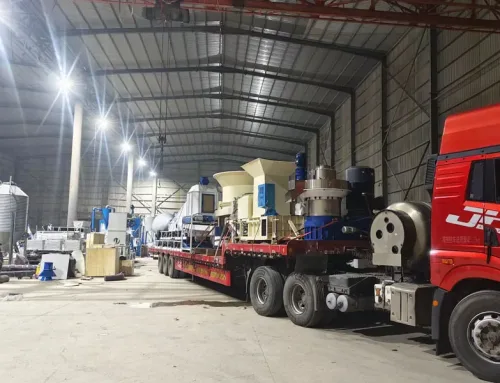
| Containers | 1 × 40HQ | The whole pellet production line ships in one container |
The 295 kW total looks heavy for 1 t/h and it is: 154 kW of it is shredding and grinding. That is the straw premium. Size the supply on the 90 kW pellet mill motor and add the rest as running load, because the shredder and the hammer mill start unloaded and the pellet mill does not.
Bale storage is the part of the site nobody quotes for. A 1 t/h straw pellet production line running two shifts burns through 20–24 bales a day, and those bales have to be under cover or the moisture figure that made the dryer unnecessary stops being true. Budget for a barn before you budget for a second pellet mill.
Dust is the other site issue. Straw grinding makes a fine, highly combustible dust, and the bag filter on the hammer mill cyclone is a safety item as much as an environmental one. We specify the ducting runs and the filter size with the layout drawing.
What ships, and what the site has to build
A straw pellet production line is quoted as a set. This is what is inside the price, and what the site has to provide.
-
All five stages
Bale shredder, wood hammer mill, vertical ring die pellet mill, pellet cooler with screen, pellet packing machine — with motors, starters and guards.
-
Conveyors and ducting
Belts between the stages and the ducting from the hammer mill cyclone, cut to the layout drawing.
-
Control cabinets
Three panels with the interlock that stops the bale shredder when the pellet mill stops — on straw that interlock is what stops the hammer mill choking.
-
Dies and rollers
One double-layer die at 1:8–1:10 for your straw and pellet diameter, plus a spare roller set.
-
Layout drawing
1:50 plan and elevation, with the foundation blocks and the cable runs marked.
-
Commissioning
One engineer on site for the first run, at our cost, for a pellet production line of this size.
Not included, and quoted separately if you want them: the bale store, the civil works and the transformer. Delivery is 15–20 working days from deposit, FOB Qingdao — the shortest lead time of any pellet production line we build, because there is no dryer to make. Spare parts are on the shelf at spare parts.
Watch a rice and wheat straw pellet production line run
Five clips: the straw plant end to end, then the shredder, the pellet mill and the die on their own.
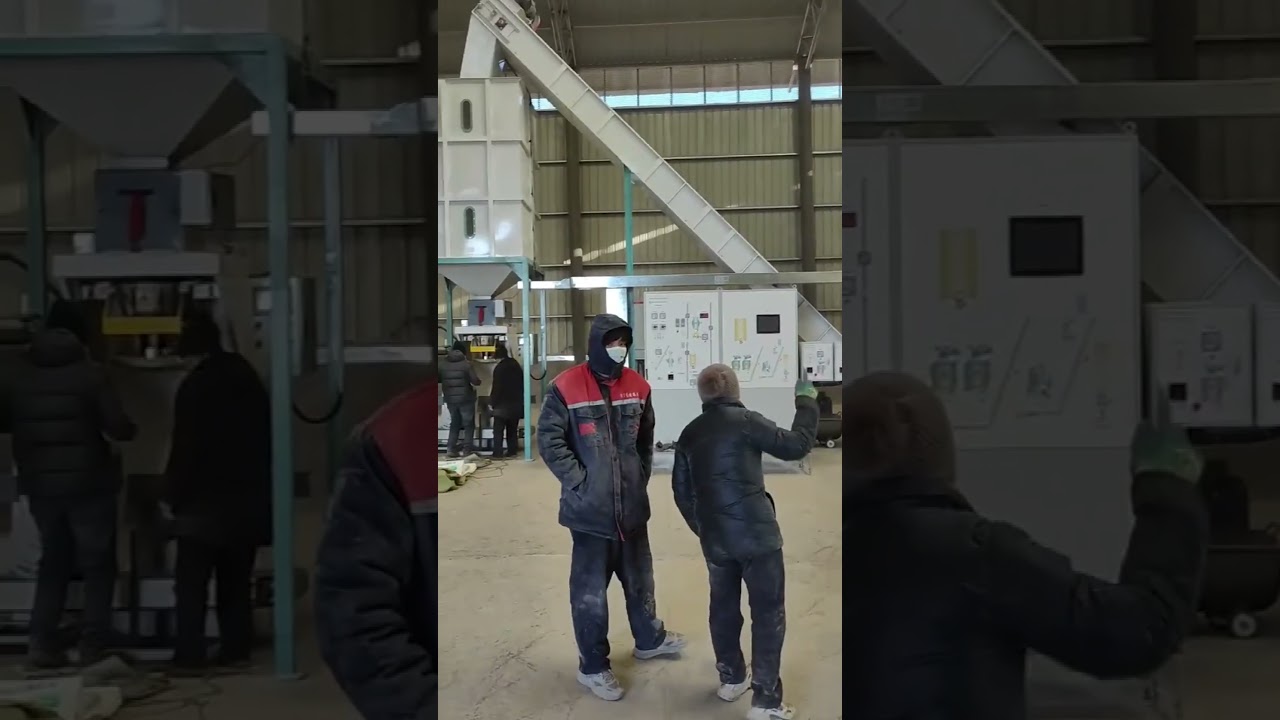
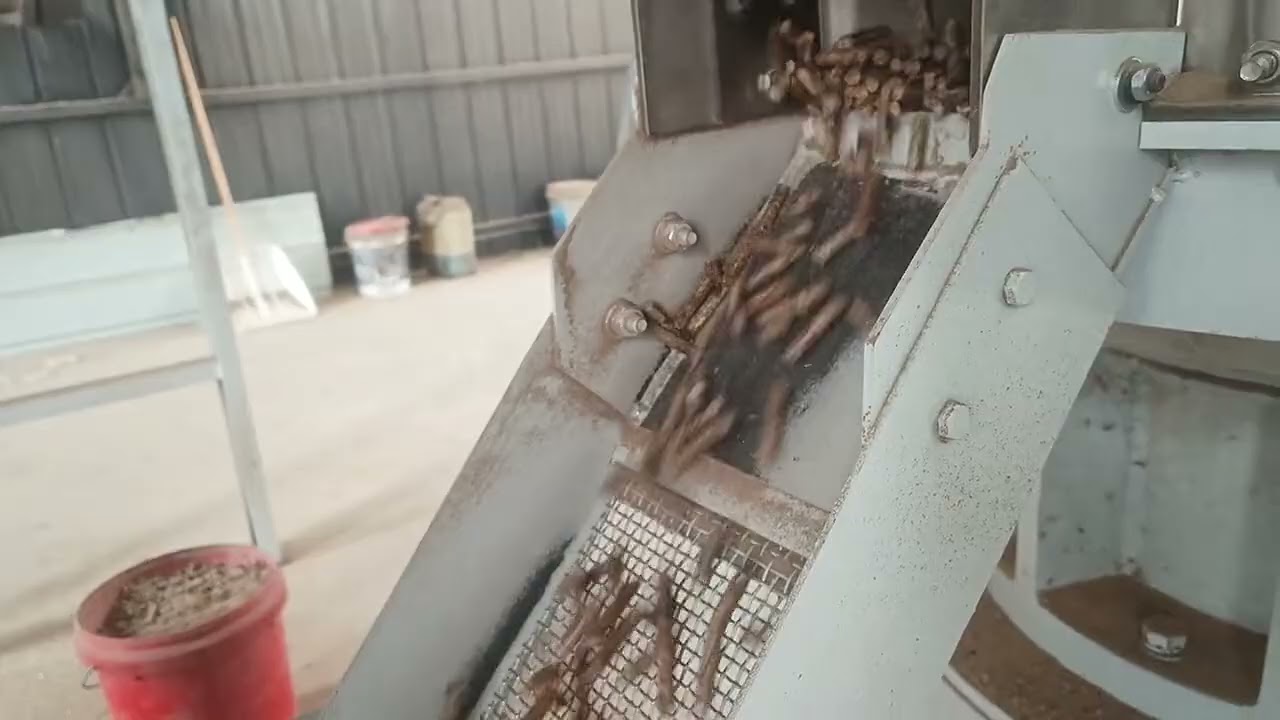


More on the PelletHills channel — the biomass playlist is where the pellet production line and pellet machine clips go up first.
What buyers ask before ordering a 1 t/h rice and wheat straw pellet production line
11 questions we answer on the phone most weeks.
What does a 1 t/h straw pellet production line include?
Five stages: a bale shredder (79 kW), a wood hammer mill with 36 hammers and a thickened screen (75 kW), a vertical ring die pellet mill with a double-layer die (HML-560, 90 kW), a counterflow pellet cooler with a vibrating screen, and a pellet packing machine. Installed power is 295 kW and the footprint is 30 × 12 m. There is no biomass sawdust dryer.
Why is there no dryer on a straw pellet production line?
Because field-dried straw arrives at 11–15 % moisture, which is already the figure the die is cut for. A dryer would only drive moisture out of a material that needs it. The one exception is straw that has been stored outside and rained on — if your bales are wet, tell us and a dryer comes back onto the quotation.
Why does straw need twice the hammer mill power that wood does?
Because straw bends where wood shatters. A 1 t/h wood pellet production line grinds with 22–37 kW; a 1 t/h straw pellet production line needs 75 kW, a heavier rotor and 36 hammers. Straw also has to be shortened rather than just broken, so the screen runs at 3–5 mm.
What compression ratio do you cut for straw?
1:8 to 1:10, against 1:5 to 1:7 for sawdust and 1:6 to 1:8 for palm fibre. Straw carries less lignin (14–18 %) and its fibres are springy, so the die has to hold pressure on the material long enough for the lignin to set. A short die gives a pellet that looks right and falls apart in the cooler.
How long does a die last on straw?
200–300 hours on rice straw at 9–14 % ash, 300–450 hours on wheat straw at 4–8 %. That is why the die on this pellet production line is a double-layer ring: when the first face is polished out you turn it over and run the second, then re-cut the ring. Dies and rollers are on the shelf at spare parts.
Can one pellet production line run both rice straw and wheat straw?
Yes, with the same die and a different setting on the screw feeder. Rice straw is softer and runs about 15 % slower for the same motor load, and it wears the die faster. If you will run both, tell us and we cut the die for the harder of the two.
Do I need a binder?
No. Straw binds on its own lignin at 14–18 %, given enough pressure and a long enough die. Some plants add 1–2 % water at the die inlet to help the material flow, and a few add 1 % starch or molasses when they are pelleting very dry, very dusty straw. Neither is standard on our builds.
What is the smallest straw pellet production line you build?
The same five stages with a 55 kW ring die pellet mill and a 22 kW hammer mill, at 800–1,000 kg/h, quoted at roughly half the price of the 1 t/h pellet production line and shipped in one 20 ft container. Below that, a combined pellet mill and hammer mill will make 100–350 kg/h from chopped straw with no cooler and no bagging scale.
How much straw does it consume?
About 1.05 t of straw for every 1 t of pellets, so 20–24 round bales a day on two shifts at 1 t/h. Those bales have to be under cover — the moisture figure that made the dryer unnecessary only holds if the bales stay dry.
How long does installation take, and what is the delivery time?
Eight to ten days on site with our engineer present, plus the civils. Delivery is 15–20 working days from deposit, FOB Qingdao, in a single 40HQ container — the shortest lead time of any pellet production line we build, because there is no dryer to make.
Can the pellet production line be expanded later?
Yes, up to the capacity of the hammer mill. The usual upgrade is a second 75 kW hammer mill feeding the same pellet mill, which takes a 1 t/h straw pellet production line to about 1.4 t/h without changing the die or the cooler.
Request a quotation for a 1 t/h rice and wheat straw pellet production line
Tell us the material, its moisture, the pellet diameter and the shed you have. We reply with a model list, a layout drawing and a price.
What happens after you send this
We answer with the model list, the die compression ratio and a price, then send a test-run video on your material before you pay a deposit.
Your details are not shared. One follow-up, no mailing list.