Poultry Manure Pellet Production LineSixty per cent water in, bagged organic fertiliser out
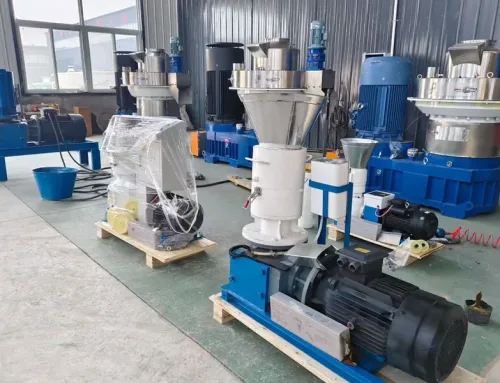
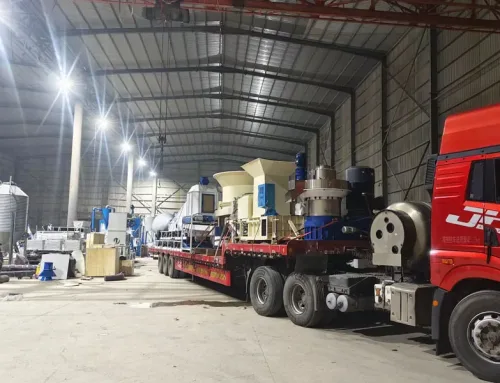
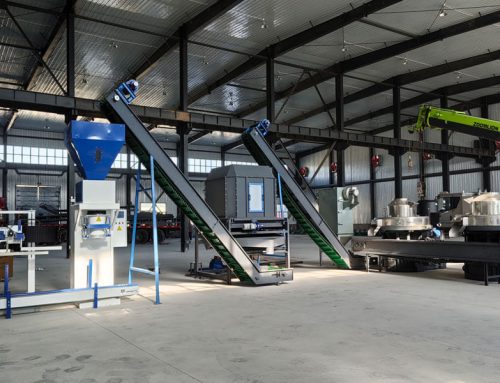
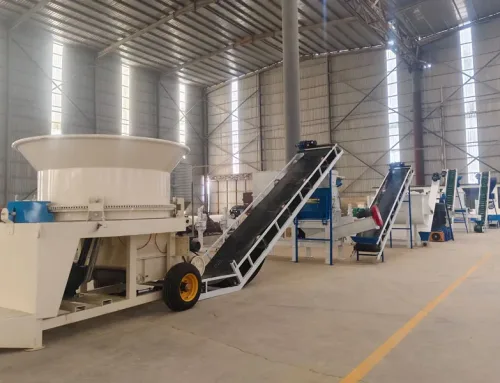
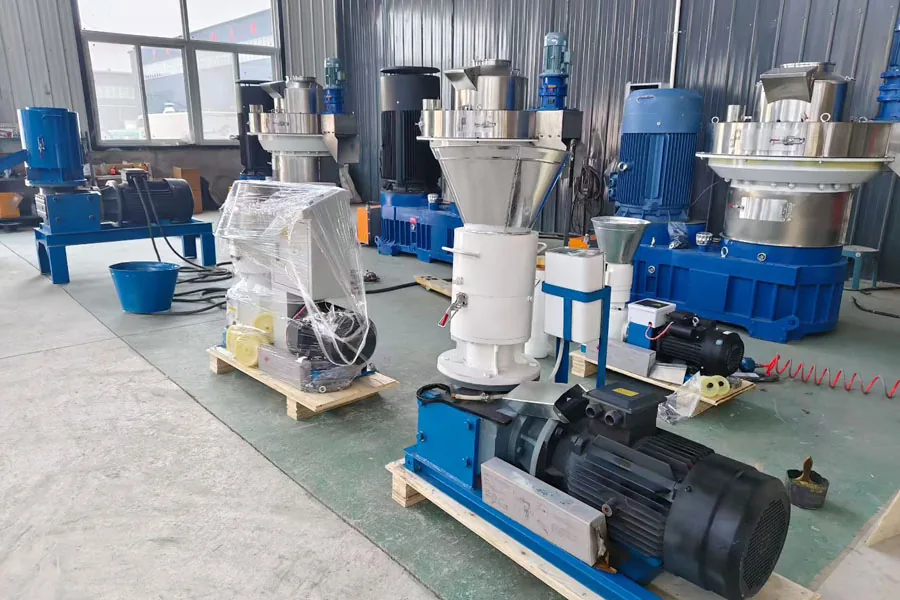
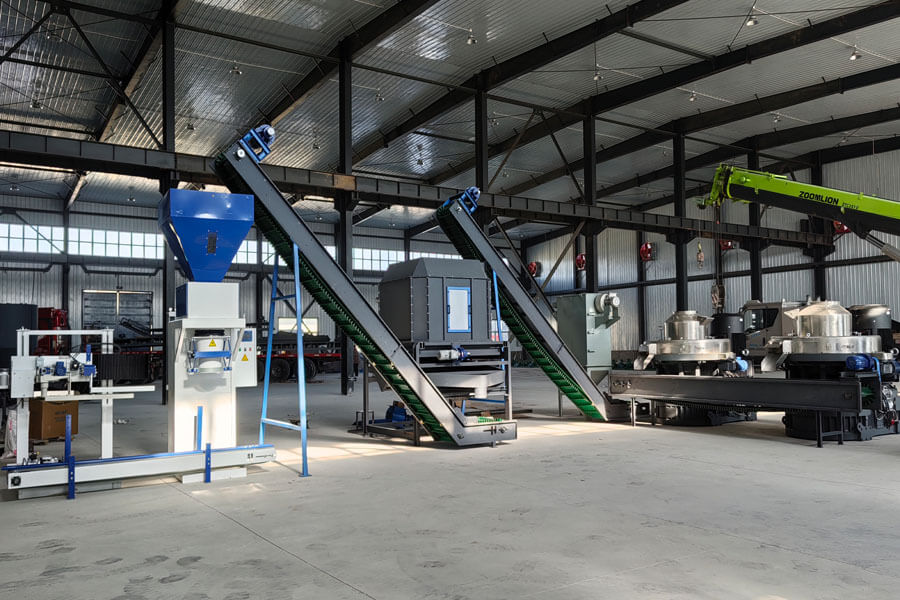
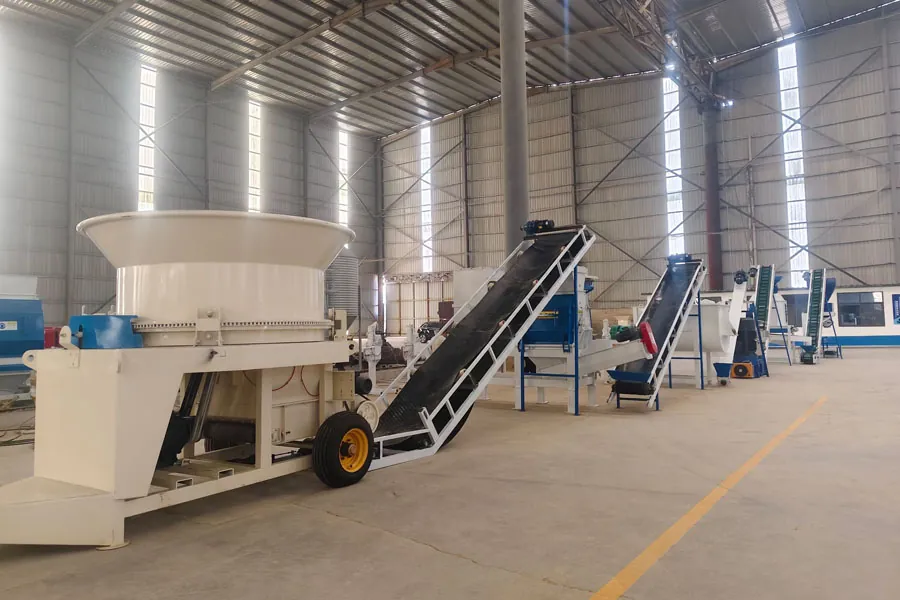
A 1 t/h poultry manure pellet production line: a rotary drum biomass sawdust dryer to take 65 % moisture down to 14 %, a 22 kW wood hammer mill, a feed mixer for the binder, a 90 kW vertical ring die pellet mill, a pellet cooler and a pellet packing machine. 145 kW of motors on 30 × 12 m of floor.
- Ferment, dry, crush, mix, pellet — the order is different from every other pellet production line here, and it has to be
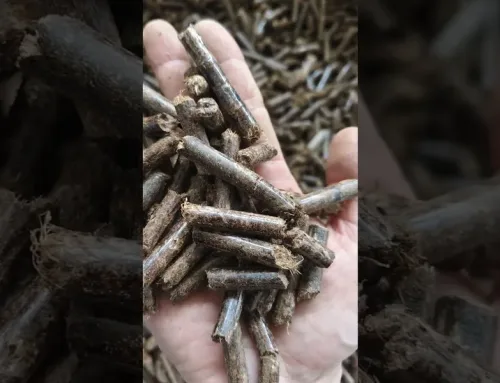
- Rotary drum dryer taking 65 % moisture down to 14 %, with its own hot air stove
- A feed mixer for the 5–10 % binder that poultry manure needs and wood does not
- 90 kW vertical ring die pellet mill, 3–5 mm pellets, 145 kW in total
Reply in 12 working hours · Sized on your material and its moisture · Layout drawing and die specification included
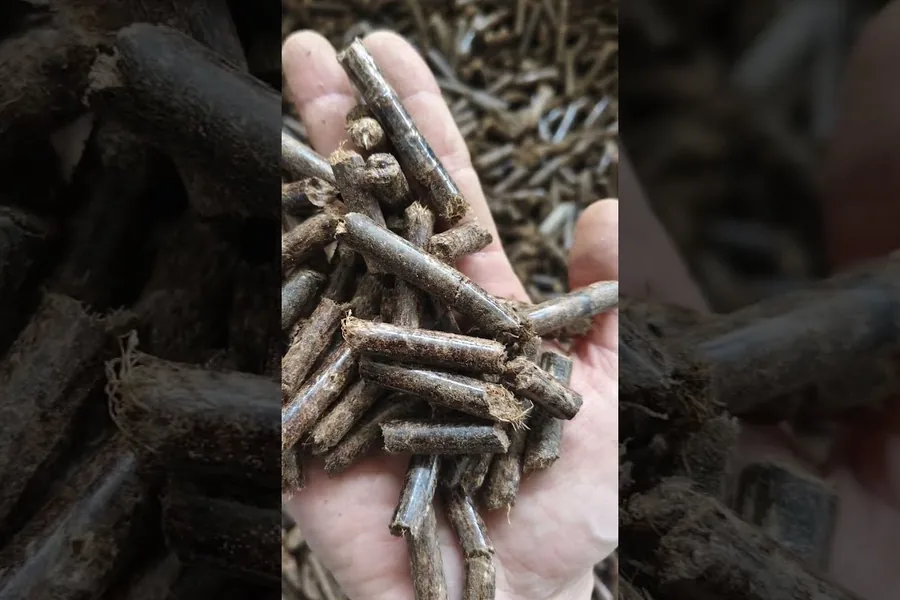
The one pellet production line on this list that starts with a fermentation, not a pellet mill
Poultry manure arrives at 60–75 % moisture, still active, and smelling. Nothing about a pellet mill will work on it until it has been fermented and dried, and that is why this pellet production line has a stage no other pellet production line here has.
Fresh layer or broiler manure is 60–75 % water. It is also still fermenting, which means it heats, it smells, and it will keep heating in a bag. The first stage of a poultry manure pellet production line is therefore not equipment but a process: the manure is stacked with a microbial agent and turned every day for seven to fifteen days, or for three to five days with a compost turner, until it stops heating and the smell has gone.
After that it goes through a rotary drum biomass sawdust dryer to 14 %, a wood hammer mill to 2–3 mm, a feed mixer where 5–10 % straw powder or bentonite goes in, and only then to a 90 kW vertical ring die pellet mill. Skip the fermentation and the pellets reheat in the bag; skip the binder and they crumble.
A 1 t/h poultry manure pellet production line 145 kW installed
| Stage | Machine | Model | What it does |
|---|---|---|---|
| 01 | Rotary drum dryer | TS 1.2 × 12, 5.5 kW | 65 % moisture down to 14 %, after the fermentation |
| 02 | Wood hammer mill | 22 kW | Dried cake down to 2–3 mm |
| 03 | Feed mixer | LJ-500, 7.5 kW | 5–10 % straw powder or bentonite, mixed evenly |
| 04 | Vertical ring die pellet mill | HML-560, 90 kW | 3–5 mm pellets, 1:8–1:10 die, 1.0–1.3 t/h |
| 05 | Pellet cooler | LQ-50 + vibrating screen | Cool, screen, and return the fines |
| 06 | Pellet packing machine | BZ-50 | 25–50 kg bags for the fertiliser trade |
Installed power is 145 kW across all 6 stages, on 30 × 12 m of floor at 6 m clear. Every machine in the table is also sold on its own, and the dies, rollers and screens for them are shipped as spares.
Thirty by twelve metres and 145 kW is the pellet production line itself. The fermentation pad is the part that is not in that figure and is usually bigger than the shed: at 1 t/h you need 12–15 t of manure on the pad at any time, turned daily, under a roof if you have rain.
The economics are different from every other pellet production line here, and better. Poultry manure is a disposal cost for the farm and a raw material for you — often free at the gate. The pellet sells as an organic fertiliser at a price set by nutrient analysis rather than by calorific value, and the market is agricultural rather than industrial.
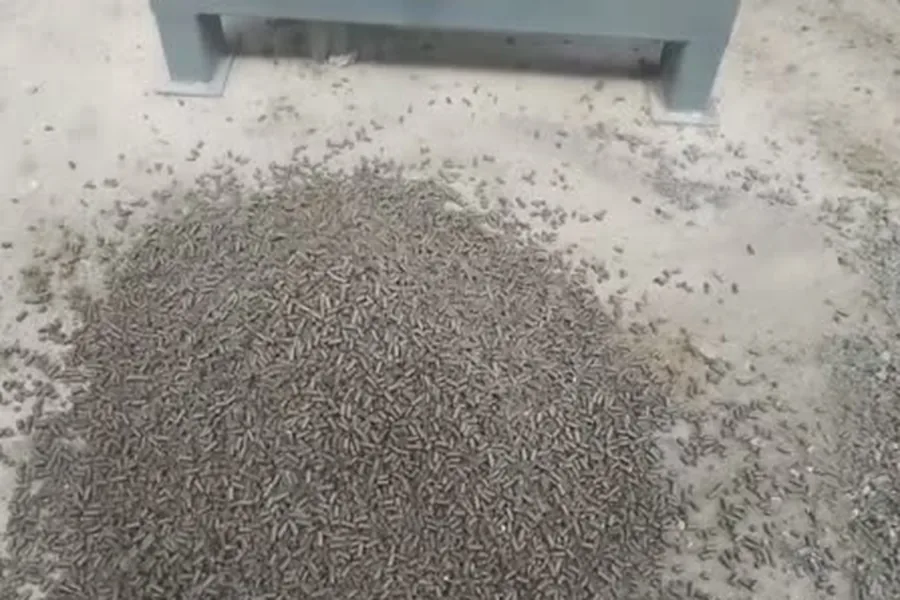
What each stage does on a 1 t/h poultry manure pellet production line
Read them in order — the material only moves one way. Every stage links to its own product page, where the model range and the power figures are.
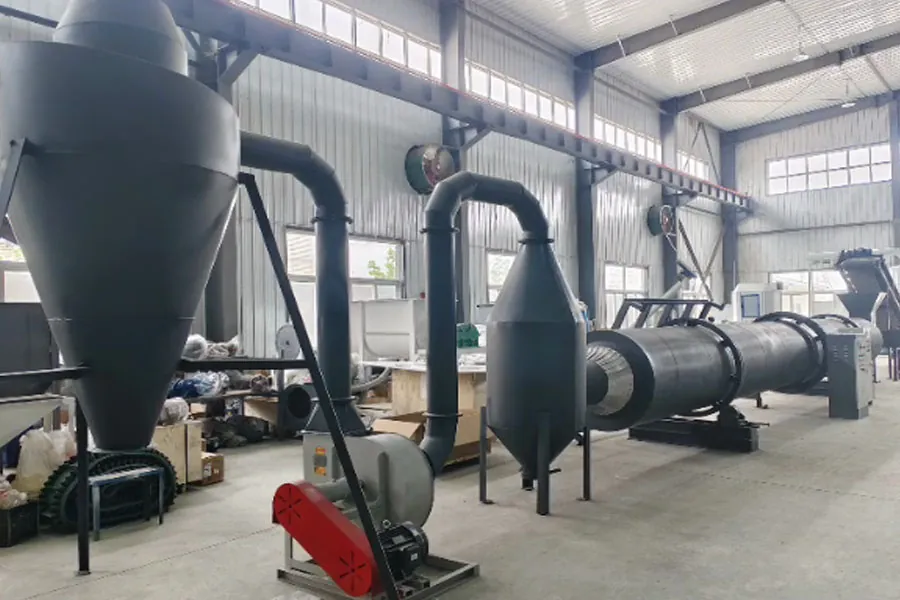
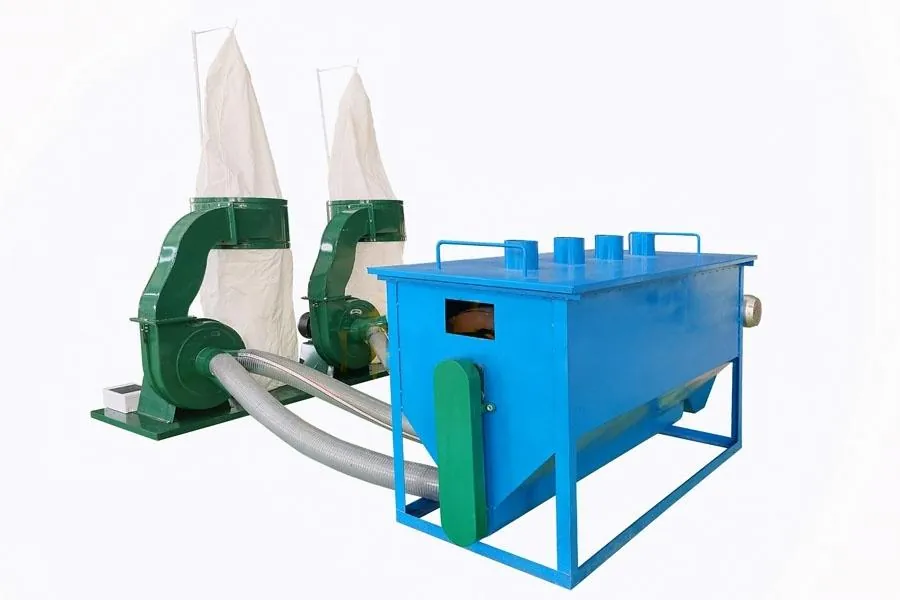
Rotary drum dryer
Fermented manure still holds 45–55 % water, and a die will not build pressure on that. The rotary drum dryer takes it to 14 % in a single pass, with its own hot air stove and an 11 kW fan on a cyclone.
The dryer does a second job on this material: it pasteurises. Manure carries weed seeds and pathogens, and a drum inlet at 400–500 °C kills both. That is what lets the pellet be sold as a certified organic fertiliser rather than as raw manure.
Biomass sawdust dryer — flash pipe from 200 kg/h, rotary drum from 500 to 2,500 kg/h.
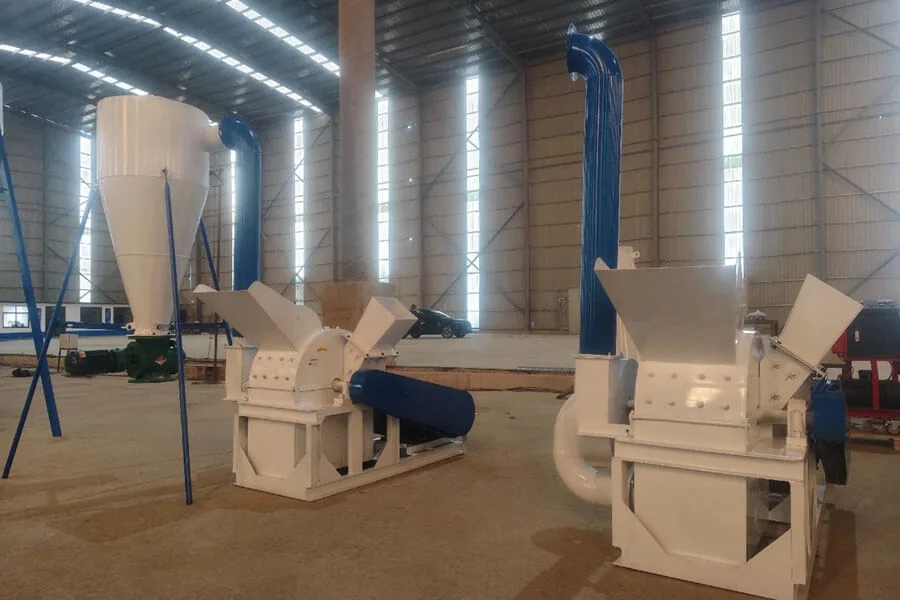
Wood hammer mill
Dried manure comes off the drum in lumps. A 22 kW hammer mill with a 2–3 mm screen takes them down to a meal that will feed evenly into a die — coarser than that and the pellet has soft spots where a lump did not break down.
This is also the stage where the hammer mill earns its corrosion protection. Manure is acidic and wet at the inlet, and a standard mild-steel chamber will be showing rust in a season. We specify a coated chamber and stainless screens on a manure build.
Wood hammer mill — FS series, 120 to 1,600 kg/h, 3 to 37 kW; the manure build uses a coated chamber.
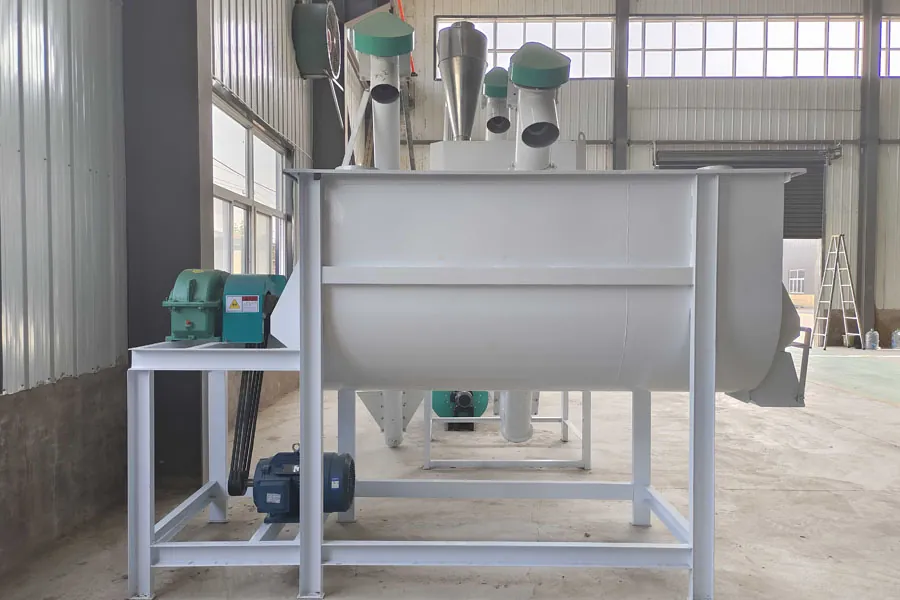
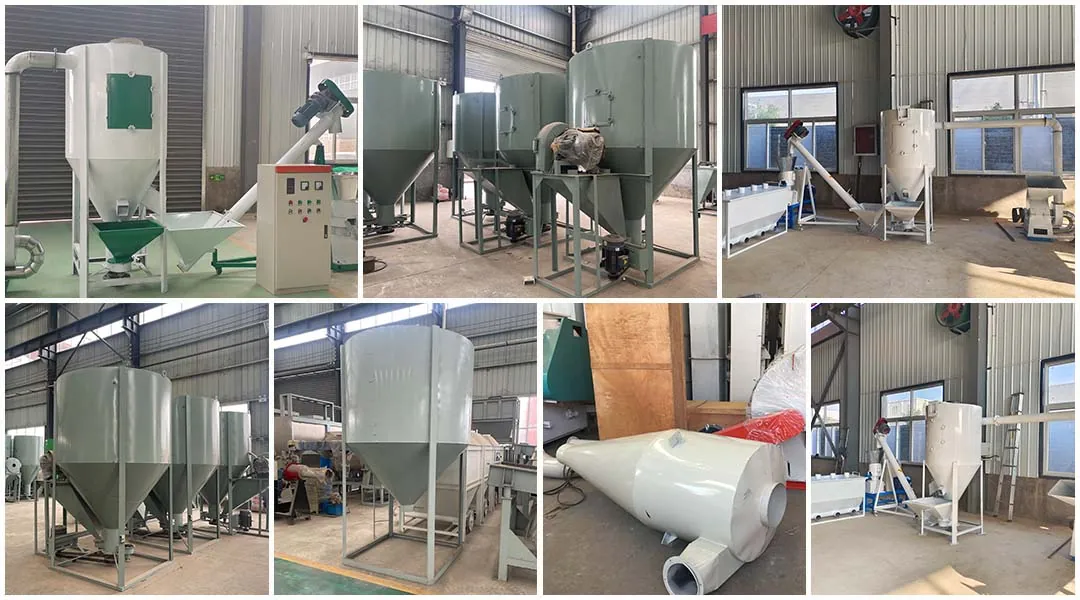
Feed mixer
This is the stage that does not exist on any other pellet production line here. Manure on its own makes a pellet that crumbles, because it has little lignin and no long fibre. Five to ten per cent straw powder, rice husk powder or bentonite gives the die something to bind, and a vertical feed mixer at 7.5 kW mixes it evenly in four to six minutes a batch.
A binder is not always needed. Manure that has been fermented with a straw-rich bedding, or manure from a deep-litter shed, already carries the fibre and pellets without one. Test a batch before you buy the mixer — it is the cheapest experiment on the pellet production line.
Feed mixer — vertical LJ series 3 to 7.5 kW, horizontal WJ series 4 to 7.5 kW.
Vertical ring die pellet mill
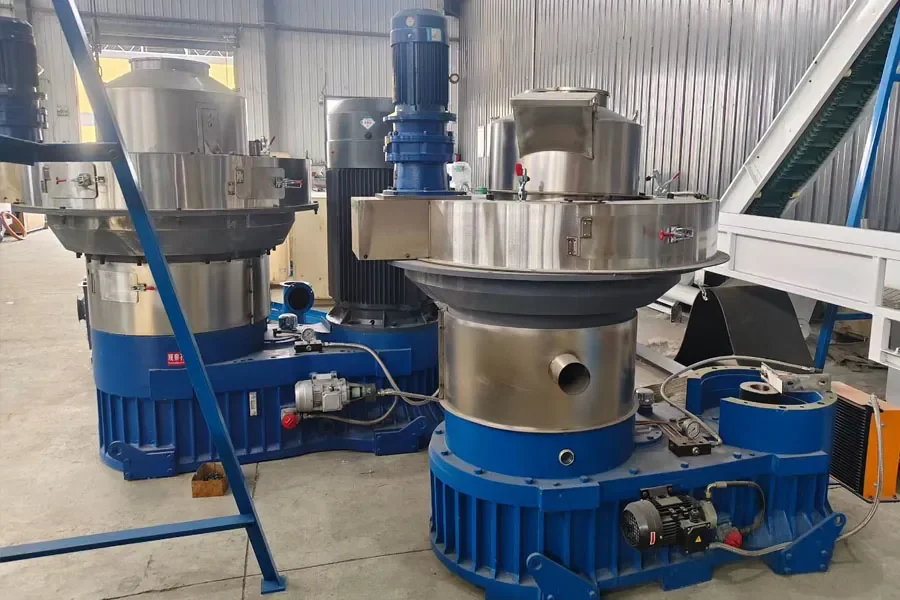
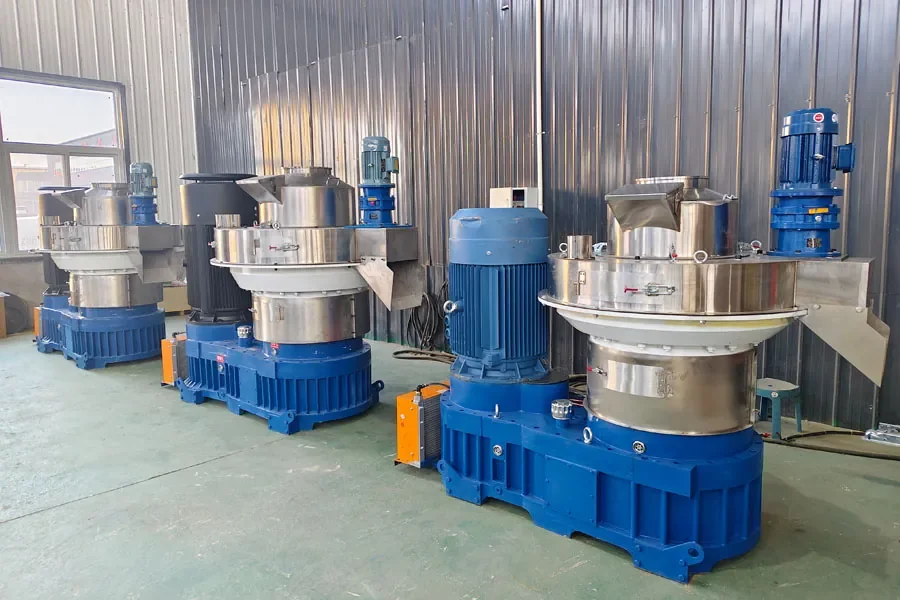
A 90 kW vertical ring die pellet mill on a 1:8 to 1:10 die, rated 1.0–1.3 t/h on a manure-and-straw mix at 14 % moisture. The die stands on its side and the rollers turn inside it, so the mix is thrown outwards against the die instead of being dropped onto a plate — which is what stops a light, dusty manure meal bridging over the rollers.
The chamber is stainless, the die is hardened, and a conditioner ahead of the die adds low-pressure steam to bring the mix to 16 % at the inlet. That last detail is what separates a fertiliser pellet that survives a bag from one that arrives as powder. Below 1 t/h we quote a flat die build instead; the three pellet mill families are compared further down the page.
Vertical ring die pellet mill — HML-560 / 600 / 700, 90 to 160 kW, 1.0 to 2.5 t/h.
Pellet cooler
Fertiliser pellets leave the die at 70–80 °C and soft. The counterflow pellet cooler brings them to ambient over seven minutes and the screen deck underneath takes out the fines, which go back to the mixer rather than to the die — a fertiliser pellet needs the binder, so the fines are worth recovering.
Cooling also stops the fermentation restarting. A bag of warm fertiliser pellets will heat in the warehouse, and a heated bag of organic fertiliser is a bag of mould by the time it reaches the customer.
Pellet cooler — LQ-50 0–500 kg/h, LQ-70 0–1,000 kg/h, NL-11 1–2 t/h counterflow.
Pellet packing machine
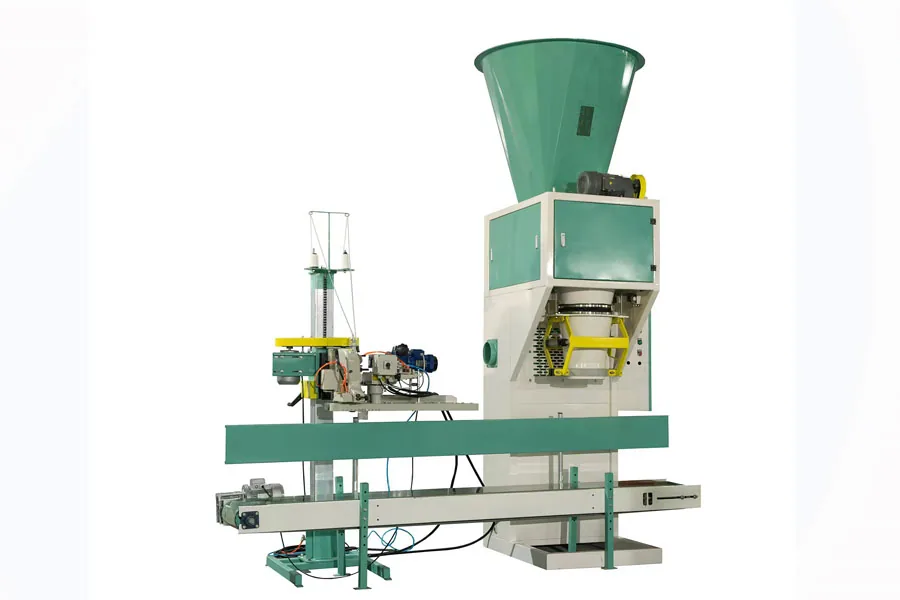
Organic fertiliser is sold in 25 kg and 50 kg bags to farms, golf courses and garden centres, and in 1,000 kg bulk bags to a blender. A 1.5 kW quantitative pellet packing machine with a sewing head covers the small bags at three to five a minute.
The bag itself matters more than on any other product here. Fertiliser pellets are hygroscopic — they pull moisture out of the air — so the bag wants a pellet production liner, and the warehouse wants to be dry. A bag that has taken up water sets into a block.
Pellet packing machine — 10–50 kg bags or 1,000 kg bulk bags, with weighing and sewing.
Price a 1 t/h poultry manure pellet production line
Send the material, its moisture as received and the shed you have. We answer with a model list, a layout drawing at 1:50 and a price.
Tell us the material and the output
The material, its moisture, the pellet diameter and the kg/h you need. We come back with a model list, a die specification and a price.
Reply within one working day. No obligation.
From a shed floor to a pallet of fertiliser
Seven steps, and the first two happen before any machine is switched on. That is what makes a manure pellet production line different from every other pellet production line here.
Fermenting
Manure stacked with a microbial agent and turned daily for 7–15 days, or 3–5 with a turner.
Drying
A 5.5 kW rotary drum takes 50 % moisture down to 14 %, and pasteurises it on the way.
Crushing
A 22 kW hammer mill takes the dried cake to 2–3 mm through a coated chamber.
Mixing
A 7.5 kW feed mixer adds 5–10 % straw powder or bentonite as a binder.
Pressing
A 90 kW vertical ring die pellet mill on a 1:8–1:10 die, conditioned to 16 % at the inlet.
Cooling and screening
Counterflow air to ambient; fines back to the mixer, not to the die.
Bagging
25–50 kg lined bags for the fertiliser trade, or 1,000 kg bulk bags for a blender.
The fermentation is not optional and it is not a formality. Fresh manure is still biologically active: it heats, it smells, and it will keep heating after it has been pelletised and bagged. Turning it daily with a microbial agent for seven to fifteen days takes the temperature down and the smell away, and it is the difference between a product that ships and a product that comes back.
The moisture number is the one that sizes the dryer, and it is higher than any other material here. Fresh manure at 65–75 % has to lose about 700 kg of water per tonne of pellets. That is more than a palm fibre pellet production line loses, from a material that arrives wetter and heavier, which is why the dryer and its stove are the biggest single cost on a manure pellet production line.
The binder is the third variable and the one most often skipped. Manure on its own has little lignin and no long fibre, so it makes a pellet that crumbles. Five to ten per cent straw powder, husk powder or bentonite fixes it, and the mixer is on the pellet production line for that reason alone. Test a batch before you buy the mixer — deep-litter manure often needs no binder at all.
A vertical ring die, a conditioner and a stainless chamber
Manure is pressed by the same principle as wood. Everything around the die is different: the chamber material, the conditioner, and the ratio.
The die runs a 1:8 to 1:10 compression ratio, longer than wood and shorter than husk. Manure has very little lignin — it has already been through a digestive system — so the pressure has to be held on the material long enough for the binder and the residual fibre to knit, and a conditioner ahead of the die brings the mix to 16 % moisture with low-pressure steam so that the knit happens at all.
The chamber is stainless or coated, and that is not a cosmetic choice. Manure is acidic and it is wet at the inlet; a mild-steel chamber rusts through in a season and puts iron into a product that is being sold on its analysis. Screens are stainless for the same reason, and the die is hardened because the mineral fraction in manure — 25–35 % ash — is abrasive.
Pellet mills for a poultry manure pellet production line
| Model | Power | Capacity | Where it fits |
|---|---|---|---|
| HML-560 | 90 kW | 1.0–1.3 t/h | The standard build for a 1 t/h manure pellet production line |
| HML-600 | 132 kW | 1.5–2.0 t/h | For 2 t/h on a manure and straw mix |
| HML-700 | 160 kW | 2.3–3.0 t/h | The largest single pellet mill we build |
| PM-D580B (flat die) | 75 kW | 800–1,200 kg/h | The flat die build we quote below 1 t/h |
Capacity is quoted on fermented, dried manure with 5–10 % straw powder at 14 % moisture, conditioned to 16 % at the die inlet. Manure with no binder runs 20–30 % lower.
The die ratio is the number to argue about. Manure has almost no lignin left after digestion, so the pressure has to be held on the mix for longer than on wood — 1:8 to 1:10 against 1:6 to 1:8 — and a conditioner brings the mix to 16 % at the inlet so that the knit happens at all. A 1:6 die on manure makes a pellet that looks right and breaks in the bag.
Abrasion is the other reason this build is specified the way it is. Manure runs 25–35 % ash, most of it mineral grit, so the die is hardened, the screens are stainless and the chamber is stainless. Expect 600–900 hours from a die on clean litter, less on material that has been picked up with sand.
Flat die, vertical ring die or horizontal ring die
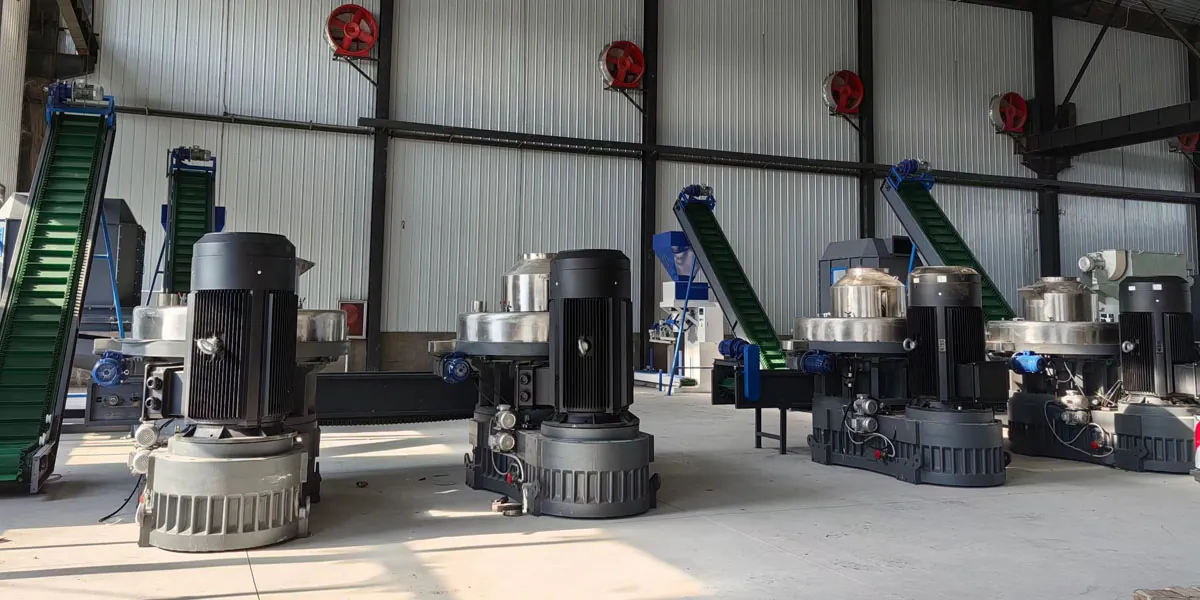
Three pellet mill families will press manure and we build all three. The choice comes down to output, to how often somebody can change a die, and to whether the site has steam.
| Pellet mill | Output on manure | Power | Where it fits |
|---|---|---|---|
| Flat die pellet mill — PM-D580B | 800–1,200 kg/h | 75 kW | The cheapest way in and the easiest die to change, in about twenty minutes. Bridges on a light, fluffy mix, so it wants a binder and a steady feed. |
| Vertical ring die pellet mill — HML-560 | 1.0–1.3 t/h | 90 kW | The build on this page. The mix is thrown outwards against the die, so it cannot bridge. Die lifted out of the top with the mill stopped. |
| Horizontal ring die pellet mill — fertiliser mill | 1.0–1.2 t/h | 45 kW, plus a conditioner | Conditioner sits on top and the die changes through a side door, so steam conditioning is easy. More wear parts and a longer footprint. |
Output figures are on fermented, dried manure with 5–10 % straw powder at 14 % moisture. A wetter mix, or no binder at all, runs 20–30 % lower on any of the three.
The short answer: under 800 kg/h, a flat die pellet mill; 1 t/h and above, a vertical ring die pellet mill; and a horizontal ring die pellet mill when you want steam conditioning at 1 t/h and have the floor for a conditioner sitting on top of the mill.
Die change is what separates them in daily use. A flat die is a plate under the rollers and one man changes it in about twenty minutes. A vertical ring die is lifted out of the top of the mill — half a day, two men. A horizontal ring die changes through a side door, which is easier than the vertical one and harder than the flat one, but the mill itself carries more bearings and more seals to look after.
All three need the same three things on manure: a hardened die at 1:8–1:10, stainless screens, and a stainless or coated chamber, because manure is acidic and 25–35 % mineral. What changes between them is how the material is fed into the die — and on a light, dusty manure meal that is the whole argument for the vertical ring die above 1 t/h.
What poultry manure decides, before any machine is chosen
Manure is the wettest, the most abrasive and the only material here that is still alive when it arrives. Four figures follow from that.
| Item | Figure | Why it matters |
|---|---|---|
| Moisture as received | 60–75 % fresh, 45–55 % after fermenting | The highest of any material here — the dryer is the biggest cost |
| Moisture into the die | 14 %, conditioned to 16 % | Steam conditioning is standard on a manure build |
| Bulk density, dried | 600–750 kg/m³ | Heavy and dense once dry, unlike every other material here |
| Particle size after the hammer mill | 2–3 mm | Finer than fuel pellets — a lump makes a soft spot in the pellet |
| Die compression ratio | 1 : 8 to 1 : 10 | Long, because manure has almost no lignin left |
| Binder | 5–10 % straw powder, husk powder or bentonite | The one material here that usually needs one |
| Ash in the finished pellet | 25–35 % | Mineral, and abrasive. Hardened dies and stainless screens |
| Pellet diameter | 3–5 mm | Fertiliser pellets are small — they are spread, not burned |
The ash figure is not a problem on this material, it is the product. A 25–35 % mineral fraction is what a fertiliser is; the pellet is sold on organic matter (45 % minimum) and on total nitrogen, phosphorus and potassium (5 % minimum), not on calorific value. That is a completely different specification from every other page in this set, and it is why a manure pellet mill is called a fertiliser mill.
The moisture figure is what makes the economics work or not. At 65–75 % incoming, a tonne of pellets needs about 700 kg of water evaporated, and that is fuel. A farm that already has a methane digester and waste heat has a large advantage over one that has to buy the heat — if that is your situation, tell us at the quotation stage, because the dryer design changes.

What the site has to provide
A 1 t/h poultry manure pellet production line is 145 kW of motors on 30 × 12 m of floor, under a roof 6 m high.
| Item | Figure | Note |
|---|---|---|
| Installed power | 145 kW | All six stages, motors only |
| Largest single motor | 90 kW on the vertical ring die pellet mill | The figure that sizes the transformer |
| Electrical supply | 180 kVA, 380 V / 50 Hz, four-wire | Size on the largest motor, not the total |
| Footprint | 30 × 12 m, 360 m² | The pellet production line only — the fermentation pad is additional |
| Fermentation pad | 150–200 m² under roof | 12–15 t on the pad at any time, turned daily |
| Building height | 6 m clear | Under the hook, at the dryer cyclone and the mixer |
| Operators | 2 per shift, plus 1 on the pad | Turning is daily and cannot be skipped |
| Water | Not required for the pellet production line | The pellet cooler is air cooled |
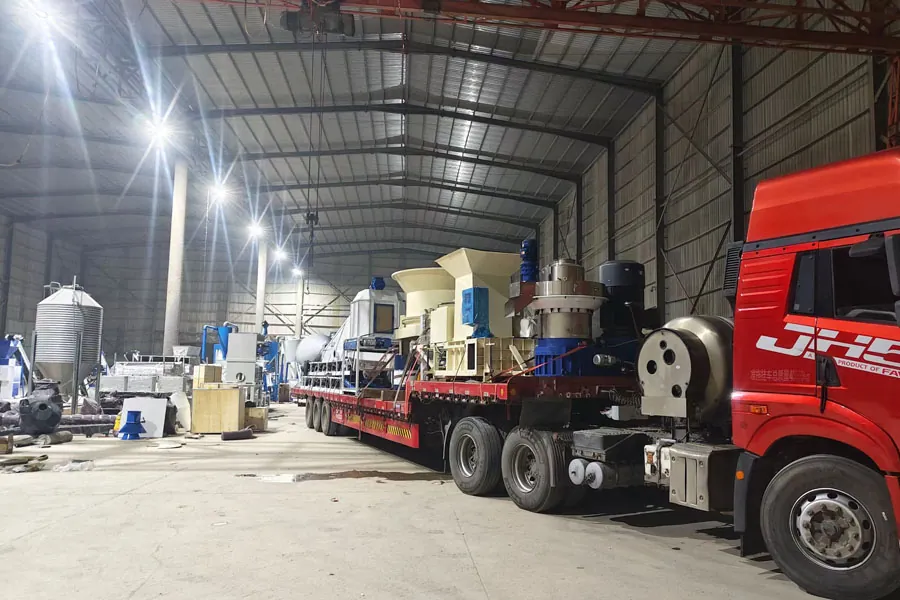
| Containers | 1 × 40HQ | The pellet production line ships in one container |
The fermentation pad is the part of a manure project that is most often under-budgeted. At 1 t/h you need 12–15 t of manure fermenting at any time, turned daily for seven to fifteen days. That is 150–200 m² under roof, with a turner, and it costs about as much as the pellet production line’s electrical installation.
The supply is sized on the 90 kW vertical ring die pellet mill. Everything else on the pellet production line — the dryer fan, the hammer mill, the mixer — starts unloaded, so a 180 kVA transformer covers 145 kW of connected load with margin. Tell your electrician that the pellet mill is the only hard start on the site.
Ventilation and odour are site issues rather than machine issues. A manure shed needs extraction at the pad, at the dryer inlet and at the bagging head, and the neighbours will notice if it does not have it. We specify the extraction with the layout drawing even though we do not supply the fans.
What ships, and what the site has to build
A poultry manure pellet production line is quoted as a set. This is what is inside the price.
-
All six stages
Rotary drum dryer, wood hammer mill, feed mixer, vertical ring die pellet mill, pellet cooler with screen and pellet packing machine — with motors, starters and guards.
-
Conveyors and ducting
Belts and screw conveyors between the stages, and the ducting from the dryer cyclone and the bag filter.
-
Conditioner
The low-pressure steam conditioner ahead of the die, which is what makes a manure pellet hold together.
-
Dies and rollers
One hardened 1:8–1:10 die at 3–5 mm, plus a spare die and a spare roller set.
-
Layout drawing
1:50 plan and elevation of the pellet production line and the fermentation pad, with the foundation blocks and the cable runs marked.
-
Commissioning
One engineer on site for the first run, at our cost, for a pellet production line of this size.
Not included, and quoted separately if you want them: the hot air stove for the dryer; the compost turner and the pad; the civil works; and the transformer. Delivery is 25–30 working days from deposit, FOB Qingdao. Spare parts are on the shelf at spare parts.
Watch a poultry manure pellet production line run
Four clips: a manure pelletising test run, the fertiliser pellet mill on its own, and a fertiliser pellet production line end to end.



More on the PelletHills channel — the biomass playlist is where the pellet production line and pellet machine clips go up first.
What buyers ask before ordering a 1 t/h poultry manure pellet production line
12 questions we answer on the phone most weeks.
What does a 1 t/h poultry manure pellet production line include?
Six stages: a rotary drum biomass sawdust dryer (5.5 kW), a wood hammer mill (22 kW), a feed mixer (LJ-500, 7.5 kW), a 90 kW vertical ring die pellet mill with a conditioner, a counterflow pellet cooler with a vibrating screen, and a 25–50 kg pellet packing machine. Installed power is 145 kW and the pellet production line footprint is 30 × 12 m, plus a 150–200 m² fermentation pad.
Why does manure need a fermentation stage?
Because fresh manure is still biologically active. It heats, it smells, and it keeps heating after it has been pelletised and bagged. Stacking it with a microbial agent and turning it daily for seven to fifteen days — three to five with a compost turner — takes the temperature down and the smell away. Skip it and the bags come back.
Do I need a binder?
Usually, yes — 5–10 % straw powder, rice husk powder or bentonite. Manure has almost no lignin left after digestion and no long fibre, so it makes a pellet that crumbles. Deep-litter manure and manure fermented with straw bedding often need none, so test a batch before you buy the mixer.
Why a vertical ring die rather than a flat die or a horizontal ring die?
Above 1 t/h, because manure meal is light and bridges in a flat die chamber rather than falling into the rollers. A vertical ring die throws the mix outwards against the die, so bridging cannot form. Below 1 t/h a flat die is a legitimate and much cheaper choice — a PM-D580B at 75 kW makes 800–1,200 kg/h — and a horizontal ring die is the one to pick if you want steam conditioning at 1 t/h and have the floor for it. The three are compared in full above.
What compression ratio do you cut for manure?
1:8 to 1:10. Manure has very little lignin, so the die has to hold pressure on the mix long enough for the binder and the residual fibre to knit. A conditioner ahead of the die brings the mix to 16 % moisture with low-pressure steam, which is what makes the knit happen.
How much water has to be evaporated?
About 700 kg per tonne of pellets, going from 65–75 % incoming to 14 % at the die. That is the largest single cost on a manure pellet production line, and it is why a farm with a digester and waste heat has a big advantage over one buying fuel for the stove.
Is the dryer doing anything other than drying?
Yes — it pasteurises. Manure carries weed seeds and pathogens, and a drum inlet at 400–500 °C kills both. That is what lets the pellet be sold as a certified organic fertiliser rather than as raw manure, and it is worth mentioning on the label.
What is the pellet sold as?
An organic fertiliser, on an analysis rather than on a calorific value: organic matter 45 % minimum, total nitrogen, phosphorus and potassium 5 % minimum, moisture under 14 %. Pellets are 3–5 mm because they are spread, not burned, and the market is agricultural and horticultural rather than industrial.
Why is the chamber stainless?
Because manure is acidic and wet at the inlet. A mild-steel chamber rusts through in a season and puts iron into a product sold on its analysis. Screens are stainless for the same reason and the die is hardened because the 25–35 % mineral fraction is abrasive.
How big does the fermentation pad have to be?
150–200 m² under roof at 1 t/h, holding 12–15 t and turned daily. It is usually bigger than the shed the pellet production line sits in, and it is the part of a manure project most often under-budgeted. Budget it before you budget a second pellet mill.
How long does installation take, and what is the delivery time?
Eight to ten days on site with our engineer present, plus the civils and the pad. Delivery is 25–30 working days from deposit, FOB Qingdao, in a single 40HQ container. Payment is 40 % deposit with the balance before delivery.
Can the same pellet production line pellet other organic waste?
Yes — pig and cattle manure, chicken litter, food waste, sewage sludge and green waste all run on the same stages with a different binder ratio and a different die. Tell us the material and its analysis and we cut the die and the binder recipe for it.
Request a quotation for a 1 t/h poultry manure pellet production line
Tell us the material, its moisture, the pellet diameter and the shed you have. We reply with a model list, a layout drawing and a price.
What happens after you send this
We answer with the model list, the die compression ratio and a price, then send a test-run video on your material before you pay a deposit.
Your details are not shared. One follow-up, no mailing list.