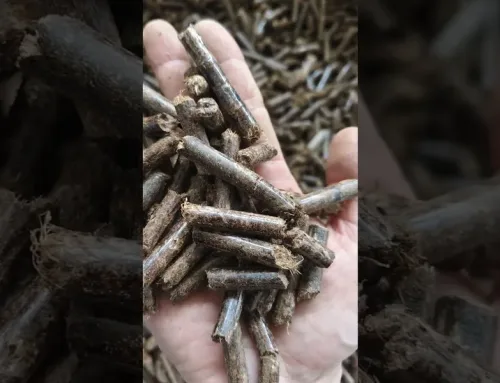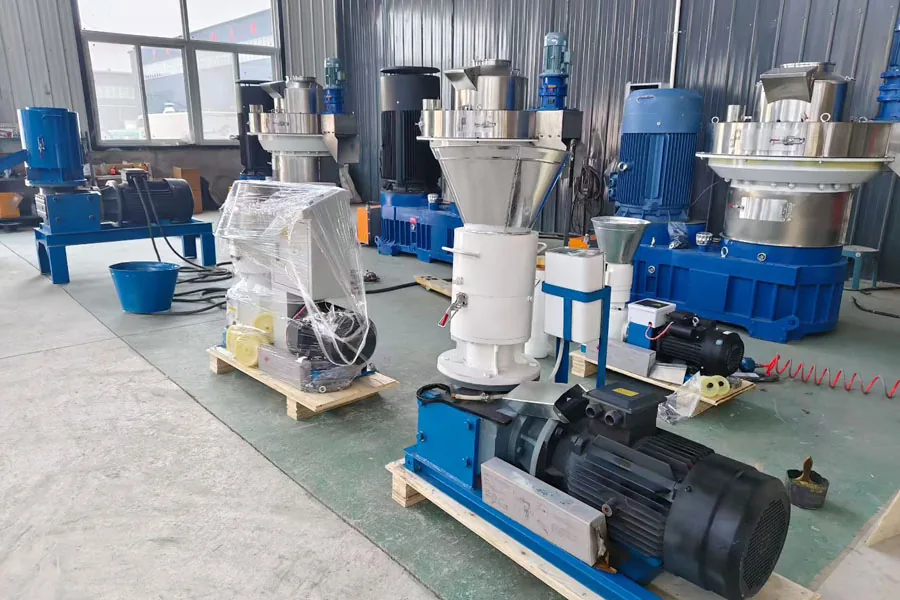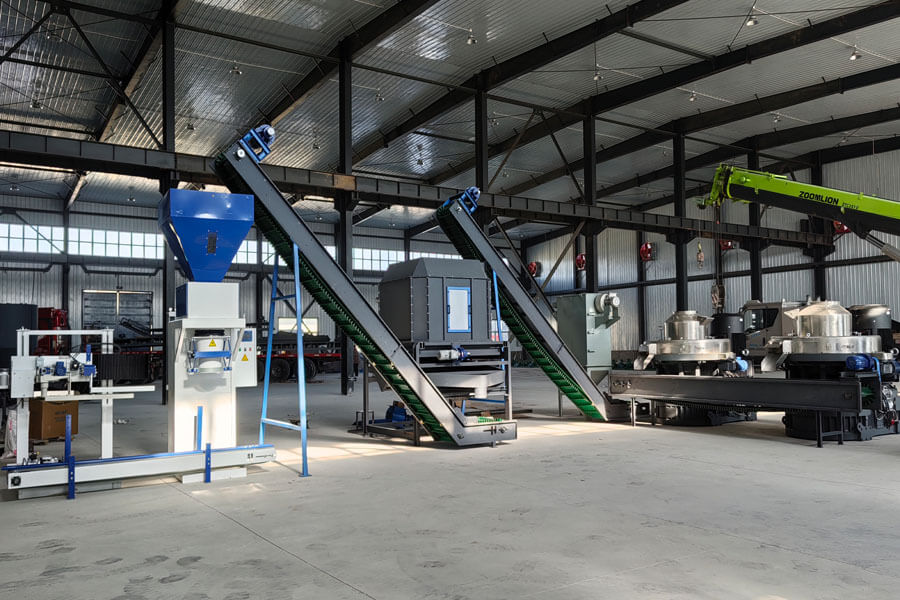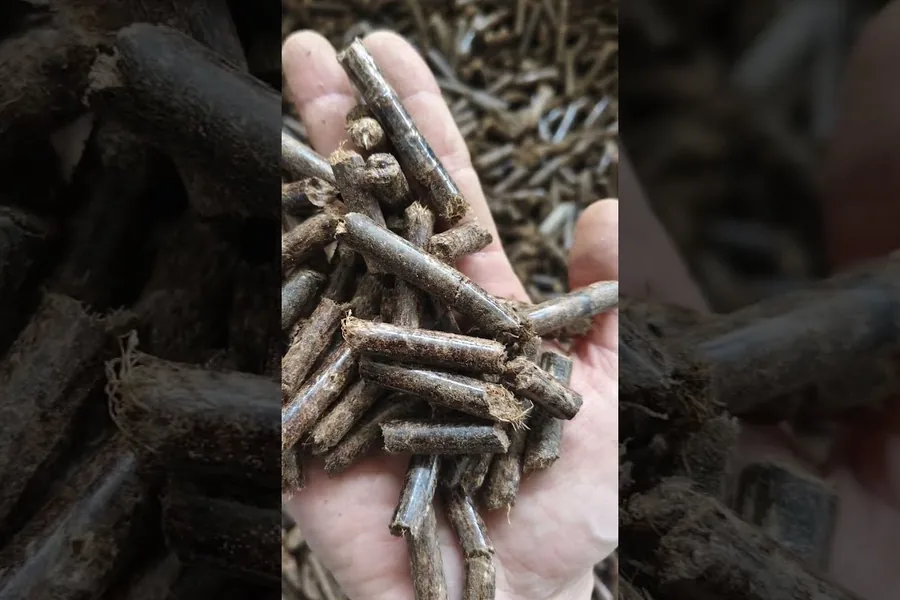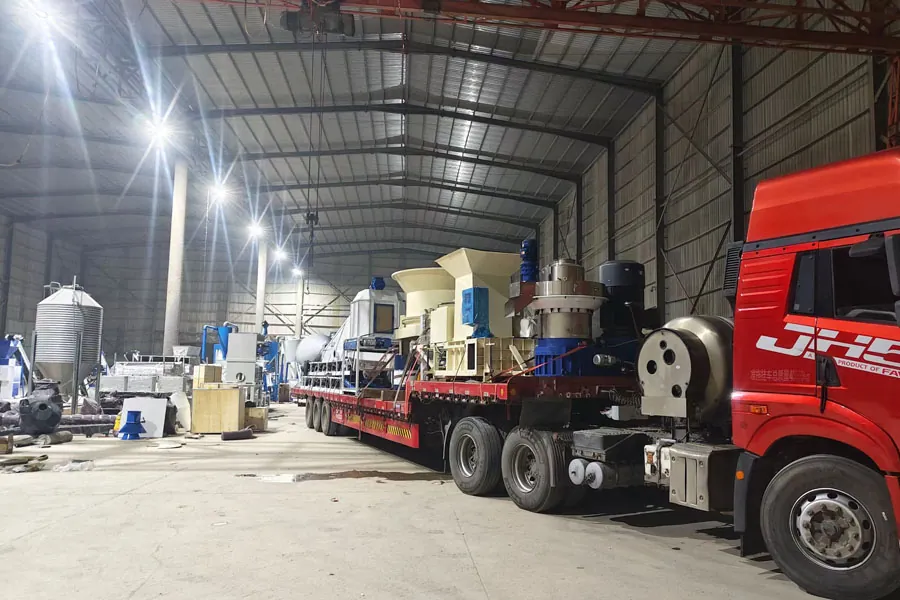
Grass and Alfalfa Pellet Production LineBale to feed pellet, and the dryer decides the season
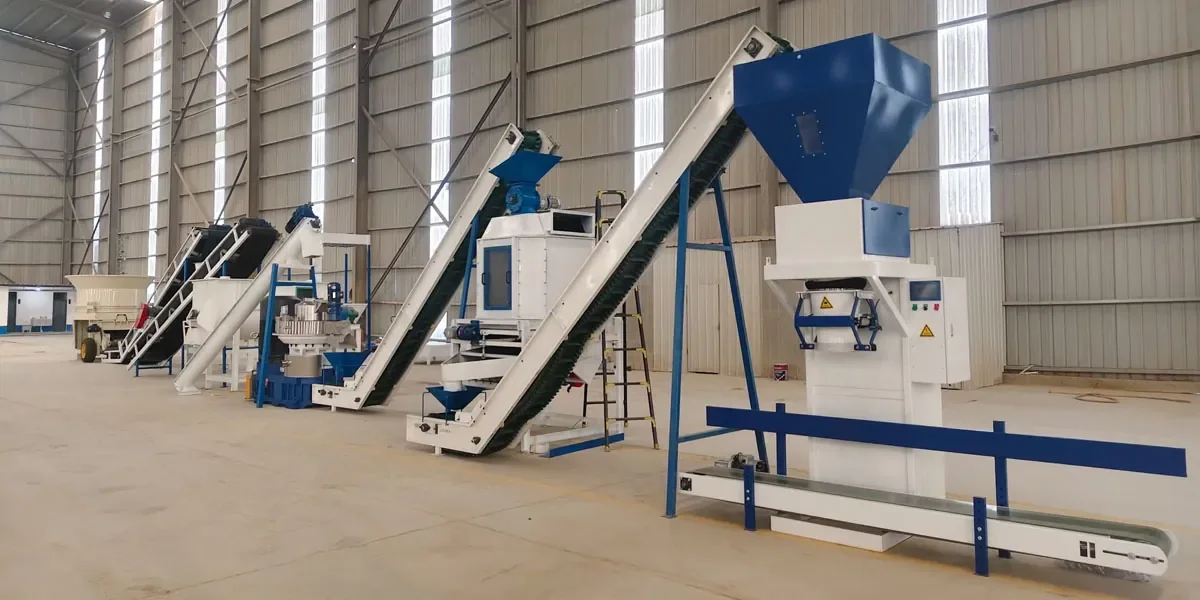
A 1.5 t/h grass and alfalfa pellet production line built around a 90 kW vertical ring die pellet mill: a 79 kW bale shredder, a 75 kW wood hammer mill, a rotary drum biomass sawdust dryer, a counterflow pellet cooler and a pellet packing machine. 305 kW of motors on 50 × 24 m of floor.
- 79 kW bale shredder taking 1.2 m alfalfa bales and 1.5 m grass bales with the netting on
- 75 kW hammer mill with a 3–4 mm screen — feed pellets need a finer grind than fuel pellets
- 90 kW vertical ring die pellet mill on a 1:6–1:8 die, 1.0–1.5 t/h on alfalfa
- Rotary drum biomass sawdust dryer: the stage that decides whether you can run fresh grass at all
Reply in 12 working hours · Sized on your material and its moisture · Layout drawing and die specification included
Two markets, one pellet production line, and a moisture problem that depends on the season
Grass and alfalfa pellets are feed, not fuel. That changes the grind, the die and the test the pellet has to pass — and it makes the dryer the stage that decides whether the pellet production line runs all year.
Alfalfa bales come off the field at 12–18 % moisture and go straight into the pellet production line. Fresh grass comes off a flail harvester at 60–70 % and has to be dried before anything will pellet it. The same grass and alfalfa pellet production line covers both, and the difference is whether the rotary drum is on the quotation and how many hours a year it runs.
The market is the other difference. Fuel pellets are judged on calorific value and ash; grass and alfalfa pellets are judged on protein, fibre and colour. That means a finer grind, a shorter die and a cooler that does not scorch — which is why the wood hammer mill on this pellet production line runs a 3–4 mm screen rather than the 5–6 mm a fuel pellet production line uses.
A 1.5 t/h grass and alfalfa pellet production line 305 kW installed
| Stage | Machine | Model | What it does |
|---|---|---|---|
| 01 | Bale shredder | TS1200-500, 79 kW | 1.2 m alfalfa bales and 1.5 m grass bales, netting and all |
| 02 | Wood hammer mill | TS650 × 75, 75 kW | Straw and grass down to 3–4 mm, which is what a feed pellet needs |
| 03 | Biomass sawdust dryer | TS 1.2 × 12, 5.5 kW | Fresh grass at 60–70 % down to 14 %; alfalfa bales often skip it |
| 04 | Vertical ring die pellet mill | HML-560, 90 kW | A 1:6–1:8 die, 1.0–1.5 t/h on alfalfa |
| 05 | Pellet cooler | LQ-70 + vibrating screen | Cool without scorching, then screen the fines out |
| 06 | Pellet packing machine | BZ-50 | 25–50 kg bags, or 1,000 kg bulk bags for a feed mill |
Installed power is 305 kW across all 6 stages, on 50 × 24 m of floor at 7 m clear. Every machine in the table is also sold on its own, and the dies, rollers and screens for them are shipped as spares.
Fifty by twenty-four metres and 305 kW is the largest pellet production line in this set, and the reason is the dryer. Fresh grass carries three times the water that alfalfa bales do, so the drum, the hot air stove and the exhaust fan are all sized for the worst case rather than the average.
If your material is bales rather than fresh grass, say so at the quotation stage. Taking the dryer off this build saves about 25 kW, 12 m of shed and the whole fuel handling system — and it turns a pellet production line that runs six weeks a year into one that runs whenever the bales are dry.
What each stage does on a 1.5 t/h grass and alfalfa pellet production line
Read them in order — the material only moves one way. Every stage links to its own product page, where the model range and the power figures are.
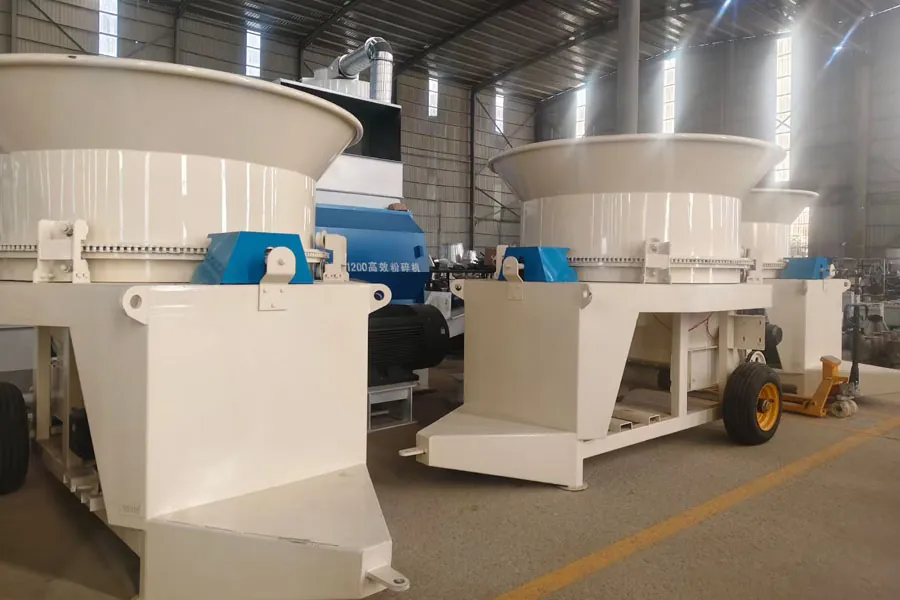
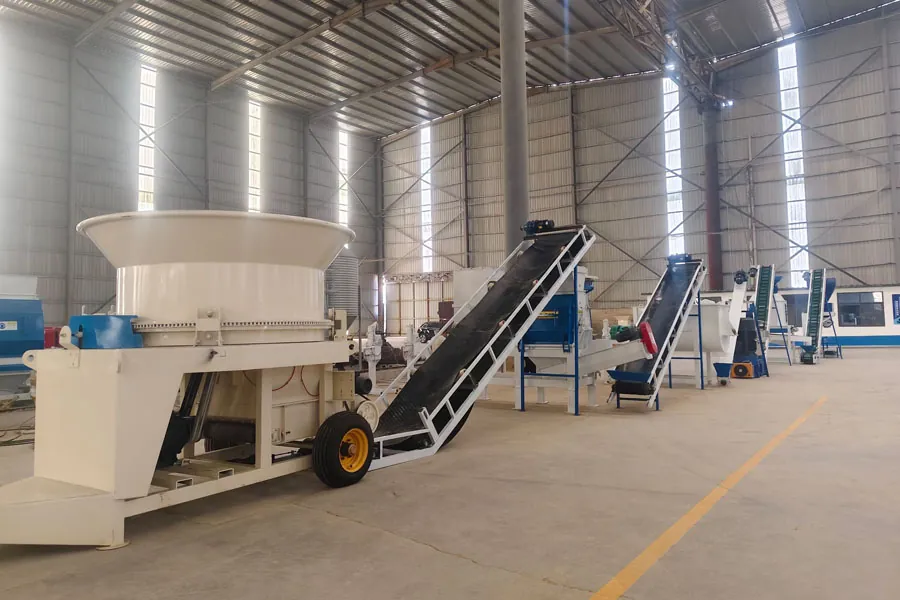
Bale shredder
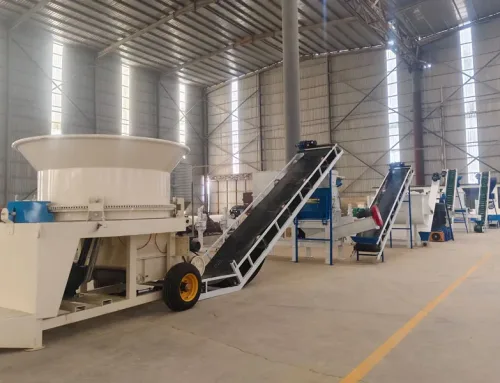
Alfalfa comes in 1.2 m bales that are dense and hard; grass comes in 1.5 m bales that are soft and stringy. A bale shredder with a 1,200 mm drum and a 500 mm discharge handles both at 79 kW for 1.5 t/h, and it takes the netting with the bale rather than asking somebody to unwrap it.
This is a rotary cutter, not a drum chipper: a round hopper with a knife drum inside, which is what a bale wants. A drum chipper is built for logs on a wood pellet line and costs twice as much for a job it does worse. What does matter here is the discharge height — shredded alfalfa is dusty and light, and a rotary cutter that drops it more than a metre loses a visible fraction to the air. Ours discharges at 500 mm onto a belt.
Bale shredder — the rotary cutter we quote on grass and straw builds; the wood chipper machine page covers the drum and disc machines we supply for wood.
Wood hammer mill
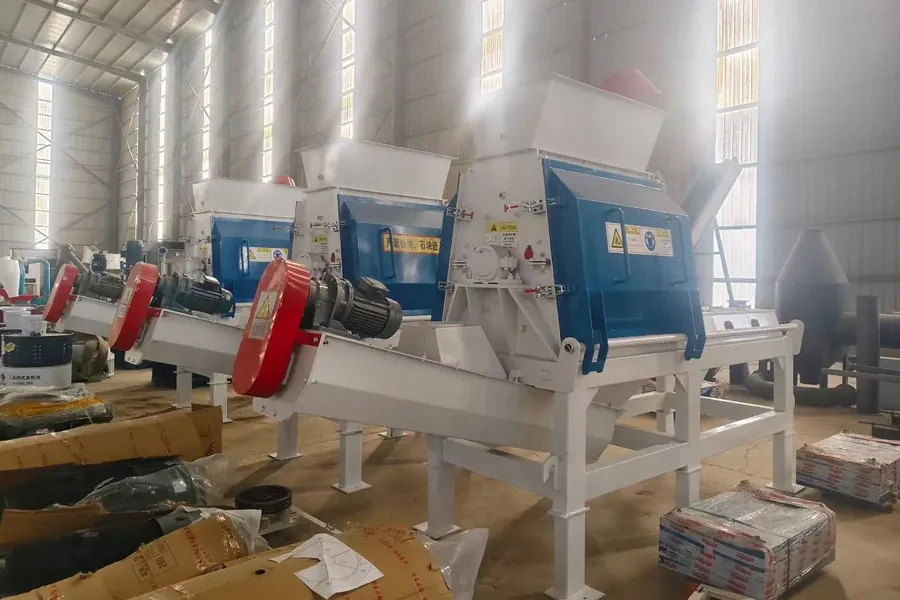
A 650 mm chamber mill at 75 kW, with 36 hammers and a 3–4 mm screen. Feed pellets are ground finer than fuel pellets because a coarse particle shows through the pellet surface and because ruminants digest a finer grind more completely — the difference between a 3 mm and a 5 mm screen is worth 5–8 % of output and a visibly better pellet.
Alfalfa is high in fibre and grinds slowly; grass is softer and grinds quickly. If you will run both, size the hammer mill on the alfalfa and accept that it runs at 70 % load on grass.
Wood hammer mill — FS series, 120 to 1,600 kg/h, 3 to 37 kW; the forage build uses a 650 mm chamber.
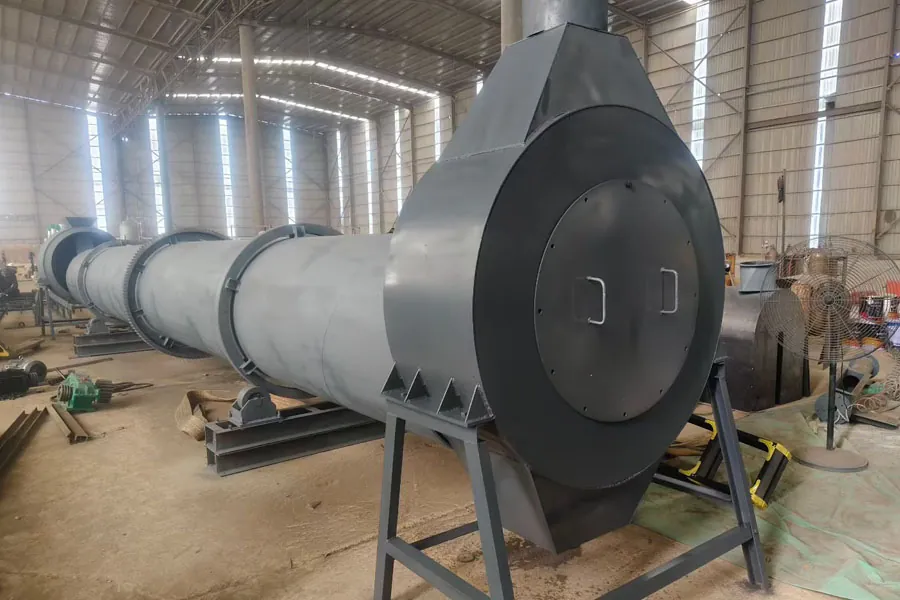
Biomass sawdust dryer
This is the stage that decides the season. Alfalfa baled at 12–18 % needs no dryer and the pellet production line runs from the bale. Fresh grass at 60–70 % needs the drum, and a pellet production line without one can only run on material that has already been field-wilted to below 20 %.
We quote a 5.5 kW rotary drum 12 m long and 1.2 m in diameter with its own hot air stove and an 11 kW fan on a cyclone. On grass the drum runs hotter than on sawdust — grass carries more water and more sugar, and sugar scorches — so the inlet temperature is held lower and the drum longer.
Biomass sawdust dryer — flash pipe from 200 kg/h, rotary drum from 500 to 2,500 kg/h.
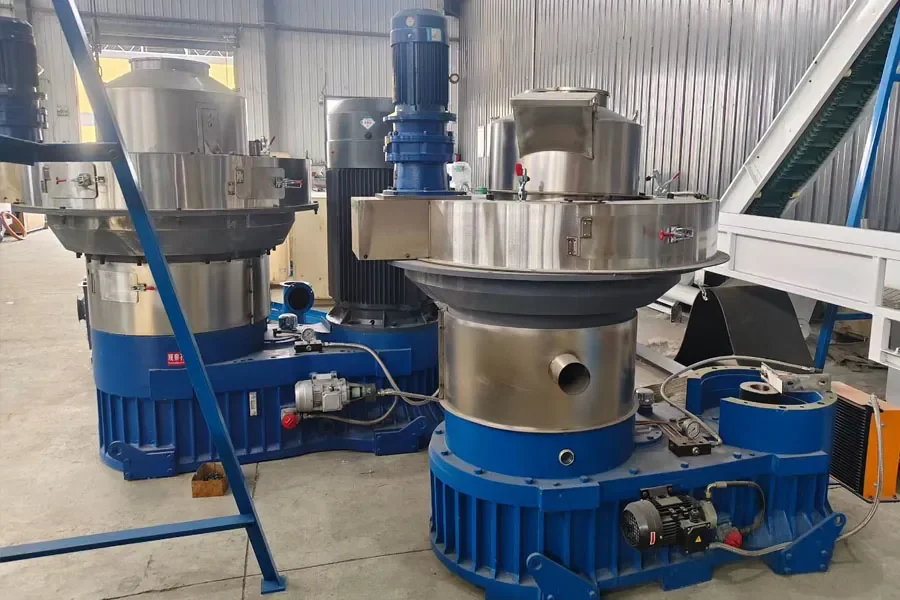
Vertical ring die pellet mill
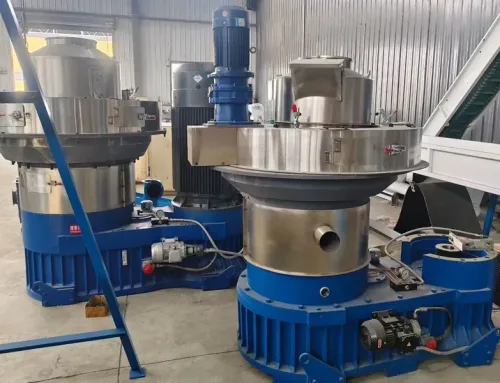
A 90 kW vertical ring die pellet mill on a 1:6 to 1:8 die, rated 1.0–1.5 t/h on alfalfa at 14 % moisture. The ratio is shorter than straw because alfalfa carries more lignin and more protein, and protein acts as a binder in its own right.
The die is where a feed pellet and a fuel pellet part company. A feed die is cut with a slightly larger hole entry and a polished bore, because a rough bore scores the pellet surface and a scored feed pellet is a rejected feed pellet. It is the same frame as a fuel build and a different ring.
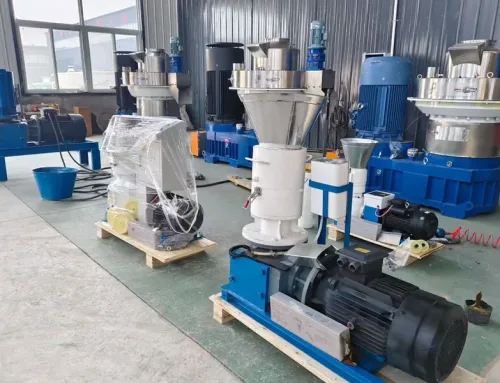
Grass pellet mill — the model range, die options and the flat die pellet mill builds for smaller outputs.
Pellet cooler
Feed pellets have to be cooled without being scorched, because colour is a quality grade in the alfalfa trade. A counterflow pellet cooler brings them from 80 °C to within a few degrees of ambient over seven minutes, with the air moving slowly enough that the surface does not dry out and go pale.
The screen deck underneath takes out the fines and the dust. On alfalfa expect 3–4 % fines, and send them back to the pellet mill rather than into the bag — a bag with visible dust in it is marked down at the buyer.
Pellet cooler — LQ-50 0–500 kg/h, LQ-70 0–1,000 kg/h, NL-11 1–2 t/h counterflow.
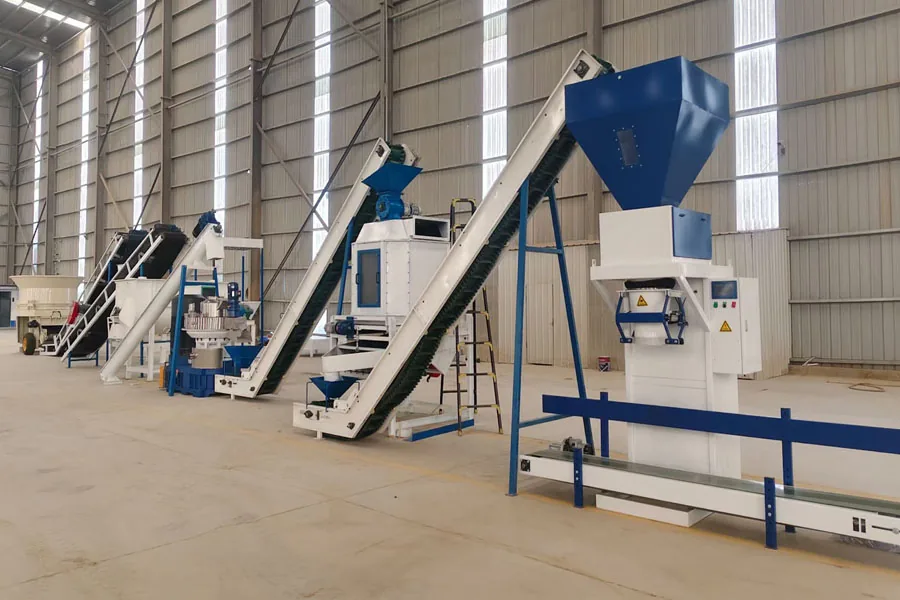
Pellet packing machine
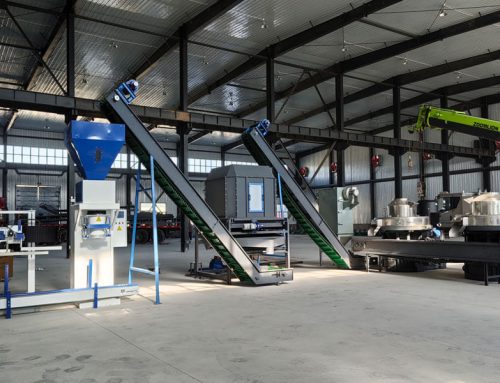
Grass and alfalfa pellets are sold in 25–50 kg bags to farms and feed merchants, or in 1,000 kg bulk bags to a feed mill that grinds them back down. A 1.5 kW quantitative pellet packing machine with a sewing head covers the small bags at three to five a minute.
For the feed trade a bag flattener and a pallet wrapper are worth adding, and so is a metal detector ahead of the bag — a broken hammer from the mill is the classic contaminant on a forage pellet production line, and one claim pays for the detector several times over.
Pellet packing machine — 10–50 kg bags or 1,000 kg bulk bags, with weighing and sewing.
Price a 1.5 t/h grass and alfalfa pellet production line
Send the material, its moisture as received and the shed you have. We answer with a model list, a layout drawing at 1:50 and a price.
Tell us the material and the output
The material, its moisture, the pellet diameter and the kg/h you need. We come back with a model list, a die specification and a price.
Reply within one working day. No obligation.
From a bale in the yard to a bag of feed pellets
Six steps. The third one is optional in a dry year and unavoidable in a wet one, and that is the whole economics of a grass pellet production line.
Bale breaking
A 79 kW bale shredder takes 1.2 m alfalfa or 1.5 m grass bales, netting and all.
Grinding
A 75 kW hammer mill with 36 hammers takes the forage to 3–4 mm through a fine screen.
Drying
Fresh grass at 60–70 % down to 14 %. Alfalfa bales at 12–18 % skip this stage.
Pressing
A 90 kW vertical ring die pellet mill on a 1:6–1:8 die with a polished bore.
Cooling and screening
Counterflow air, gentle enough not to scorch; 3–4 % fines back to the die.
Bagging
25–50 kg bags for farms and merchants, or 1,000 kg bulk bags for a feed mill.
The moisture figure is a seasonal one on this material. Alfalfa cut and baled in a dry week is at 12–14 % and needs nothing. The same crop cut in a wet week is at 20 % and will not pellet. A dryer turns a three-week harvest window into a six-month season, and that is how it should be costed — not against the average moisture, but against the weeks you would otherwise lose.
The second figure is protein. Alfalfa at 15–18 % crude protein is a feed ingredient and sells at a feed price; grass at 8–12 % is a filler and sells at a fuel-adjacent price. The pellet production line is the same. What changes is the die — a feed die has a polished bore because a scored pellet surface is a rejected pellet — and the screen, which is finer for feed.
Colour is the third. Alfalfa pellets are graded partly on how green they are, and green comes from a cool, fast dry and a cool, slow cool. Overheat the drum and the pellet goes brown; overheat the cooler and the surface goes pale. Neither shows up in a lab test and both show up in the price.
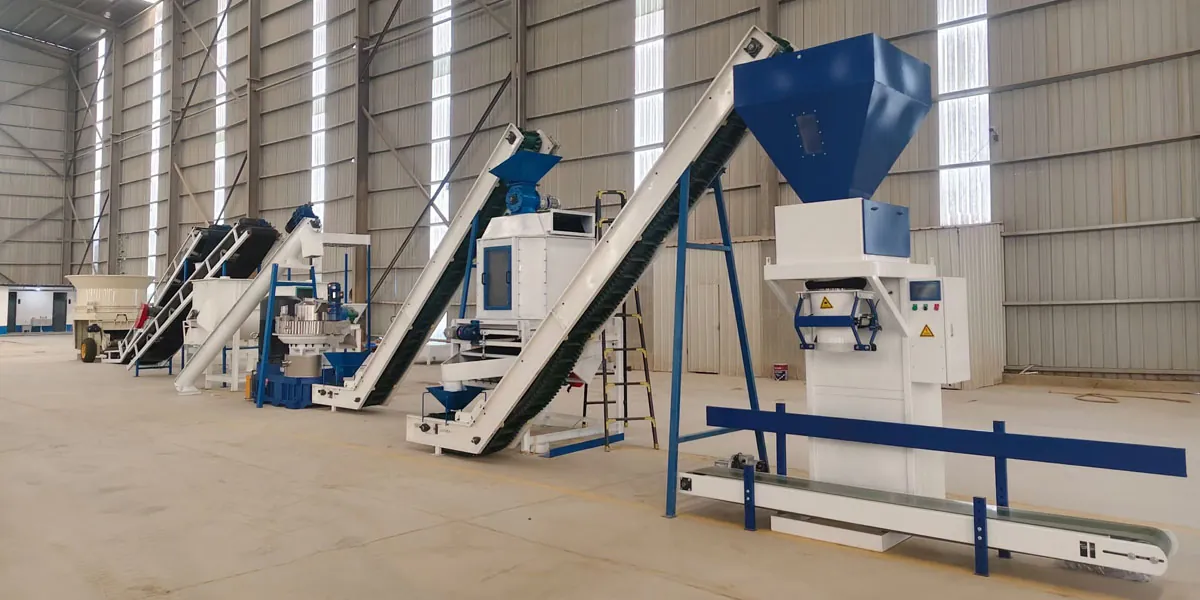
A feed die on a fuel frame
The pellet mill on a grass pellet production line is the same 90 kW vertical ring die frame used on a wood pellet production line. What makes it a grass pellet mill is the ring that goes in it.
Alfalfa carries 15–18 % crude protein and 25–30 % fibre, and protein denatures under heat and pressure into a binder in its own right. That is why the compression ratio is shorter than straw’s — 1:6 to 1:8 against 1:8 to 1:10 — and why the mill makes a harder pellet at a lower die temperature. A cooler die means a greener pellet, which on this material is money.
The bore is the other difference. A fuel die is cut and left; a feed die is honed, because a rough bore scores the pellet surface and a scored surface is a downgrade at the buyer. It is the same ring, cut and finished differently, and it costs about 15 % more.
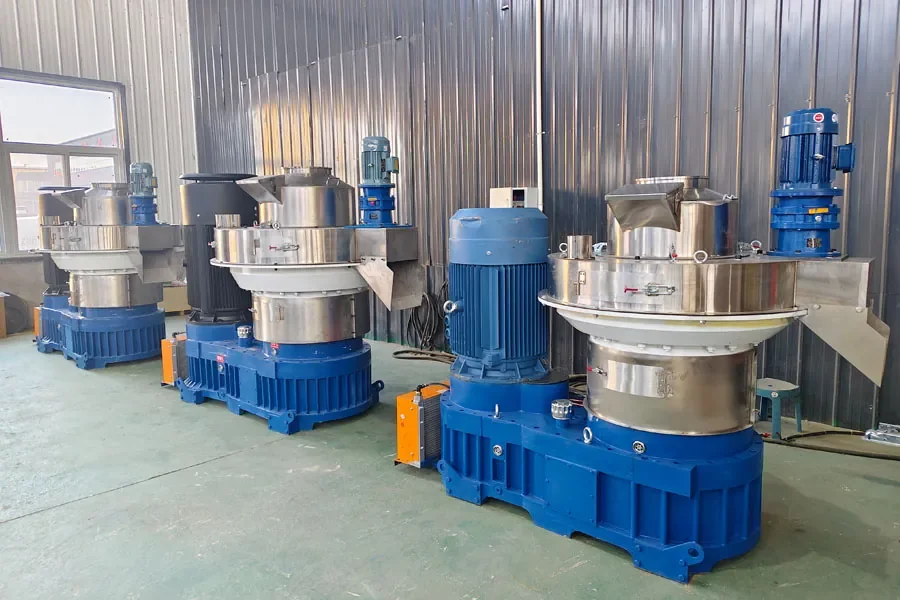
Pellet mills for a grass and alfalfa pellet production line
| Model | Power | Capacity | Where it fits |
|---|---|---|---|
| HML-560 | 90 kW | 1.0–1.5 t/h on alfalfa | The standard build for a 1.5 t/h grass and alfalfa pellet production line |
| HML-560 | 90 kW | 1.5–1.8 t/h on grass | Softer material, higher output, same frame |
| HML-600 | 132 kW | 1.5–2.2 t/h on alfalfa | One press for a 2 t/h build |
| PM-D450B (flat die) | 45 kW | 350–500 kg/h on alfalfa | The small end — see the grass pellet mill page |
Capacity is quoted on alfalfa at 12–15 % moisture with a 1:6–1:8 honed die. Fresh grass at 14 % runs about 15 % higher on the same die; wet grass runs lower and needs the dryer first.
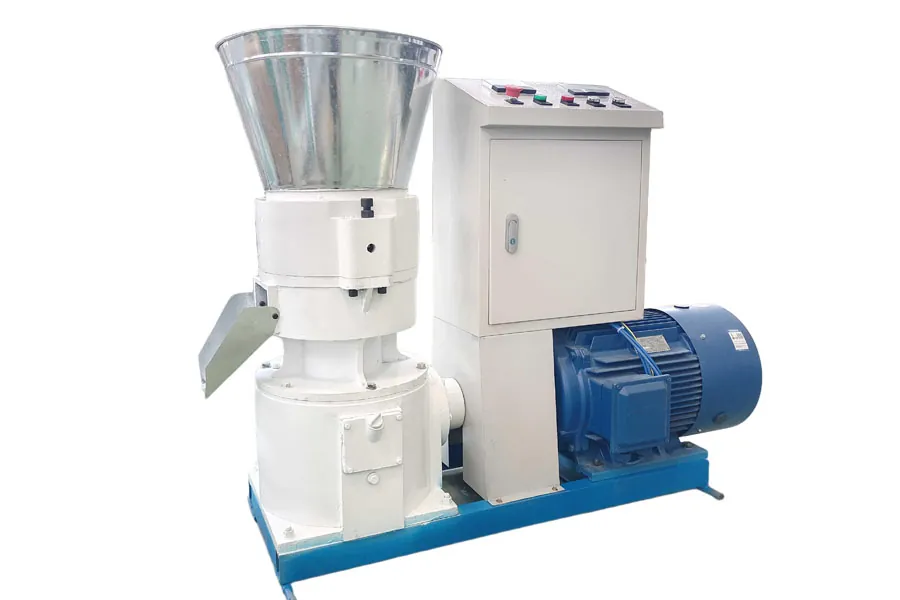
Below about 600 kg/h the answer is a flat die pellet mill, and the grass pellet mill page covers those builds — a flat die grass pellet mill, the 300B at 22 kW, making 250–350 kg/h is what most smallholders and horse yards buy. It is the same die principle and a fraction of the money, and it is the right machine up to about 500 kg/h.
Above 1.5 t/h the constraint is the dryer again. Two 90 kW presses will make 3 t/h of alfalfa pellets, but a 12 m drum will not dry the grass for them, and the pellet production line becomes a different design rather than a bigger version of this one. We size the drum on the wettest material you will run, not the average.
What grass and alfalfa decide, before any machine is chosen
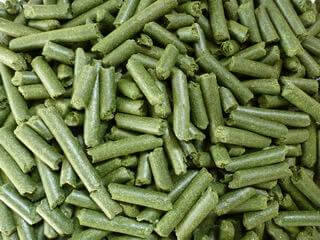
This is the one material on our list where the product is feed, so protein and colour join moisture and ash as design figures.
| Item | Figure | Why it matters |
|---|---|---|
| Moisture as received | 12–18 % in a bale, 60–70 % fresh cut | The figure that decides whether a dryer is on the pellet production line |
| Moisture into the die | 13–15 % | Alfalfa binds best at 14 %; drier than 12 % and the pellet cracks |
| Bulk density, baled | 120–200 kg/m³ | Light. The shredder discharge and the belts are sized for volume |
| Particle size after the hammer mill | 3–4 mm | Finer than a fuel pellet production line — a coarse particle shows in the pellet |
| Die compression ratio | 1 : 6 to 1 : 8 | Shorter than straw because protein acts as a binder |
| Binder | None | Protein and lignin together. Some plants add 1 % molasses for dust control |
| Crude protein | 15–18 % alfalfa, 8–12 % grass | This is what the pellet is bought for; it sets the price |
| Pellet diameter | 4, 6 or 8 mm | 4–6 mm for poultry and calves, 8 mm for cattle and for fuel blending |
Protein is the figure that separates a good year from a bad one, and it is decided in the field rather than at the mill. Alfalfa cut at 10 % bloom is 17–18 % protein; cut at full bloom it is 14 %. Nothing on this pellet production line changes that — but a dryer that runs too hot will bind some of the protein and knock a point off the analysis, which is why the drum inlet temperature is held lower on forage than on sawdust.
Colour is the other graded figure and it is entirely a plant problem. Green comes from a fast dry at a moderate temperature and a slow cool. Overheat the drum and the pellet browns; run the cooler too hard and the surface goes pale. Neither shows up on a feed analysis and both show up in the price, so the operators on a grass pellet production line are trained on temperature before they are trained on throughput.


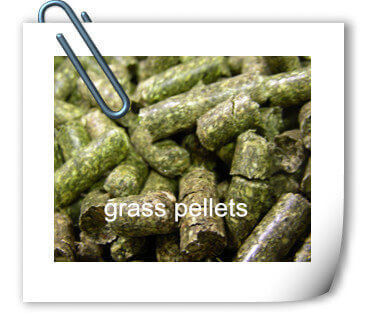
What the site has to provide
A 1.5 t/h grass and alfalfa pellet production line is 305 kW of motors on 50 × 24 m of floor, under a roof 7 m high.
| Item | Figure | Note |
|---|---|---|
| Installed power | 305 kW | All six stages, motors only |
| Largest single motor | 90 kW on the pellet mill | The figure that sizes the transformer |
| Electrical supply | 350 kVA, 380 V / 50 Hz, four-wire | Size on the largest motor, not the total |
| Footprint | 50 × 24 m, 1,200 m² | Arranged in a straight line, bale store excluded |
| Building height | 7 m clear | Under the hook, at the dryer cyclone and the buffer bin |
| Operators | 3 per shift | One on the shredder, one on the dryer, one on the pellet mill and bags |
| Water | Not required | The pellet cooler is air cooled |
| Compressed air | 0.6 m³/min at 7 bar | Bag clamp and weigh gate |
| Containers | 2 × 40HQ | The whole pellet production line ships in two containers |
The 305 kW total is dominated by the front end: 79 kW of shredding, 75 kW of grinding and 11 kW of dryer fan, against 90 kW of pellet mill. That is the shape of a forage pellet production line, and it is why a grass build quotes higher than a sawdust build of the same output.
Bale storage is the site item that decides whether the dryer is needed at all. Alfalfa bales under cover hold 12–15 % for months; the same bales under a tarpaulin in a wet autumn come in at 20 % and the dryer runs flat out. A barn is cheaper than a bigger drum, and it is the first thing we ask about.
Dust and fire risk are the safety items. Alfalfa dust is finer and more combustible than wood dust, and the hammer mill cyclone, the drum inlet and the bagging head all need extraction. The ducting runs and the filter sizes go out with the layout drawing.
What ships, and what the site has to build
A grass and alfalfa pellet production line is quoted as a set. This is what is inside the price.
-
All six stages
Bale shredder, wood hammer mill, rotary drum dryer, vertical ring die pellet mill, pellet cooler with screen and pellet packing machine — with motors, starters and guards.
-
Conveyors and ducting
Belts between the stages, the buffer bin over the pellet mill and the ducting from the dryer and hammer mill cyclones.
-
Control cabinets
Three panels — shredding and grinding, drying, pelletizing and bagging — with the interlock that stops the feed when the pellet mill stops.
-
Dies and rollers
One honed 1:6–1:8 die at your pellet diameter, plus a spare die and a spare roller set.
-
Layout drawing
1:50 plan and elevation, with the foundation blocks, the ducting and the cable runs marked.
-
Commissioning
One engineer on site for the first run, at our cost, for a pellet production line of this size.
Not included, and quoted separately if you want them: the hot air stove for the dryer; the bale store; a metal detector ahead of the bag; the civil works; and the transformer. Delivery is 25–30 working days from deposit, FOB Qingdao. Spare parts are on the shelf at spare parts.
Watch a grass and alfalfa pellet production line run
Five clips: a grass pellet production line end to end, the pellet mill inside it, and the same stages at a larger scale.


More on the PelletHills channel — the biomass playlist is where the pellet production line and pellet machine clips go up first.
What buyers ask before ordering a 1.5 t/h grass and alfalfa pellet production line
11 questions we answer on the phone most weeks.
What does a 1.5 t/h grass and alfalfa pellet production line include?
Six stages: a bale shredder (79 kW), a wood hammer mill with a 3–4 mm screen (75 kW), a rotary drum biomass sawdust dryer (5.5 kW, 12 × 1.2 m), a vertical ring die pellet mill (HML-560, 90 kW), a counterflow pellet cooler with a vibrating screen, and a 25–50 kg pellet packing machine. Installed power is 305 kW and the footprint is 50 × 24 m.
Do I need the dryer for alfalfa?
Usually not. Alfalfa baled in a dry week is at 12–18 % moisture, which is inside the window the die wants, and the drum comes off the quotation — saving about 25 kW, 12 m of shed and the fuel handling. Fresh-cut grass at 60–70 % cannot be pelletised without one, so the answer depends on what you will run.
What is the difference between a grass pellet and a fuel pellet?
The grind, the die and the grading. Feed pellets are ground to 3–4 mm against 5–6 mm for fuel, pressed through a 1:6–1:8 die with a honed bore against 1:5–1:7 cut and left, and graded on protein and colour rather than on calorific value and ash.
What compression ratio do you cut for alfalfa?
1:6 to 1:8. Alfalfa carries 15–18 % protein and 25–30 % fibre, and protein denatures into a binder under heat and pressure, so the die does not need to be as long as a straw die. A cooler die also keeps the pellet greener, and colour is a grade on this material.
Can the same pellet production line run grass and alfalfa?
Yes, with the same die and a different hammer mill setting. Alfalfa is denser and higher in fibre and grinds more slowly; grass is softer and runs about 15 % faster for the same motor load. If you will run both, size the hammer mill and the dryer on the alfalfa.
How much does colour matter?
On alfalfa, a lot — it is graded partly on how green the pellet is, and green comes from a fast dry at a moderate temperature and a slow cool. Overheat the drum and the pellet browns; run the cooler too hard and the surface goes pale. Neither shows up in a feed analysis and both show up in the price.
What is the smallest grass pellet production line you build?
A flat die grass pellet mill — a 300B at 22 kW making 250–350 kg/h, which is what smallholders and horse yards buy. It is the same die principle, a fraction of the money, and the right machine up to about 500 kg/h.
Do I need a binder?
No. Alfalfa binds on its own protein and lignin given 13–15 % moisture and a 1:6–1:8 die. Some plants add 1 % molasses for dust control and palatability, and a few add 1 % fat for energy density. Neither is standard on our builds.
How much material does it consume?
About 1.03 t of alfalfa for every 1 t of pellets, so 24 t a day on two shifts at 1.5 t/h. That is roughly 40 bales a day, and they have to be under cover — the moisture figure that made the dryer unnecessary only holds if the bales stay dry.
How long does installation take, and what is the delivery time?
Ten to fourteen days on site with our engineer present, plus the civils. Delivery is 25–30 working days from deposit, FOB Qingdao, in two 40HQ containers. Payment is 40 % deposit with the balance before delivery.
Can the pellet production line make fuel pellets as well as feed pellets?
Yes — the same frame with a 1:5–1:7 die and a coarser screen makes a fuel pellet from the same bales. What you cannot do is run both products through the same die at the same time, because the bore finish that suits feed is not what a fuel die needs.
Request a quotation for a 1.5 t/h grass and alfalfa pellet production line
Tell us the material, its moisture, the pellet diameter and the shed you have. We reply with a model list, a layout drawing and a price.
What happens after you send this
We answer with the model list, the die compression ratio and a price, then send a test-run video on your material before you pay a deposit.
Your details are not shared. One follow-up, no mailing list.